When your commit looks like a melted SpongeBob instead of the Trello spec
Why is this VersionControl meme funny?
Level 1: Expectation vs. Reality
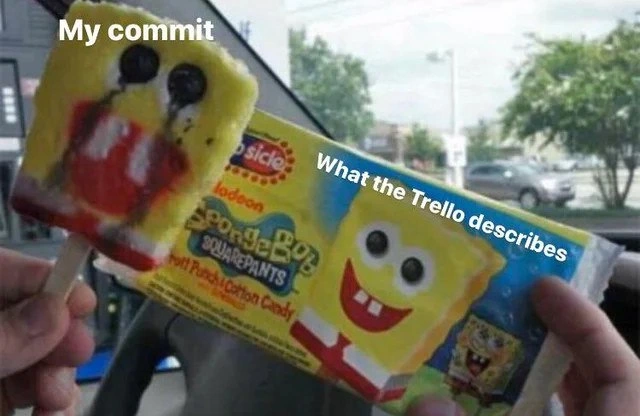
Imagine you see a picture of a yummy SpongeBob popsicle on a wrapper. It looks perfect – bright yellow SpongeBob with big happy eyes and a nice smile. You’re excited to get that exact treat. But when you open it, you find a silly, melted SpongeBob popsicle that looks all wrong: the eyes are goofy and the smile is smudged. You can’t even be mad; it’s kind of funny how bad it looks compared to the picture. This meme is joking about the same feeling. The wrapper’s picture is like a promise or a plan (saying “this is what you’ll get!”). The melted popsicle is what you actually got. It’s funny because in life (and in coding), things often turn out quite different (and messier) than we planned. The person holding both is basically saying: “See how these don’t match? That’s how my work turned out versus what I was supposed to do!” Even if you’re not a developer, you know this little disappointment: like when you build a toy or bake a cake and it comes out looking nothing like the nice picture in the instructions. It makes us laugh because we all recognize that gap between expectation and reality – and sometimes, all you can do is laugh and say, “Whoops, close enough!”
Level 2: Code vs Card Reality
Let’s break down the scene for those newer to coding and project management. On the right in the image, we have a Trello card (represented by the SpongeBob popsicle wrapper). Trello is a popular tool where teams keep track of tasks using virtual cards on a board – think of it like digital sticky notes in columns labeled "To Do", "Doing", "Done". Each Trello card describes a task or feature, often with details of what needs to be done (the requirements). Here, the wrapper’s perfect SpongeBob picture is like the Trello card’s description of how the feature should look or behave: bright, cheerful, and exactly like SpongeBob with round eyes and a big smile. This is the expectation set by project management: “Build the SpongeBob feature to look just like this!” In software terms, that means the requirements or spec (short for specification) are clear and ideal.
Now, on the left we see “My commit” – a commit is a saved change in your code, typically using a VersionControl system like Git. When developers finish a piece of work, they commit their code with a message describing what they did. The meme jokes that my commit (the code I actually wrote and checked into Git) ended up looking like that melted, derpy SpongeBob popsicle. In other words, the code that was delivered is kind of a mess compared to what was asked for. Why would that happen? There are a few common reasons a junior developer might relate to:
- Misunderstanding the spec: Maybe the developer didn’t fully understand the Trello card’s instructions, so they implemented something incorrectly. It’s like misunderstanding a recipe: the Trello card said two nicely placed eyes, but the code put the “eyes” off-center, analogous to the popsicle’s wonky black gumball eyes.
- Unforeseen complexity: Sometimes a task sounds easy when reading the card, but when you start coding, you discover it’s much harder. Maybe the developer hit some technical challenges or edge cases not mentioned in the Trello description. For example, the Trello card didn’t mention that the SpongeBob popsicle feature had to work on an older device (just imagining a scenario), and accommodating that made the code more convoluted. The result can be lots of quick fixes piled on, making the final code less clean – hence a “melted” outcome.
- Rushing or deadlines: Perhaps this feature was due soon (end of the sprint, pressure from your team lead), and the developer rushed the work. When we rush, our code can get sloppy. Think of trying to draw SpongeBob in 10 seconds – you’d get something that looks like the left image. The commit might compile and run, but it’s held together by duct tape and dreams. It might have bugs (flaws that make the program act weird, just like how the popsicle has eyes out of place – not quite right).
In software development, CodeQuality is a term that means how well-written and maintainable the code is (plus being bug-free). High code quality is like a perfect SpongeBob popsicle: everything in the right place, nothing broken or ugly. Low code quality is like the melted version: it might still be recognizable, but it’s messy and not what anyone wanted. New developers often learn that writing good code isn’t just about making it work (functional correctness), but also about making it clean and matching the requirements. In this meme’s scenario, the code probably “works” in a basic sense (maybe the feature kind of does what it’s supposed to), but it doesn’t meet the original requirements cleanly or elegantly. The Trello card’s SpongeBob was supposed to be neat and on-point, but the delivered commit is off-model. This mismatch is a rite of passage in development — the first time you proudly ship a feature only for someone to say, “This isn’t quite what we wanted,” or you yourself look at the result and go, “Hmm, that’s uglier than I hoped.” It’s both humorous and educational: it reminds us to communicate better about requirements, take our time to refine code, and also that DeveloperHumor thrives on these little failures. Everyone in coding has produced a “melted SpongeBob” commit at some point, especially early on. The key is to learn from it (and maybe laugh about it later, as we do with memes like this). After all, the difference between what’s on the TrelloBoards and what ends up in the code repository is often a great story (or at least a funny meme).
Level 3: Frozen Requirements vs Melted Code
In this meme, a developer’s git commit is represented by a deformed, half-melted SpongeBob popsicle, while the Trello card’s specification is the pristine SpongeBob on the wrapper. This contrast is a brutally funny take on RequirementsVsReality in software projects. The Trello board (our project management spec) painted a picture of a bright, perfectly shaped feature — the kind of ideal outcome that project managers dream about. But when it came time to implement, the code commit turned out more like SpongeBob after a microwave accident. Why does this happen? Because in real life, CodeQuality often melts under pressure from deadlines, unclear requirements, or legacy code. The Trello card’s description might have been as optimistic and clean as a cartoon on a wrapper, but the actual code had to grapple with all the gritty details and bugs, ending up looking pretty borked. It’s a scenario every seasoned developer recognizes: the “This isn’t what the spec described” moment during a code review, when your commit diff reveals a hacky solution that only vaguely resembles the original acceptance criteria.
Let’s dissect the humor here. VersionControl (like Git) means every change you make is recorded as a commit, a little snapshot of your code at a given time. When your commit is a melted mess, it implies the code changes are ugly, perhaps riddled with bugs (just like the popsicle’s eyes are wonky and dripping). Meanwhile, the TrelloBoards spec likely listed clear requirements: maybe a checklist saying “SpongeBob feature: Two perfectly placed eyes, big smiling mouth, all colors correct.” In theory, you’d commit code that fulfills those bullet points exactly. But in practice, maybe the existing codebase fought back: integration issues, missing libraries, off-by-one errors — all conspired to produce something that technically runs but looks nothing like the picture. The developer probably rushed to push the commit (“just ship it!”) because the sprint was ending, resulting in a commit that’s half-baked (or rather, half-melted). A cynical veteran on the team might quip: “Well, the Trello card didn’t mention the eyes couldn’t slide off, so…commit accepted?” The humor cuts deep: we laugh, but we’ve all been there, checking in code at 3 AM that we know isn’t pretty, just to close a ticket.
This meme also hints at projectManagement realities. Trello (or Jira, or any agile board) can sometimes give a false sense of simplicity. A card might describe a feature in one sentence, but that belies the iceberg of complexity underneath. Senior devs grimace because they’ve seen the pattern repeat throughout their careers: initial requirements are frozen and picture-perfect (like that immaculate SpongeBob candy image), but actual development is messy. Maybe the spec was incomplete or changed (specification drift), or the technical debt in the codebase forced an ugly workaround. The result? A commit that passes the basic tests by the skin of its teeth but is dripping with kludges. It’s the software equivalent of a kid’s melting popsicle on a hot day – you got something to show for it, but it’s sticky and misshapen. CodeQuality suffers, and now there’s a lingering mess in the repository that someone (often a grumpy senior developer) will have to clean up later. The meme exaggerates it with SpongeBob’s derpy face, but in truth this happens with real commits: maybe your new login feature works but fails half the code style guidelines, or the UI looks like a mutant version of the mock-up. It’s a comical reminder that bridging the gap between “What the Trello describes” and “My commit” is the eternal struggle of developers. In the end, we chuckle because we survive these moments all the time, and we take solace knowing every dev team has their own melted SpongeBob lurking in the commit history.
// Trello spec: "The popsicle feature should match SpongeBob exactly."
function implementFeature() {
// Reality: quick hacks to meet the deadline:
const popsicle = new SpongeBobPopsicle();
popsicle.eyes = placeEyes({ approximate: true }); // eyes might be uneven
popsicle.mouth = drawMouth({ melting: true }); // smile is a bit drippy
return popsicle || "close enough";
}
Above is a tongue-in-cheek pseudo-code of what that commit might look like. The comments show the Trello spec’s intent versus the “close enough” reality of the code. It’s a DeveloperHumor way of admitting that sometimes our implementations are just barely acceptable. The code tries to assemble a SpongeBob, but uses approximate: true and melting: true flags – sly nods that we knowingly introduced imprecision and flaws. Returning "close enough" as a fallback is exactly the mindset of a tired developer: “It’s not perfect, but it’s done.” This is how technical debt accumulates: today’s melted popsicle commit gets merged, and we promise ourselves we’ll refactor later (spoiler: that “later” often never comes). The meme resonates strongly with anyone who’s had to demo a feature that only works if you don’t look too closely. It’s funny because it’s painfully true: in the repository of life, there’s always a commit that makes you cringe and laugh at the same time.
Description
The meme shows a person inside a car holding two items. In the left hand is a deformed, partially-melted SpongeBob SquarePants ice-cream bar; above it, white text reads "My commit". In the right hand is the pristine product wrapper displaying the bright, perfectly shaped "SpongeBob SquarePants" popsicle; angled white text over the wrapper says "What the Trello describes". The visual joke contrasts the messy, bug-ridden reality of a developer’s code commit with the clean, idealized requirements outlined on a Trello card. It highlights the perennial software-engineering gap between implementation and project-management expectations, poking fun at code quality, specification drift, and version-control life
Comments
7Comment deleted
PM: “Just a 2-pointer - render a happy SpongeBob.” Git diff: five hot-fix branches later, prod is serving a Salvador-Dalí popsicle that only passes tests if the datacenter is below 0 °C
After 15 years in this industry, I've learned that the gap between a Trello card and its implementation is inversely proportional to how many times the PM said 'it's just a simple change' during sprint planning
Every senior engineer knows this feeling: the Trello card describes a pristine, well-architected feature with comprehensive error handling, observability hooks, and backward compatibility. Your actual commit? A hastily refactored mess at 2 AM with three TODO comments, a suppressed linter warning, and a prayer that the integration tests pass. The gap between 'Definition of Done' and 'Done Enough to Deploy Friday Afternoon' is where technical debt is born - one melted popsicle commit at a time
When the Trello card is the spec, the acceptance criteria are entropy; after three rebases, two surprise integrations, and a stealth NFR, my commit ships like that popsicle
Trello said “minor UI tweak”; my commit touches six repos, retires a decade-old singleton, ships a feature flag and a data migration, and - fine - rounds the corner by 2px
Trello: elegant MVP. Commit: 'grep -ri "TODO" && ship it'
Ouch. Comment deleted