Programmer's Quarantine: A Study in Unchanged Routines
Why is this RemoteWork meme funny?
Level 1: Spot the Difference: None
Imagine you have a friend who always plays quietly in his room every day. Then a big storm comes and everyone has to stay indoors. Does anything change for your friend? Not at all! He’s still in his room playing just like before. This meme is joking in the same way: a big event (the COVID-19 pandemic) made most people’s lives look very different “after” compared to “before.” But for this programmer, life before the virus and life after the virus look exactly the same. He was already sitting at home, in front of his computer, with his snacks and toys (or in this case, coffee and code) even before everyone else had to. So the funny part is that something that was a huge change for everyone else was no change at all for him. It’s like asking “Can you spot the difference between these two pictures?” and the answer is “There is no difference!” The programmer was basically working from home and keeping to himself the whole time, so when the world went into lockdown, he didn’t have to do anything new. It’s just another normal day for him, and that’s why we laugh – sometimes a very big thing out in the world doesn’t change the little day-to-day things for certain people at all.
Level 2: Coffee & Code Routine
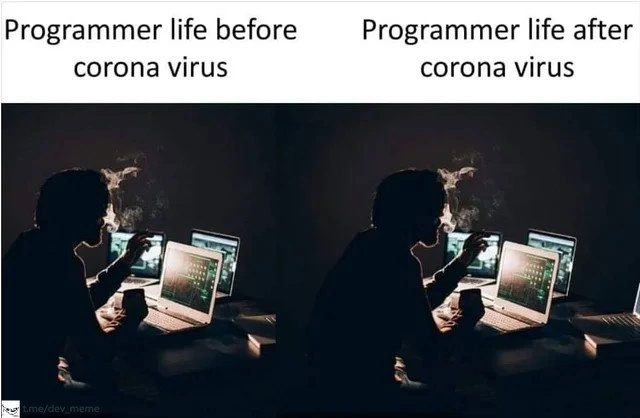
This meme shows a programmer’s life before and after COVID-19 to explain that it’s essentially the same life. In both the “before” and “after” pictures, we see the same developer at his desk. He’s in a dark room with the only light coming from his computer screens. The text on those screens is green on a black background – a style often called a “dark mode” or even reminiscent of old terminal monitors (think The Matrix code rain). Many developers prefer dark mode themes in their code editors because it’s easier on the eyes during long coding sessions (and, let’s be honest, it looks cool). Here it contributes to the moody, nocturnal atmosphere of the scene. The developer has multiple monitors (actually two laptops side-by-side in this image) which is common for coding: one screen might show the code or IDE, and the other could show documentation, a testing environment, or a running program. Using two or more screens helps improve productivity because you can see more information at once without constantly switching windows.
In the meme, the person’s right hand is on a mouse and the left hand holds a coffee mug. Coffee is basically a cliché in programming culture – it’s the fuel for late-night coding marathons. “Coffee and code” is practically a daily routine for many developers. The developer is also exhaling a cloud of smoke that’s lit up by the monitor glow. This detail gives a dramatic hacker vibe (a bit like scenes from tech TV shows or movies). It could be cigarette smoke or vape smoke – in any case, it adds to the image of a lone coder immersed in his work, hardly noticing the outside world. The desk is cluttered with typical programmer stuff: maybe some notebooks, gadgets, or spare electronics lying around, adding to the working from home messiness.
Now, the key joke: above the left image it says “Programmer life before corona virus” and above the right it says “Programmer life after corona virus.” But the two images are identical – there is no visible difference at all. Usually, a “before and after” comparison highlights some change (like those makeover memes or productivity hacks that show contrast). But here, nothing changes. The meme is pointing out that when the COVID-19 pandemic hit (around early 2020), a lot of people’s work lives changed dramatically – offices closed, people started working from home full-time, and daily routines were disrupted. However, for many programmers, this transition wasn’t a big shock. Remote work was already part of the tech world. Plenty of developers were already used to working remotely or spending long hours at their home computer. They might have already been collaborating through Slack messages, GitHub commits, and video calls, even when they technically worked “in an office.” So when the coronavirus lockdowns forced everyone to stay home, programmers felt like they were just continuing their normal work routine.
Some companies even noticed that their engineering teams kept things running smoothly during lockdown because coding can often be done from anywhere as long as you have your laptop and an internet connection. The term WFH (Work From Home) became very popular during the pandemic, but developers kind of smile at it because many of them were WFH at least occasionally even before it was mandatory. This meme falls under DeveloperHumor and PandemicHumor because it’s making light of a serious situation (the pandemic) by showing that at least one group – the programmers – had an unchanged routine. It’s a relatable dev experience: if you’re a programmer who was already spending your days (and nights) coding at home, you likely saw this meme and chuckled because it’s true for you. The developer lifestyle portrayed here includes being somewhat isolated, glued to the computer, and on a caffeine high, which didn’t suddenly start with COVID-19 – it was already the norm.
In summary, the meme uses the before/after format to say “Look, nothing changed.” The left side is life before the pandemic and the right side is life after the pandemic, and the programmer is doing the exact same thing in the exact same environment. It’s emphasizing how comfortable and common remote work culture is in programming. While friends in other professions were scrambling to adapt to Zoom meetings and home setups, developers were like, “This is just another day in the home office.” The humor comes from that contrast – a global upheaval happens, but this programmer’s day-to-day looks identical, right down to the coffee cup and code on the screen.
Level 3: No Diff Found
At first glance, this before/after meme is literally pointing out a git diff with zero changes. Both panels show the exact same scene: a lone programmer in a dark room, dual monitors glowing green text, coffee mug in one hand, and a curl of smoke hovering above. The top labels read “Programmer life before coronavirus” on the left and “Programmer life after coronavirus” on the right. The punchline is that nothing in the programmer’s life visibly changes. It’s a humorous nod to how remote work was already second nature for many developers, long before COVID-19 lockdowns forced everyone else into home offices. In late March 2020 – as offices worldwide emptied out due to the pandemic – countless engineers chuckled at this image because it rang true: quarantine didn’t really disrupt their daily routine at all.
Why is this so funny (and a bit tragic)? It speaks to a shared reality in tech culture: plenty of programmers were effectively in “quarantine” long before it was official. The meme highlights classic developer stereotypes and realities: working late in a dark room (with everything in dark mode, of course), surrounded by screens and cables, fueled by coffee (or maybe an energy drink), possibly exhaling a puff from a vape or cigarette. This “coffee and code” routine isn’t a 9-to-5 office scene – it’s a lifestyle. Many developers have been Work From Home (WFH) or at least working odd hours from their own home office corners for years. Even those in offices often operate in a bubble: noise-cancelling headphones on, lasers focus on code, Slack messages instead of hallway chats. In other words, DeveloperLifestyle can be quite isolated and RemoteWorkCulture was thriving in tech well before 2020. When the pandemic hit, developers found themselves telling friends, “Welcome to my world.”
From a DeveloperProductivity standpoint, the meme hints that whether in a corporate cubicle or at a home desk, a coder’s output might be unchanged. The two images being identical is like saying the “before” commit and “after” commit of life have no diff – productivity and routine remain constant. In fact, many engineers felt more productive at home: no commute, fewer random interruptions, and the freedom to work in pajamas or late into the night if inspiration struck. The industry had long been moving toward remote-friendly tools: version control like GitHub, project trackers, and video calls on Zoom were already daily staples. So when COVID-19 forced everyone to go remote, dev teams transitioned relatively smoothly – code repositories and CI/CD pipelines don’t care where you’re pushing from. This meme exaggerates it to comedic effect: the pandemic changed everything for society, but the programmer pictured just keeps coding as usual, illuminated by that dual-monitor glow.
It also pokes fun at the relatable dev experience of being so deep in the coding zone that external events barely register. (Remember those jokes about developers not noticing what day of the week it is?) The two-panel “spot the difference” format typically expects us to find changes, but here the lack of any change is the joke. The programmer’s routine – write code, drink coffee, stare at multiple terminals in a dark cave – is unchanged by social distancing or office closures. It’s TechHumor with a dash of PandemicHumor: the world turned upside down, yet this coder’s life looks absolutely the same. The meme resonates especially with veteran developers who recall that long before Zoom happy hours, their social life was an IRC chat or a GitHub comment thread late at night. RemoteWork isn’t a new paradigm for them; it’s the status quo.
To put it in code terms, the situation is akin to comparing two identical commits:
$ git diff life_before_COVID life_after_COVID
# No differences found (life workflow remains the same)
No lines added, no lines removed – the “diff” is empty. WorkplaceHumor like this gets a knowing laugh because it’s rooted in truth: for a lot of programmers, being a lone silhouette hunched over a keyboard at 2 AM was not caused by the pandemic… it was just business as usual.
Description
A two-panel meme format. The left panel is captioned 'Programmer life before corona virus' and the right panel is captioned 'Programmer life after corona virus'. Both panels display the exact same image: a dark, moody shot of a person's silhouette sitting in front of multiple glowing laptop screens. The person is holding a cup in one hand and smoking a cigarette or cigar in the other, with smoke wafting upwards. The scene implies intense, late-night work and isolation. The humor comes from the identical images, satirizing the stereotype that many programmers already lived a socially distant, work-from-home lifestyle, so the global shift to quarantine and remote work during the pandemic didn't fundamentally change their daily existence
Comments
7Comment deleted
The only difference between 'before' and 'after' is that now my git commits from 3 AM are considered 'working remotely' instead of 'having a problem'
Pandemic memo: “We’re switching to remote-first.” 15-year staff engineer from his perpetually dark home office: “Cool, a git mv on the workplace path with an empty diff.”
The only pandemic that changed my work setup was when npm went down for 2 hours and I had to actually read documentation instead of copying from Stack Overflow
The pandemic's greatest revelation for non-developers: discovering that programmers had already perfected the art of social distancing, asynchronous communication, and thriving in isolation years before it was mandatory. While the world scrambled to adapt to remote work, developers simply continued their regular Tuesday - dark room, glowing screen, coffee within arm's reach, and the only 'meeting' being a merge conflict with themselves from yesterday
COVID was an idempotent op on dev life: kubectl apply -f wfh.yaml -> changed 0; same three monitors, same dark mode, same failing CI
COVID forced distributed teams on the world, but devs were already running a high-availability WFH cluster with zero downtime
Before COVID: debugging distributed systems; after COVID: debugging distributed teams - same dark room, just with Zoom quorum and more network partitions