Facebook's cookie consent logic revealed
Why is this DataPrivacy meme funny?
Level 1: Fake Choice
Imagine your teacher asks the class, “Do you guys want extra homework? Be honest – yes or no.” If you answer yes, the teacher gives you extra homework. If you answer no, the teacher says, “Alright… you get extra homework anyway!” That would be pretty unfair and silly, right? Why ask the question if the answer doesn’t matter? You’d probably laugh at how ridiculous that is (after the shock wears off).
That’s exactly what this meme is joking about, but with websites and your personal data. Websites often ask, “Can we track what you’re doing for research or ads?” Saying “yes” or “no” should change what they do. The funny (and kinda naughty) joke here is that this pretend website will track you no matter what you say – just like that teacher who gives homework no matter what. It’s a fake choice: you feel like you had a say, but in the end, the outcome is the same.
Why is this funny to developers? Because it pokes fun at big social media companies (like Facebook) that ask for permission but are famously known for tracking people a lot. It’s like someone asking politely for something, then doing it even if you said no – it’s so bad that it’s laughable. The meme uses a little snippet of code to tell this joke. Even if you don’t code, you can understand the idea: it’s making fun of the lack of honesty. So, just like you’d roll your eyes at that unfair teacher, people laugh at this meme because it shows how some websites might be behaving just as sneakily with our privacy – asking, but not really listening.
Level 2: Always Be Tracking
Let’s break down what’s happening in simpler terms. This meme revolves around cookies, those small pieces of data websites store in your browser. In web development, cookies are often used to remember who you are (so you don’t have to log in every time) and to track what you do on the site. Tracking is how companies learn about your behavior – like which pages you visit or which items you click on – and it’s especially important for advertising on SocialMedia platforms like Facebook.
Now, because of privacy laws and user backlash, many websites show a cookie consent banner when you first visit. This banner basically asks: “Can we use cookies and similar trackers to collect your data?” If you click “Accept”, you’re giving permission to collect data (beyond the essentials needed to run the site). If you click “Decline” or “Manage preferences” and refuse, the site is supposed to respect your choice and not run those tracking scripts. This was largely driven by GDPR, a major European privacy law that requires user consent for non-essential cookies. In theory, it empowers users to say no to tracking and protects their personal data – that’s the core of DataPrivacy.
The code snippet in the image is written like a tiny program a developer might write to handle that choice. It uses an if/else statement (a basic programming construct taught in any beginner class):
- The
ifpart checkscookies.accepted(). This is pseudo-code meaning “if the user accepted cookies (i.e., gave consent)”. - Inside that block, there’s a call to
TrackUser()– which we can assume starts the tracking process (perhaps logging user activity, enabling ad trackers, etc.). This is what a site would normally do only if you said yes. - The
elsepart covers the opposite case: if the user did not accept the cookies. Normally, here the code should not run tracking. It might instead just not load analytics or advertising scripts. But in this joke, theelseblock callsTrackUserAnyway(). Literally, it means “track the user anyway.” In plain language: regardless of what the user answered, go ahead and track them.
So the meme is a if_else_privacy_mock – it’s mocking the privacy logic. Instead of respecting the user’s choice, this fake code says the site will always collect your data. It’s like the website is thinking: “Oh, you don’t consent? We’ll just track you under the hood.” For developers, the humor comes from how explicit and shameless this code is written. Real code wouldn’t be so obvious; if a company were being sneaky, they’d hide it better. But naming the function TrackUserAnyway() is a tongue-in-cheek way to show the intent blatantly. It’s plainly a facebook_tracking_joke, insinuating that a big platform like Facebook might do this (given its notoriety for extensive data collection).
Let’s clarify a few terms here for those newer to WebDev and privacy discussions:
- Cookies: Small text files saved on your browser by websites. They can store your login session, preferences, or an ID used to follow what you do on that site (and sometimes across sites). They’re a key tool for tracking user behavior online.
- Cookie consent banner: That pop-up asking you about cookies. It became ubiquitous after privacy laws tightened. It usually has options like “Accept All” or “Reject” or sometimes “Customize”. It’s meant to give users control.
- Tracking: In this context, it means collecting data on the user’s actions. Facebook and other sites track clicks, viewed content, time spent, etc., often to personalize your experience or target ads (“We noticed you looked at sneakers, here are more sneakers!”).
- GDPR (General Data Protection Regulation): A comprehensive data protection law in the EU that, among many things, says companies need a valid lawful basis (like consent) to collect and use personal data. If a site is using cookies for ads or analytics in the EU, they typically must ask permission first. If you say no, they legally should not track you beyond essential functionality. GDPR also mandates that consent must be freely given and as easy to refuse as to grant – which is why an if/else that ignores your refusal is not just a bad joke, it’d be illegal.
- PrivacyConcerns: The worries users and regulators have about how companies use personal data. For developers, this translates into needing to write code that respect user privacy settings.
In an early-career scenario, you might have encountered tasks like adding Google Analytics or Facebook Pixel to a site. Back in the day, we’d just include those scripts by default. Now, however, we must wrap them so they only run if the user consents. For a junior dev, learning to implement that might involve code like:
if (userConsented) {
loadAnalyticsScripts();
}
and ensuring there’s no tracking if userConsented is false. Seeing the meme’s code, a junior dev would immediately notice something is wrong (and also comical). The else doing TrackUserAnyway() contradicts the entire purpose of checking consent! It’s like writing a function that is supposed to respect a setting but then ignores it. It’s so obviously incorrect logic that it becomes a joke.
This relates to TechHumor and DeveloperHumor because it exaggerates a real concern. Facebook (and other big SocialMedia companies) often face skepticism about whether they truly stop tracking when you ask them to. For a newcomer, it might be surprising or even shocking to think a site would disregard your choice — “Why even ask me if you’re going to do it anyway?!” Exactly – that’s the joke here. In fact, many newcomers might not know that even if you refuse cookies, there are other ways companies can track you (like device fingerprinting, which uses your browser’s unique traits). The meme hints at that reality in a humorous way.
Also, consider the cultural reference: developers often joke about “It’s not a bug, it’s a feature.” Here the feature is asking for consent, but the bug (or rather, the intended hidden feature) is ignoring the answer. It’s a form of TechSatire because it takes a serious issue (user privacy) and exposes the hypocrisy with humor. If you’re a junior dev who has just learned about ethical coding and respecting user settings, this meme is an eye-opener (and a bit of dark comedy): it basically whispers, “In the real world, sometimes business wins over ethics in code, wink wink.”
In summary, at this intermediate level: the meme is showing a piece of pretend code that says regardless of user consent, tracking will happen. It resonates as developer humor because it combines a straightforward programming structure with a cheeky violation of rules. Whether you’re new or experienced, you can understand the basic irony: an if/else that produces the same outcome is pointless. And here that pointlessness is exactly the point – it’s a jab at how some companies handle privacy. Always tracking, no matter what the user says. Always Be Tracking, as a cynical spin on the old phrase "Always Be Closing." It’s funny, a bit scary, and a teachable moment all at once.
Level 3: Consent is Futile
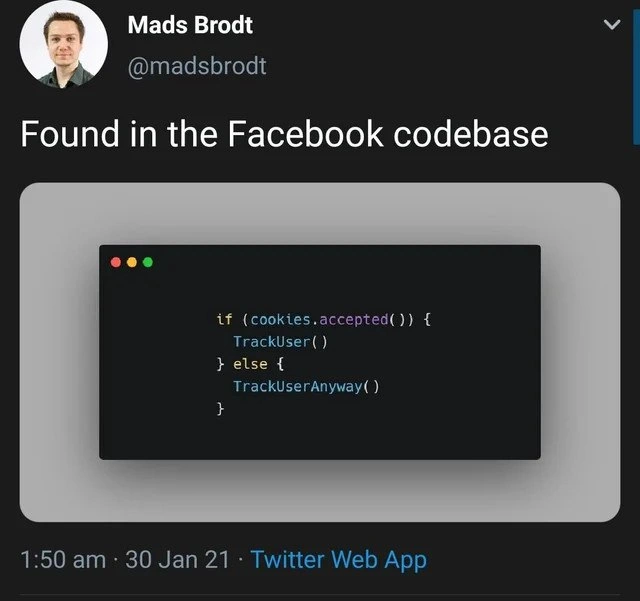
This meme drops us straight into a DataPrivacy nightmare with a sardonic twist. In the screenshot (originating from a tweet by Mads Brodt), we see a fake code snippet purportedly "Found in the Facebook codebase". The code is a classic if/else structure checking cookie consent:
if (cookies.accepted()) {
TrackUser();
} else {
TrackUserAnyway();
}
At first glance, any experienced web developer will smirk at the blatant user_tracking_irony here. The code says: if the user accepted cookies, run TrackUser(). Else – meaning if the user did not accept – call TrackUserAnyway(). Both branches eventually invoke tracking. It's a pointed parody of a cookie_banner_parody: no matter what the user chooses on that consent popup, the outcome is the same – the user gets tracked. Essentially, the meme is joking that asking for cookie consent on some platforms is just for show, a form of Privacy Theater. The user's choice is an illusion.
From a senior developer perspective, this hits on real PrivacyConcerns and frustrations. Backend engineers and front-end developers alike know that big tech companies (the FacebookPlatform, among others) have built their empires on comprehensive user data collection. Regulations like GDPR (General Data Protection Regulation) were enacted to curb exactly this kind of behavior – requiring explicit user consent before tracking or dropping non-essential cookies. In theory, if the user declines tracking, the site should respect that and disable all tracking scripts. But this meme cynically suggests a dark truth: some companies might pay lip service to consent while still finding a way to monitor you (hence TrackUserAnyway). The humor has a bite because it reflects a common suspicion in tech circles: “Sure, that site asks if it can track me, but it probably does it even if I say no.”
This is a form of tech satire highlighting corporate cynicism. Within a seasoned dev’s context, it echoes experiences where legal compliance and actual code diverge. Perhaps a harried engineer was told by management, “Make sure we have a cookie consent banner to satisfy the law, but don’t you dare turn off our analytics and ad trackers – we need that data!” The result? Code that technically checks consent, but effectively ignores it. It’s an absurd extreme of CorporateCulture priorities: user privacy takes a backseat to ad revenue and growth metrics. In real life, no respectable company would name a function TrackUserAnyway() – that’s way too on-the-nose. They’d call it something innocuous like loadBasicAnalytics() or hide it behind some A/B test flag. But the meme’s blunt naming is what makes it funny; it’s HumorInTech through obvious transparency. It’s as if a frustrated developer wanted to blow the whistle by coding the truth plainly.
Seasoned developers might also recall infamous incidents and design patterns that resonate here. For example, the concept of dark patterns in UX: interfaces that trick users into consenting or make it hard to refuse. This code snippet is the dark pattern boiled down to actual code. It’s practically saying, “No” means “Not now – ask later and keep tracking in the meantime.” For those who have implemented compliance features under pressure, the joke cuts close to home. It’s developer humor that satirizes how we sometimes implement features that satisfy the letter of the law (a visible consent banner) while betraying the spirit of it (respecting user choice). The TechHumor here also lies in how brazen the code is: any senior engineer reading TrackUserAnyway() will likely chuckle and wince at the same time. We’ve encountered code that does the opposite of what comments or variables claim – this meme just makes that contradiction overt.
Importantly, there’s industry history behind this joke. When GDPR rolled out in 2018, every website suddenly threw up cookie consent dialogs, often implemented in a rush. Developers shared war stories of late-night patches to disable tracking if users declined – and the subsequent panic from marketing teams when analytics numbers dropped. The less ethical approach (that GDPR enforcement agencies would love to catch) is to pretend to comply while continuing tracking. This meme imagines exactly that scenario in one snippet. It’s an if_else_privacy_mock aimed squarely at Facebook’s reputation: people joke that Facebook tracks everything about everyone, so this code is plausible as a piece of Facebook’s codebase in jest. In reality, if such code were truly found, it would be a huge scandal and likely illegal under privacy laws. But as TechSatire, it captures the essence of many developers’ cynical view: that some companies will track you no matter what, using any excuse or sneaky method – be it cookies, local storage, browser fingerprinting, or just outright ignoring your choice.
So at this senior level, the meme is both funny and a bit dark. It’s calling out the user_tracking_irony of cookie consent in the modern web. Any experienced dev who has dealt with compliance will recognize the satire: the code’s logic is intentionally wrong, and that’s the joke. It mocks the dissonance between what companies claim (“We value your privacy”) and what they do (“We’ll do whatever we want with your data”). In summary, this meme is a GDPR satire gem – capturing in one sarcastic if/else the feeling that for some platforms, “consent” is just a variable that doesn’t actually change the program’s outcome.
Description
This image is a screenshot of a tweet from user Mads Brodt. The tweet humorously claims to have found a piece of code in the Facebook codebase. The code snippet shows an if-else statement that checks if a user has accepted cookies. If `cookies.accepted()` is true, it calls a `TrackUser()` function. If it's false, it calls a `TrackUserAnyway()` function. The visual is a clean, dark-themed code editor window with syntax highlighting. This meme is a cynical take on corporate data privacy practices, suggesting that user consent is merely an illusion. For senior developers, it's a relatable joke about 'dark patterns' in software design where user choices are presented but the outcome is the same, reflecting a deep-seated skepticism towards how large tech companies handle user data and comply with regulations like GDPR
Comments
15Comment deleted
That's not a bug, it's a feature: 'eventual consistency' with the marketing department's requirements
Facebook’s idea of a consent flow: two Strategy classes - AcceptCookie and DeclineCookie - both forwarding to Panopticon.track(); SOLID 1, GDPR 0
This is the software equivalent of asking 'May I come in?' while already sitting on your couch eating your snacks - except instead of snacks, it's your behavioral data, and instead of a couch, it's a multi-billion dollar ad targeting infrastructure that knows you better than your therapist
Ah yes, the classic 'Schrödinger's Consent' pattern - where user privacy exists in a superposition of respected and violated states until observed by regulators, at which point it collapses into a $5 billion FTC fine. The real engineering challenge here isn't the tracking implementation; it's architecting the legal team's response pipeline to scale with your disregard for GDPR
Enterprise GDPR playbook: rename TrackUserAnyway() to legitimateInterest(), put it behind ConsentService, and pass the audit in release notes
The empty if branch: because in ad tech, consent is just a compliance speed bump on the road to infinite tracking
When OKRs outrank GDPR, the else clause turns into TrackUserAnyway() - great branch coverage, questionable governance
Bad meme Comment deleted
Realistic* Comment deleted
No Comment deleted
いぎあり。Just call TrackUser Comment deleted
Pretty readable to me Comment deleted
https://twitter.com/jordwalke/status/1355681285717385217 Comment deleted
top tier comedy was achieved Comment deleted
😂 Comment deleted