Skip to content
DevMeme
5516 of 7435
Critiquing AGI Hype with Linear Extrapolation Fallacy
AI ML Post #6047, on Jun 6, 2024 in TG

Critiquing AGI Hype with Linear Extrapolation Fallacy

Why is this AI ML meme funny?

Level 1: That’s Not How It Works

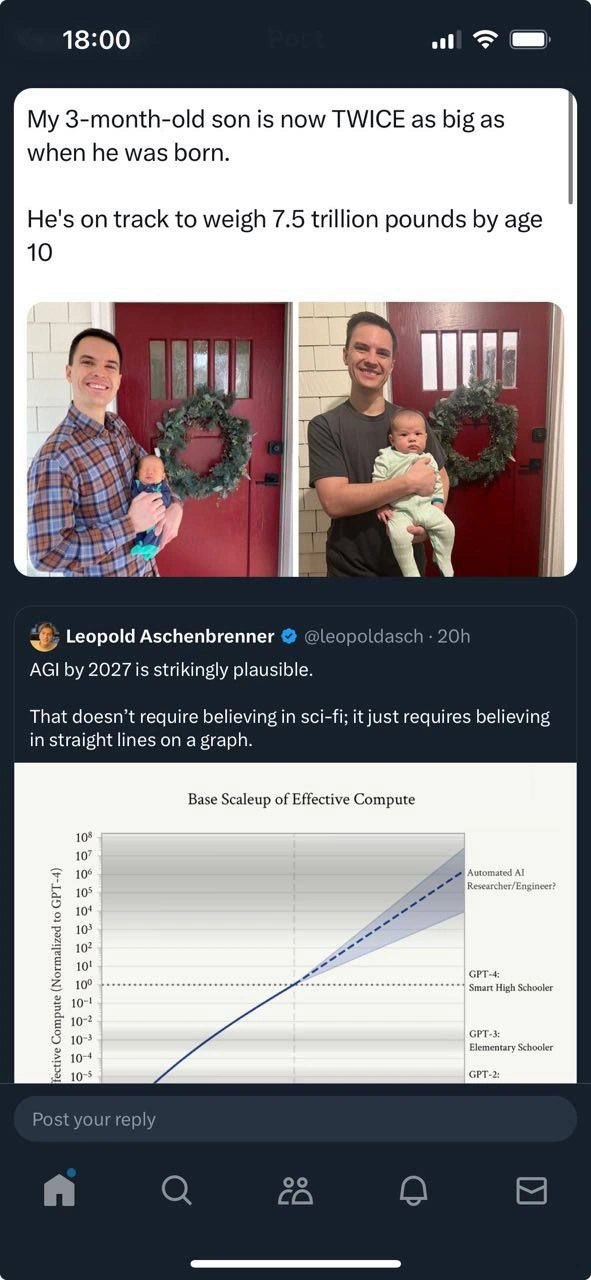
Imagine you have a tiny puppy. In one month, the puppy grows and doubles its weight – from 5 pounds to 10 pounds. You’re happy and joke, “Wow, if it keeps doubling like this, by the time it’s 5 years old, it’ll weigh as much as an elephant!” That’s a silly thing to say, right? We know puppies don’t keep growing that fast forever. They slow down and stop at a normal dog size. This meme is laughing at the same kind of silly idea. In the first part, a dad jokes that his baby, who doubled in size in a few months, will weigh trillions of pounds in a few years – which is impossible, so it’s funny. In the second part, someone says a computer will become super-duper smart (as smart as a whole engineer team!) in just a few years, just because it’s been getting smarter quickly lately. The joke is pointing out how both ideas are using the same goofy thinking: assuming things will keep going in a straight line forever. Real life doesn’t work that way – babies, puppies, or even computers have limits and changes. We laugh because the mistake is so clear with the baby example, and it helps us see that the super smart computer prediction might be just as far-fetched. In simple terms: you can’t just take a short-term trend and run wild with it, or you’ll end up with trillion-pound babies and other impossible things. That’s why this meme is funny – it’s a playful reminder that that’s not how it works in real life.

Level 2: Two Graphs, Same Mistake

Let’s break down the meme in plainer terms. On one side, we have a dad joking that his baby boy doubled in weight in three months, so by age 10 the kid will weigh an astronomical 7.5 trillion pounds. On the other side, there’s a tweet claiming that Artificial General Intelligence (AGI) could plausibly arrive by 2027, based on a graph that’s basically a straight upward line. These two posts are placed together to show the same silly logic in two different worlds: baby growth and high-tech AI/ML forecasts. It’s a classic case of faulty extrapolation – assuming a short-term trend will continue unchanged far into the future.

Extrapolation means taking a current trend (like a line on a graph) and extending it forward to predict future values. A straight_line_extrapolation is the simplest kind: “it’s going up fast now, so it’ll keep going up just as fast later.” The dad applied this to baby weight. Babies do gain weight very quickly in their first months (doubling birth weight by around 3-4 months is quite normal!). But as any parent or biology textbook will tell you, that growth slows down a lot over time. If you actually chart a child’s weight over years, it’s not a straight line to infinity – it starts steep but then curves and levels off as the child approaches their genetically determined size. By age 10, maybe that kid is 4-5 feet tall and, say, 80 pounds. The joke is obvious: claiming 7.5 trillion lbs is just laughable. (For context, 7.5 trillion pounds is an unfathomable mass – Earth’s total atmosphere weighs about 11 trillion pounds! So a ten-year-old approaching planetary mass is pure comedy.) This is an example of faulty_linear_modeling – using a linear model (constant doubling) where it doesn’t apply. It’s basically the dad doing bad math for a laugh, or as we say in data science, making a model with no sanity checks.

Now, the meme compares that to something happening in the AI world. AGI stands for Artificial General Intelligence, which is the hypothetical AI that can understand, learn, and apply knowledge in any domain like a human (or beyond). Think of an AI that isn’t just good at one thing (like playing chess or answering trivia), but can do everything: pass any exam, learn any skill, maybe even improve itself – basically sci-fi level AI. Many experts debate when or if we’ll achieve AGI. Some are very optimistic (a few years), others think it’s decades away or not possible without new breakthroughs. The tweet we see in the meme (by Leopold Aschenbrenner) suggests “AGI by 2027 is strikingly plausible”, and importantly he says this “just requires believing in straight lines on a graph.” Why a graph? In AI research, people often make graphs of progress – for example, how AI capabilities improve as we use more computing power (more GPU chips, larger neural networks, etc.). One common graph is about compute_scaling_laws: it shows that if you increase compute (and data), AI models like GPT-2, GPT-3, GPT-4 have gotten better and better in a somewhat predictable way. The graph in the meme has a log-scale (the y-axis has numbers like 10^2, 10^3... 10^8 – each step is a tenfold jump). On such a graph, GPT-2 (an earlier language model) is at a lower point (like “Elementary Schooler” intelligence as a label), GPT-3 higher (“Elementary Schooler” – the chart labels suggest GPT-3 is at that level? The description says GPT-3: Elementary Schooler, GPT-4: Smart High Schooler), and GPT-4 even higher (“Smart High Schooler”). There’s a dotted line extending that trajectory upwards towards a point labeled something like “Automated AI Researcher/Engineer?” which implies human-expert-level AI. The straight dotted line indicates “if we keep going like this, we might hit that level by 2027.” It’s basically an agi_prediction based purely on extending the current trend of improvement.

For a newcomer, it might look convincing – the AI models are clearly getting better as we invest more compute, so why not assume that by, say, doubling compute a few more times we’ll get to human-level AI? The meme’s punchline is: believing that is as naive as believing the baby will turn into a trillions-pound giant. In both cases, it’s AIHype (or baby hype!) without considering real-world limits. In the baby’s case, biology and common sense impose limits. In the AI’s case, there are also limits and uncertainties: maybe we’ll run out of quality data to feed the AI, maybe just adding compute gives diminishing returns (each doubling of compute might give a smaller and smaller boost in capability), or perhaps intelligence doesn’t scale linearly with compute at all beyond a point – we might need new algorithms or paradigms (just like you can keep making a car faster by adding horsepower, but at some point, aerodynamics and friction will stop further gains without a completely different design, like flight).

Let’s also clarify OverfittingModels, since it’s tagged and relevant here. In machine learning, overfitting is when a model learns the training data too well, including all the noise and quirks, so that it doesn’t generalize to new data. It’s like memorizing answers to specific questions rather than understanding the subject – you do great on practice tests but fail the real exam with new questions. How does that concept apply here? The dad’s “model” (and the AGI timeline model) might be seen as overfitting to the initial trend. They take the early data (baby’s first 3 months growth, or AI’s progress up to GPT-4) and assume that pattern alone is a perfect predictor forever. They’re not considering the bigger picture or the underlying mechanisms. In other words, they “fit” a simple model to the data they have, but that model isn’t truly valid as conditions change (baby’s growth slows, AI problems get harder). It’s a playful connection: obviously the dad isn’t training a machine learning model on his baby’s weight, but the logical folly is similar to an overfit ML model – it performs extremely well on known data (it exactly “predicted” that 3 months = double weight, since that was true by definition) but fails spectacularly on new data (age 10 projection is nonsense).

The context tags mention AIHypeCycle. The “hype cycle” is a way to describe how new technologies tend to get overhyped early on (everyone assumes it will change the world overnight), then there’s a crash when those lofty predictions don’t materialize as fast (the “trough of disillusionment”), and eventually a more realistic progress continues. AI has been through several hype cycles. Right now, with things like GPT-4, there’s a lot of hype again. Some people are making very bold claims – like full human-level AI in just a few years – which is exactly what that tweet exemplifies. The meme is a way of injecting some humor and skepticism into that discussion. It’s saying: hey, maybe we should cool down and not draw crazy straight lines; remember the baby! It’s AIHumor/MachineLearningHumor that uses a funny real-life analogy (the baby growth) to point out the potential folly in the tech world’s thinking. And because it’s presented in a familiar format (tweets, side-by-side), even a junior developer or someone new to AI can get the joke: don’t believe every graph with a straight upward line – the reality might not cooperate. It’s a gentle introduction to thinking critically about AIIndustryTrends and forecasts.

In summary, the meme’s message in simple technical terms is: correlation is not destiny. Just because something has been improving rapidly doesn’t mean it will keep doing so in a linear (or exponential) fashion indefinitely. Whether it’s a human baby or a CPU/GPU-fueled AI, systems have limits, and naive projections can lead to comically wrong predictions. The meme wraps that lesson in humor: by equating an agi_prediction with a baby_weight_projection, it reminds everyone (junior devs and experienced architects alike) to keep a healthy skepticism about those perfectly straight lines on flashy graphs. After all, if someone ever tells you their model’s performance will go “to the moon” on a chart, you might want to double-check that they’re not about to pitch you a trillion-pound baby.

Level 3: Straight-Line Prophecies

This meme brilliantly jux­taposes two scenarios to poke fun at AIHype and the blind faith in trends. On the left, we have a new dad making an obviously ridiculous prediction about his son’s future weight. On the right, we see a tech pundit’s tweet about an imminent timeline for AGI (Artificial General Intelligence). By placing these side by side, the meme screams: “Hey, these are the same mistake!”

Dad Tweet: “My 3-month-old son is now TWICE as big as when he was born. He’s on track to weigh 7.5 trillion pounds by age 10.”
AI Tweet: “AGI by 2027 is strikingly plausible... it just requires believing in straight lines on a graph.”

Reading the dad’s proclamation, any sane adult chuckles. Doubling in three months is normal for a newborn, but by age 10 kids level off around maybe 70-100 pounds, not 7.5 trillion. The absurdity is obvious – it’s a joke about straight_line_extrapolation taken to the extreme. Seasoned engineers immediately recognize a familiar pattern: we’ve sat through too many PowerPoint slides where someone takes an early KPI uptick and draws it out into a miraculous future. In startup pitches and quarterly planning, this is practically cliché. “User sign-ups grew 5% this week, so by next year we’ll have 50 million users!” or “Our model accuracy improved by 1% every month, straight-line that and we’ll exceed human-level by Christmas.” These are the straight-line prophecies we’ve grown cynical about. They ignore that growth gets harder as you scale – eventually you saturate your market, hit physical limits, or encounter unforeseen complexities. IndustryTrends_Hype often lives on such graphs: every new tech is going to grow forever on slides, whether it’s blockchain adoption, GPU performance, or AI capabilities, if you believe the pretty lines.

In the meme’s second part, Leopold Aschenbrenner’s tweet about “AGI by 2027” encapsulates that hype. He literally says all it takes is “believing in straight lines on a graph.” That phrase drips with irony. To a senior developer or researcher, it’s a subtle burn – suggesting that some AI evangelists are essentially doing what the goofy dad did: ignoring AIHypeVsReality checks and just trusting a trend line. The chart shown (titled “Base Scaleup of Effective Compute”) has all the hallmarks of AIHypeCycle optimism: it plots AI compute increases (on a log scale) and draws a trajectory towards an almost mystical end-goal (an “Automated AI Researcher/Engineer?”, i.e., AGI). They even annotate points like “GPT-4 = Smart High Schooler” to tantalize us: look, at this compute level we got a high-school-smart AI, so with just a few more years of Moore’s Law… voilà! The AIHumor here is that anyone who’s been around the block knows reality isn’t that linear. We recall past agi_prediction fiascos – from the 1970s when experts predicted full AI by the 1980s, to the self-driving car hype of the 2010s where Level 5 autonomy was always “just 2 years away.” Bold straight-line forecasts sell books, grab headlines, and secure funding, but they habitually crash into the wall of complexity. It’s AIHype on overdrive, and those who’ve survived a hype bubble or two have a reflexive eye-roll ready.

The juxtaposition with the baby isn’t just funny – it’s instructive. It screams “do a sanity check!” Faulty_linear_modeling becomes crystal clear when you see it applied to something as concrete as body weight. A baby’s weight can’t follow that straight trajectory because of basic biology (and physics – a multi-trillion-pound anything would crumble into a black hole… or at least require one heck of a stroller). Likewise, bridging the gap from today’s smart-but-narrow AI (even GPT-4 with its impressive but specific talents) to a human-level “general” intelligence likely requires more than just scaling up parameter counts or FLOPs on a graph. Senior engineers suspect qualitative leaps are needed – new algorithms, better understanding of consciousness or learning – not merely quantitative extension. We’ve been burned by OverfittingModels of progress before: when you take a model (or assumption) that worked for a bit and push it way beyond its tested region, odds are you’ll be very embarrassed. It’s akin to training an ML model on cat photos and expecting it to suddenly identify dark matter in space – you changed domains, all bets are off.

In meetings, we’ve learned to ask the awkward questions: “Uh, boss, if this trend continues, the baby weighs more than the Pacific Ocean – are we sure that’s realistic?” or “If our server throughput keeps doubling, by next year we’ll handle more requests than the entire internet generates – maybe we should factor in some limits?” Often there’s an uncomfortable silence, a nervous chuckle, and a grudging admission: the straight line might be too good to be true. This meme distills that moment into a visual gag. It’s the perfect senior-engineer humor: it uses a bit of MachineLearningHumor (a sly nod to overfitting and naive modeling) to call out the elephant in the room: AIHypeCycle projections can be as delusional as predicting a trillion-pound kid. And just as the dad’s tweet is obviously satirical, the meme nudges us to view the “AGI by 2027” claim with the same skepticism. After all, trusting a straight line on a fancy AGI graph without context is about as scientific as using one baby’s growth spurt to set your KPI for diaper sizes in 2035.

Level 4: Straight Lines, Crooked Logic

At the most theoretical level, this meme highlights the perils of naïve extrapolation in complex systems. The father’s tongue-in-cheek projection of his infant’s weight presumes a constant doubling rate, akin to plotting a straight_line_extrapolation far beyond the data. Formally, if we treat the baby’s weight growth as an unconstrained exponential, we might model it as W(t) = W(0) * 2^{t/3mo}, leading to an absurd result by age 10. In reality, biological growth follows a logistic curve – rapid at first but eventually plateauing due to genetic limits and resource constraints. The dad’s “model” ignores the inevitable asymptotic slowdown (no 10-year-old becomes a planet-sized toddler). This humorous example underscores a core issue in predictive modeling: domain validity. A model that fits initial data (the baby doubling from ~7 to ~14 lbs) can break down catastrophically when extended beyond its applicable range. In machine learning terms, the father effectively overfit a model to two data points and then trusted it for a wildly out-of-distribution prediction – a textbook illustration of OverfittingModels with zero generalization.

Now consider the AI side of the meme. The tweet claiming “AGI by 2027” leans on a graph labeled “Base Scaleup of Effective Compute.” The x-axis (likely time or model generations) and y-axis (compute normalized to GPT-4) are on a log scale, where a straight line corresponds to exponential growth in actual compute. In essence, it’s assuming the compute_scaling_laws observed so far (where more compute yields better AI performance) will continue unabated. This is reminiscent of Moore’s Law-like thinking – the belief that industry trends (transistor counts, model sizes, etc.) will march steadily upward. However, any senior engineer knows that exponential trends eventually face headwinds: physical limits (e.g., energy consumption, heat dissipation, cost), diminishing returns, or paradigm shifts. In theoretical computer science and economics, endless exponential growth triggers singularities or crashes, not smooth sailing. The crooked logic here is treating an empirical trend as an immutable law of nature. Just as a baby’s growth cannot be linear forever (gravity and physiology say “no”), AI intelligence growth isn’t guaranteed to follow a simple straight line. There might be fundamental algorithmic breakthroughs required or hidden complexity ceilings – problems where scaling alone hits diminishing returns (think of training data exhaustion or fundamental limits like the Halting Problem for certain intelligence tasks). The faulty_linear_modeling showcased by the meme ignores these nuance: it’s effectively extending a line on a graph without asking “does the real system allow this?”

From a historical perspective, this kind of linear thinking has been debunked time and again. Early AI research in the 1960s saw promise in simple perceptrons until mathematicians showed their limits; progress wasn’t a straight line, it required new approaches (hello, multi-layer networks decades later!). Similarly, raw compute alone doesn’t automatically yield Artificial General Intelligence. We have scaling laws papers showing smooth power-law improvements on benchmarks as models get bigger, but extrapolating those curves indefinitely is as misguided as predicting a 7.5 trillion lb child. In fact, seasoned researchers expect regime changes: for example, a model might need fundamentally new architectures or training techniques to move from “Smart High Schooler” level to “Automated AI Researcher/Engineer.” If we plot performance vs. compute, we may see phases – slow start, exponential climb, then flattening when hitting a capacity limit. In technical terms, many real-world processes are sub-exponential over the long term or transition to an S-curve. The meme’s dotted straight-line projection ignores that straight lines eventually bend under real-world constraints. It’s a witty reminder of a core scientific principle: an extrapolation is only as good as the assumptions that underlie it. When those assumptions quietly break (a child’s growth decelerates, an algorithm’s efficiency caps out, the speed of light limits network calls, etc.), the model crumbles. In short, believing “straight lines on a graph” without questioning context is a recipe for what we might call extrapolation explosions – predictions that blow up into nonsense. The baby won’t become a black hole, and today’s AI/ML curve won’t magically reach omniscience by 2027 without encountering a few laws of physics and computing along the way.

Description

This meme is a screenshot of a tweet that juxtaposes a humorous, personal anecdote with a serious technological prediction to highlight a logical fallacy. The top tweet shows a father with his newborn son and then at 3 months old, joking, 'My 3-month-old son is now TWICE as big as when he was born. He's on track to weigh 7.5 trillion pounds by age 10.' Below this, a tweet from AI researcher Leopold Aschenbrenner is shown, which seriously claims, 'AGI by 2027 is strikingly plausible... it just requires believing in straight lines on a graph.' Aschenbrenner's tweet includes a logarithmic graph showing the 'Base Scaleup of Effective Compute' on an exponential trajectory. The humor and technical critique arise from the direct comparison: the top tweet uses a simple, relatable example to demonstrate the absurdity of linear extrapolation, thereby implicitly mocking the AGI prediction for relying on the same flawed reasoning. It's a sophisticated joke for a technical audience that understands the limits of models and the nuances of interpreting data, especially amidst technological hype cycles
Comments

11
Anonymous ★ Top Pick Sure, AGI is plausible if you believe in straight lines. So is my junior dev becoming a 100x engineer by next quarter because he closed two tickets this week instead of one
  1. Anonymous ★ Top Pick

    Sure, AGI is plausible if you believe in straight lines. So is my junior dev becoming a 100x engineer by next quarter because he closed two tickets this week instead of one

  2. Anonymous

    If Moore’s Law really worked like that graph, my toddler’s BMI would crash the AWS billing dashboard long before GPT-7 eats the planet

  3. Anonymous

    Every senior engineer knows the danger of extrapolating from two data points, yet here we are watching the entire AI industry draw a straight line through GPT-2 and GPT-4 on a log scale and confidently declaring AGI by 2027 - it's like estimating project completion based on the first sprint's velocity

  4. Anonymous

    Ah yes, the classic 'straight line on a log scale' argument for AGI - because if my toddler's growth rate holds, he'll be filing for his own zip code by kindergarten. This is the ML equivalent of estimating your startup's Series B valuation by extrapolating your first week's user signups. Any senior engineer who's watched a promising metric plateau after initial exponential growth knows that reality has a nasty habit of introducing sigmoid curves right when your PowerPoint deck promised hockey sticks. The real question isn't whether we can draw a straight line through GPT-2, GPT-3, and GPT-4 - it's whether we're measuring the right thing, and whether the next order of magnitude in compute will hit architectural bottlenecks, data quality ceilings, or the uncomfortable realization that intelligence doesn't scale linearly with FLOPS. But hey, at least the confidence interval is honest about the uncertainty, which is more than most AI hype cycles offer

  5. Anonymous

    Scaling laws don't negotiate with biology or thermodynamics - baby to black hole, flops to femtosecond inference, straight line or bust

  6. Anonymous

    AGI by 2027? Sure - if capability scales like GPU invoices; our last straight-line forecast had the cloud bill approaching small‑moon mass by Q4

  7. Anonymous

    Believing AGI by 2027 because the line is straight is the same model that promotes my 3-month-old to a 7.5-trillion-pound principal engineer - spectacular R2, catastrophic error bars

  8. @Sp1cyP3pp3r 2y

    If open ai weren't lazy as Mojang and were productive as Epic Games, they would make GPT10 already

    1. @mira_the_cat 2y

      i prefer not that big (my computer isn't good enough for large models) open-source (so i can run it on my pc) models

    2. dev_meme 2y

      I’m afraid I will have to repost that meme about GPT few more times, lol

    3. @samorosnie 2y

      And if they would be speedrunning versioning like chromium they would have gpt162 by now?

Use J and K for navigation