Skip to content
DevMeme
5515 of 7435
The AI Automation Paradox: Creative Work vs. House Chores
AI ML Post #6045, on Jun 6, 2024 in TG

The AI Automation Paradox: Creative Work vs. House Chores

Why is this AI ML meme funny?

Level 1: Robots Hogging the Fun

Imagine you have a helper robot that you really want to clean your room and do your homework. Instead, this robot says, “I’ll do your drawing and writing for you, and you go clean the room.” That’s completely backwards, right? You wanted help with the boring stuff (chores), not the fun stuff (drawing and writing)! This meme is making a similar silly point: today’s super-smart computers (AI) are doing the fun jobs like making pretty pictures and stories, but they still won’t help with washing dishes or folding clothes. It’s like if you asked for help with chores, and the helper decided to play artist instead. It feels unfair and funny because the robot is basically hogging the fun tasks, leaving you with the yucky housework. The joke is that we built really fancy smart machines… but they still can’t help us with the simple cleaning we all dread, so the whole situation is upside-down and laughable.

Level 2: Chores vs. Creativity

For a less jaded explanation: this meme is comparing what AI is currently good at with what it’s not so good at, using a funny everyday example. The title says “AI can paint a Rembrandt, but still can’t fold a fitted sheet.” Rembrandt was a master painter, so “paint a Rembrandt” means creating artwork as skillful as a famous artist. Modern AI image generators (for example, apps that create paintings from text prompts) actually can produce images that look remarkably like a Rembrandt painting or van Gogh or any style you want. Similarly, AI text models can write essays or stories that read like a human author wrote them. That’s the first half: AI is doing “art and writing” now – the kind of creative work humans usually do for pleasure or expression.

Now the second half: “still can’t fold a fitted sheet.” A fitted sheet is that bed sheet with elastic corners that’s notoriously difficult to fold neatly (even many humans struggle with that chore!). Folding laundry, doing dishes, cleaning the bathroom – these are household chores that are pretty simple for a person but require a lot of intricate handling and adjustment. The meme quote from Joanna Maciejewska basically says: I would prefer AI handle my boring chores (laundry and dishes) so I have time to do the fun creative stuff (art and writing), but instead AI is doing the fun stuff for me, leaving me with the boring chores! It’s an upside-down situation.

In slightly more technical terms, there’s a gap in automation: we have made huge strides in software that can automate intellectual or creative tasks (thanks to advances in machine learning and neural networks), but automating physical tasks in the real world (which involves robots or machines that can manipulate objects) is still very hard and undeveloped. We do have some appliances and robots – like a Roomba vacuum that automatically cleans floors or a dishwasher for plates – but there’s no general-purpose robotic maid to fold your clothes or clean the shower. You might have a smart speaker that can tell you a joke or a story, but it definitely can’t make your bed. The meme highlights this ironic reality: all the high-tech innovation is going into creative software (AI that draws, writes, or does art for you) rather than into the kind of automation that would take tedious chores off your plate. For many people, that feels like misplaced effort: why are we teaching computers to be artists and writers before we’ve taught them to be butlers and maids? Especially for developers and techies, this contrast is both funny and a bit frustrating, because it reflects how tech progress doesn’t always target the things that would make everyday life easier.

So in simple terms, AI is great at pretending to be a creative human, but it’s terrible at being a handyman or housekeeper. We’ve got algorithms that can beat chess grandmasters and generate funny cat paintings, but if you ask your fancy AI device to fold your laundry, it’s going to do a hard fail. That’s the joke: the priorities of AI research seem a bit backwards from an ordinary person’s perspective.

Level 3: Hype vs Housework

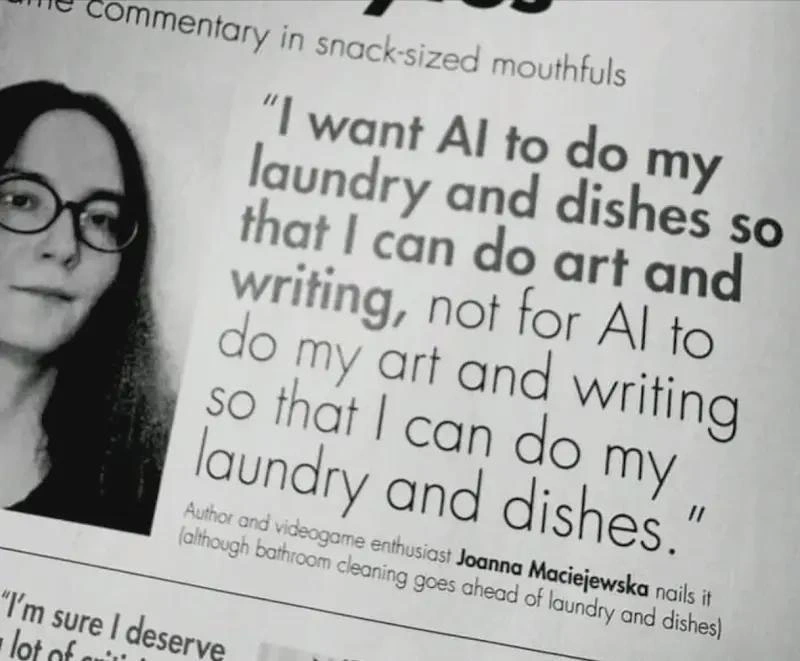
At a more practical level, the meme is poking fun at the AI hype cycles and product priorities we see in the tech industry. Any seasoned engineer has watched how funding and talent often flow into flashy generative AI projects — like AI that writes articles, paints portraits, or codes — because those yield cool demos, viral stories, and investor excitement. Meanwhile, the more mundane automation, like a reliable dish-washing robot or a laundry-folding machine, gets comparatively little attention (and turns out to be way harder to build). The quote by Joanna Maciejewska nails this disconnect: “I want AI to do my laundry and dishes so that I can do art and writing, not for AI to do my art and writing so that I can do my laundry and dishes.” It’s a senior-dev-eye-roll-inducing commentary on how tech’s priorities feel misplaced. We’ve ended up with AI assistant tools that attempt to automate the fun, creative stuff (writing, drawing, even coding) while leaving humans stuck with the same old chores and grunt work.

From a DeveloperHumor perspective, this resonates deeply. Think about our daily work: We have intelligent code generators and auto-complete (hi, GitHub Copilot) that can spit out boilerplate or even craft whole functions. Cool, right? But who is still stuck wrangling build scripts, fixing CI pipelines at 2 AM, and cleaning up legacy spaghetti code? Us, the developers. The AI might help write a function or two (the “art and writing” of coding), but it’s not refactoring our 10-year-old legacy codebase or triaging support tickets (the “laundry and dishes” of software maintenance). It’s the same irony the meme highlights in household terms. Everyone’s pouring resources into AI that creates new images and text, while the unsexy automation of real-world problems — whether it’s DevOps drudgery or actual housework — remains unsolved. AIHypeVsReality indeed: we were promised robot butlers, and instead we got predictive text and deepfakes.

There’s also a broader industry commentary here about Automation and where it’s applied. In theory, tech advances are supposed to free humans from menial labor so we can focus on higher pursuits. In reality, current AI has flipped the script: it’s encroaching on higher pursuits (artistic creation, writing, even making music) while the menial labor still falls on our shoulders. Part of this is because automation in the physical world (think IoT devices, home robotics) faces stubborn challenges — physics is hard, sensors can be flaky, environments are unpredictable. A senior engineer can tell you war stories about ambitious home robot projects that ended up as expensive flops. It’s way easier to deploy a cloud AI service that generates funny images of cats playing chess than to build a physical robot that can reliably scrub a bathtub. Companies follow the path of least resistance (and greatest profit): why invest billions in a dishwashing robot R&D for years, when a generative AI model can start earning fame and fortune now by writing poems or painting a Rembrandt clone? The IndustryTrends_Hype favors digital AI assistants over tangible robots — partly because software scales quickly, and partly because, well, folding laundry is boring to work on and doesn’t demo well at CES.

The humor also isn’t just about big tech — it’s relatable on a personal level. We’ve all seen the irony when someone shows off an AI that does something "creative" and we joke, “Cool, but can it clean my house?” It’s a form of AIHumor among tech folks: we sarcastically ask when our coding AI will also take out the garbage or when our smart speaker will tidy up the living room. The meme’s magazine-style seriousness adds to the joke: it reads like a profound insight in a lifestyle magazine, yet it’s basically one giant eye-roll at AI’s limitations. The author even quips that “bathroom cleaning goes ahead of laundry and dishes” — highlighting how most of us would rank these real-life tasks we’d eagerly hand off to a robot if we could.

In summary, the meme captures a shared experience and frustration in the tech community: AI’s misplaced priorities (or rather, our priorities for AI) mean we’re automating the wrong things first. It’s as if we’ve built a genius robot painter but still don’t have Rosie the Robot Maid from The Jetsons. The laugh comes with a side of sigh: sure, our algorithms can generate a sonnet or a stunning piece of digital art, but at the end of the day, we’re still elbow-deep in dish soap and laundry baskets.

# A tongue-in-cheek depiction of the current AI utility imbalance:
tasks = ["writing code", "painting artwork", "folding laundry", "washing dishes"]
for task in tasks:
    if task in ["folding laundry", "washing dishes"]:
        print(f"{task}: Human's problem 🤖❌")
    else:
        print(f"{task}: AI's on it! 🤖✅")

(Output):

writing code: AI's on it! 🤖✅  
painting artwork: AI's on it! 🤖✅  
folding laundry: Human's problem 🤖❌  
washing dishes: Human's problem 🤖❌  

In the code above, the AI cheerfully takes on the creative tasks, but for the chores it throws up its hands – a lighthearted illustration of the meme’s message that today’s AI will happily draw your Rembrandt while you’re left to scrub the dirty dishes.

Level 4: Moravec’s Dirty Laundry

At the deepest technical level, this meme spotlights a classic quirk of AI research known as Moravec’s Paradox. In the 1980s, roboticist Hans Moravec observed that tasks humans find intuitive and simple (like physical chores or perception) are often the hardest for AI, while abstract tasks we find hard (like composing music, playing chess, or painting in the style of Rembrandt) can be easier for AI given enough computing power and data. The quote “AI can paint a Rembrandt, but still can’t fold a fitted sheet” is basically Moravec’s Paradox in everyday terms.

Consider what’s going on under the hood: Generating a Rembrandt-style painting or a human-like essay is largely a pattern recognition and data-driven machine learning problem. Give a big neural network (like a deep learning model) millions of images or texts, and it can statistically reproduce or remix those patterns. It’s working in a virtual world of pixels and words (high-dimensional but well-defined). Folding a fitted sheet, on the other hand, is an embedded AI problem — it requires real-time perception, computer vision to recognize the crumpled cloth’s shape, and dexterous robotics to manipulate a squishy, stretchy object. The state space for a rumpled piece of laundry is enormous and continuous; there’s no large curated dataset of “all possible ways a sheet can fold” that a robot can simply memorize. Instead, a laundry-folding AI would need advanced sensorimotor skills, dynamic planning, and tactile feedback loops. It’s a holy grail of robotics to handle such deformable objects reliably.

In essence, today’s AI/ML excels at cognitive tasks within a computer’s comfort zone (lots of data, clear rules or patterns), but it struggles with embodied intelligence — dealing with the messy unpredictability of atoms, gravity, and geometry in the physical world. Painting like Rembrandt is mostly about crunching numbers and styles in silicon; folding a sheet is physics, requiring fine motor control and spatial understanding that our most advanced algorithms and robots are still clumsily learning. This fundamental disparity explains why we have masterful AI artists and superhuman game players, yet a household robot that can neatly fold laundry or wash dishes remains the stuff of science fiction (or extremely slow research prototypes). The meme humorously exposes this technical gulf: our generative models are off creating art galleries while the laundry basket in the corner continues to mock our technological impotence.

Description

A black-and-white photograph of a printed article featuring a quote from author Joanna Maciejewska next to her headshot. The powerful and widely shared quote reads: 'I want AI to do my laundry and dishes so that I can do art and writing, not for AI to do my art and writing so that I can do my laundry and dishes.' This statement succinctly captures a growing sentiment and critique regarding the trajectory of artificial intelligence. It highlights the ironic reality that while the promise of automation was to free humanity from menial labor for more creative pursuits, the current focus of generative AI often seems to be automating the creative pursuits themselves, leaving the mundane physical tasks to humans. The meme resonates deeply with developers and creatives who are witnessing the rapid advancement of AI in digital content creation while practical robotics for everyday chores remains largely inaccessible
Comments

23
Anonymous ★ Top Pick We were promised AI would handle the chores so we could write poetry. Instead, we got AI that writes poetry while we're still debugging the dishwasher's firmware
  1. Anonymous ★ Top Pick

    We were promised AI would handle the chores so we could write poetry. Instead, we got AI that writes poetry while we're still debugging the dishwasher's firmware

  2. Anonymous

    We’ve got diffusion models hallucinating entire universes, yet my smart washer still needs a webhook and three retries to remember the rinse cycle - talk about mis-allocated compute credits

  3. Anonymous

    We've successfully trained models to hallucinate entire codebases and generate infinite tech debt through AI-written pull requests, yet my Roomba still gets stuck under the same chair every day. Peak Silicon Valley: disrupting creative industries while my deployment scripts can't even fold fitted sheets

  4. Anonymous

    We spent decades dreaming of robots that would handle our physical labor so we could pursue creative fulfillment, but instead we built neural networks that generate art and write code while we're still stuck doing our own laundry. It's the ultimate product-market fit failure: we optimized for the wrong loss function and now GPT-4 can write poetry but can't fold a fitted sheet. Turns out the real technical debt was the automation priorities we made along the way

  5. Anonymous

    Wake me when an LLM can close Jira, tame flaky E2E, reconcile Terraform drift, and write the postmortem - until then it’s just a very confident intern trying to steal the fun parts

  6. Anonymous

    Wake me when we can kubectl apply chores.yaml and get exactly-once semantics on dishes - until then, LLMs are automating the part we weren’t avoiding

  7. Anonymous

    Devs want LLMs for CRUD and configs to architect systems; instead, we're refactoring AI hallucinations while it 'innovates' our on-call rotations

  8. @NanoSector 2y

    https://www.nuvoton.com/ai/scenario/TSNuvotonAIDiscovery-000021/ AI dishwashers are becoming a thing

  9. @mira_the_cat 2y

    it would be good if she had a real body and helped with such things

  10. @Sp1cyP3pp3r 2y

    I felt that

  11. @Araalith 2y

    Meatbags slowly realize their real place and value...

    1. @asaushkin 2y

      so true

  12. @deerspangle 2y

    Big mood. Robotics has lagged badly

  13. @udinanon 2y

    Imma be real we have dishwashers and washing machines, i want it to do other stuff really But robotics hard and less profitable

  14. @pixelsex 2y

    I, for one, welcome our new AI overlords

  15. @SamsonovAnton 2y

    Little Santa's helper

    1. @ZgGPuo8dZef58K6hxxGVj3Z2 2y

      Wait till it falls because the magnets weren’t made for double layered windows💀

      1. @endisn16h 2y

        it uses vacuum though

        1. @ZgGPuo8dZef58K6hxxGVj3Z2 2y

          Oh okay didn’t knew

  16. @kitbot256 2y

    Its art and writing are shit anyway

    1. @plusdanshi69 2y

      oh come on, 6 fingers on one hand does not mean it is shit

  17. @plusdanshi69 2y

    ironic.jpg

  18. @mira_the_cat 2y

    just make such ai

Use J and K for navigation