Skip to content
DevMeme
3608 of 7435
The Unlikely Overlap of Data Formatting and Social Awkwardness
DataScience Post #3945, on Nov 18, 2021 in TG

The Unlikely Overlap of Data Formatting and Social Awkwardness

Why is this DataScience meme funny?

Level 1: Not That Kind of Date

Think about the word “date.” It can mean a day on the calendar, or it can mean going out with someone you like. Sometimes people or tools get confused by this! This meme joke is saying that both a computer program (Excel) and a certain kind of person (an incel, or someone who really wants a girlfriend/boyfriend) make the same silly mistake: they see something and assume it’s about a calendar date or a romantic date when it isn’t.

It’s like if you had a helpful robot that looks at what you write and tries to guess what you mean. You write down “03-01” as a code for something, but the robot gets excited and says, “Oh, that must be March 1st, a date!” The robot changed what you wrote into a calendar date even though you didn’t mean a date at all. That’s what Excel does – it’s a computer program that sometimes automatically turns things into dates. Now imagine a person who, when someone is just being friendly or saying hello, that person thinks, “Yay, I have a date!” even though the other person was just being nice. In both cases, the robot and the person are confused by the word “date.” They both guess wrong and end up looking silly.

So the meme is funny because it’s pointing out this shared goof-up. Excel the spreadsheet and an incel the person both mistake something ordinary for a date when it isn’t one. It’s a bit like confusing a date (a day or meeting) with a date (a sweet fruit) – you’d laugh if someone packed a bunch of fruit for what they thought was a date at the movies! The overlap in the picture – where the two circles meet – is saying they both make the “not a date” mistake. In simple terms: Excel isn’t always smart about dates, and some people aren’t always smart about dates either. That’s why we giggle at this meme. It’s telling us, “Oops, not that kind of date!”

Level 2: Excel’s Guessing Game

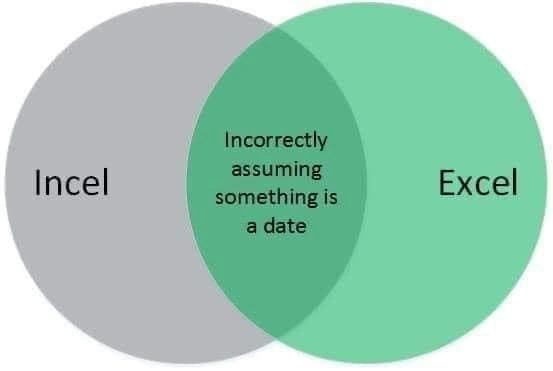
This meme uses a simple Venn diagram (two overlapping circles) to compare Excel with “incel.” On the left, “Incel” represents a person who is involuntarily celibate – basically someone who can’t get a romantic date and might desperately misinterpret social cues. On the right, “Excel” represents Microsoft Excel, the popular spreadsheet software. The overlapping middle says “Incorrectly assuming something is a date.” This is the joke: it’s pointing out a funny behavior that both an incel and Excel share.

Let’s break it down in clear terms. Excel spreadsheets often try to be smart by guessing the data format you intended. If you type or import something that looks like a date (for example, 3-1 or 07/08), Excel might automatically change it into an actual calendar date. That means if you had a string like "03-01" in a CSV file and opened it in Excel, you might suddenly see Mar 1 (March 1st) instead of the original text. Excel assumed the text was a date and reformatted it. This feature can be useful when you’re actually entering dates (it saves you time formatting), but it becomes a problem when the text wasn’t supposed to be a date at all. It’s essentially a data parsing bug: Excel is incorrectly assuming the data type. In tech terms, this is called type coercion or type inference. The software is coercing (converting) the type of your input from “text” to “date” without asking you.

Now, why is that a bad thing? Because it can mess up your data quality. Imagine you have a list of product codes or IDs that happen to have a format like “01-02”. If Excel thinks those are dates, it will change 01-02 into January 2 (or 01/02/2021 with a year). Your product code “01-02” just got turned into something completely different! This actually happens in real life: a famous example is with gene names in biology. Some gene names (like one called SEP8) looked like “Sep 8” to Excel, so it turned them into actual dates. You can see how that would create big confusion in a scientific spreadsheet – suddenly some gene entries become dates like 8-Sep-2021 instead of staying as the gene code. These kinds of data format follies are extremely frustrating bugs for anyone working with data.

The meme jokingly compares this Excel behavior to an incel in social life. “Incel” is an internet term (short for involuntary celibate) describing someone (typically a young man) who has trouble finding romantic partners and might hang out in online forums about it. The stereotype is that an incel might misread normal friendly interactions as signs of romantic interest – essentially assuming something is a date (a romantic date) when it isn’t. It’s a bit of edgy humor, because we’re comparing a software bug to a social awkwardness. But it fits: Excel sees a string of text and wrongly thinks “Oh, this must be a date!”, while an incel might see a simple smile or hello and wrongly think “Oh, this person must want to date me!”. Both are false assumptions.

In the Venn diagram, the overlapping area (colored darker green) is labeling that shared trait: “Incorrectly assuming something is a date.” This is the heart of the joke, the common ground between the two circles. The left grey circle labeled “Incel” refers to the human scenario, and the right green circle labeled “Excel” refers to the software scenario. The format itself – a Venn diagram – is a popular meme template for showing two groups overlapping on an idea. So this is a venn_diagram_joke format.

For a junior developer or someone new to data handling, the meme is also a light lesson: be careful with spreadsheet type inference. Excel (and other software) will sometimes automatically change the data format of what you input. This is done with good intentions (to apply the right format or make calculations easier), but it can lead to mistakes if the software guesses wrong. A good practice is to use data validation or explicitly set the cell format. For instance, if you want “03-01” to remain text in Excel, you can pre-format that column as “Text” or prefix the entry with a single quote (’) to tell Excel “treat this as text, not a number/date.” In programming, when reading data from Excel or CSV, you might turn off automatic parsing for dates or specify the data types for each field. This way you avoid the classic bug of your data being silently altered. In summary, Excel’s “guessing game” with dates is funny in a meme, but in real projects it’s something to watch out for to maintain data accuracy!

Level 3: False Date Positives

At first glance, this meme is a piece of type coercion humor that senior developers and data analysts immediately recognize. It highlights a notorious Excel autoconvert issue: the spreadsheet’s overzealous type inference causing a date parsing mishap. The Venn diagram’s overlap text, “Incorrectly assuming something is a date,” is the punchline that bridges two worlds: technical data handling and an edgy social trope. On the technical side, Excel spreadsheets are infamous for silently coercing strings into dates. For example, if you input 03-01 into a cell, Excel might cheerfully reinterpret it as March 1 of the current year. This is essentially a false positive in data detection – Excel thinks it’s helping by guessing a date format when it shouldn’t. In the meme’s other circle, we have “incels” (involuntary celibates), a subculture of people frustrated by the lack of romantic dates. The dark humor here is that incels, in a completely different context, also tend to misread situations as promising a date when in reality they are not. The meme’s overlap is a witty incel/Excel wordplay – both Excel and incels share the habit of incorrect date assumption, each in their own domain.

From a seasoned developer’s perspective, the Excel side of this joke hits a nerve. It satirizes a classic data format bug: Excel’s automatic cell format inference. This “feature” has plagued data professionals for years. It often leads to data quality nightmares because Excel will silently change your data under the hood. We know it’s not just a theoretical annoyance – it has real consequences. A famous example: scientists had to rename genes like MARCH1 and SEPT2 in published datasets because Excel kept converting those gene symbols into dates (e.g. MARCH1 turned into 1-Mar). This kind of date parsing mishap corrupts raw data and is incredibly hard to notice until reports or analyses break. In database terms, Excel’s behavior is akin to an implicit cast gone wrong – a type conversion done without explicit consent. The overlapping joke is essentially calling out that spreadsheet type inference can be as socially clueless as an internet incel. Both see a pattern that looks like a “date” and eagerly jump to the wrong conclusion.

Why is this funny to experienced devs? Because it’s painfully true. We’ve all seen or written code where an innocent string like "2012/07" suddenly becomes a date object, breaking something downstream. It’s the same vibe as the classic “it’s always DNS” joke – a mundane feature (date formatting here) causing absurd problems. Excel’s design choice to auto-convert cells originates from a user-friendly ethos: make things convenient. But past a certain complexity, that convenience flips into a trap. The meme points out this irony: a tool intended to help with DataFormats and user input actually introduces SoftwareBugs and confusion.

In practice, veteran developers and analysts guard against this “helpful” behavior. They use data validation and explicit import settings as armor against Excel’s aggressive guesses. For instance, when importing a CSV into Excel (or better yet, into Python/R), we’ll often specify column types or quote fields to prevent unwarranted date conversion. We double-check that something like ID 03-01 stays as text "03-01", not a datetime 2021-03-01. In other words, we try to save the data, not the date. The meme’s overlap “incorrectly assuming something is a date” succinctly captures the core of this bug/feature dichotomy. It’s a Venn diagram joke that makes you smirk because you realize Excel’s guessing game can be as misguided as an awkward geek misreading a smile. In both cases, a context-blind assumption leads to an embarrassing outcome. The senior chuckle comes from recognizing this absurd shared pattern – and perhaps recalling the late-night Slack messages that start with, “Why did half our product codes turn into dates in the export?!”.

Description

This meme presents a simple Venn diagram with two overlapping circles, making a clever and cynical joke by connecting two completely unrelated concepts. The left circle, colored grey, is labeled 'Incel'. The right circle, colored green, is labeled 'Excel'. The intersection between them, a darker green, contains the unifying phrase: 'Incorrectly assuming something is a date'. The humor is a multi-layered pun. On one hand, it refers to the social awkwardness associated with the 'incel' subculture, where a person might misinterpret a friendly outing as a romantic date. On the other, it points to a notorious and deeply frustrating feature of Microsoft Excel, where the software aggressively auto-formats various text and number inputs into calendar dates (e.g., converting gene names like 'MARCH1' to '1-Mar' or identifiers like '1-10' to 'October 1st'). This is a well-known source of data corruption, especially in scientific research, and is a major pain point for data analysts, scientists, and developers

Comments

58
Anonymous ★ Top Pick I've written data validation scripts stricter than a bouncer at a club, all because Excel is more optimistic about finding a date in my CSVs than a fresh college grad on Tinder
  1. Anonymous ★ Top Pick

    I've written data validation scripts stricter than a bouncer at a club, all because Excel is more optimistic about finding a date in my CSVs than a fresh college grad on Tinder

  2. Anonymous

    Excel parsing a CSV is the incel of data tools - ignores your schema boundaries, insists every hyphenated string is a “date,” then gaslights the pipeline when half your primary keys disappear

  3. Anonymous

    After 20 years in the industry, I've seen Excel turn MARCH1 genes into March 1st, version numbers into dates, and entire research papers get retracted due to auto-formatting. The real tragedy? We still deploy critical financial models in spreadsheets that think '1/2' means January 2nd, not 0.5. At least the incels only misinterpret social cues - Excel misinterprets scientific data and crashes pharmaceutical studies

  4. Anonymous

    This meme brilliantly captures Excel's infamous date auto-formatting behavior that has corrupted countless datasets, including forcing the scientific community to rename genes like SEPT1 and MARCH1 because Excel kept converting them to dates. It's the kind of implicit type coercion that makes you appreciate strongly-typed languages and proper data validation pipelines - because when your ETL process has to include 'undo Excel's helpful assumptions' as a preprocessing step, you know something has gone terribly wrong with the tool-data contract

  5. Anonymous

    The non-idempotent step in every ETL: someone opens the CSV in Excel and silently converts IDs into 4/5/24

  6. Anonymous

    Excel's date autocorrect: turning '45053' into Feb 14th, 2023 faster than an incel spots 'friendzone' as flirtation

  7. Anonymous

    Excel: the only ETL that confidently turns string IDs into anniversaries - SEPT9 → 9‑Sep, 03/04 → “depends on locale” - which is why we enforce schema-on-write

  8. @callofvoid0 4y

    wait what?

    1. @sylfn 4y

      from google translate

    2. @sylfn 4y

      An incel (/ˈɪnsɛl/ IN-sel, an abbreviation of "involuntary celibate") is a member of an online subculture of people who define themselves as unable to get a romantic or sexual partner despite desiring one. (copypaste from wikipedia)

      1. @callofvoid0 4y

        definition even harder than word😂

        1. @feskow 4y

          A dude who wants to date a woman but always blames the woman (like, rage at her when she denies a sex)

          1. @callofvoid0 4y

            oh thanks

          2. @kitbot256 4y

            not just blames the women. He is never dated by anyone, at least on their own free will. Possibly because he starts talking about his collection of Star Wars characters right after "hello", or maybe something else but no less unattractive.

            1. @SamsonovAnton 4y

              This is weird then. Because... what on earth can possibly be more sexually appealing than a collection of Star Wars characters? 🤪

            2. @RiedleroD 4y

              So me talking about sorting algorithms and how counting sort is cheating is not attractive? /s

              1. @kitbot256 4y

                absolutely. Everybody is divided into two groups. One group thinks that it is nerd stuff and not attractive. Another group knows that counting sort has a very specific application, but is in no sense cheating.

                1. @RiedleroD 4y

                  it is cheating when competing with general sorting algorithms in sorting a randomized linearly ascending list with no holes - that's how comments like "why not use counting sort for everything?" appear in the comment sections of "the sound of sorting algorithms" videos

                2. @p4vook 4y

                  Go go radix sort

                  1. @RiedleroD 4y

                    radix sort beste

      2. @SamsonovAnton 4y

        omfg I think it won't hurt to add small explanations to the meme pictures - 'cause I really thought that "Incel" may just be some new software, like a popular JavaScript framework, that messes with date formats, too.

        1. @sylfn 4y

          wont be surprised if incel.js exists

          1. @feskow 4y

            Well, it's an empty project. Does that count? https://www.npmjs.com/package/incel

            1. @sylfn 4y

              it does... (but is cant mess dates)

  9. @callofvoid0 4y

    thanks anyway

  10. @rmshko 4y

    Ahahahahahahahahahahaha THIS IS SO GOOD

    1. @RiedleroD 4y

      beta males: lol nice alpha males: lmao that's funny delta males:

      1. @rmshko 4y

        Still laughing

        1. @rmshko 4y

          But just realise how perfect this joke is!

  11. @dosboxd 4y

    this one is good

  12. @p4vook 4y

    Stalin sort

    1. @p4vook 4y

      On each pass eliminate all elements that are less than previous

  13. @sylfn 4y

    std::vector<T>::clear()-sort

    1. @p4vook 4y

      Legendary O(1) sort

      1. @sylfn 4y

        clear() is O(n)

        1. @RiedleroD 4y

          lmao

        2. @p4vook 4y

          Of course you should override delete with "do nothing"

          1. @sylfn 4y

            with no-delete allocator?

            1. @p4vook 4y

              Cheers to Burunduk

              1. @p4vook 4y

                Aka Sergey Kopeliovich, the father of Russian optimizations

      2. @affirvega 4y

        Stalin Sort

        1. @p4vook 4y

          Dude

  14. @RiedleroD 4y

    bah, I prefer Intelligent design sort. It has O(1)

  15. @p4vook 4y

    *tovarisch

    1. @sylfn 4y

      origins from "tovar" (product)

      1. @p4vook 4y

        Morphology in ancap 👍

  16. @kitbot256 4y

    And funny enough how many people in this thread can as much as implement bubble sort in a whiteboard interview? What about radix? Merge?

    1. @p4vook 4y

      Sufmas in 10 minutes

      1. @sylfn 4y

        sufmas ---> suffix array [non-russian won't understand sufmas because "suffiksniy massiv"]

        1. @p4vook 4y

          Where's your boat, cap?

          1. @kitbot256 4y

            you would rather https://www.instagram.com/explore/tags/sufmas/?hl=en ?

    2. @RiedleroD 4y

      I can do all three :)

    3. @sylfn 4y

      void bubble_sort(vector<int> &a) { sort(begin(a), end(a)); }

      1. @p4vook 4y

        Error: forbidden to use sort

      2. @kitbot256 4y

        that's not bubble

    4. @thematdev 4y

      *kicks in*

    5. @thematdev 4y

      i can do it

      1. @p4vook 4y

        Wow but how?

Use J and K for navigation