Debugging on the Production Server: What Could Go Wrong?
Why is this OnCall ProductionIssues meme funny?
Level 1: Tower of Blocks
Imagine you and your friends built a huge tower out of toy blocks. It's standing tall, and everyone is proud of it. Now one of the blocks in the middle is loose and needs to be fixed. But here's the catch: you can't take the tower apart or stop using it because your friends are still playing with it right now. So what do you do? You climb to the very top of the tower with a little toy hammer and start tapping that block while the tower is still standing. Every tap makes the tower wobble, and all your friends are watching with wide eyes, hoping it doesn't crash. It's pretty silly and super risky, right? One wrong move and boom – the whole tower could collapse into a pile of blocks! That mix of feeling scared and a bit amused because it's so crazy – that's exactly why this picture is funny. It's showing someone trying to fix something big and important without turning it off or stopping, which is a wild thing to attempt. Even if you don't know anything about coding or buildings, you can understand that trying to repair a tower while people are still using it is both scary and kinda comical.
Level 2: Legacy Code Renovation
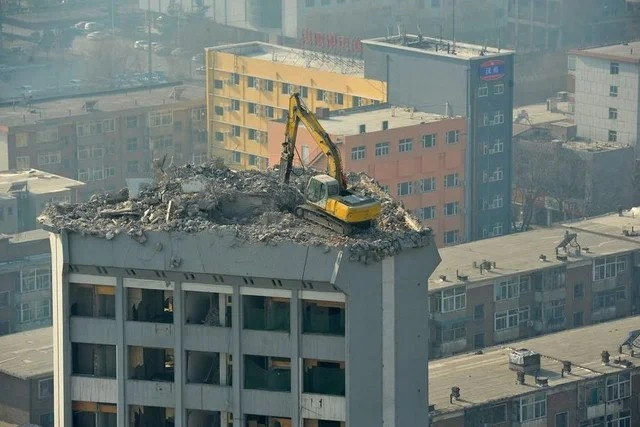
In this image, a yellow excavator is tearing up the rooftop of a building. For developers, that building represents a huge old application (a monolith), and the excavator is like the developer or tool trying to change it. The meme uses this scene as a metaphor for refactoring a massive legacy system while it's still running.
Let's break down the terms:
- Legacy monolith: This means an old, large application where all the parts of the system are tangled together in one big codebase or program. It's "legacy" because it was built a long time ago (in tech years) and has been patched and extended over many years. Over time, it can turn into a fragile tower of code. Everyone is a bit afraid to touch it because there's no telling which part of the code holds up which feature – just like an old building where you're not sure which wall is supporting the roof.
- Refactoring: Refactoring is like renovating a house. You improve the code's structure and clean things up without changing what the software actually does for users. The idea is to make the code cleaner and easier to work on (fixing cracks in the walls, updating the wiring), while the "house" — the software's features — looks the same from the outside. When done right, the software should behave exactly as it did before, just with better code under the hood. Usually, developers refactor small pieces at a time and test as they go, especially for a big system.
- Technical debt: This term describes what happens when developers take shortcuts in code — those shortcuts make it faster to build something now, but create more work for later. It's called debt because, like a loan, you "borrow" time by not doing things properly, and you "pay it back" with interest when you have to fix things up later. In our building analogy, technical debt is like using cheap materials or skipping maintenance. Eventually, those shortcuts catch up to you, and the building (or code) starts falling apart unless you do serious repairs.
- Production environment: This is the real, live system that users are currently using. In software, we usually have development or testing environments to experiment on safely. Production is like the actual open-to-the-public building. If you break something in production, real people immediately feel it. That's why we have the saying "Never test in production" — because testing or changing things on the live system is dangerous; one mistake can cause a real outage.
Now, what is this meme showing us? It's someone modifying a legacy system directly on production. In plainer terms, imagine a software company has a big old program that's crucial for their business (like a big online store or a bank system). It's full of outdated code (maybe written in an old language or style) but it's still running because the business depends on it. One day, something is so wrong or so outdated in that system that a developer has to fix it immediately. Ideally, they'd take the system offline or use a copy of it to redo that part — but sometimes there's no time, or they don't have a spare copy that works the same way. So what do they do? They log into the live server and start making changes right there on the running system. That's as scary as it sounds, and the excavator-on-roof picture illustrates it in a visceral way.
For a junior developer (or anyone new to this concept), a few key points:
- Avoid live changes: As a rule, you try not to do big changes on a live system. Instead, you set up a test server (like staging) that is a clone of production. You perform the refactor or fix there, verify everything, and then deploy those tested changes to production. This is like practicing the roof repair on a model building first.
- Small steps: If you must refactor, do it in small increments. Developers often break a big job into smaller pieces. For example, rather than rewriting an entire module in one go, they might refactor one function or one section at a time and deploy that. It's safer because if something goes wrong, you'll know exactly which change did it.
- Use safety mechanisms: Modern systems have things like feature flags (toggles to turn new code on/off quickly) or blue-green deployment (where you have two versions of the environment and switch users over to the new one gradually). These are like having scaffolding and nets when working on a building — they catch you if something falls. In our scenario, it seems they didn't have those, so the risk is very high.
- Have a rollback plan: This means always be ready to restore the old system or code if your changes don't work. It's like, if you're pulling blocks out of a tower, know how to put them back quickly if the tower starts wobbling too much. In software, this could mean backups, version control, or the ability to redeploy the last stable version quickly.
The reason this image is funny (and scary) even to less-experienced developers is because it shows a very extreme example of what not to do. It's obviously a metaphor — nobody literally uses an excavator on a running server — but it represents the feeling of desperation and risk when working on old systems. If you've ever been told not to push code changes on Friday evening or not to debug on the production server, this picture is the exaggerated scenario of why those warnings exist.
Think of a time you had a device or game that was acting up, and you had to fix it without turning it off because others were using it. It's stressful! This meme takes that idea to a grand scale: a whole building (system) being fixed live. In real IT terms, it's often better to schedule downtime or do a planned maintenance window for big refactors (like telling everyone "stay out of the building for a day while we fix the roof"). But when that's not possible, you get this kind of high-stakes improvisation.
So, the takeaway is: legacy systems can be very tough to maintain, and if you ignore problems for too long (refactoring needed but kept getting postponed), you might end up in a situation where an emergency fix in production is the only way out. It's a lesson in why regular maintenance and modernization are important. The humor makes it easier to remember: nobody wants to be that developer on the roof with an excavator, but we laugh because sometimes, in the craziest situations, that is us or our teammates trying to keep an old system alive against the odds.
Level 3: Cowboy Coding on the Roof
"Debugging on production server."
This meme perfectly captures a scenario that makes veteran engineers cringe and chuckle at the same time. It's the image of a lone dev (symbolized by that yellow excavator) performing major surgery on a legacy monolith of code while it's still running. Think of it as doing open-heart surgery with a jackhammer: the building (system) is still standing, and here we are tearing the roof off (rewriting critical code) in production, hoping the rest of the structure doesn’t collapse.
Why would anyone resort to such madness? The short answer: technical debt. Over the years, this monolithic application likely accumulated layer upon layer of quick fixes and messy hacks – like a building where extra floors were added without reinforcing the foundation. Eventually, things get so unstable that you have no choice but to rip out and replace parts of the structure. But doing that live, on a running system, is incredibly risky. Every seasoned dev looking at this knows it's the stuff of maintenance nightmares: a huge, brittle codebase where even a small tweak can trigger unpredictable side effects. You touch the wrong part, and the whole thing might come crashing down (just like hitting a load-bearing pillar by accident).
This scenario checks all the classic disaster boxes:
- No safety net: No proper staging environment or downtime window. They're making changes on the actual live server because there’s no time (or hardware) for a realistic test setup. Who needs a sandbox when you can break production, right?
- Unknown territory: A decade of legacy code that nobody fully understands. Half the original developers have moved on, documentation is sparse, and you’re basically digging through spaghetti code blindfolded.
- Urgent pressure: Likely a severe issue or production incident forced this refactor now. We don't wake up one day and say "let’s refactor in prod for fun." Usually it's "the system is on fire and only a drastic change will save it." This is a desperate attempt to pay back technical debt under duress.
- Single point of failure: A lone, brave (or cornered) developer with root access is up there. Management might have said, "Just a quick fix, we can't afford downtime", and now one person is frantically jackhammering away, hoping they don't bring the whole system down on themselves.
- House-of-cards architecture: The internal design is so entangled (some might say over-engineered) that everything depends on everything else. Removing one chunk of code is like pulling out a critical support beam. One wrong move and boom – the entire application could fall over.
At this level of experience, we also think about what should have happened instead of this rooftop demolition derby. Ideally, large refactors are done in small, controlled steps. There’s the famous Strangler Fig pattern for gradually modernizing a legacy system: you build new microservices or modules around the edges of the monolith and slowly siphon off functionality, strangling the old system gently. Clearly, that ship sailed here. Maybe the team never got the time or budget for a proper rewrite. So now we get the "wrecking ball approach" to modernization. Our intrepid excavator has basically said, "Forget careful pruning, let's just smash out a whole chunk and see what happens."
For example, instead of carving off one small service or module at a time, this scenario is like deleting or gutting a major component all at once. It's refactoring by brute force. Every senior engineer viewing this is thinking about all the hidden dependencies that might be tied to that component. It's the nightmare where a "simple refactor" cascades into a week of outages. If that top floor in the image corresponds to a core module in the app, ripping it out could break features on all the floors below. We've all seen how a change in one part of a legacy system mysteriously breaks something in a completely different part. That's when pager alerts start firing and you find yourself knee-deep in production debugging at 3 AM, scrambling to figure out why removing that "innocent" piece of code caused the login page (or some other critical feature) to crash.
A grizzled veteran might quip, "It worked fine until we tried to improve it." 😅 That dark joke comes from lived experience. We laugh at the absurdity because we've felt that adrenaline spike when a hotfix in production suddenly goes sideways. The meme is funny in a throat-tightening way: it takes the concept of a risky live refactor and makes it literal. For senior devs, it's a perfect visual metaphor for refactoring pain. You know the system desperately needs improvement (just like that crumbling roof needs removal), but doing it live is like playing Jenga with your whole company’s infrastructure. It’s both hilarious and horrifying. And you can bet that after surviving an episode like this, every engineer will insist on better testing environments and backup plans — because once you’ve operated an excavator on a production rooftop, you never want to be up there again.
Description
A striking photograph shows a yellow excavator perched precariously on the rubble-strewn roof of a multi-story building it is in the process of demolishing. The building's upper floors are partially destroyed, exposing its internal structure amidst a cityscape. This image, paired with the caption 'Debugging on production server,' serves as a powerful and hilarious metaphor for a notoriously risky practice in software development. It perfectly visualizes the act of making live, untested changes directly on a production system. The excavator represents the developer, who, in an attempt to fix a problem, ends up destroying the very environment they are working on, with no easy way to escape the consequences. For senior engineers, it's a deeply relatable image that evokes the anxiety and potential for catastrophic failure associated with such high-stakes, ill-advised 'hotfixes'
Comments
7Comment deleted
Ah, the classic 'rm -rf' approach to debugging. The bug can't persist if the server doesn't
“Sure, it’s an ‘incremental strangler migration’ - we just point traffic elsewhere while Dave’s lone excavator live-patches the monolith’s roof and hopes the error budget covers structural collapse.”
This is what it feels like when the CTO says 'just refactor the monolith piece by piece while keeping everything running in production' - except at least this excavator operator has a clear exit strategy
When the CTO finally approves your proposal to 'aggressively refactor' the 15-year-old monolith, but you realize there's no staging environment and the excavator is already on the roof of production. At least you're following the microservices pattern: one service at a time, starting from the top. The good news? No more technical debt. The bad news? Also no more technical credit, infrastructure, or that one critical API nobody documented but everyone depends on
Top-down refactoring: because nothing stabilizes a legacy monolith like excavating the penthouse before the pilings
Strangler Fig migration, management-approved: park an excavator on prod, peel off a floor per sprint, and trust that gravity is eventually consistent with our SLOs
The architectural equivalent of ALTER TABLE DROP COLUMN in prod - no replica, no canary, just an excavator and a prayer