Skip to content
DevMeme
1419 of 7435
Pronunciation Bugs in Technical Tutorials
Learning Post #1592, on May 16, 2020 in TG

Pronunciation Bugs in Technical Tutorials

Why is this Learning meme funny?

Level 1: Silly Sound Mix-Up

Imagine you have a friend from another country, and sometimes when they talk, the words sound a little different. Let’s say your friend is trying to say a special code word, like “H-T-T-P,” but because of the way they speak, you mistakenly hear something funny, like “shih-tee pee.” You both giggle because it sounded like a goofy or even a slightly naughty phrase, even though your friend wasn’t trying to say anything bad. This meme is just like that! It’s showing how a very normal thing (in this case, a computer term) can accidentally sound like a silly or gross word when spoken in a different accent. The humor comes from the surprise — it’s as if someone said a harmless word but we all heard a potty word by mistake. It’s a bit like when you play the telephone game and the message gets mixed up into something ridiculous. In the end, nobody is upset; we’re all laughing because sometimes our ears play tricks on us and even serious computer talk can turn into a funny misunderstanding.

Level 2: Acronyms and Accents

Let’s break down the meme in simpler terms. HTTP is short for HyperText Transfer Protocol, which is a fancy name for the set of rules that lets web browsers and web servers talk to each other. Whenever you visit a website or call a web service (an API), your computer is sending an HTTP request – basically saying “Hey server, can I have this information?” The server then answers with an HTTP response (like “Sure, here it is!” or an error code if something went wrong). In programming and WebDevelopment, we use the phrase “make an HTTP request” all the time. We usually pronounce HTTP by saying each letter: “H T T P request.”

Now, here’s where the humor kicks in. The meme shows a pretend conversation:

  • Everyone else says: “an HTTP request.”
  • Indian tutorial boi says: “a shitty pee request.”

It’s mocking the way a person with an Indian accent might pronounce “an HTTP request.” Because of their accent or how they speak English, the string of letters “H T T P” can come out sounding like the phrase “shitty pee.” This is a form of pronunciation humor – when something said in one accent accidentally sounds like totally different (often silly or off-color) words in another accent. In this case, “HTTP” (said quickly or with a certain accent) was heard as “shitty pee.” The content is meant to be a joke and is not seriously insulting anyone; it’s playing on a miscommunication that many people in the coding community find amusing and relatable. If you’ve ever watched a programming tutorial on YouTube by someone whose first language isn’t English, you might have experienced needing a moment to understand a word they said. Here, that moment is blown up into a joke: our ears hear a toilet humor phrase, even though our brain eventually figures out they meant the very technical “HTTP request.” It’s funny because “shitty pee” on its own is a crude, almost nonsensical phrase – something like a child might giggle at – and completely out of place in a serious coding lesson.

The phrase “Indian tutorial boi” refers to an Indian guy teaching programming in a tutorial video. The spelling boi (b-o-i) is internet slang; it’s a playful way to say “boy” or guy – often used humorously or affectionately in memes. So, the meme isn’t targeting a specific person, but a general stereotype that many coding tutorials are taught by Indian developers (there are indeed a lot of popular Indian tech educators online). When the meme says everyone calls it “an HTTP request” but the Indian tutorial guy calls it “a shitty pee request,” it exaggerates a bit for comic effect. Of course, not every Indian tutor mispronounces HTTP that way, but enough people have heard something similar that it resonates. It’s relatable humor: plenty of newcomers have stories like, “I was following along a demo and I thought the instructor said something bizarre, then I realized oh – he meant HTTP!”

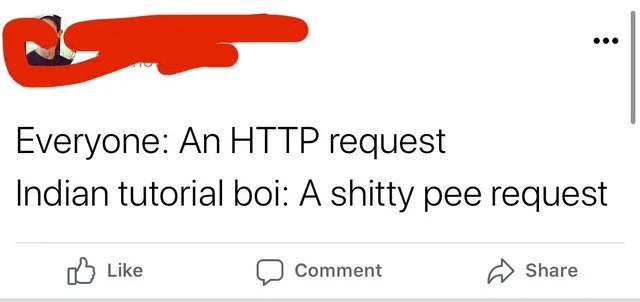
Let’s also notice how the meme is presented. It’s actually a screenshot of a Facebook post. You can tell by the layout: the text is at the top, and at the bottom of the image you see the grey icons for Like, Comment, and Share (just like you’d see under any Facebook status update). They even scribbled out the poster’s name and profile picture in red, which is commonly done to keep the person anonymous when a post is shared publicly. This style is common for sharing jokes in developer groups or social media pages – someone writes a funny one-liner about coding, and it gets screenshot and passed around as a meme. The post format makes it feel like a genuine observation from a real person’s feed, which can make it even funnier (#KeepingItReal). It’s basically the meme saying: “Look, someone just had to say this out loud – and we all relate.”

From a learning perspective (especially if you’re a junior developer or just starting out), this meme is also a tiny lesson in communication. The programming world is global. You might read documentation written by a German, watch a coding tutorial by an Indian, then debug code with answers from a Brazilian on Stack Overflow – all in one afternoon! Not everyone speaks English in the same way, and that’s okay. Sometimes you’ll encounter an unfamiliar accent and momentarily misunderstand a term. The first time you hear HTTP pronounced oddly, you might scratch your head, maybe even chuckle when you realize what you thought you heard. The meme exaggerates this experience for comedy. It turns an innocent misunderstanding into a punchline. Pronunciation_humor like this is popular because it’s a way to laugh at the small bumps on the road of learning. After all, whether we say H-T-T-P very clearly or end up making it sound like “Hitti-P”, we’re all trying to talk about the same thing – those all-important web requests that make the internet work! And as long as the code is right (you write HTTP in your program where it’s needed), it doesn’t matter how your accent delivers it in conversation. In fact, sharing these little quirks helps the developer community bond and reminds us that we all come from different backgrounds but share the same concepts.

So the next time you hear someone pronounce a tech term differently – maybe someone says “SQL” like “sequel” or calls an API “A-P-I” in a unique rhythm – you’ll remember this meme and realize lots of us have had that “Wait, what did he say?” moment. It’s normal and even funny! In short, this meme takes a simple technical phrase (“HTTP request”) and shows how a non-native accent can turn it into a goofy sounding line (“shitty pee request”), making developers everywhere laugh and nod knowingly. It teaches us about the importance of clarity in communication, but does so with a wink and a nudge. After all, humor is one API call we can all understand.

Level 3: Protocol Pronunciation Predicaments

Everyone: An HTTP request
Indian tutorial boi: A shitty pee request

Welcome to the world of developer humor where even the most mundane technical terms can turn into punchlines. Here, our star is HTTP, which stands for HyperText Transfer Protocol – the fundamental web protocol that your browser, apps, and APIs use to communicate. In everyday WebDev and API work, making an “HTTP request” is as common as typing google.com into your browser or fetching data from a REST API. It’s a serious tech staple. Yet this meme hilariously warps it through the lens of cross-cultural communication: due to a strong accent, "HTTP request" is misheard as "a shitty pee request". Yes, you read that right – a core piece of web lingo suddenly sounds like bathroom humor! It’s a classic case of lost in pronunciation, where an innocent acronym turns into a cheeky phrase that would make any engineer do a double-take.

Why is this so side-splitting for developers? Because it captures a relatable scenario in global DevCommunities. Many of us have learned coding from online tutorials, YouTube videos, or courses where the instructor might hail from halfway across the world. The meme specifically says “Indian tutorial boi,” poking lighthearted fun at the way some Indian instructors pronounce certain terms. The slang boi (with an i) signals a joking, friendly tone – as if we’re affectionately teasing that one tutor we all know. It’s not mean-spirited; it’s more like an inside joke among coders. After all, accent_in_tutorials is a known phenomenon: the content is golden, but sometimes the pronunciation_humor steals the show. Here, the teacher clearly knows what an HTTP request is – they’re teaching it! – but the way they say “H-T-T-P” out loud morphs into a phrase that sounds like “shitty pee.” Phonetically, the soft “H” sound and rapid letters might blur together in certain accents, producing that comical result. To a room of developers, that mispronunciation is instantly recognizable and relatable_humor. It’s the kind of joke you laugh at because you’ve been there – straining to understand a thick accent in a video, until suddenly you realize “Oh, they meant HTTP, not… uh… that.”

On a deeper level, this meme highlights the quirks of tech’s lingua franca. English is the de facto language of programming, but not everyone enunciates these abbreviations the same way. HTTP is actually an initialism (each letter pronounced individually) rather than a true acronym (like “NASA” or “JSON” which we speak as a word). We all say “H-T-T-P.” However, when someone from a different linguistic background says those letters, subtle differences in emphasis and syllable insertion can create what sounds like entirely new words. Think of it as the API of language getting a parameter in an unexpected format. The result here is pure DeveloperHumor: a mashup of serious tech terminology and a bit of potty-sounding gibberish. It’s funny because it’s a benign misunderstanding — nothing is actually broken (the code still runs, the HTTP request still works!), but our ears kind of threw a 400 Bad Request. In other words, the http_request_mispronunciation doesn’t stop the server, but it might stop the meeting for a moment of laughter.

The presentation of the meme as a screenshot of a Facebook post (complete with the familiar Like, Comment, Share icons and a red-scribbled name for anonymity) adds another layer of developer culture. This format says: “someone in the community posted a one-liner so good, we had to screenshot and share it.” It’s how modern inside-jokes propagate in coding circles. The content itself – “Everyone: [normal phrase]; Indian tutorial guy: [funny mispronunciation]” – is a common meme template to contrast the ordinary with the quirky. Seasoned engineers have seen variations of this joke format across many topics (it’s basically the dev humor equivalent of a setup and punchline). The fact that HTTP – the cornerstone of web communication – is the subject of the joke makes it extra amusing. It’s like making a joke about gravity in a room full of physicists: it’s so fundamental that any twist on it becomes instantly recognizable comedy. Long-time coders chuckle not just at the phonetics, but at the shared memory of trying to learn something new from an accented tutorial. Perhaps they recall hearing “eloop” instead of “loop” or “JavaScript” pronounced in a unique cadence. These memories bond us – realizing that despite different accents or mother tongues, we’ve all ended up debugging the same for-loop problems and laughing at the same silly miscommunications.

In essence, this meme underscores a warm truth in tech: our community is truly global. We come from everywhere, and sometimes that means an HTTP might sound like a “shitty pee”. Instead of that being a problem, it becomes a point of TechHumor and camaraderie. The next time you’re on a late-night conference call and someone’s pronunciation throws you off, you might just remember this joke and smile. Because if there’s one thing decades of programming has taught even the most cynical coders, it’s that a little laughter (and maybe a slower repetition of the phrase) helps to bridge any communication gap. Everyone eventually gets on the same page – or in this case, the same webpage – even if we pronounce the protocols a bit differently along the way.

Description

A screenshot of a social media post, likely from Facebook, where the user's name and profile picture have been redacted with a red scribble. The post presents a two-line joke based on stereotypes. The text reads: 'Everyone: An HTTP request' followed by 'Indian tutorial boi: A shitty pee request'. The humor, which may be considered offensive, stems from mocking the perceived pronunciation of 'HTTP' in some Indian accents. This is a common trope in online developer culture, referencing the vast number of programming tutorials created by Indian educators on platforms like YouTube. For developers, it's a recognizable, albeit low-brow, joke about the global and diverse nature of the online learning ecosystem

Comments

7
Anonymous ★ Top Pick This is precisely why we have RFCs. If protocol specifications were transmitted verbally, half the internet would be responding with '400 Bad Pronunciation'
  1. Anonymous ★ Top Pick

    This is precisely why we have RFCs. If protocol specifications were transmitted verbally, half the internet would be responding with '400 Bad Pronunciation'

  2. Anonymous

    If you think it’s pronounced “shitty-pee,” you should see what it sounds like after tunneling our COBOL payroll service through three Kong gateways and a flaky HTTP/3 upgrade - the P is the least of our problems

  3. Anonymous

    The real pronunciation challenge is explaining to your PM why the "shitty pee request" to the legacy monolith takes 3 seconds while the properly articulated HTTP/2 multiplexed request to your new microservice still somehow takes 4

  4. Anonymous

    This perfectly captures the experience of searching 'how to make HTTP request' at 2 AM and landing on an auto-generated tutorial that somehow has 500K views but explains REST as 'taking a nap between API calls.' The real tragedy is when you realize the bot's explanation of POST vs PUT is still more coherent than your team's API documentation

  5. Anonymous

    I pronounce HTTP as “Hope The Timeouts Tolerate Proxies” - because every “simple request” is actually a negotiation with three caches, two L7 balancers, and an overzealous retry

  6. Anonymous

    Indian tutorial boi APIs: Where 'HTTP request' hits endpoint /shity-pee and returns 418 'I'm a teapot... requestest'

  7. Anonymous

    Call it H‑T‑T‑P or “hattie‑pee” - just don’t retry a non‑idempotent POST, or finance will hear it as “double charge” with perfect clarity

Use J and K for navigation