Skip to content
DevMeme
1555 of 7435
The Evolution of Hacking: From Pioneers to Script Kiddies
Security Post #1736, on Jun 23, 2020 in TG

The Evolution of Hacking: From Pioneers to Script Kiddies

Why is this Security meme funny?

Level 1: Old Hacker vs New Hacker (Simple Analogy)

Imagine two chefs in a kitchen. One chef (like the 1990 hacker) is old-school and can cook a complicated dish from scratch. He grows his own veggies, mixes his own spices, and bakes fresh bread – the whole works. He’s so strong in his skills that he can create a new recipe on the fly and make an amazing meal. Now, the other chef (like the 2020 hacker) is more like someone who only knows how to heat up frozen dinners in the microwave. He has a fancy microwave and some pre-packaged meals, and as long as he has those, he’s okay. But one day, he looks in the freezer and – oh no – there’s no pre-made meal for what he wants to eat! This second chef has no idea how to cook it from raw ingredients because he always relied on ready-made stuff. So he basically says, “I can’t cook dinner because there’s no microwave meal for it.”

This is exactly the joke of the meme: the first hacker is like the skilled chef who can make anything (he even “baked” the Morris Worm, a famous “dish” in hacking, all by himself). The second hacker is like the guy who needs a pre-made solution (a Metasploit module, which is like a frozen dinner for hacking). If it’s not available, he’s stuck and goes hungry (or in this case, he can’t hack). It’s funny because you’d expect someone calling themselves a “hacker” to be clever and self-sufficient, but here the modern hacker is portrayed as a bit helpless without his convenience tools. The meme makes us laugh by showing the old hacker as a super-strong Doge who DIYs everything, versus the modern hacker as a silly Cheems dog with a clown wig who can’t do anything original. It’s like saying, “Grandpa could build a car from spare parts, and you can’t even fix a flat tire without Googling it.” The humor comes from that stark, exaggerated contrast.

Level 2: Hacks Then & Now

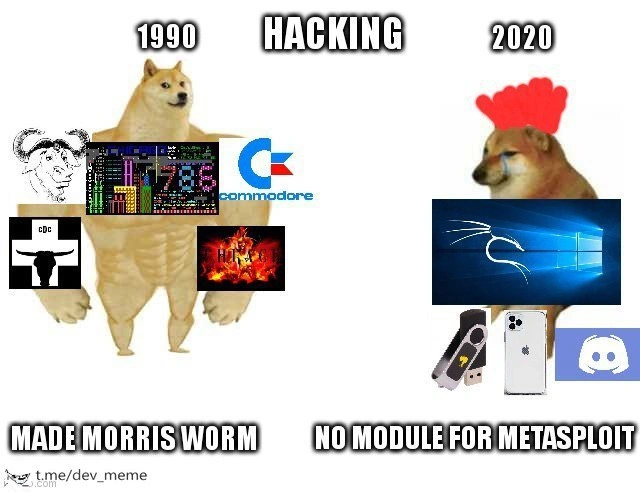
Let’s break down what’s happening in this meme in simpler terms. The meme is comparing hacking in 1990 to hacking in 2020 using the popular Swole Doge (strong dog) vs Cheems (weaker dog) format. Essentially, it’s saying: “Hackers back in the day were super tough and skilled, but hackers now are kind of weak and just rely on tools.” The big dog on the left represents an old-school hacker from around 1990, and the small dog on the right represents a modern hacker in 2020 who is not very capable without help.

On the 1990 side (left), we have the muscular Doge with the label “MADE MORRIS WORM.” This refers to the Morris Worm, which was one of the first computer worms (a type of malware that spreads by itself) to ever go on the Internet. In 1988, a student actually wrote this worm program from scratch and it ended up infecting a lot of computers (it caused a major outage on the early internet). The meme implies that the 1990 hacker is so strong and cool because he created this entire hacking program by himself. Surrounding the 1990 Doge are a bunch of icons:

  • GNU logo (the head of a wildebeest): GNU is an old project that provided free versions of Unix software tools. It symbolizes the early hacker era when people used command-line tools and shared software freely. Hackers in that era often used GNU compilers and utilities to build their own programs. It’s basically a nod to the open-source, do-it-yourself mindset of that time.
  • Colorful ASCII/terminal screen: This looks like a screenshot of an ASCII art or a terminal game. Back then, most computing was text-based (no fancy graphics), and hackers often dealt with text interfaces. This image represents the “old-school” look and feel of 80s/90s computing — green/colored text on black screens, simple graphics, etc. It’s the environment our 1990 hacker operated in.
  • Commodore 64 logo: The Commodore 64 was a very popular home computer in the 1980s. Many early hackers started learning to program on machines like the C64. Including this logo suggests that the hacker on the left grew up with these early computers and learned to code on them. It gives a very retro vibe — reminding us that computing power was much more limited, and you had to be clever to make things work.
  • cDc “Cult of the Dead Cow” logo: Cult of the Dead Cow is a famous hacker group that started in the 80s. They published hacking tools and text files teaching people how to hack (and they’re known in hacker history for coining the term “hacktivism”). By putting the cDc logo in the meme, it’s referencing the whole 90s hacker scene — small groups of experts sharing exploits on bulletin boards or at early hacker conferences (like DEF CON, which started in 1993). It’s an icon of hacker culture back then.
  • Pixelated flame graphic: A flame often symbolizes something destructive or chaotic. This could represent the chaos caused by early malware/viruses (like how the Morris Worm “burned” through the internet causing damage). It’s basically flair to say “this old hacker caused a big fire on the internet.” In general meme imagery, fire = havoc, which fits the idea that the Morris Worm wreaked havoc.

The text under the left dog says “MADE MORRIS WORM” in bold caps. This is like a proud statement: the 1990 hacker built an original cyber weapon (the Morris Worm). The tone is boastful — it’s the ultimate achievement for a hacker, especially back then.

Now, the 2020 side (right) shows Cheems, the smaller doge, wearing a red clown wig. Already, the clown wig is there to make him look foolish. Around him are modern hacking-related icons:

  • Kali Linux + Windows 10 background: The image looks like the Kali Linux dragon logo in front of a Windows 10 wallpaper. Kali Linux is a special Linux distribution used by penetration testers and hackers; it comes with lots of hacking tools pre-installed. The presence of Windows 10 suggests that this person might just be using Windows with some Kali tools, or they slapped a hacker-looking wallpaper on Windows. It’s hinting that the 2020 hacker might be all about appearances (running Kali, the “hacker OS,” but maybe not in a truly hardcore way, since Windows is still underneath). Essentially, they have the tools, but maybe not the skill.
  • USB Rubber Ducky: This is a gadget that looks like a normal USB flash drive, but when you plug it into a computer, it acts like a keyboard that automatically types commands really fast. Hackers use it to quickly run scripts on someone’s computer (for example, if you get a few seconds on an unlocked PC, you plug this in and it can install malware or create a backdoor in seconds). It’s a relatively recent hacking tool (made popular in the 2010s) that you can just buy. So our 2020 hacker has cool toys like this at his disposal.
  • Flipper Zero: That’s a newer multi-purpose hacking gadget. It can scan and emulate radio frequencies, NFC cards (like badges or credit cards), infrared signals (like TV remotes), etc. It’s like a little hacker Swiss Army knife with a cute Tamagotchi-like interface. Including it suggests the 2020 guy invested in the latest gear. But again, owning a Flipper doesn’t automatically make you a master hacker — you still have to know how to use it effectively.
  • iPhone (smartphone): The smartphone indicates that the modern hacker has a powerful computer in their pocket, possibly using it for some hacking tasks or at least as part of their tech arsenal. It also contrasts with 1990 when cellphones were rare and certainly not used for hacking. Now you can run some hacking apps on a phone or use the phone to control devices, etc. It underscores how much tech is readily available to the new generation.
  • Discord logo: Discord is a chat/voice application that’s very popular with gaming and tech communities (like Slack but more casual). There are many Discord servers dedicated to hacking, where people share tips, tools, or ask questions. Seeing the Discord icon implies that this 2020 hacker probably learns and socializes through Discord communities. It’s a hint at meme culture and hacker culture today – knowledge is often gained by asking others in these chat groups, rather than discovering it alone. It might also imply this person is complaining on Discord about their hacking woes. In contrast, 30 years ago, a hacker might have read text files or books to learn, whereas now they might just hop on Discord or Reddit for answers.

Finally, the text under Cheems says “NO MODULE FOR METASPLOIT.” Metasploit is a famous framework (program) that has a bunch of pre-made exploits (called modules) for known vulnerabilities. Think of it as a collection of break-in techniques that you can use without having to write them yourself. If you want to hack something and you know it has a certain weakness, you can see if Metasploit already has a module to exploit that weakness. The meme suggests that the 2020 hacker ran into a problem: they want to hack some target, but when they check Metasploit, there is no module available for that particular vulnerability or system. In other words, there’s no ready-made script for it. So the hacker is basically stuck and whining: “Oh no, I can’t hack this because Metasploit doesn’t already have the solution for me.” This is portrayed as pretty pathetic compared to the 1990 hacker who would just write a new exploit if one didn’t exist. It’s essentially calling the 2020 guy a script kiddie (someone who doesn’t write their own hacks, only uses tools others made).

To put it simply, the left side is an original hacker who innovates, and the right side is a copy-paste hacker who hits a wall without copy-paste options. It’s a humorous jab at how the hacking scene has changed. In 1990, very few people had the skill to pull off something like creating a worm; it was cutting-edge and those who did it were the pioneers of CyberSecurity (even if what they did was illegal or disruptive, it forced improvements in security). In 2020, lots more people are “hackers” but many are just using automated tools. So the meme is saying the overall skill level (or at least the self-reliance) of hackers has dropped for a certain crowd.

For someone new to tech, imagine it like this:

  • In 1990, if a hacker wanted to break into a computer system, they might have to write their own program to do it – really understand the computer’s weaknesses and code something tailor-made.
  • In 2020, a hacker might just download a program or use an app that’s designed to break into systems. If that app doesn’t have the feature they need, they’re stuck because they don’t know how to make it themselves.

The meme is funny to programmers and security people because it exaggerates a real trend. It’s both a tech history lesson and a joke: the “buff” old hacker built a famous piece of malware from nothing, while the “wimpy” new hacker can’t proceed without a pre-existing cheat code. It resonates with anyone who’s seen how tools like Metasploit are double-edged — great for productivity, but also a crutch for those who rely on them too much.

Level 3: 0x90 vs 404

For seasoned security folks, this meme hits a nerve. It contrasts the old-school hacker who wrote exploits from raw bytes (the kind who knew their assembly opcodes by heart) with the new-school “hacker” who mostly runs other people’s code and panics when their one-click tool doesn’t have what they need. The title “HACKING” across the top sets the theme: it’s about how hacking techniques have changed from 1990 to 2020. The left panel (1990) is the muscular Swole Doge labeled “MADE MORRIS WORMS” – a nod to the fact that back in the day, creating something like the Morris Worm was considered an ultimate hack, and it required serious skills. In 1988, the Morris Worm was basically zero-day malware with no precedent. Imagine sitting at a terminal with a black screen and green text, figuring out how to make a program replicate itself across networked computers that barely even have security policies. The creators and peers of that era had to be part programmer, part engineer, part hacker – truly self-sufficient. They often found vulnerabilities by reading source code or binaries manually, and exploited them by writing custom code. There was no GitHub full of proofs-of-concept, no YouTube tutorials spoon-feeding “how to hack X”. You learned from dense technical publications (like the legendary “Phrack” magazine or Cult of the Dead Cow text files) and by trial-and-error. The left side images in the meme are essentially a brag collage for that era:

  • The GNU logo: hints at the free Unix tools (compilers, debuggers) and the open-source ethos. Many early hackers were also contributors or users of GNU software; plus it evokes the time when you often had to compile tools from source.
  • The ASCII art screen: a stand-in for the look of old terminals and maybe the BBS/ANSI art scene. It’s reminding us that UIs were text, and hackers spent time in text-only interfaces (no flashy GUIs, just text adventures, bulletin boards, and command prompts).
  • The Commodore 64 logo: represents early personal computing where many hackers started (writing BASIC or assembly on machines with 64KB of RAM!). It’s a symbol of TechHistory: the 80s/90s hacker might have started hacking hardware and games on a C64 or similar, which built the mindset of “tinker with the guts of the system”.
  • The Cult of the Dead Cow logo: cDc is famous in hacker lore — a group that mixed hacking and counter-culture. By showing it, the meme evokes the golden age of hacker groups sharing exploits and tools on BBS boards. cDc members wrote some of the first widely-used hacking tools (like “Back Orifice” in ’98 which let you remote-control a Windows PC — hugely “elite” at the time). It’s effectively saying: “1990 hacker was likely involved with or at least inspired by these OG groups.”
  • The flame graphic: likely just representing the chaos and impact of old hacks (the Morris Worm did set the internet on fire, figuratively). It could also hint at the flashy payloads some early viruses carried (some would display graphics or cause screens to blink, etc., though Morris Worm itself was not visible except for its network impact).

All together, the left side screams: “This was the era of self-made cyber mischief.” No ready-made exploit tools — you had to build the bomb before you could set it off. The phrase “MADE MORRIS WORM” is almost boastful: that buff Doge created something original and potent.

Now, compare that to the right panel (2020) where things have almost flipped. We have a less-impressive Cheems dog (slouching, smaller) wearing a clown wig. Right away, the clown wig is a mockery — it implies the modern hacker depicted is a bit of a clown, not to be taken seriously. The caption under Cheems, “NO MODULE FOR METASPLOIT,” is written as if it’s the character’s complaint. This is a joke about Metasploit, which is a real and widely-used penetration testing framework. Metasploit is basically a menu of exploits: search for a known vulnerability, load the module, maybe set a couple options, and launch it. It’s very powerful for professionals, but it’s also the crutch of many amateurs because it does the hard work for you. By saying “no module for Metasploit,” the meme suggests our 2020 Cheems only knows how to hack by selecting pre-made modules. If the exact exploit isn’t already available in his tool, he’s stuck, confused — hence the script_kiddie_joke. A “script kiddie” is a derogatory term in hacker culture for someone who doesn’t really understand the complexities but can run scripts or tools written by others (basically, a kiddie with someone else’s script). It’s the opposite of the self-reliant 1990 hacker.

The icons floating around Cheems illustrate what a 2020 script kiddie might have at their disposal:

  • Kali Linux wallpaper over Windows 10: This is hinting at a common newbie setup. Kali Linux is the go-to operating system for learning hacking (it has tools like Metasploit, Nmap, Aircrack, etc. pre-installed). Sometimes newbies run Kali in a virtual machine on Windows or dual-boot their system. The meme humorously shows the Kali dragon logo slapped onto the Windows 10 wallpaper, implying maybe this person is running Kali in WSL (Windows Subsystem for Linux) or just superficially loves the hacker aesthetic. It’s a bit of a poser vibe: “I’ve got Kali, I’m a hacker now!” – but underneath they’re still on Windows clicking around.
  • USB Rubber Ducky: A pen-testing gadget that looks like a USB thumb drive but acts like a keyboard that can type super fast. It’s used to inject pre-written attack scripts (like opening a terminal and downloading malware on a locked PC). It became famous on YouTube and hacking demos – script kiddies love it because it feels like a James Bond tool. Showing it here suggests the 2020 hacker buys cool toys, perhaps thinking gadgets alone make the hacker.
  • Flipper Zero: Another show-off gadget. Released around 2020, it’s a multifunctional hacking toy that can read/cloning RFID badges (door entry cards), emulate NFC (like credit cards or metro passes), broadcast infrared, capture some wireless signals – all with an easy interface. Real security researchers use it for quick tests, but a lot of people bought it as a trendy hack toy. Including it in the meme is saying, “Look, this guy has all the new shiny tools.”
  • iPhone: Possibly indicating the person’s modern tech – maybe they try app hacking or they just have the latest phone to fit the image. It could also subtly mock how today everyone has powerful tech in their pocket (an iPhone today is thousands of times more powerful than a Commodore 64 or even the VAX machines the Morris Worm hit), yet despite this power, our Cheems hacker isn’t doing anything original.
  • Discord logo: This points to where modern hackers (especially younger ones) hang out. In 1990, hackers might be on private BBSes or early IRC channels swapping techniques. In 2020, it’s Discord servers and online forums. Discord has many channels dedicated to hacking, where often you find people asking basic questions or trading exploits. By showing Discord, the meme implies this Cheems probably learned whatever he knows from online communities and probably goes there to beg for help when his tools don’t work. It’s also a bit of a jab: instead of deeply understanding systems, he’s socially dependent – when stuck he might just say “hey anyone have a Metasploit module for XYZ?”

Together, these elements paint the 2020 hacker as someone with high-level tools but low-level skills. The humor comes from how absurd the contrast is: the big Doge literally authored a worm that changed cybersecurity history, while Cheems can’t even proceed with a hack because he can’t find a pre-written module. It’s a HackerCulture in-joke. Anyone who’s spent time in security forums has seen a question from a newbie like, “How do I hack X? I tried Metasploit and there’s no module 😭.” More experienced folks usually respond with some mix of scorn and advice like, “Well, guess you might have to write your own exploit or try something manual,” which is the modern way of saying “kid, time to actually learn to code”.

The meme hits on that generational divide too. The TechHistory aspect is strong – 30 years is a long time in tech. Veterans who remember or studied the Morris Worm era have a bit of nostalgia and pride: those were the days of “real hackers”. Meanwhile, they see some (not all, but the stereotype) of today’s beginners as overly reliant on frameworks. It’s not that Metasploit or Kali are bad — they’re amazing tools — but the joke implies that ease-of-use has bred a kind of laziness. It’s the difference between understanding a recipe versus just following one. The meme exaggerates it for effect: obviously not every 2020 hacker is clueless if a module is missing, but it’s funny because this scenario does happen. The Cheems is even wearing a clown wig, a universal meme sign of foolishness — meaning the community might quietly snicker at someone who can’t hack outside of Metasploit’s menu.

This resonates with senior engineers and researchers who have encountered “push-button pentesters.” It’s like an experienced carpenter seeing a newbie with a fancy power tool who still can’t drive a nail straight. There’s a mix of amusement and mild annoyance. The older generation often tells war stories: how they manually exploited a buffer overflow or crafted a phishing scheme before kits were available. To them, the idea of giving up because “there’s no tool” is laughable — you make your own tool! Thus the Swole Doge’s bragging tone “made Morris Worm” is the ultimate flex: not just using a hack, creating one that became legendary.

One can almost imagine the internal monologue:

  • 1990 hacker (Swole Doge): “No one’s written a worm for this? No problem, I’ll write one myself in C tonight.”
  • 2020 hacker (Cheems): “Wait, Metasploit doesn’t have this exploit as a module? Guess I can’t hack it… Does anyone on Discord have a script for this? Also, check out my cool Flipper gadget that I don’t actually know how to fully utilize.”

The meme uses the popular swole Doge vs Cheems format, which itself is a bit of MemeCulture commentary format. Typically, Swole Doge represents the old, super-capable version of something, and Cheems represents the modern weaker or sillier version. Here it’s applied to hacking. This format is instantly recognizable to online audiences, which adds an extra layer of humor: viewers know the template and are primed to fill in the blanks with their own experience (“Yep, old-school hacking was hardcore; modern skriddies are kinda laughable.”).

To sum up the senior perspective: This meme is funny because it’s painfully true in many cases. Those of us in cybersecurity have seen both ends of this spectrum. We admire the ingenuity of early hackers – the HackerCulture legends who wrote viruses in assembly on systems with minimal resources. And we chuckle at the newcomer who thinks hacking is just running exploit.py someone else wrote. It’s a mix of TechHistory lesson and insider humor. The punchline (“NO MODULE FOR METASPLOIT”) encapsulates an entire attitude in five words. It’s the modern equivalent of a kid saying “I can’t do my homework because I couldn’t find the answer key online.” Meanwhile, the Morris Worm reference is like mentioning an exam the teacher had to create from scratch because no textbook existed.

In real penetration testing or security research, of course, the best folks today are as creative as the old ones — they have to be, because modern systems have many more protections (like ASLR, non-executable memory, etc., which didn’t exist in 1990, meaning ironically you often do need sophisticated tools now to bypass defenses). But the meme isn’t really about those top-tier pros; it’s poking fun at the lower end of the skill spectrum. It exaggerates for comedic effect: making it seem like all 2020 hackers are clownish tool-dependents (which seasoned readers know isn’t 100% true, but it’s relatable because we’ve all met at least one person like that).

It’s worth noting the underlying message: tools vs knowledge. The best scenario is tools and knowledge together. But here we see a dichotomy: DIY hacking versus plug-and-play hacking. The meme clearly sides with the DIY ethos as the “swole” or superior one. It’s basically a nerdy “back in my day, we did it the hard way (and it was better)” joke. And the reason it elicits a grin is because it captures a real cultural shift in cybersecurity.

To illustrate the contrast in code-style humor:

# 1990 hacker approach:
if not public_exploit_available(target):
    exploit_code = write_exploit_in_C(target_vuln)
    run(exploit_code)
    print("System owned with handcrafted exploit!")
else:
    # actually, in 1990 public exploits were rare, so this else might never run
    pass

# 2020 script kiddie approach:
if not metasploit.has_module(target_vuln):
    print("[-] No module found for this exploit. Hacking impossible!")
    complain_on_discord("Module for {} not found, halp!".format(target_vuln))
else:
    metasploit.run_module(target_vuln)

(The snippet above humorously contrasts the self-reliant 1990 mentality with the dependent 2020 mentality.)

In summary, the senior perspective sees this meme as a witty nod to tech history and a playful jab at newcomers who haven’t put in the sweat equity. It’s a reminder that hacking isn’t about the tools you have, but the knowledge and creativity behind how you use them. The Morris Worm vs Metasploit module comparison perfectly encapsulates that: one side had nothing but knowledge and created a cyber weapon, the other has every weapon handed to them yet is powerless without instructions. It’s funny because it’s true — at least, true enough to make any seasoned security engineer smirk.

Level 4: Shellcode Alchemy

In the late 80s and early 90s, hacking meant diving deep into machine code and OS internals — a kind of arcane engineering. The left side’s 1990 super-buff Doge (the “Swole Doge”) represents an era when exploits were hand-crafted from scratch. Back then, if you wanted to create malware or break into a system, you had to understand how things worked at a fundamental level. For example, the infamous Morris Worm (referenced by “MADE MORRIS WORM”) was one of the first internet worms unleashed in 1988. Its creator, a grad student named Robert Tappan Morris, wrote it in C targeting Unix systems. To make it propagate, he exploited low-level vulnerabilities: a buffer overflow in the fingerd network service and a debug backdoor in the sendmail program. Buffer overflows occur when a program writes more data into a memory buffer than it can hold, so extra data overwrites adjacent memory (often the function’s return address on the call stack). This allows crafty code (called shellcode) to slip into memory and execute unauthorized actions. Writing an exploit for a buffer overflow back then meant carefully crafting malicious input — often in assembly — to inject code (e.g. a routine that spawns a shell) into a running program. The Morris Worm’s shellcode had to be compact and tailored to different CPU architectures (VAX and Sun 3, in that case). This was shellcode alchemy: turning obscure byte sequences into a self-spreading network spell. It was so effective that the worm accidentally bogged down a chunk of the early Internet (about 10% of ARPANET) in a matter of days. It also spurred the creation of the first CERT (Computer Emergency Response Team) because nobody had seen an attack like that before. In short, old-school hackers dealt directly with pointers, syscalls, and protocols — HackingTechniques at the metal level. If a tool they needed didn’t exist, they wrote it themselves in C or assembler. The meme’s left side images drive this point home: the GNU logo hints at the free software tools and compilers (GNU GCC, etc.) that early hackers used; the Commodore 64 logo nods to the TechHistory of tinkering on early personal computers (many 80s hackers cut their teeth with such machines); a colorful ASCII terminal screen evokes the text-based interfaces and BBS systems of the time (maybe a roguelike game or an ANSI art MemeCulture of underground boards); the black-and-white bull logo of Cult of the Dead Cow (cDc) represents one of the oldest hacker collectives (founded 1984) famous for publishing exploits and hacker zines (they released the “Back Orifice” trojan in 1998, another hand-crafted hack); and that pixelated flame graphic? – a classic symbol of mayhem, possibly alluding to early viruses or the “🔥 chaos” unleashed by these pioneering exploits. It’s a collage of HackerCulture from an era when pushing a system to its limits took original research and Malware often meant a custom virus passed around on a floppy disk or via slow networks.

Fast-forward to the right side, labeled 2020, with Cheems (the weaker doge) in a red clown wig. This represents the modern “script kiddie” scenario. Today’s would-be hacker has an arsenal of advanced tools that early hackers could only dream about. There’s a Kali Linux wallpaper plastered over a Windows 10 background, suggesting our 2020 hacker is perhaps running a Kali Linux virtual machine or the Windows Subsystem for Linux with Kali – a popular setup for beginners following YouTube tutorials. Kali Linux is a security-focused Linux distribution pre-loaded with hundreds of exploit tools, from port scanners to password crackers. It’s basically an instant hacker toolkit. The presence of the Windows 10 logo behind it hints that despite using fancy tools, this person might not have fully switched to a “real” Linux environment – they’re relying on a convenient layer (which already says something about skill level, as hardcore folks in the 90s were the ones writing OS code, not juggling UIs). Next, we see gadget icons: a USB Rubber Ducky and a Flipper Zero. These are modern hacking hardware anyone can buy. The Rubber Ducky is a USB stick that acts like a keyboard: plug it in and it automatically injects keystrokes at lightning speed — useful for automating exploits like typing out a malicious script on someone’s locked computer (to a 1990 hacker, this would feel like spy gear out of a movie!). The Flipper Zero, a more recent gadget, is like a Swiss-army knife for hackers: it can emulate RFID badges, NFC cards, TV remotes, Bluetooth signals, you name it — all with a cute dolphin-themed interface. Owning these devices signals “I’m into hacking” in 2020, but crucially, owning tools isn’t the same as mastering tools. The silver iPhone icon suggests our modern hacker is also armed with a smartphone – maybe to run scripts, control smart devices, or simply to watch hacking tutorials and chat. And speaking of chat, there’s the Discord logo: today’s hackers (especially the less experienced) frequent Discord servers, Reddit, Telegram groups, etc., to share scripts and CyberSecurityMemes. Discord in particular has many hacking communities where novices ask “how do I hack X?” and trade ready-made code. This is a far cry from the BBS forums or text-only IRC chatrooms of the 90s; the medium has changed, but also the message – there’s an expectation of instant solutions.

All these modern conveniences cultivate a different mindset. Instead of discovering vulnerabilities by poring over C code or protocol specs, many newbies in 2020 rely on frameworks like the Metasploit Framework. Metasploit (released in 2003 and actively maintained) is essentially a database of pre-written exploits (called modules) and payloads. You fire up msfconsole, pick an exploit module for a known vulnerability (say a CVE for an old version of Windows SMB service), set a target, and let it run. It’s powerful: under the hood Metasploit is doing the shellcode generation, the buffer overflow or SQL injection or whatever technique, and delivering a payload (often spawning a remote shell or Meterpreter session). But here’s the catch: if your target is something unusual or a vulnerability that doesn’t already have a module, a script kiddie is lost at sea. They haven’t learned to write exploits from scratch. That’s exactly the joke in the meme’s right caption “NO MODULE FOR METASPLOIT”. It’s the plaintive cry of someone who only knows how to point-and-click hack: “If the Metasploit module doesn’t exist, I can’t hack this. There’s no ‘Hack’ button!” The buff 1990 Doge, by contrast, essentially was Metasploit before Metasploit existed — writing the code that would become exploits. The meme humorously contrasts a self-reliant pioneer vs. a dependency-laden novice. It also reflects a bit of gatekeeping or tongue-in-cheek arrogance from veteran hackers: “Kids these days, with their fancy UIs and gadgets, can’t even exploit a hole unless GitHub provides the code.” It’s an exaggeration, of course — many modern security researchers are extremely skilled — but the stereotype of the copy-paste script kiddie is real enough to produce this joke.

From a technical perspective, the meme underscores how security has evolved as a discipline. Early hackers operated in a Wild West: few security tools, few vulnerability databases, hardly any legal penetration testing industry. They had to invent techniques like overflow exploits, trojans, packet sniffers, etc. Modern hackers have billions of dollars of R&D at their fingertips — decades of collective knowledge packaged into open-source tools (Metasploit, nmap, Wireshark) and devices. You’d think that makes today’s hacks more potent, and indeed state-sponsored attackers or skilled researchers do achieve incredibly sophisticated hacks now. But the average wannabe hacker just downloads tools without fully grasping them. They might run a Metasploit module blindly, much like running a program without reading its source. If something goes wrong — say the target isn’t exactly the version the module expects, or a filter is in place — they’re stuck. The meme highlights this HackerCulture gap: The left side’s “Morris Worm” is a reminder that one determined person with knowledge of networking and C could shake the internet, while the right side’s “No Metasploit module” joke implies that someone today might be defeated by even a minor obstacle if it’s not pre-chewed for them. It’s both a funny TechHumor punchline and a commentary on how democratization of hacking tools has led to a new class of less-skilled participants.

To put it academically: early hacking was an experimental science performed by a few elite enthusiasts, whereas modern hacking (at least portrayed here) can feel like using cookie-cutter recipes from an online cookbook. If the exact recipe isn’t available, some cooks simply shrug. The meme’s humor comes from this tech history irony and a bit of nostalgia: the strong Doge literally built one of the first worms without any template, while Cheems with all his 2020 advantages still says “I can’t hack because there’s no existing script.” It’s a classic “then vs now” juxtaposition, using the swole_doge_vs_cheems_format to satirize changes in HackerCulture over 30 years.

Description

A "Swole Doge vs. Cheems" meme comparing the perception of hackers in 1990 versus 2020. On the left, a muscular Swole Doge represents "1990 HACKING," adorned with logos of the Cult of the Dead Cow (cDc), Commodore, and retro pixel art, with the caption "MADE MORRIS WORM." This portrays early hackers as strong, foundational figures who created legendary exploits from scratch. On the right, a small, sad Cheems with a red comb on its head represents "2020 HACKING," surrounded by modern tools like the Kali Linux logo on a Windows desktop, a USB drive, an iPhone, and the Discord logo. The caption reads, "NO MODULE FOR METASPLOIT." The meme satirizes the modern state of hacking, suggesting that contemporary practitioners are weak and helpless, utterly dependent on pre-built frameworks like Metasploit and unable to function if a ready-made tool for their task doesn't exist. It's a nostalgic joke for old-school tech veterans, contrasting the pioneering spirit with a perceived decline in fundamental skills. A watermark for "t.me/dev_meme" is at the bottom

Comments

7
Anonymous ★ Top Pick Back then, you needed to understand buffer overflows to own a system. Now, you just need to find the right YouTube tutorial and hope the Metasploit module isn't outdated
  1. Anonymous ★ Top Pick

    Back then, you needed to understand buffer overflows to own a system. Now, you just need to find the right YouTube tutorial and hope the Metasploit module isn't outdated

  2. Anonymous

    Legend has it the Morris Worm took 99 lines of handcrafted C; thirty years later a junior pentester files a Jira ticket because `msf> search smb` returns zero results

  3. Anonymous

    The real vulnerability isn't in the system anymore - it's in pip's dependency resolver when you're trying to install a 5-year-old exploit framework that requires Python 2.7, libssl1.0.0, and three deprecated Ruby gems that conflict with your current metasploit installation

  4. Anonymous

    The irony is palpable: in 1990, a Cornell grad student accidentally brought down 10% of the internet with a self-propagating worm written from scratch in C, exploiting buffer overflows in fingerd and sendmail. Today's 'hackers' panic when their favorite Metasploit module isn't available, frantically searching GitHub for a pre-built exploit instead of reading the CVE and writing their own. We've gone from understanding assembly and network protocols at a fundamental level to being framework-dependent script kiddies with RGB keyboards and Discord servers. The Morris Worm was 99 lines of sophisticated code; modern exploits are 99 lines of dependency imports

  5. Anonymous

    1990: hand-rolled shellcode after poking stack frames in gdb; 2020: file a ticket when “msf> search” returns 0 results

  6. Anonymous

    1990: One worm downed the proto-internet. 2020: One missing Metasploit module downs the pentester

  7. Anonymous

    From buffer overflows in sendmail to waiting on a Metasploit PR - turns out the hardest part of hacking is dependency resolution

Use J and K for navigation