SRE: The 'Wrong' Answer That Hits Too Close to Home
Why is this DevOps SRE meme funny?
Level 1: Turn It Off and On
Imagine you have a really cool remote-control toy car that you love to play with. One day, the car stops responding and won’t drive anymore. What’s the first thing your parent or friend might suggest? “Let’s turn it off and then back on.” You switch the car off, count to ten, turn it on again, and suddenly the car works like new! In the grown-up world of big computers and websites, the people in charge of keeping things working (they’re called Site Reliability Engineers, or SREs) often end up doing the exact same thing. Their job sounds super fancy – like they have to solve very complex puzzles all day – and sometimes they do. But a lot of times, when a website or server is frozen or acting weird, the quickest way to fix it is just to restart it, kind of like turning your toy off and on.
This meme made a joke that the fancy title “SRE” really stands for “Server-Restart Expert.” It’s funny because it’s like saying a highly trained race car mechanic is really just someone who knows how to turn the ignition off and on. It’s a silly exaggeration that makes people laugh. Why? Because even in a world of high-tech gadgets and big internet systems, sometimes the simple tricks – like rebooting – are the ones that save the day. So the meme is joking that these expert engineers are basically professional “off-and-on-again” button pressers. It’s a playful way to tease them, kind of like joking with a firefighter that their job is mostly just holding a hose. Everyone knows there’s more to it, but we laugh because, at the heart of it, the basic solution is so often the same.
Level 2: Title vs. Reality
Let’s break down the terms for newcomers. SRE stands for Site Reliability Engineer – that’s the official title for someone in tech who focuses on keeping websites and services up and running smoothly. It’s a role Google popularized, combining software development and IT operations skills to achieve high reliability. Think of an SRE as a sort of guardian of uptime: they automate tasks, write tools, set up monitoring, and respond to outages. In a perfect world, an SRE prevents problems before they happen and ensures that when code goes live, it’s rock-solid.
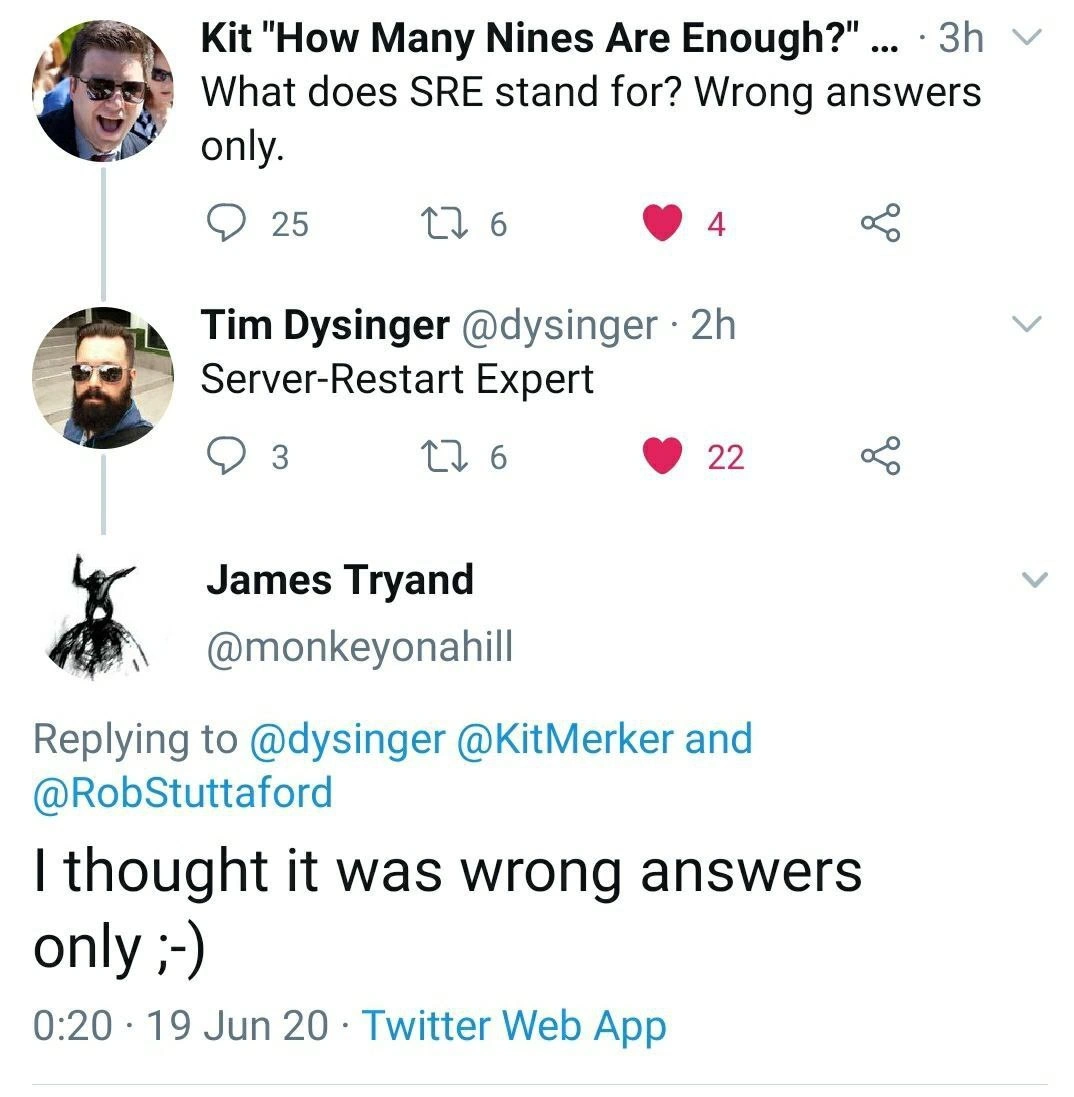
Now, the meme flips this on its head with a “wrong answers only” challenge. This is a popular internet meme format where you intentionally give an incorrect definition for something, purely for laughs. So when asked “What does SRE stand for?”, the expected serious answer is Site Reliability Engineering. But a jokester replies, “Server-Restart Expert.” Why that? Because it humorously captures how SREs often feel in real life. Instead of some high-minded engineering superhero, you end up becoming an expert at restarting servers. The joke implies that despite the fancy title and all the DevOps tooling, a lot of an SRE’s day (or late night) is spent simply rebooting systems to fix issues.
To a junior developer or someone new to IT, here’s why that’s funny: Imagine you have a very sophisticated machine, and you have an engineer whose job is to keep that machine running. The company calls them a “Reliability Engineer” to suggest they do complicated, skilled work. But many times, when the machine acts up, their solution is basically to turn the machine off and back on again. It’s like calling someone a “car reliability engineer” when what they really do is jump-start the car whenever it stalls. Server-Restart Expert is a tongue-in-cheek way to describe the SRE role by one of its simplest actions. Among ops folks (people who work in IT operations), this resonates because they’ve all been there, repeatedly rebooting servers, services, or applications to deal with crashes and lock-ups.
The reference to “How Many Nines Are Enough?” in the original post is all about uptime. “Nines” refer to the percentage of time a system is available. For example, 99% uptime means out of 100 days, 1 day of downtime is allowed. 99.9% (three nines) means only 0.1% downtime – that’s about 8.5 hours per year. Five nines (99.999%) means only about 5 minutes of downtime per year! It’s a common SRE and management obsession to ask if the service can get even more nines. The higher the nines, the more high-availability features you need (like backups, failovers, redundancy). The Twitter username joking about “How many nines are enough?” hints that maybe people demand crazy levels of uptime. The humor is that no matter how many nines you shoot for, something as low-tech as a restart is still part of the toolkit to actually achieve it.
So the meme’s context: It’s a screenshot of a Twitter thread where tech folks are riffing on the SRE acronym. One person’s witty wrong answer – "Server-Restart Expert" – got a bunch of likes because it rang true. Another person cheekily replied, “I thought it was wrong answers only ;-)”, implying that “Server-Restart Expert” might sound like a joke but it’s basically accurate. This is a classic bit of SRE humor and DevOps humor. It pokes fun at the sometimes mundane reality behind a fancy job title. Anyone who’s fixed a server by rebooting it (which is basically everyone in IT at some point) can relate. Even if you’re new, you quickly learn that production issues often have that annoyingly simple fix. It’s like the tech version of a riddle where the silly answer reveals a truth.
Level 3: When in Doubt, Reboot
This meme hits home for anyone who’s been on on-call duty for a large system. The Twitter thread starts with the question, “What does SRE stand for? Wrong answers only.” An experienced ops guy quips back: “Server-Restart Expert.” It’s tagged as a wrong answer, but every battle-scarred SRE chuckles because it feels alarmingly true. In the trenches of DevOps humor, there’s a saying: Not all heroes wear capes; some wear pagers. And when that pager screams at 2:00 AM that a critical service is down, the hero’s magic weapon is often a good old-fashioned reboot.
Why is “Server-Restart Expert” so amusing? Because it nails a core ops reality with dark humor: despite all our sophisticated monitoring, automation, and deployment pipelines, a huge chunk of ProductionIncidents boil down to “we tried turning it off and on again, and it worked.” SREs are supposed to be system gurus tuning reliability, writing code to prevent failures, and managing on-call production issues with surgical precision. Yet, in practice, that often translates to frantically bouncing servers and services to extinguish fires. The meme is a wink to all those nights where you’re bleary-eyed on a Zoom call, the system is down, the CEO is panicking, and after hours of fruitless debugging someone sighs, “Let’s just restart the server,” and boom – problem mysteriously solved.
This scenario is painfully common: maybe a database got deadlocked, maybe there’s a memory leak chewing up RAM, or a thread pool got stuck – whatever the cause, the quickest remediation is often a restart to clear the state. SREs aim for mean time to recovery (MTTR) to be as low as possible, and guess what – rebooting is usually the fastest path to recovery. It’s practically a reflex. The culture of DevOps_SRE has even institutionalized this with rotating OnCall rotations and runbooks that often include steps like: “Step 1: Restart the service. Step 2: If issue persists, restart the whole server.” It’s both a production issue lifehack and a running joke.
Remember the iconic IT helpdesk phrase, “Did you try turning it off and on again?” SREs are like the final bosses of that concept. Sure, they can dive into complex debug logs, inspect garbage collection metrics, or trace distributed request flows. But under a 5-minute SLA pressure, nobody’s busting out formal proofs – they’re doing sudo systemctl restart my-service and crossing their fingers. This meme is essentially an insider wink: it pokes fun at SRE humor by suggesting the highly-skilled Site Reliability Engineer is really just a glorified reboot technician. The reply “I thought it was wrong answers only ;-)” from another user underscores the irony: calling an SRE a “Server-Restart Expert” was supposed to be a joke, but maybe it’s too on-point to be just a wrong answer.
Consider the daily grind of an SRE: they wrangle CI/CD pipelines, juggle Terraform scripts for infrastructure, set up sophisticated alerts for when latency goes above 500ms. Yet, when an alert actually fires, half the time the immediate fix is to reboot some container or VM. It’s a shared trauma among ops folks – you prepare for elegance, but you fall back on blunt force fixes. The humor lands because anyone who’s maintained a complex system knows that feeling of exasperation: all these advanced systems, and here I am power cycling instances like it’s 1999. It’s a gentle jab at the industry, too. We rebranded “SysAdmin” to “SRE” to chase the glamour of Google’s practices, but many teams haven’t caught up to that ideal. They slap the SRE title on an ops engineer and still expect them to do everything manually. So Server-Restart Expert becomes a sardonic expansion of the acronym – a little iffy as a job description, but dead-on as a job reality on those bad days.
To put it bluntly, this meme captures a fundamental truth in Ops reality: no matter how advanced our cloud architecture or how many nines of uptime we strive for, we’re all one ugly outage away from fixing things with a good old reboot. It’s funny because it’s true, and it’s also a coping mechanism. Laughing at calling yourself a restart expert is way better than crying over yet another 4 AM outage. After all, if you can find humor in the fact that your high-availability cluster was ultimately saved by turning it off and on, you’re less likely to throw your pager into the ocean. And the next morning, in the post-mortem meeting, when someone asks what happened, you might just shrug and say, “SRE did its thing – Server Reboot Executed. Issue resolved.” Cue the knowing groans (and chuckles) from your team.
Level 4: The Five-Nines Paradox
In the rarefied air of Site Reliability Engineering, there’s a constant push to achieve “five nines” (99.999%) uptime. This quest for ultra-high availability borders on theoretical computer science: it tangles with the CAP theorem (you can’t have it all – consistency, availability, partition tolerance – pick two), and it demands elaborate distributed systems designs. Companies build redundant data centers on opposite sides of the planet, implement consensus algorithms like Paxos/Raft to keep data consistent, and deploy layers of caches and load balancers – all to avoid any outage. In theory, an SRE is armed with math and algorithms to keep things running seamlessly, taming chaos with code and architecture.
But here’s the paradox: even with all that complexity, real systems still fail in unpredictable ways. A tiny memory leak in a service, a GC pause at the wrong time, or a network partition can cause a cascade of problems no whitepaper prepared you for. When a distributed database node gets stuck in a weird state or a container orchestration cluster starts flapping, the elegant theoretical fixes often go out the window at 3 AM. Those beautifully redundant microservices might still grind to a halt due to a one-in-a-million race condition, and your meticulously planned high-availability setup suddenly begs for a blunt intervention. At that delirious hour, the academic purity of reliability theory meets the gritty reality: sometimes the fastest way to uphold your precious uptime SLA is to restart something and pray. It’s a bit humbling – and darkly funny – that after all the advanced math ensuring consistency and fault tolerance, the ops reality often devolves to the old adage: “Have you tried turning it off and on again?”
Ironically, this brute-force tactic – rebooting servers – is even baked into modern reliability strategies. Chaos engineering tools like Netflix’s Chaos Monkey intentionally kill instances to prove the system can survive it. Why? Because we implicitly acknowledge that failures will happen, and the system must restart or reroute to heal itself. In the end, achieving those mythical “how many nines” of uptime sometimes comes down to how fast and automatically you can cycle things when they break. No wonder seasoned SREs wear a cynical grin: behind the polished title and the complex math, a big part of keeping systems reliable is mastering the art of the restart. It’s reliability by any means necessary – even if that means embracing the very unglamorous, very human solution of rolling up your sleeves and hitting the reset button on a misbehaving server.
Description
A screenshot of a humorous Twitter exchange. The first tweet, by Kit, asks the tech community for comical, incorrect definitions of the acronym SRE, stating, "What does SRE stand for? Wrong answers only." The second tweet, a reply from Tim Dysinger, suggests "Server-Restart Expert." The final tweet, from James Tryand, delivers the punchline by replying to Tim, "I thought it was wrong answers only ;-)". This implies that "Server-Restart Expert" is, ironically, the correct and most accurate description of a Site Reliability Engineer's job. The joke resonates with experienced engineers who know that despite the complexity of ensuring system reliability, a surprising number of production issues are resolved by the simple, age-old trick of restarting a service or server

Comments
7Comment deleted
SRE stands for 'Someone Rebooting Everything.' The goal is to automate yourself out of that job, but by the time you do, they've added three new microservices that only respond to a swift kick
SRE: turning the 3 a.m. “have you tried restarting it?” ritual into a Kubernetes liveness probe and calling it a five-nines architecture
After 20 years in tech, I've learned that SRE actually stands for "Statistically Recurring Events" - because that P0 incident you just fixed? See you again next quarter when someone deploys the same anti-pattern with a different microservice name
The beauty of this exchange is that 'Server-Restart Expert' was supposed to be a joke answer, but any SRE with 15+ years of experience knows that after exhausting distributed tracing, analyzing heap dumps, reviewing circuit breaker patterns, and debugging race conditions in a microservices mesh at 3 AM, sometimes the most pragmatic solution is still 'have you tried turning it off and on again?' The real expertise is knowing *when* that's the right call versus when it's just masking a deeper architectural problem you'll be debugging again next quarter
SRE: Stateless Restarts Everywhere - if the runbook starts with “kubectl rollout restart,” you’re optimizing MTTR, not reliability
If SRE means “ssh; sudo systemctl restart” until the SLO graph flattens, your error budget is just venture debt
SRE: Site Reliability Engineering, or 'Server Reboot Extraordinaire' - because five nines evaporate faster than a JVM heap at peak load without that one restart