Skip to content
DevMeme
1554 of 7435
Git Rebase on Master: A Dangerous Game
VersionControl Post #1735, on Jun 22, 2020 in TG

Git Rebase on Master: A Dangerous Game

Why is this VersionControl meme funny?

Level 1: Rewriting the Story

Imagine 12 friends are all working together to build a big castle out of LEGO blocks. Each friend is adding their own section to this castle. Now picture that one friend secretly takes apart the foundation of the castle and rebuilds it in a different way while everyone else is on a break, because he thinks it will make the castle look cleaner and better. What do you suppose happens when the others come back? The base has changed – some of the walls and towers they built don’t fit anymore or have fallen down. All the friends are confused: “Why does my part of the castle look all messed up now? Who moved these pieces?” They all have to stop building and try to fix the foundation and their sections so the castle can be whole again.

In this little analogy, the castle is like the shared project, and the foundation is like the project’s history. One friend “rewrote” the foundation (changed the past structure), and it ended up causing a big mess for everyone else. Doing something like that took a lot of nerve, because it almost guaranteed chaos. That’s why the meme says “I like to live dangerously.” It’s joking that only someone who isn’t afraid of causing a serious mess (or very confident to the point of foolishness) would do something so risky when everyone is working together. In real life, it’s usually much better to just add your new blocks on top (like a normal merge) rather than secretly redoing the foundation that others are relying on!

Level 2: Force Push Fallout

In simpler terms, this meme is about Git (a popular system for tracking code changes) and a particularly risky thing you can do when working with others. In Git, developers use “branches” as separate lines of work. The master branch (now often called “main”) is the primary line of code that everyone works to keep stable and up-to-date. Imagine 12 people are all contributing to the same codebase – that main branch is like the central story everyone’s writing together.

Normally, to bring your changes into the master branch, you’d use a merge. Merging takes the changes from your branch and combines them with the master branch in a new commit (think of it like stitching two pieces of a story together at the end). This method adds to history but doesn’t change anything that happened before. All the earlier commits remain intact, so none of your teammates’ work is undone.

Rebasing, on the other hand, is more like rewriting the story’s timeline. When you rebase your branch, you take your commits and reapply them on top of the latest version of the master branch, as if you had created your changes starting from that point all along. The end result looks clean – it’s as if you made your changes after the most recent commit on master, so the project history becomes a nice straight line without a branching merge. However, there’s a catch: by doing this, you are changing the history of commits. If you then update the shared master branch with this rebased history, you’re essentially saying to everyone, “Hey, I rewrote the past commits of our project to include my work differently.”

Git is very cautious about this. Normally, if you try to push a rewritten history to a remote repository, it will be rejected – Git will warn you that your updates don’t line up with what’s on the server (because the server still has the old history that all your teammates share). To bypass that, you have to force push (git push --force). A force push basically tells Git, “I know this is a drastic change, but do it anyway.” This will overwrite the remote history with your new history. It’s as dangerous as it sounds in a team setting! The moment someone force-pushes a new history onto the master branch, everyone else’s copies of the code become out-of-sync. When your coworkers try to pull the latest code, Git will detect that the history has changed in a way that can’t be merged cleanly. They might get error messages or have to deal with a bunch of conflicted files because their work and the “new” master history don’t agree.

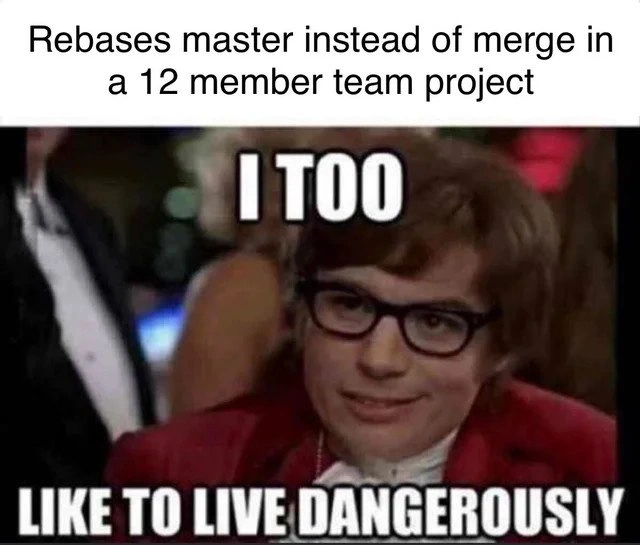
The meme’s caption is highlighting this scenario: “Rebases master instead of merge in a 12 member team project.” In plain language, it’s describing a person choosing to use rebase (and likely a force push) on the main branch rather than the safe route of merging, in a project with 12 developers. That’s a big team_workflow_risk because it can confuse and frustrate all 11 other developers. The image below the caption is from an Austin Powers movie – a famous comedy spy character dressed in a flashy 60s-style suit. The text on his image, “I TOO LIKE TO LIVE DANGEROUSLY,” is a quote from the film played up as a meme. Austin Powers (played by Mike Myers) says this line jokingly in the movie after taking an absurd risk during a card game. It’s become an Internet meme for boldly doing something very risky and acting proud of it.

In our context, the Austin Powers quote is applied to the developer who rebased the shared master branch. It’s poking fun at them, saying essentially: “Wow, you must enjoy living on the edge, huh?” – because doing that in a 12-person project is courting disaster. It’s relatable humor for developers because we all know it’s a bad idea; anyone who’s learned Git in a team setting has been warned: don’t rewrite the history on a shared branch. The meme is a lighthearted way to reinforce that lesson. It’s funny to imagine someone being so cavalier (“dangerously” bold) with their Git commands, and it’s a bit of an inside joke among programmers.

For a newer developer, the key takeaway is: be very careful with commands like git rebase and git push --force, especially on a shared branch. Those are powerful tools, but misusing them in a collaborative project can wreak havoc. It’s much safer to stick with merging (or use pull requests that handle the merges for you) so that you don’t surprise your teammates by rewriting parts of the project’s history. The reason everyone’s laughing at this meme (and also grimacing a little) is because we’ve either seen this go wrong first-hand or we’ve heard the horror stories. It’s a comic reminder that in Git, as in spy movies, some moves are just too dangerous to attempt without expecting explosions.

Level 3: Rebase Roulette

For experienced devs, seeing someone run git rebase directly on the team’s master branch triggers instant dread. It violates a cardinal Git rule: never rewrite shared history. So when the meme’s top panel describes “Rebases master instead of merge in a 12 member team project,” every seasoned engineer who’s been through a Git war story cringes (and then laughs nervously, relieved it’s not their repo this time). This scenario is infamous in VersionControl circles: one daredevil developer effectively altered the project’s commit history on the main branch. That’s a recipe for a cascade of MergeConflicts and even lost work. The humor comes from the sheer recklessness of it — it’s the coding equivalent of defusing a bomb blindfolded or deploying on a Friday. Only a thrill-seeker would choose this approach, which is why the meme perfectly pairs it with Austin Powers smugly saying, “I too like to live dangerously.”

Technically speaking, the reason this is so chaotic comes down to how Git manages history. Git stores commits as nodes in a directed acyclic graph (DAG), where each commit points to its parent(s). A normal merge operation preserves this history: it creates a new merge commit that ties two branches together, but all existing commits remain unchanged (nothing gets rewritten). In contrast, a rebase literally relocates commits: it takes the commits from one branch and replays them on top of another base commit, as if they had been created there originally. This process generates new commit IDs (hashes) for the moved commits. On a private branch, rebasing is a handy way to line up your changes into a tidy, linear sequence (no extra merge bubbles in the timeline). But rebasing the master branch that everyone else is also working on? That’s like suddenly editing the previous chapters of a book that a whole group is writing together – you’re changing pages that others thought were already final. In effect, you create an alternate timeline of the project history.

After such a rebase, our daring developer can’t just do a normal push. Git will rightfully refuse, since the remote repository has the “old” history and you now have a conflicting “new” history. So what do they do? They invoke the ultimate dangerous command: git push --force. This force push basically tells Git: “I know my history is different from everyone else’s – but let’s make my version the official one.” It’s the nuclear option. The moment that force push hits the shared repo, it’s as if you told all your teammates, “I rewrote what happened in the project’s past; your copies are now out-of-date.”

git checkout master
# Integrate a feature branch by rebasing (risky on a shared branch!)
git rebase feature_branch   
git push origin master --force
# (!!) Force-pushing rewritten history: chaos level now at 100%

The fallout is immediate. The next developer who pulls the code is greeted with a confusing error or a tangle of conflicts. Git might complain about “non-fast-forward updates” or throw merge conflict markers into files that person never even touched. In plain terms, Git is saying: “Your copy of the project and the server’s copy have drifted apart in a way I can’t reconcile automatically.” Each of the other 11 team members now has to scramble to fix their local repositories. They might have to discard their local master branch and re-fetch it, or perform a careful rebase of their own work on top of the new history. Either way, everyone is temporarily in version control hell. In a panicked team chat, someone will inevitably shout:

Teammate: “Who just force-pushed master?! 😡”

Seasoned teams know this nightmare scenario well, and they go to great lengths to avoid it. Many organizations set up branch protections on the main branch (e.g. preventing force pushes or requiring all changes to go through pull requests) specifically to stop this kind of fiasco. Why? Because one rogue rebase can steal hours (or days) of productivity as everyone tries to sort out the mess. It’s a prime example of DeveloperHumor that’s funny only because it’s true – many of us have either experienced this headache or heard horror stories about it.

What makes rewriting history possible (and risky) is Git’s distributed design. Every developer’s clone has the full repository history. When you rewrite the shared history, those old commits don’t instantly vanish from your teammates’ computers – instead, the team ends up with two divergent realities that must be manually reconciled. It’s like a time-travel paradox: the timeline has split, and now someone has to clean up the inconsistencies. Git itself won’t magically fix it; humans have to step in and decide how to merge the two histories back together. Rebase is a powerful tool for crafting a clean commit timeline (Linus Torvalds designed Git to be this flexible), but with great power comes great responsibility… and in the wrong context, great chaos.

In the end, this meme perfectly captures a bit of shared developer wisdom: don’t mess with public history unless you “like to live dangerously.” The image of Austin Powers – a goofy, swaggering spy who loves taking outrageous risks – is an ideal tongue-in-cheek metaphor. It labels the rebase-happy developer as a suave but crazy risk-taker. Every experienced dev gets a chuckle because we all know that one person (maybe an overenthusiastic newcomer, or an “I-know-what-I’m-doing” veteran) who learned the hard way why you don’t rewrite commits on a busy shared branch. We laugh at the joke, remembering the chaos, and we’re just glad that these days this lesson is usually learned from memes rather than from breaking the production code base.

Description

This is a meme based on a still image of the character Austin Powers, who has a smug, mischievous look on his face. The top text caption reads, "Rebases master instead of merge in a 12 member team project." The bottom text, superimposed over the image, says, "I TOO LIKE TO LIVE DANGEROUSLY." The meme humorously equates the technical act of rebasing a shared `master` branch in a large team to a reckless, thrill-seeking behavior. For experienced developers, rebasing a public, shared branch is a major violation of version control etiquette because it rewrites commit history. This action can cause significant disruption and merge conflicts for all other team members, forcing them into complicated `git` gymnastics to realign their local branches. The joke lies in the dramatic overstatement, portraying a poor workflow choice as a form of high-stakes gambling

Comments

7
Anonymous ★ Top Pick Some people skydive for an adrenaline rush. I just force-push a rebased master branch and wait for the panicked Slack messages to roll in
  1. Anonymous ★ Top Pick

    Some people skydive for an adrenaline rush. I just force-push a rebased master branch and wait for the panicked Slack messages to roll in

  2. Anonymous

    We replaced our chaos-engineering budget by letting someone rebase main at 5 PM - if your `git reflog` kung-fu survives, you get prod access

  3. Anonymous

    The same developer who rebases master also force-pushes to production on Fridays because "the git history looks cleaner" and Slack is just for people who can't read commit messages

  4. Anonymous

    Rebasing master on a 12-person team is the version control equivalent of performing open-heart surgery on a moving train - technically possible, but the moment you force-push, you've just turned everyone's local branches into archaeological artifacts and their next pull into an existential crisis. It's the kind of move that makes senior engineers reach for both the incident postmortem template and their résumé simultaneously

  5. Anonymous

    Rebasing master on a 12‑dev team: rewriting history while everyone’s still writing it - aka git push --force-with-lease your friendships

  6. Anonymous

    Rebasing master in a 12‑dev repo is the fastest way to turn linear history into a company‑wide reflog restoration ceremony and 47 orphaned PRs

  7. Anonymous

    Rebasing master in a 12-dev repo: optimizing for linear history perfection while turning teammates' clones into untrackable warzones

Use J and K for navigation