The Sophisticated Evolution of C# Naming Conventions
Why is this Languages meme funny?
Level 1: Super Fancy Naming Game
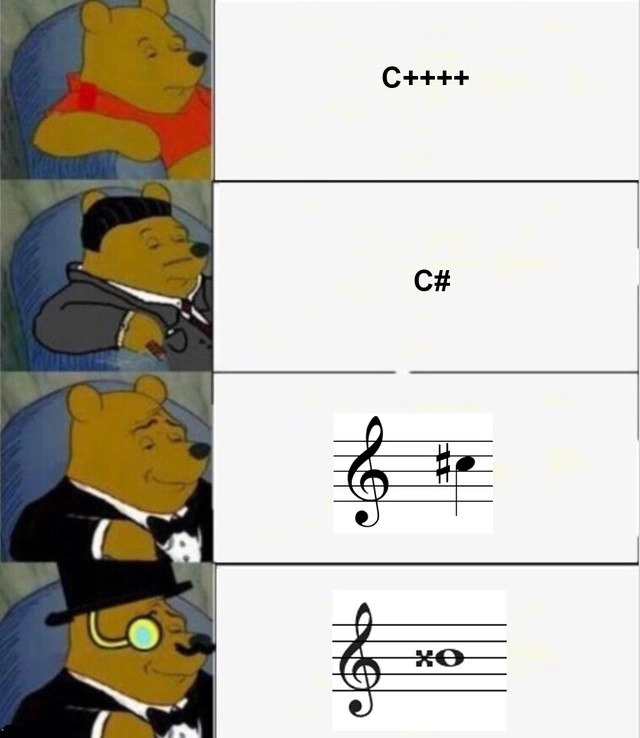
Imagine you and your friends are trying to one-up each other by saying the same thing in a fancier way each time. The first friend says a regular word plainly. The second friend says it in a cooler way. The third friend sings it in a musical, opera-like way to sound really fancy. Then the fourth friend says it in an ultra-special, rare language that almost nobody understands, just to sound extra smart. 😆 It’s funny because each friend is basically saying the same idea, but they keep making it sound more and more high-class and complicated for no real reason. This Pooh bear meme is doing exactly that with the name "C". It starts plain, then adds some extra "pluses" to jazz it up, then says it as a musical note (fancy!), and finally uses a super rare music symbol to be ridiculously fancy. It’s like a simple joke that keeps getting dressed up in a tuxedo — and that silliness is what makes us laugh.
Level 2: Sharp Naming Explained
So, what's going on here? Let's break the meme down in simpler terms. The joke revolves around programming languages in the C family and how their names use symbols like plus signs and the # sign. It’s also playing with the idea of making things fancier and fancier. The meme uses the four-panel tuxedo Winnie-the-Pooh template – a popular format where each row shows Winnie-the-Pooh looking more formal or smug as the captions get more "sophisticated." Here’s each part explained:
Row 1: "C++++" (Pooh in a red shirt) – This isn’t a real language at all. It’s a humorous exaggeration of C++. In programming, C++ (pronounced "see plus plus") is a language that was created as an extension of the C language. The
++in its name comes from the increment operator++in C/C++ code, which means "increase by one." So, C++ literally meant "C incremented by one," implying it’s one step beyond C. Now, the meme jokingly saysC++++(C plus plus plus plus) – adding two extra plus signs. In actual code, writing++++after something doesn’t make sense; you can’t just keep stacking plus operators like that. But as a joke, C++++ implies "even more advanced than C++." Pooh is in his normal casual look here, suggesting this idea is pretty basic or crude in humor value (just slapping more plus signs – haha, sure). It mocks the notion of LanguageWars or tech one-upmanship: if C++ is good, then hey, C++++ must be even better, right? 😅 (Not really, but that’s the joke.)Row 2: "C#" (Pooh in a business suit) – This is an actual programming language called C# (pronounced "see sharp"). C# was developed by Microsoft as part of its DotNet (.NET) framework in the early 2000s. The
#symbol in the name is read as "sharp" (a term from music). So the language name is a musical reference, but programmers see "C#" and know it’s a major language like Java or C++ in capability. In the meme, Pooh looks a bit classier (a suit) next to C# because this is a step up in sophistication from just adding more pluses. It’s like saying, “Now we’re talking about a real advanced language.” C# was designed to be more modern and programmer-friendly than C++. For example, C# has automatic garbage collection (it manages memory for you) and runs on a virtual machine, which makes it a bit safer and easier to use for many applications. Meanwhile, C++ is lower-level and gives you more manual control (and responsibility) over things like memory. People often compare the two, but they’re different tools. In any case, the meme assumes you know that C# is a step beyond C++ in naming, and presenting it with Pooh in a suit gives it a fancier vibe. The humor here also comes from the fact that you need to know#is pronounced "sharp." Someone not aware might read it as "C hash" or "C number-sign," and miss the joke. But most developers do call it C-sharp, connecting it with the idea of a musical sharp note.Row 3: (Sheet music showing a C-sharp note, Pooh in tuxedo) – Here, they stopped using text and switched to an image of sheet music. The image has a treble clef (the fancy symbol at the beginning that tells you it’s the higher musical register) and a note positioned on the staff with a
♯symbol next to it. That♯symbol is a sharp sign in music, which indicates the note is a half-step higher. The note shown is on the line for C, so with the sharp sign, it represents C-sharp (the musical note). Essentially, this is "C#" written in music notation instead of letters. Winnie-the-Pooh is now in a full tuxedo, indicating this is very high-class and refined. Why is this funny? Because the meme expects you to connect that this musical notation means "C-sharp," which is the exact same name as the programming language in the previous panel. It’s a clever twist: they’re referring to the programming language without writing any programming letters at all! It’s like a double inside joke: you have to know how to read the basic idea of sheet music and realize it’s referring to the coding language C#. It’s definitely a musical_notation_pun. For a junior developer, this might be the first time seeing a joke mix code and music. But believe it or not, many programmers also have some music background or just know trivial things like what a sharp note is. The meme is banking on that overlap. The effect is to make the joke seem more sophisticated – it’s not just spelling "C#," it’s demonstrating it in a classy, cultured way (hence Pooh’s tux). Think of it as the meme saying, "We’re smart and classy enough to use classical music notation to talk about a programming language."Row 4: (Sheet music showing a C double-sharp note, Pooh with top hat and monocle) – Now comes the ultimate punchline. The image in this panel shows another bit of sheet music, again on the note C, but this time with a special symbol that looks like an "×" or kind of like a double ♯♯. This is the double-sharp symbol in music (actually written as 𝄪 in musical notation). A sharp raises a note by one semitone (for example, C to C♯ means go up to the very next piano key). A double-sharp raises it by two semitones (so C double-sharp would actually sound like a D note, two steps up). Double-sharps are not common; they usually appear only in advanced musical pieces or certain key signatures to maintain theoretical correctness. For instance, in a weird key, you might call a note C double-sharp instead of D natural for music theory reasons. But that’s deep music theory trivia – the average person or even musician doesn’t deal with double-sharps often. Now, how does that relate to programming? Well, it really doesn’t – there is no programming language called C double-sharp. This is the meme going one step beyond C#. It’s as if someone said, "Hmm, C# was one sharp, what if we had C double-sharp (C##)?" Visually, "C##" would be a fun way to indicate two sharps. And indeed, programmers sometimes joke about C## as a hypothetical name meaning "even sharper than C-sharp." There’s also an ironic twist: in music, C double-sharp is enharmonically equivalent to D (meaning it’s the same sound as the note D). And guess what? There is a programming language called D (which was created as a successor to C++ as well!). So in a roundabout way, the meme hints that "C double-sharp" would effectively be "D" – which is a nerdy detail that some well-read devs might catch. Winnie-the-Pooh in this final frame is decked out like a 19th-century aristocrat with a top hat and monocle, portraying the ultimate level of sophistication/pretentiousness. The meme is basically satirizing how people try to make each new thing sound fancier or more advanced. It went from a basic fake name with pluses, to a real language name, to a fancier representation of that name, to an ultra-obscure concept that hardly anyone uses. The increasing formality of Pooh’s outfit is the visual way to show each step is "higher class."
Why it’s funny: It’s the contrast and the absurd escalation. Developers find it funny because it’s true that we often name new languages or versions as if they’re better (LanguageComparison is constant in tech: which is better, C++ or C#? etc.). Here that idea is blown out of proportion by purely focusing on the names. The meme doesn’t say anything about what these languages do – it’s all about how they’re labeled and perceived. By the end, the meme-makers mix in something as unrelated (but analogous) as music notation to push the joke further. It’s like a nerdy inside joke: you feel proud if you understand the final panel without explanation, because it means you know a bit about musical notation and programming language history. Not everyone will get that last frame immediately, and that’s the point – it’s humor with an "elitist flair." But even without music knowledge, a junior dev can appreciate: okay, they took C, added more +, then turned it into C#, then went double. It’s the pattern of one-upmanship that comes through. The tagline in the post says "Pooh evolves from C++++ to C# to musical double-sharp sophistication," which perfectly sums it up. Each stage is an evolution in fanciness. In simpler memes, maybe you’d just go from something like "Good, Better, Best, Ultimate," but here the creator used programming and musical terminology for each step, making it a very geeky kind of DeveloperHumor. In short, the meme humorously traces a fake lineage of the C language: from a silly over-the-top extension (C++++), to a real modern language (C#), to a sophisticated representation of that language (musical C#), and finally to a hyper-pretentious imaginary language (C double-sharp). It’s a playful nod to both the history of programming language naming and the cliché of always wanting a "next level" — delivered with a wink and a nudge to those of us who enjoy a bit of classical music with our code.
Level 3: Operator Overkill
At first glance, this meme is a multi-layered inside joke bridging programming language naming and music theory. It's poking fun at the one-upmanship in tech culture: always trying to make something sound more advanced than it is. The four panels use the famous Winnie-the-Pooh meme template (Pooh gets progressively more sophisticated) to represent an "evolution" of the C-language family from plain old plus signs to exotic musical notation. Seasoned developers recognize the escalating LanguageQuirks here immediately. Let's break down why this is hilarious to an experienced coder:
Panel 1 – Casual Pooh + "C++++": The meme starts with Pooh in his normal red shirt looking uninterested, next to the text
C++++. This screams "exaggeration" to any C/C++ veteran. We all know C++ is C "plus plus," named after the++operator that increments a value. SeeingC++++(with four plus signs) is absurd – it's like attempting to doC++twice in a row. In code, writing something likevalue++++;would either not compile or do something unintended (the compiler would parse it as(value++)++, which is invalid). Essentially, C++++ is not a real language – it's a tongue-in-cheek way of saying "even more C++ than C++." This panel satirizes the idea of endless one-up increments. Veteran devs chuckle because it mocks how we sometimes jokingly propose "C++++" when C++ isn’t cutting edge enough. It's an instance of CodingHumor where more plus signs = more elite (even though that’s nonsense technically).Panel 2 – Suit Pooh + "C#": Now Pooh has donned a modest suit and crosses his arms, looking a bit more sophisticated. Beside him is
C#. This is a real language pronounced C-sharp. The joke here is a play on naming: after C++, the next well-known language in the "C family" is C# (created by Microsoft for the .NET platform). The#symbol in the name is meant to evoke a musical sharp (♯). Fun fact for the seniors: the name C# was partly chosen because, graphically, a#can look like four plus signs arranged in a two-by-two grid. In other words, C# is, in a witty sense, "C++++" compressed into one glyph – an increment on C++. 😄 By showing C# after C++++, the meme implies "this is the refined real deal." In programming culture, C# is often seen as a more modern, high-level evolution compared to C++. The suit attire fits because C# was introduced in an era of enterprise development with an emphasis on polished frameworks and managed code (some might picture C# developers as the well-dressed corporate types versus the messy systems programmer stereotype of C++ folks). This panel gets a nod from experienced devs who remember the early 2000s cplusplus_vs_csharp debates — where each camp touted their language as the superior successor of C.Panel 3 – Tuxedo Pooh + "♮ with ♯ on staff": Now Pooh upgrades to a white-tie tuxedo. Instead of text, we see a snippet of sheet music: a treble clef and a sharp sign on the C note line. This is literally the musical notation for the note C-sharp. The meme has cranked the sophistication up a notch by not even writing "C#" in letters, but showing it in music theory form. It's a brilliant musical_notation_pun. Only those who know how to read music (or at least recognize a treble clef and a sharp symbol) will get that this still means "C-sharp." This signals extra elitism: now the joke spans two knowledge domains. Developers who also dabble in music or just know the name "C-sharp" enjoy feeling "in on it." The humor comes from the multi-disciplined flex: the meme assumes you're cultured enough to interpret classical musical notation. Essentially, it's saying "C# is fancy — so fancy we're literally writing it as a musical key." The tuxedo Pooh’s pleased expression matches the vibe of "ah, quite refined, isn’t it?" The senior crowd loves this because it’s an unexpected crossover of tech and art. It reminds us how LanguageComparison culture can sometimes get pretentious — here, pretentiousness is portrayed by moving from plain text to classical score notation.
Panel 4 – Monocle Pooh + "C double-sharp (𝄪)": Finally, Pooh is in full aristocrat mode: tux, bow tie, top hat, monocle – the works. Next to him is an image of sheet music showing a treble clef and the symbol "𝄪" on the C note. That symbol is a double-sharp in music. A double-sharp looks like a stylized "×" and indicates raising a note by two semitones (two half-steps). So a C double-sharp in musical terms is actually the same pitch as a normal D note (♯♯ on C = D natural). This is an ultra-nerdy twist. In programming, there's no language called "C##" (and if you wrote
C##, people might jokingly read it as "C double-sharp"). The meme is basically inventing C double-sharp as an even more sophisticated successor to C#. It's satire of the tech world’s penchant to keep one-upping: "Oh, you made a language after C++ named C-sharp? Hold my monocle, I'll envision C double-sharp!" 😂 The double-sharp is a rare symbol even in music theory – it's not something you encounter unless you're quite advanced (certain obscure key signatures or harmonic analyses). By using it, the meme makers show off an extra level of elitist knowledge, which completes the crescendo of the joke. For seasoned devs, this final panel is the absurd punchline that takes the naming hype to a comical extreme. It's as if the meme says, "We've reached peak sophistication – a concept so refined (or ridiculous) that it's barely practical." This self-aware absurdity is what makes the meme memorable. It’s not actually criticizing C# or C++ directly; it’s ribbing the one-up culture and the quirky naming conventions of programming languages. We go from a simple idea (adding more "++") to an actual language (C#) to a high-brow cross-domain pun (musical C#) to a ridiculously esoteric concept (C double-sharp). Each step up is both an evolution and an exercise in nerdy grandiosity. And as any experienced developer will tell you, when it comes to DeveloperHumor, the more over-the-top the reference, the funnier it can be.
Description
A four-panel 'Tuxedo Winnie the Pooh' meme illustrates an escalating level of sophistication regarding the name of the C# programming language. The first panel shows the standard Pooh Bear next to 'C++++'. The second panel features a slightly more dapper Pooh in a suit next to 'C#'. The third panel presents Pooh in a full tuxedo, looking pleased, next to musical notation on a staff with a treble clef showing the note C sharp. The final, most sophisticated panel shows Pooh with a top hat and monocle, looking discerningly at musical notation for a C double sharp (a 'C' with an 'x' symbol). The meme is a multi-layered pun. It starts with the common joke that C# is like 'C++ ++' (hence 'C++++'), progresses to its actual name, then elevates the concept by literally representing 'C sharp' and 'C double sharp' in musical terms, which is itself a clever nod to the '++++' notation resembling two sharp symbols
Comments
7Comment deleted
Musically, a C double sharp is enharmonically equivalent to a D natural. This feels like an accurate metaphor for a language that was supposed to be a sharp improvement on C++ but ended up being Microsoft's version of Java
Roadmap update: we’re renaming the codebase from C++++ to C𝄪 - same underlying note as D, but marketing says the extra layer of indirection justifies the enterprise pricing
After 20 years in the industry, I've seen developers argue about tabs vs spaces, vim vs emacs, but the real sophisticates know the ultimate flex is insisting your language name requires actual musical notation in documentation - though explaining C double-sharp in a code review might finally be what makes the junior devs switch to Rust
This meme brilliantly captures the eternal debate about C-family language naming conventions: we started with C, added pluses for features until someone realized 'C Sharp' sounds more sophisticated than 'C++++' - though both technically increment C by the same amount. The musical notation twist is the chef's kiss: C# developers insist their language is 'sharp' and refined, but deep down we all know it's just C with a fancy suit and some syntactic sugar. The final panel with C♮ (natural) suggests that perhaps the most elegant solution is to drop all the pretense and return to simplicity - a sentiment every architect who's maintained a decade-old enterprise C# codebase can appreciate
C++++ parses as (c++)++ - still illegal - while C# got a GC and music theory just shipped a breaking rename of D as “C double‑sharp.”
C+++ for that extra template bloat, C# for managed bliss - until the board demands C♭♭ refactoring, aka 'downgrade to B'
C++++, C#, then the score: C double‑sharp is D - aka the language you end up using after the third attempt to “just add a few pluses to the C++ monolith.”