The EU's Regulatory Chad Move on YouTube's Adblock War
Why is this DataPrivacy meme funny?
Level 1: Rules Are Rules
Imagine you have a friend who runs a little neighborhood movie night. This friend always makes everyone watch a five-minute commercial before the movie, because that’s how he earns popcorn money. Now, you really don’t like commercials, so you found a clever way to skip them – maybe by closing your eyes or wearing noise-cancelling headphones whenever a commercial starts. Let’s call that your “ad blocker.” 🍿
Your friend isn’t happy about you skipping his ads, so he says, “If you don’t watch the ad, I won’t let you see the movie at all!” This feels unfair, right? Now picture the school principal (who makes the rules for the whole town) finding out about this. The principal is super calm, confident, and strong – nothing rattles them. They walk in, sipping a cup of coffee, and gently say to your friend, “You’re not allowed to force them to watch the ad. Those are the rules.” Your friend pouts because, well, the big boss has spoken.
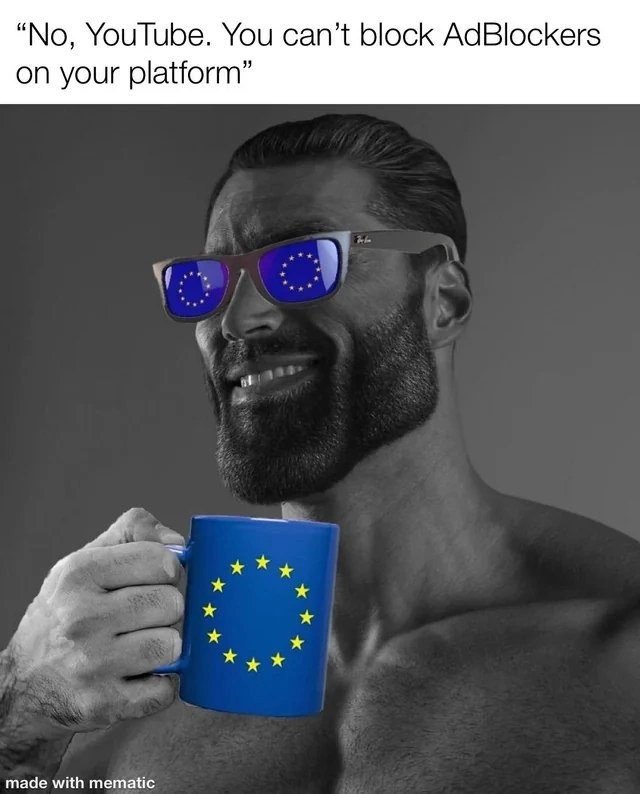
In this meme, YouTube is like that friend who wanted to force ads on everyone, people using ad blockers are like you trying to skip the commercials, and the European Union is like the principal who lays down the law. The EU is shown as a cool, strong guy calmly enforcing the rules (that’s the GigaChad character with the EU mug and sunglasses). It’s funny because the usually powerful kid (YouTube) gets told off by the even bigger authority. The message is simple: no matter how much YouTube wants you to watch ads, in Europe the rules are rules – and one of those rules is that you can’t punish people for protecting their privacy or skipping annoying ads. Seeing the “big guy” (EU) casually put a stop to the mischief gives everyone who hates unskippable ads a little smile.
Level 2: Can’t Block the Blockers
This meme shows a famous internet character, “GigaChad,” holding a bright blue mug with the EU flag. He looks totally confident, even smug, behind blue EU-themed sunglasses. The text on the image says, “No, YouTube. You can’t block AdBlockers on your platform.” Essentially, it imagines the European Union telling YouTube to knock it off with trying to stop ad-blocking. The joke here centers on OnlinePrivacy and user rights versus YouTube’s need to show you ads for money. If you’re a newer developer (or just new to this topic), let’s break down why this is both funny and relevant:
YouTube and Ads: YouTube, the huge video platform, makes most of its money through ads. Every time you watch a video, chances are there’s an ad before or during it (those unskippable 5-second pre-roll ads, ring a bell?). That’s AdTech in action – technology powering advertising.
What AdBlockers Do: Many users install AdBlocker browser extensions (like uBlock Origin or Adblock Plus) specifically to avoid those ads. An adblocker works by filtering out requests to known ad servers or hiding ad elements on a page. So when you go to YouTube with an adblocker on, the video player might skip the ads entirely or not load the ad sections, letting you watch without interruption. It’s like magic for viewers, but it cuts into YouTube’s ad revenue.
YouTube’s Anti-AdBlocker Script: Understandably, YouTube isn’t happy about people bypassing ads. Recently (around late 2023), they started testing ways to detect adblockers. For example, YouTube’s website can include a little script that checks if the ad content was loaded. If the script finds “Hmm, the ad didn’t load – probably blocked,” YouTube might stop the video and show a warning: “Please disable your ad blocker to continue watching.” In other words, YouTube was trying to block the blockers – preventing you from using your adblocker by refusing to serve content unless you disable it. This is a big youtube_vs_users standoff, because users want ad-free viewing and YouTube wants to enforce its ads.
Enter the EU and Regulations: The European Union has some of the strictest internet privacy and consumer protection laws in the world. You might have heard of GDPR, the General Data Protection Regulation, which is why every website started asking about cookies and consent a few years ago. There’s also a newer law called the Digital Services Act (DSA) focusing on fair online platforms. These laws are part of DataPrivacy regulations that insist companies respect user rights and data. For example, GDPR says companies can’t track you or use your personal data without clear permission. It also indirectly means companies can’t just punish you for trying to protect your privacy (like using an adblocker to avoid tracking cookies that often come with ads). The Digital Services Act requires big platforms to be transparent and not misuse their power over consumers.
“Audited” Script: In the meme caption, it says YouTube’s anti-adblock script gets audited. That means EU officials or compliance teams might inspect what that code is doing to ensure it doesn’t break any laws. If YouTube is scanning your browser or device to see if you have an adblocker, that could be seen as collecting data about you or your software without consent – which is a potential PrivacyConcern under GDPR. Also, under EU rules, a service generally shouldn’t be outright denied just because you exercise a privacy choice (like using a tracker-blocker). The EU could rule that YouTube must still allow access to content, even if ads are blocked.
Meme’s Meaning: So putting it together: the meme humorously imagines the EU as a super cool strong guy (GigaChad) basically telling YouTube, “Sorry, you’re not allowed to do that. Users in Europe get to use their adblockers.” The EU GigaChad is calmly sipping coffee because he knows he has the authority. It’s a power flex: giant tech companies like YouTube (Google) might be powerful, but if they break EU rules, they can get fined or forced to change their design. And many developers know what happens next – the company’s engineering team has to rush to change the code to comply with the law. (Cue the late-night coding sessions to disable that anti-adblock feature for EU users, because Legal said so!)
Why it’s Relatable: If you’ve ever worked at a company that does online business, you might have encountered something similar. Maybe your app had to add a cookie consent popup, or you had to change how you handle user data because of GDPR. Often these changes feel sudden – one day your Marketing team is celebrating a new way to get users to watch more ads, and the next day the Legal team comes in and says “Actually, under regulation XYZ, we can’t do that, we must allow users to opt out or face huge fines.” Developers (even junior ones) end up fixing things last minute to meet compliance. It’s a bit stressful, but also satisfying to see user-friendly practices enforced. This meme captures that feeling in a lighthearted way. Engineers who have dealt with compliance tickets get a chuckle because they’ve seen even the biggest platforms have to bow to the rule of law.
In short, you can’t block the blockers when the law is in town. The EU, symbolized by that confident GigaChad with an EU mug, represents the rule-maker who ensures companies like YouTube play fair with users. It’s funny and cathartic: even a tech giant doesn’t stand a chance against “the big boss” regulator who’s calmly watching them, coffee in hand, ready to enforce platform_regulation.
Level 3: Regulatory Chad Mode
“No, YouTube. You can’t block AdBlockers on your platform.”
In this meme, the European Union (EU) is portrayed as an unbothered, muscle-bound GigaChad casually sipping coffee from a blue mug emblazoned with the EU’s yellow stars. The gray background and YouTube’s predicament contrast with the color-popped EU symbols, emphasizing a Privacy Power Move in action. This scene humorously captures a real tension in tech: Europe’s strict DataPrivacy rules versus Big Tech’s ad-driven Marketing strategies.
For the seasoned engineer, this hits close to home. YouTube’s attempt to detect and disable AdBlocker use (a classic move in AdTech to force ads on viewers) is getting smacked down by EU regulation. The caption reads like a stern ultimatum from Brussels: YouTube’s anti-adblock script is under audit. Why? Because the EU’s legal arsenal — from GDPR (General Data Protection Regulation) to the new *Digital Services Act (DSA) — gives regulators the last laugh when user rights are at stake. Under these laws, platforms must respect OnlinePrivacy and consumer choice, even if it dents ad revenue. It’s the EU flexing its regulatory muscles (picture GigaChad’s bicep) to say “Users in our jurisdiction get to decide what loads in their browser, ads or not.”
Technically, this scenario is a classic arms race between users and platforms. YouTube’s anti-adblock script likely injects a dummy ad element or checks for a loaded ad iframe, then throws up a “please disable your ad blocker” message if it suspects one. For example, the script might do something like:
// Pseudo-code for anti-adblock detection
const adFrame = document.querySelector("#ad_iframe");
if (!adFrame || adFrame.offsetHeight === 0) {
triggerAdblockWarning(); // Ad was blocked, show a prompt to the user
}
This kind of code tries to detect if an ad element was removed or hidden by a browser extension. But here comes the EU’s platform_regulation twist: if that script even sniffs at a user’s personal setup (like checking for extensions or blocking content without consent), it can fall foul of privacy law. Under GDPR, something as simple as identifying who is using an adblocker could be considered personal data or a PrivacyConcern. Under the DSA, major platforms must not unfairly restrict access – and saying “no videos unless you see our ads” might be deemed an unfair gatekeeping tactic. In other words, YouTube’s code is getting a regulatory rebuff: the EU calls them out, audits the script, and potentially fines or forbids the practice.
The humor here is that usually tech giants call the shots on their platforms, but when youtube_vs_users turns into YouTube vs. EU, the balance of power shifts. We’ve all been in those “Oh no, legal says our feature violates compliance” moments. Experienced devs remember the scramble of 2018 when GDPR went live – overnight, every tracking script and cookie banner became a ticking time bomb. Many had to retrofit “Ask for consent” dialogs or drop invasive practices entirely. It was chaotic: one day you’re smooth sailing with your monetization plan, next day a PrivacyConcern ticket from Legal with URGENT in the title lands in your queue. Some U.S. websites even blocked all EU traffic rather than comply – talk about a brute-force workaround! Fast forward to now: YouTube’s aggressive anti-adblock push is that new monetization play, and the EU is once again the enforcer saying “Not so fast.” Seasoned engineers can practically smell the 3 A.M. deploys to disable that script for EU users and avoid a colossal fine.
The meme nails this dynamic by showing the EU as GigaChad – the ultimate boss who isn’t breaking a sweat. The EU’s calm demeanor (those reflective EU-flag sunglasses hiding any hint of worry) is peak dark humor for devs who’ve been on the receiving end of such regulatory smackdowns. It’s the “legal said fix it yesterday” situation embodied in a single image. Instead of panicking, the EU Chad just sips coffee, confident that rules are rules and YouTube must comply. The message is clear: in the showdown between user-powered tools like browser_extensions (AdBlockers) and profit-driven algorithms, sometimes the law (wielded by a cool-headed European GigaChad) steps in to tip the scales. And as every battle-scarred senior dev knows, when the law speaks, even the biggest tech platform has to fall in line – no matter how many ads it hoped to show.
Description
A meme using the 'GigaChad' format to comment on the power of EU regulations over big tech policies. The image features the classic black-and-white photo of a muscular, chiseled man, but with the flag of the European Union - blue with yellow stars - superimposed on his sunglasses and a coffee mug he is holding. The caption above reads, '"No, YouTube. You can't block AdBlockers on your platform"'. This meme personifies the European Union as the decisive and powerful 'GigaChad' character, confidently overriding YouTube's controversial attempts to block users who use ad-blocking software. The technical and cultural context is the late 2023 escalation by YouTube to prevent adblockers, which sparked a significant backlash from users and privacy advocates. The meme humorously suggests that while YouTube can impose its will on individual users, it is ultimately subject to the EU's strong consumer protection and data privacy laws, like GDPR, which could be interpreted to protect the user's right to control their own device and browsing experience
Comments
7Comment deleted
Google's complex ad-serving algorithm met its match: the EU's even more complex and recursively defined regulatory framework. It's the ultimate dependency hell
Somewhere in Brussels, an EU lawyer just returned a 451 - this time to YouTube’s anti-adblock JavaScript
YouTube's anti-adblock detection is just another distributed system where the CAP theorem applies: you can have Consistency (all users see ads), Availability (the platform works), or Partition tolerance (users can modify their clients), but not all three. The EU just reminded them which two they're legally required to pick
When your entire business model depends on client-side JavaScript execution but you forgot that the EU actually reads the terms of service - and has lawyers. YouTube's anti-adblock crusade is the technical equivalent of trying to DRM the DOM: theoretically possible, practically futile, and legally questionable in jurisdictions that take 'user agent' literally. It's a beautiful reminder that no matter how sophisticated your obfuscated detection scripts become, they're still running on hardware the user owns, in a regulatory environment that remembers Microsoft's browser wars. The real engineering challenge isn't detecting adblockers - it's explaining to your PM why 'just block them' isn't architecturally sound when half your user base has legal precedent on their side
The only ad blocker that survives Manifest V3 is EURegulator.run() - it patches your OKRs, not the DOM
YouTube's anti-adblock JS? EU just force-pushed 'git revert --hard origin/dma' from Brussels
Anti-adblock is a fragile heuristic until Legal throws DSAException: ConsentRequired and your revenue pipeline rolls back behind the CMP