Bellman-Ford's True Passion: Negative Weight Edges
Why is this CS Fundamentals meme funny?
Level 1: Only When It Gets Weird
Imagine you have two friends to help solve a puzzle. One friend is super fast at solving normal puzzles, and the other friend is slower but really good at handling strange, tricky puzzles. Most of the time, you give your fast friend the job, and your slower friend just sits there bored because the puzzles are straightforward. But one day, you open a puzzle box and it’s bizarre – pieces that change shape, rules that don’t make sense… a real weirdo puzzle! Suddenly, your slow friend perks up and says, “Oh, this is my specialty!” Now your fast friend can’t solve this one at all, and your slower friend is the hero who figures it out.
That’s exactly the joke here. The “fast friend” is like the usual quick method we use to find the shortest route (Dijkstra’s algorithm), and the “slow friend” is like the Bellman-Ford method. In normal situations, the fast method is all we need, and Bellman-Ford is ignored (he’s just hanging around, not paying attention). But when something weird happens – like a road that magically gives you money instead of costing it (that’s the “negative weight edge”) – the usual method gets confused and can’t handle it. That’s when Bellman-Ford, our slow and steady friend, suddenly gets interested and takes over, because he’s built for these oddball cases. The meme is funny because it’s like saying this slow algorithm friend only wakes up and cares when things get really strange. We usually don’t think of algorithms as having preferences, but picturing Bellman-Ford going “Wait, did someone say weird negative road? I’m on it!” makes us chuckle. It’s a silly way to remember that sometimes the slower, methodical solution is the one you need, but only for those special cases when the problem throws a curveball.
Level 2: Shortest Path 101
Let’s break this down in simpler terms. In computer science, a graph is like a map of cities connected by roads. The shortest path problem asks: what’s the cheapest or shortest route from one city (the start) to another (the destination) if every road has a certain length or cost (called the weight of the edge)? Most of the time, those road weights are positive numbers (it costs you time or money to travel). A graph algorithm is just a step-by-step method to figure things out on a graph – in this case, to find that minimum-cost route.
Dijkstra’s algorithm is a famous method for shortest paths. Think of Dijkstra as a very efficient GPS: it starts at your home, then explores outward, always going to the nearest unvisited city next. It keeps track of the best distances found so far, updating routes as it goes, and it never goes back to reconsider a route once it has marked a city as “done.” This works great – but only if all road distances are non-negative (you can’t have a road of “negative length”). In everyday life that makes sense: you can’t have a trip that gives you negative travel time or negative cost. So for most practical routes (where every step adds some cost), Dijkstra’s greedy approach finds the shortest path fast and accurately.
Now, what are negative-weight edges? They’re a bit imaginary in typical travel terms, but in computing problems we sometimes allow them. A negative weight edge would be like a road that gives you money or reduces time – say you go through a toll road but instead of paying, the toll pays you $5 for taking that route! That would subtract from your total cost. It sounds great, but it introduces a paradox: if you had a loop of roads that overall gave you -$20 cost, you could drive in circles and earn unlimited money – a scenario with no best answer (why stop at earning $20 when you could go around again and make $40, $60, and so on?). In algorithms, that’s called a negative cycle. It means you can keep reducing cost indefinitely, so there is no well-defined “shortest” path (it just keeps getting shorter as you loop). Most algorithms simply can’t handle that; instead, they check for it and say “there’s a negative cycle, so shortest path is undefined.”
Enter the Bellman-Ford algorithm. Bellman-Ford is a reliable but slower method for finding shortest paths. Its claim to fame is that it can handle those weird negative weights (as long as there’s no negative cycle that breaks the problem completely). How does it do this? Instead of greedily picking the nearest city like Dijkstra, Bellman-Ford goes through all the roads repeatedly, gradually improving the distance estimates. Imagine you allow paths that use 1 road, then paths that use up to 2 roads, then 3, and so on. Each pass might discover a cheaper route to some city by chaining together more hops. If there’s a road that gives you a -5 cost somewhere, a longer route that includes that road might end up cheaper than a shorter route that didn’t – and Bellman-Ford will eventually find that. It’s like it double-checks and triple-checks all possible ways to get somewhere, up to a certain limit, to be sure it hasn’t missed a sneaky shortcut. This thorough approach is why Bellman-Ford takes more time – it’s doing a lot more work – but it’s also why it doesn’t mess up when a negative weight is in the mix.
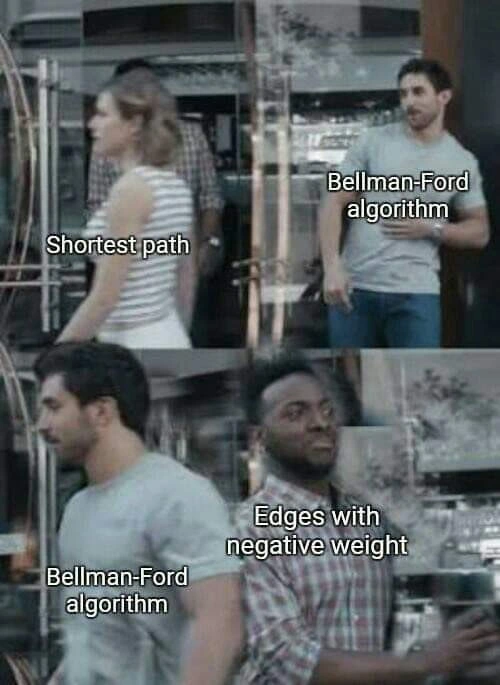
Let’s connect this to the meme scene: the woman labeled “Shortest path” walking away and the guy (Bellman-Ford) not reacting represents the typical situation where Bellman-Ford isn’t particularly special. If all weights are normal (non-negative), finding a shortest path is a pretty ordinary task that other algorithms handle faster, so our Bellman-Ford “guy” is just hanging out, not really needed. Now, in the next panels, another character shows up labeled “Edges with negative weight”. This is the cue for Bellman-Ford to suddenly turn his head, meaning the Bellman-Ford algorithm cares a lot when negative weights are involved. Why? Because it’s practically the algorithm’s job to deal with that scenario. Bellman-Ford is the one you call when a graph has a negative-weight edge and you still need correct results. In simpler terms, Bellman-Ford gets used when the graph has some tricky roads that actually reduce cost – something the faster algorithms can’t handle.
To a newcomer, it might be weird that we even consider negative weights. But think of scenarios beyond physical distance: maybe edges represent profit/loss or changes in some quantity. For example, say each edge is a currency exchange rate fee (and a negative weight means you gain money in an exchange). If you find a way to exchange currencies in a cycle and end up with more money than you started (a profit cycle), that’s a negative cycle in graph terms. Bellman-Ford would catch that by seeing distances (or costs) keep going down round after round. Dijkstra’s method, by contrast, might get the wrong idea because it would assume once you found a decent exchange route, it’s final, not realizing a later step could lead to a profit.
In summary, Dijkstra is wonderful for most shortest path problems – it’s fast but assumes no weird negative roads. Bellman-Ford is slower but more flexible: it works even when some paths might subtract cost. The meme humorously personifies these algorithms: Bellman-Ford is like “I’m not interested in the ordinary stuff, but I’m all ears when negative edges show up, because that’s when I get to be the hero.” For someone learning algorithms, the key point is: use Bellman-Ford when your graph might have negative weights (and no negative cycles), otherwise stick with faster methods. The meme just dramatizes that advice with a fun visual metaphor.
Level 3: Edges with Benefits
For the seasoned developer or CS student, this meme elicits a knowing grin because it captures a classic algorithmic gotcha. In day-to-day work or coding interviews, finding the shortest path in a graph usually means whipping out Dijkstra’s algorithm – it’s fast and reliable as long as all edge weights are non-negative (most real-world distances or costs can’t be negative, after all). Bellman-Ford, on the other hand, is that algorithm you learned in school that’s slower and usually sits on the bench. You only dust it off for those special cases. The meme shows exactly that dynamic: Bellman-Ford (the muscular guy leaning by the door) is minding its own business, ignoring the usual shortest path problems passing by, because honestly, Dijkstra and other algorithms have those covered more efficiently. But wait – who’s that coming into frame? It’s an edge with negative weight (the other passer-by). Suddenly Bellman-Ford whips his head around, laser-focused. Now you have his attention!
This is funny to us because it’s so true in practice. If you’ve ever implemented graph algorithms, you likely default to Dijkstra for shortest paths, only considering Bellman-Ford when you hear the words “negative weights”. It’s like an inside joke among programmers: “Need shortest paths? Use Dijkstra… unless there’s a sneaky negative edge, then it’s Bellman-Ford’s time to shine.” The meme’s labels boil it down perfectly. We picture Bellman-Ford almost bored, thinking “call me when something weird happens”. The moment a negative weight edge appears, Bellman-Ford is like “Hold on, did someone say negative? Step aside, I got this.”
Why is this scenario so relatable? Because many of us have learned it the hard way. Imagine you’re in a coding interview or a programming contest and the problem asks for shortest paths. You confidently code up Dijkstra’s algorithm – it’s blazing fast. But your solution fails the tests. The hidden twist? There were negative edge weights in the input! That’s the kind of curveball that separates the juniors from the seniors. Experienced folks immediately think: “Negative weights? Okay, use Bellman-Ford (or another strategy) because Dijkstra will give the wrong answer.” The meme captures that “Aha!” moment: Bellman-Ford finally paying attention is like the algorithmic equivalent of an old expert waking up when an exotic problem lands on the table.
In team discussions or system design, it’s similar. Most of the time, you choose the efficient tool. But everyone on the team knows there’s that one scenario where the usual tool breaks. It’s almost humorous how predictable it is: “We have to allow negative costs? Alright, time to bring out Bellman-Ford.” There’s even an analogy in network routing: distance-vector protocols (like the old Routing Information Protocol) use Bellman-Ford’s approach to handle dynamic path costs (and they had to handle negative changes and count-to-infinity problems), whereas link-state protocols use Dijkstra but assume all link costs are positive. Seasoned network engineers and algorithm enthusiasts alike nod at this: each algorithm has its domain.
The “edges with benefits” phrasing is apt because a negative-weight edge is essentially a road that gives you a bonus instead of a cost – like a sale or rebate on a path. Seasoned devs know that such “free lunch” edges can wreak havoc on greedy algorithms. We’ve seen bizarre cases like currency arbitrage being modeled as a graph with exchange rates: you take the log of rates (to sum them along a path), and a cycle that multiplies money ends up as a negative cycle in that graph. Dijkstra wouldn’t catch the arbitrage opportunity, but Bellman-Ford will – it will detect the negative cycle that signifies “infinite profit” by looping exchanges. So Bellman-Ford literally finds money where Dijkstra sees none. No wonder he’s suddenly interested when negative edges show up!
From an experienced perspective, the meme also hints at the trade-off we constantly juggle: performance vs capability. Bellman-Ford’s double-take at negative edges says, “sure, I’m slower, but I’m the one for this job.” In Big-O terms, if you recall your AlgorithmComplexityAnalysis, Bellman-Ford is (O(V \times E)) – not exactly lightweight – whereas Dijkstra (with a binary heap) is about (O(E \log V)). In a big graph that difference is huge. So no sane engineer uses Bellman-Ford on a million-node network if they can avoid it. But if negative weights are part of the spec, you have to use an algorithm like Bellman-Ford (or Johnson’s algorithm or Floyd-Warshall for all-pairs) because correctness trumps speed in those cases. It’s the classic tortoise and hare situation: the speedy hare (Dijkstra) wins most races, but can’t run on weird terrains; the tortoise (Bellman-Ford) takes its time and can go anywhere, even through those weird negative valleys.
In essence, this meme lands because it anthropomorphizes our algorithms and pokes fun at how Bellman-Ford is largely overlooked until a very specific condition arises. Seasoned devs find it funny that we talk about algorithms like they have feelings: “Bellman-Ford doesn’t care about your graph… until you introduce some drama (negative weights) – then he’s all in.” It’s a slice of ComputerScienceHumor that captures a common narrative in algorithm design: the slower, robust solution waiting in the wings while the fast solution steals the show, until an edge-case plot twist suddenly flips the script.
Level 4: The Negative Edge Case
On a deep theoretical level, this meme riffs on the shortest path problem in graphs and how different algorithms handle a tricky scenario: negative edge weights. In algorithm design terms, a negative-weight edge is like an unusual rule that can decrease the path cost instead of increasing it. This breaks the normal greedy assumptions many algorithms rely on. Dijkstra’s algorithm, for instance, assumes all edge weights are non-negative; it greedily selects the nearest node and never revisits it, because in a world of positive weights, once you’ve found a shortest route to a node, any later path will only be longer. But introduce a negative-weight edge (a sneaky shortcut that actually reduces cost), and that assumption collapses. Dijkstra might declare a path “shortest” too early, missing an even cheaper route that loops through that negative edge. The result? Dijkstra gives wrong answers or gets very confused.
This is where the Bellman-Ford algorithm shines. Bellman-Ford doesn’t make the greedy mistake of “settling” distances prematurely. Instead, it takes a dynamic programming style approach: it systematically relaxes every edge, over and over, up to (V-1) times (where V is the number of vertices). Relaxation means checking if a path to v can be improved by going through some neighbor u (in formula form: update dist[v] = min(dist[v], dist[u] + w(u,v)) for each edge ((u,v))). By repeating this, Bellman-Ford progressively considers paths of length 1 edge, 2 edges, 3 edges, ... up to (V-1) edges, ensuring that even far-fetched routes that take many hops (like those sneaky ones involving negative edges) are accounted for. It’s essentially solving a system of difference constraints – finding a distance assignment that satisfies (dist[v] \le dist[u] + w(u,v)) for every edge. If a shorter path exists via a negative weight, eventually one of these relaxation rounds will catch it.
The algorithm’s piece de résistance is how it handles the really weird case: negative cycles. A negative cycle is a loop whose total weight sum is negative, meaning you could run around it forever, subtracting cost each time – essentially an infinite reward. If such a cycle is reachable, the notion of “shortest path” to some nodes isn’t well-defined (you can keep going around the loop to push cost towards negative infinity!). Bellman-Ford has a built-in final check: after (V-1) rounds, it does one more pass through the edges. If any distance can still be improved on this (V^{th}) iteration, it means “aha, there’s a cycle that keeps reducing cost!” – in other words, a negative cycle exists. No purely greedy algorithm can detect this so elegantly. This theoretical insight – that after shortest paths of up to length (V-1) have been considered, any further improvement signals a cycle – is a profound result in graph theory and is exactly why Bellman-Ford pays attention when negative weights are around.
From a complexity standpoint, Bellman-Ford is the heavy-duty tool. It runs in O(V · E) time (outer loop of V-1 iterations times E edges), which in the worst case (a dense graph) is (O(V^3)). Contrast that with Dijkstra’s efficient O(E \log V) (using a min-priority queue) or (O(V^2)) in simpler implementations. That’s a massive difference for big graphs. Why pay this cost? Because Bellman-Ford guarantees correctness even when weights can be negative. It’s the price of generality: by not assuming positivity, it has to work harder. The meme humorously personifies this trade-off: Bellman-Ford (the algorithm, depicted as the guy hanging back) isn’t the fastest or first choice if all is well (all weights positive). But in the edge case (pun intended) of a negative weight appearing, the problem fundamentally changes – and Bellman-Ford’s more exhaustive approach becomes not just relevant, but necessary. Academic papers and algorithm textbooks highlight this scenario as a classic lesson: greedy vs dynamic programming, efficiency vs generality. The Bellman-Ford algorithm was originally published by Richard Bellman and Lester Ford (and independently by others) in the late 1950s, and it epitomizes the dynamic programming ethos: systematically explore all possibilities, at the cost of more work, to handle cases that greedy methods can’t. In summary, on a theoretical level, this meme is nodding to the “negative edge” case in shortest-path algorithms – a scenario where fundamental constraints of algorithm design (like non-negative weights for Dijkstra) suddenly shift, and a more robust algorithm (Bellman-Ford) finally steps into the spotlight.
Description
This meme uses a two-panel format, a variation of the 'distracted boyfriend' template. In the top panel, a man labeled 'Bellman-Ford algorithm' is walking with a woman labeled 'Shortest path'. In the bottom panel, the same man ('Bellman-Ford algorithm') looks back with interest at another person who has just walked by, who is labeled 'Edges with negative weight'. The humor is rooted in computer science graph theory. The Bellman-Ford algorithm is designed to find the shortest path in a weighted graph. While other algorithms like Dijkstra's are generally faster, their major limitation is that they cannot handle graphs with edges that have negative weights. Bellman-Ford's specific advantage and primary use case is its ability to correctly solve the shortest path problem in the presence of such negative edges. The meme hilariously personifies the algorithm as being specifically 'distracted' or 'attracted' to the very problem it is uniquely suited to solve, forsaking the more generic 'Shortest path' goal for its niche
Comments
7Comment deleted
Bellman-Ford runs in O(VE) time. It's not the fastest, but it takes its time to appreciate the negativity in life that Dijkstra just can't handle
Bellman-Ford is that grizzled architect everyone ignores during the shiny O(E log V) demos - right up until a negative edge hits the budget and they’re suddenly fine paying O(V·E) for hazard pay
Bellman-Ford is like that senior engineer who insists on supporting every edge case in the requirements doc, then spends the next sprint explaining why the build takes 30 minutes longer than Dijkstra's team
The Bellman-Ford algorithm is that one engineer who insists on handling every edge case - literally. Sure, Dijkstra's algorithm is faster and gets the job done 99% of the time, but Bellman-Ford can't resist the allure of negative weights, running V-1 iterations just to make absolutely certain no negative cycle ruins the party. It's the difference between shipping fast and shipping paranoid - sometimes you need that extra pessimism when your graph data comes from untrusted sources or represents arbitrage opportunities in currency exchange
Bellman - Ford is that senior who accepts O(V·E) meetings to accommodate one negative requirement and cancels the launch the moment it smells a negative cycle
Dijkstra ghosts at negative weights; Bellman-Ford relaxes all edges till cycle drama unfolds
Bellman-Ford is that senior who ignores the happy path and spends V-1 passes checking everyone's baggage - then pages you only if there's a negative cycle