Skip to content
DevMeme
289 of 7435
When Legacy Systems Meet the Upgrade Culture
Modernization Post #346, on Apr 29, 2019 in TG

When Legacy Systems Meet the Upgrade Culture

Why is this Modernization meme funny?

Level 1: Shiny New vs Old Reliable

Imagine you have an old favorite toy or tool that still works perfectly well. Maybe it’s a comfortable old bicycle you ride every day. Now your friend zooms up on the latest hoverboard and says, “You should upgrade to this, it’s way cooler!” That’s the situation here, but with zebras. One zebra has his normal stripes – that’s like your trusty old bike or beloved old toy. The other zebra has a flashy new pattern (a QR code, which is a fancy square barcode) – that’s like the shiny new hoverboard. The QR-code zebra is basically telling his friend, “Throw away those boring stripes and get this new thing!”

It’s funny because we can tell the striped zebra is tired and skeptical. It’s as if he’s thinking, “My stripes have worked just fine all my life… why do I need a change?” We laugh because the idea of a zebra changing its stripes to keep up with a trend is silly. It’s like telling someone’s grandma to ditch her comfy old sweater and start wearing the latest high-tech jacket with LEDs – pretty ridiculous, right? The emotional core of the joke is familiar to everyone: sometimes people push others to adopt new fashions or gadgets for no good reason. If the old way isn’t broken, do we really need to fix it? The poor zebra with stripes is the voice of common sense here, and the QR-zebra is that one friend who’s always after the newest, shiniest thing. The meme is showing in a very simple way that new doesn’t always equal better, especially when you’re perfectly happy with the old. And that little truth is what makes it both funny and easy to relate to – even a kid can understand why a zebra with a QR code is a goofy idea!

Level 2: Barcodes vs QR Codes

This meme uses two zebras to represent an old way and a new way of storing information, especially data formats. The zebra on the left has normal stripes, which represent something like a classic barcode. In real life, a barcode is those black-and-white vertical lines you see on product packages – essentially a machine-readable label. It encodes a small amount of data (usually just an ID number) in a simple visual pattern that a laser scanner can read. It’s old-school but very reliable. That’s our “legacy” in the picture: the idea that if something works, we keep it.

Now, the zebra on the right has a QR code on its body instead of stripes. A QR code (short for “Quick Response code”) is that square, pixelated pattern you might scan with your phone to open a menu or a website. It’s like a modern 2D barcode, capable of holding a lot more information. For example, while a regular barcode might just store a product number like 123456, a QR code could encode a whole sentence or a URL like https://example.com. Also, you can scan a QR code from any direction with a camera, which is super handy. So in the meme, the zebra with the QR code is essentially showing off a high-tech upgrade to the basic stripe pattern. The right zebra is telling the left one to “upgrade, man!” – meaning, ditch those old stripes (old tech) and get with the new QR-style program (new tech).

For a junior developer, it helps to connect this to formats or tools you might encounter when dealing with data. Think of a simple text-based format like CSV (Comma-Separated Values) or even older XML files – these are like the zebra’s stripes: straightforward, easy to read, and they’ve been around forever. Now think of a newer format like JSON (JavaScript Object Notation) or a shiny new protocol like GraphQL. These are more structured or have more features – they’re like the QR code: more complex but also more powerful. The meme humorously compares ModernVsLegacy approaches. The striped zebra represents the legacy method that still works (even if it's a bit old-fashioned), whereas the QR-patterned zebra represents the modern approach that everyone’s buzzing about.

When the QR zebra says "UPGRADE MAN!", it’s just like a scene many of us have experienced in the tech world. Imagine you just got comfortable with one framework or tool, and then a well-meaning colleague comes along and says, "Why are you still using that? We should use this new library, it’s so much better!" For example, maybe you wrote a script in Python that outputs data in a simple CSV, and a teammate suggests, "Hey, we should make it output JSON instead, that’s the cool standard now," even if the CSV was working fine. Or you’re maintaining an older project using PHP, and someone nudges you, "We ought to rewrite this in Node.js, it's the modern way." As a newcomer, you might feel a bit like the left-hand zebra – being told your perfectly fine stripes are somehow not good enough just because something new came along.

So what is this comic really pointing out? It’s highlighting the common pressure in tech to adopt the latest thing. This is the modernization push: even if an older system or format is stable, people will often talk about replacing it with a newer one. Sometimes that brings real improvements (new tools can be faster, more secure, or easier to use in the long run). But other times, it’s done mainly because of hype — everybody’s talking about it, so it feels like we have to jump on the bandwagon. As a junior dev, you might not have a lot of legacy code experience yet, but you’ll definitely hear these conversations. It can be confusing: should you refactor everything just because a new tech came out? The striped zebra’s skeptical face is basically saying, "Are you sure this is necessary?"

Let’s break down the characters in simple tech terms:

  • Zebra with stripes (left) – This is like an old but reliable system or format. For instance, an application written in an older language, or data stored in a simple format like a CSV file. It might not be fancy, but everyone understands it and it gets the job done.
  • Zebra with QR code (right) – This represents the new or trending technology. It’s the friend who’s early-adopting the latest framework or the newest data encoding. For example, a service switching to send data in JSON or a brand new microservice architecture, just because that’s what’s “in vogue” now. It has more features (like the QR code can store more data), but it’s also more complex.
  • "Upgrade, man!" – This phrase is the direct peer pressure to modernize. It’s what you hear when someone insists you must move off the old system. Maybe something like, "We must migrate from a monolith to microservices this quarter," or "Why are we using SQL? Let’s move to NoSQL, it’s what all the cool projects do." It’s often said with good intentions — after all, who doesn’t want improvements? — but it can come off as pushy when the benefits aren’t obvious.

As a newer developer, the key takeaway from this meme is a mix of advice and amusement: don’t feel bad if you’re working with “legacy” tech, and don’t race to change things just for the sake of change. Yes, you’ll routinely encounter new, exciting tools and you should definitely learn about them. But as the grumpy striped zebra hints, it’s okay to ask “Why?” before jumping into an upgrade. The comic exaggerates the scenario to make you laugh – I mean, a zebra getting a QR code is a pretty ridiculous upgrade! – and that exaggeration carries the message: sometimes upgrade fever in tech can be just as ridiculous. The old stripes were working; the new pattern, while cool, might not actually solve a real problem. It’s a funny reminder that newer isn’t always better by default, especially if the old solution wasn’t actually causing pain.

In short, if you ever feel like the only one not rewriting everything in the latest framework, remember the zebra. It’s okay to pace yourself. Change is constant in technology, but good engineering is about choosing the right changes, not just following every trend. The meme uses a simple visual joke to convey that feeling – and once you’ve had a few experiences with "forced upgrades", you’ll likely chuckle in agreement and maybe share this cartoon with a knowing smile.

Level 3: Legacy Stripes vs QR Hype

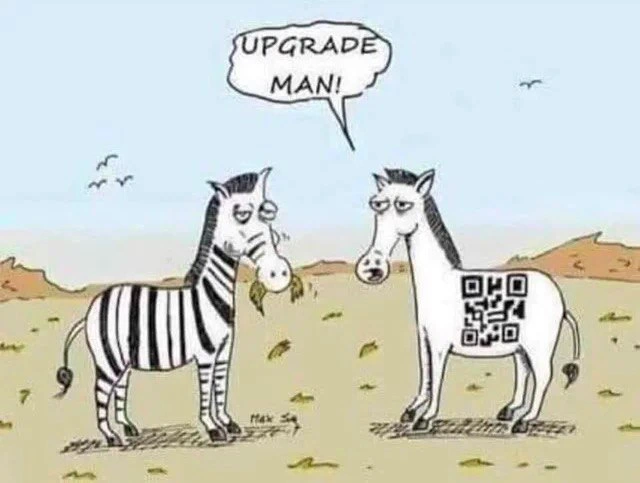
In this tech humor cartoon, a weary zebra with classic black-and-white stripes stands next to a zebra whose coat has been replaced by a giant scannable QR code. The QR-coded zebra casually says:

"UPGRADE MAN!"
— encapsulating the relentless push for modernization in our industry. This absurd image perfectly satirizes the tension between reliable legacy solutions and the latest hype-driving IndustryTrends.

At its core, the meme is about evolving DataFormats under peer pressure. The left zebra’s natural stripes are analogous to an old, stable technology or data format – something like a plain-text CSV file or a trusty XML config that’s been around forever. It's not glamorous, but it's dependable and universally understood (just like every zebra’s stripes pattern). The right zebra’s flashy QR-code patch represents the new tech du jour – think JSON or a shiny binary protocol like gRPC – basically any "modern" spec that promises to encode more data more efficiently. It’s literally a legacy_to_modern_encoding on four legs.

Data formats are at the heart of the joke: zebra stripes evoke the look of a traditional barcode – those one-dimensional black lines you find on grocery items – while the QR code is a newer two-dimensional matrix loaded with information. A standard barcode (old stripes) holds a limited ID number and has virtually no error tolerance (a single scratch can make it unreadable). A QR code, by contrast, can store far more data (URLs, text, even Wi-Fi passwords) and includes built-in error correction (thanks to Reed–Solomon codes, it can be scanned even if part is damaged). It’s a genuinely more advanced encoding scheme. But does a zebra really need to encode a URL on its side? Probably not. The humor kicks in because no zebra naturally needs a high-tech upgrade; this forced zebra_barcode_metamorphosis is clearly overkill when stripes were doing the job for millennia. It’s modernization mania taken to an absurd extreme: the poor striped zebra is being asked to adopt a complex solution to a problem that doesn’t exist.

For seasoned developers, this scene triggers a knowing grin. We've all encountered the colleague or manager pushing to "upgrade" something that already works fine. It's relatable humor for anyone who’s been urged to replace a stable legacy system with whatever is trending on Hacker News that week. The exhausted expression of the striped zebra says, "I’ve seen this nonsense before," while the QR-coded zebra is like that tech evangelist who just came back from a conference, hyped about the latest IndustryTrends in data encoding, cloud architecture, or whatever the buzzword of the month might be. The combination of these elements is funny because it’s true: in tech, modernization is often driven more by fashion than by actual need. The industry sometimes treats technology adoption like a savanna fashion show – new patterns are all the rage this season. One year SOAP and XML web services are everywhere; the next year those are considered archaic and everyone is yelling to use REST with JSON, and a year after that GraphQL or gRPC is the "must-have" upgrade. We’ve seen plain old CSV files (simple comma-separated text) get shunned as teams clamor to stream data in JSON or store it in some fancy binary format like Parquet because it’s the cool new thing, even if CSV was doing the job just fine.

The meme nails this pattern by exaggerating it. Swapping zebra stripes for a QR code is like replacing a simple, time-tested tool with a complex new one purely for the sake of modernity. The right-hand zebra genuinely believes he’s helping: "Come on, join the future!" But the left zebra looks unconvinced, reflecting the skepticism of an engineer who knows that upgrading often isn’t as simple or beneficial as it sounds. There’s unspoken trauma hidden here: any senior dev who’s lived through a big "system upgrade" or migration knows it can be a nightmare of broken dependencies, data conversion issues, and late-night fire-fighting. Yet the cheerleaders for change (like our QR zebra, happily munching grass) tend not to mention those gritty details. It mirrors that scenario where an excited architect proclaims a bold migration ("Let's re-write everything in Rust because Rust is faster!"), and then the team that actually has to do it feels as beleaguered as a zebra asked to change its stripes.

The cartoon also hints at the unintended consequences of chasing hype. A zebra’s stripes aren’t just for show – in the wild they serve as camouflage and identity. Painting a big blocky QR code on a zebra might make it stand out more (so much for blending in!), defeating the original purpose of stripes. Likewise, in software, slapping a trendy new tech onto a stable system can introduce new problems: performance issues, security vulnerabilities, loss of clarity, etc. It’s as if the zebra lost its natural protection just to look "cool." Everyone familiar with legacy systems has seen something like this: for example, ripping out a simple, robust relational database and replacing it with a convoluted NoSQL cluster because everyone’s doing NoSQL now – even if the data didn't need that kind of change. Suddenly, things that were simple become complex (just as our zebra’s life might become complex when predators can spot his QR coat from a mile away).

Ultimately, the meme gets a laugh (and a groan) from veteran developers because it captures a cycle we know too well. Today’s hot framework or data format (QR codes! microservices! blockchain, anyone?) is tomorrow’s legacy burden. The QR-code zebra might feel superior now, but give it a few years – maybe an even newer pattern or technology will come along (imagine a zebra with an AR marker or a blockchain-powered stripe pattern) and then the QR zebra itself becomes the outdated one. There's an ironic justice in that: the once-trendy tech becomes the old guard facing replacement. This cycle of ever-churning trends is the lifeblood of inside jokes among experienced devs. We laugh at this comic because it’s a playful reminder of how absurd the “upgrade or die” mentality can be. It pokes fun at our field’s obsession with novelty, urging us to admit that sometimes replacing Old Reliable with Shiny New is as silly as painting a perfectly good zebra with a QR code. After all, if the old stripes weren’t broken, why fix the zebra?

Description

A single-panel cartoon depicting two zebras in a desert-like landscape. The zebra on the left has traditional black and white stripes and looks tired, chewing on some grass. The zebra on the right is mostly white but has a large QR code on its side instead of stripes. It has a smug, superior expression and is saying, 'UPGRADE MAN!' in a speech bubble. The cartoon humorously analogizes technological evolution and the pressure to modernize. The striped zebra represents a legacy system - proven, functional, but considered outdated. The QR code zebra represents the new, upgraded technology, which is often pushed with an air of superiority. This scenario is relatable to experienced developers who have seen countless 'upgrades' and 'next-gen' solutions pitched, and who understand the trade-offs between adopting new trends and maintaining stable, well-understood legacy systems
Comments

8
Anonymous ★ Top Pick The striped zebra's pattern is a fault-tolerant, distributed system that's been in production for millennia. The QR code zebra requires a client-side scanner and has a hard dependency on a third-party API that's probably hosted in us-east-1
  1. Anonymous ★ Top Pick

    The striped zebra's pattern is a fault-tolerant, distributed system that's been in production for millennia. The QR code zebra requires a client-side scanner and has a hard dependency on a third-party API that's probably hosted in us-east-1

  2. Anonymous

    We just rotated the zebra’s perfectly fine 1-D stripes by 90°, added error-correction, rebranded it “QR-as-a-Service,” and management calls it digital transformation

  3. Anonymous

    The new zebra's stripes are now serverless, auto-scaling, and cost 10x more to maintain than the original implementation that worked perfectly fine for 50 million years

  4. Anonymous

    Classic migration story: the barcode still scans fine everywhere, but the QR guy insists you adopt his format because it 'holds more data' nobody asked for

  5. Anonymous

    This perfectly captures the modern software 'upgrade' experience: ship a horse with a QR code and call it progress, while the legacy zebra - complete with all its stripes compiled in - looks on in disbelief. It's the architectural equivalent of replacing your monolith with microservices, then realizing half your features now require an internet connection and three API calls just to render. The zebra represents on-premise, fully-featured software; the horse is your SaaS MVP that's perpetually 'one sprint away' from feature parity

  6. Anonymous

    PM's genius fix: slap QR codes on the legacy monolith - now 'modern,' until the first scanner library deprecation

  7. Anonymous

    Classic migration: we upgraded the zebra’s 1D stripes to a 2D QR, shipped a semver-major without a deprecation window, and discovered every downstream consumer (lions) only supports EAN-13

  8. Anonymous

    Upgrade, man: migrating the zebra from unstructured stripes to QR-coded metadata - observability improved, camouflage deprecated; turns out the lions’ client supports scanning

Use J and K for navigation