When being nice triggers the software engineer's conspiracy theorem mode
Why is this Communication meme funny?
Level 1: Just Being Nice
Imagine a very shy kid at school who usually keeps to themselves and focuses on their own activities, like building puzzles or reading, instead of playing with others. One day, another child comes up to them with a big smile, offers to share a cookie, and says, “Hey, you can join our game if you want!” Now, a kid with good social skills would just think, “Oh, how nice, they want to be friends!” But our shy kid isn’t used to this kind of friendly approach. They might straightaway get suspicious and think, “Why are they being so nice to me? Is this a trick? Do they secretly want something from me?”
Of course, in reality, there’s no secret plan – the other child is just being friendly and trying to include them. The shy kid is looking for an ulterior motive that isn’t there, simply because they’re not familiar with people just being nice for no special reason. This is exactly what the meme is joking about, but with software engineers instead of schoolchildren. It’s saying that some engineers are like that shy kid: they’re so unused to ordinary friendliness that when a coworker or boss is just being kind or pleasant, they react with confusion or distrust, almost as if someone is trying to play a trick on them. The humor comes from how silly that is – most of us know that being nice usually just means someone is kind or wants to be polite, not that they’re plotting something. So, the meme is funny because it exaggerates a real feeling in a way anyone can understand: it’s like a person who’s not used to kindness thinking, “Uh oh, why are you smiling at me… what are you up to?” when really, there’s no scheme at all. It’s just a little reminder that sometimes a “hello” or a smile is just that – just being nice.
Level 2: Soft Skills Not Found
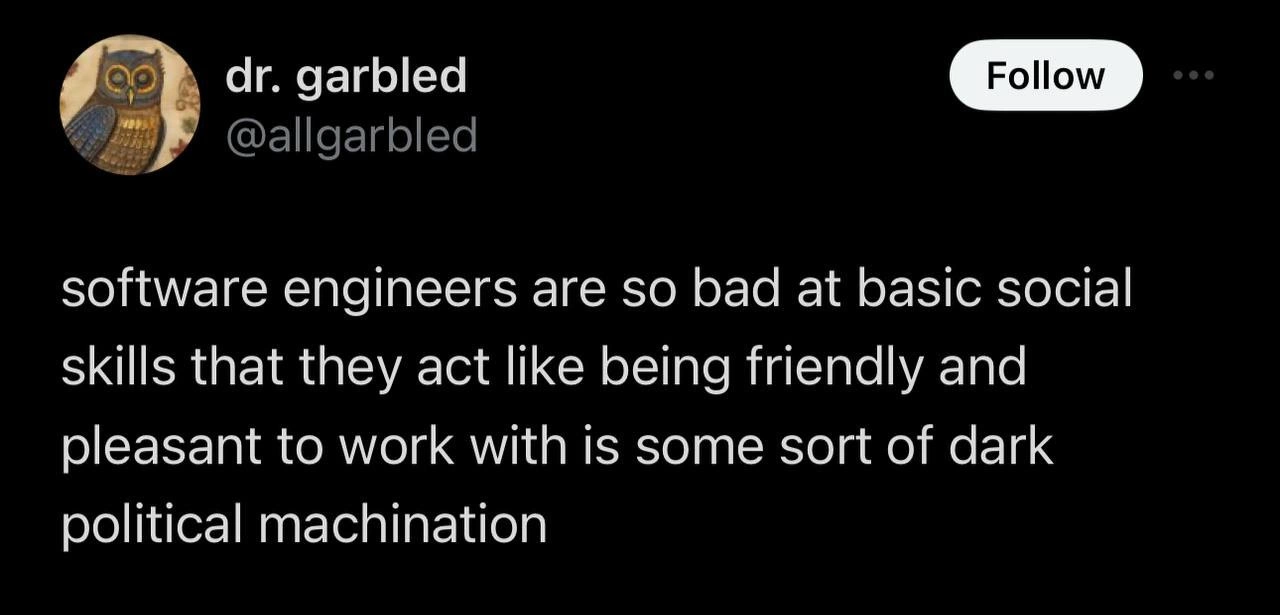
At its core, this meme is pointing out that a lot of software engineers struggle with basic social skills, and it’s joking about how they might overreact to normal friendliness. The tweet says that engineers sometimes act like being friendly and pleasant to work with is a “dark political machination.” In plainer words, some developers are so unused to social niceties that when someone is simply nice or easy to work with, they suspect there’s a hidden agenda or office politics trick behind it.
Let’s break down some terms. “Basic social skills” means simple polite behaviors — things like saying hello, smiling, asking how your day is, listening to others, or being generally pleasant and cooperative. Many people use these skills every day without thinking about it. But there’s a stereotype (a commonly held image) that developers or engineers are not very good at these soft skills. Soft skills refer to people skills like communication, teamwork, and empathy (as opposed to hard skills like knowing a programming language or how to optimize an algorithm). When the meme says engineers are “so bad” at social skills, it’s using hyperbole (exaggeration) for comedic effect — implying that some engineers might be almost clueless or at least under-practiced when it comes to things like small talk or giving compliments.
Now, the phrase “dark political machination” sounds dramatic. “Political machination” basically means a sneaky or complicated scheme to gain power or advantage, often used in the context of office politics (where people might try to personally benefit under the guise of normal work interactions). By saying engineers act like friendliness is a dark machination, the tweet humorously suggests that these engineers interpret a coworker simply being nice as if it were some evil plot or manipulative strategy. It’s like thinking, “There’s no way they’re genuinely being nice — they must want something or be scheming!” The word “dark” adds an extra layer, implying a secretive, possibly unethical intention. Of course, in reality, someone saying “Good morning, how are you?” is usually just being polite, not executing a master plan to take over the team. But the joke is that to an engineer who lacks social confidence, even that normal friendliness can seem suspicious or confusing.
This reflects a communication gap that can happen in tech workplaces. A communication gap means there's a disconnect in how people understand each other. In many tech teams, people focus heavily on technical work and factual, task-oriented communication. For example, developers might be very direct when discussing code (“This function is too slow, we need to optimize it”) and there’s often less emphasis on pleasantries or emotional nuances. Some engineers even pride themselves on being “brutally honest” or only caring about logic and facts. In an environment like that, someone who is very friendly, asks personal how-you-are-doing questions, or gives a lot of positive feedback might stand out. The others might not know how to respond or might wonder if there’s a motive behind this behavior, since it's not the norm for them. It’s a bit like a cultural difference: one person is speaking the language of friendliness, and the other is so unfamiliar with it that they think, “This seems strategic. Why are they doing this?”
For example, if a new project manager comes in and is extremely pleasant — always smiling, complimenting the team, and remembering everyone’s birthdays — a few engineers on the team (especially those who have been in very no-nonsense, purely technical environments) might joke privately, “Alright, what’s this person up to? Are they trying to win us over for some reason?” They might half-seriously suspect that the manager is being nice just to get them to accept extra work or to avoid blame later on. In reality, the manager could just genuinely have good people skills and believe in keeping morale high. But because these engineers haven’t often encountered that style, they interpret it through a lens of skepticism. The meme exaggerates this dynamic for humor: it implies engineers practically think being nice is a calculated move, like something you’d do only to gain political advantage.
It’s funny to many people in tech because it’s an exaggeration of a real developer culture phenomenon. A lot of developers will chuckle at this because they recognize a bit of truth in it. They’ve maybe met a colleague who was amazingly skilled at coding but terribly awkward in social situations. Perhaps that colleague did actually get nervous or defensive when someone else was cheerful or diplomatic, accusing them of “playing politics”. The meme is essentially saying, “Engineers sometimes get so deep into their logical, coding mindset that they treat normal friendly behavior as an unusual event or even a threat.” It’s highlighting the importance of soft skills (and the lack thereof) in a tongue-in-cheek way. After all, being “friendly and pleasant to work with” is usually considered a positive trait in the workplace, not something devious. So the humor comes from this role reversal: what most people see as positive (being nice), a stereotypical engineer humorously frames as negative or suspicious.
In simpler terms, the tweet jabs at the social awkwardness that can exist in the tech world (WorkplaceCulture in tech can be a bit geeky and not always socially polished). It’s reminding us that while writing good code is important, basic human kindness shouldn’t be so rare that it confuses people! The fact that some engineers could interpret politeness as trickery is both a joke and a gentle critique — suggesting maybe tech folks should work on communication skills and not treat every friendly gesture like a hidden bug in the program.
Level 3: Politeness Paranoia
In the depths of tech corporate culture, basic friendliness can trigger more alarms than a failed unit test. This meme zeroes in on a classic developer stereotype: some software engineers have such a soft skills deficit that they perceive simple collegial kindness as a suspicious act. The tweet’s punchline – engineers acting like “being friendly and pleasant to work with is some sort of dark political machination” – hits home because many seasoned devs have communication habits as blunt as a git rebase in the wrong branch. They’re more fluent in Python or C++ than in “hello” and “thank you,” so when a co-worker is unusually cheerful or cooperative, these engineers involuntarily switch into conspiracy theorem mode. It’s as if normal kindness doesn’t compile in their world without errors.
Why is this funny (and a bit tragic) to senior engineers? Because it satirizes a truth about our industry’s social dynamics. Engineering teams often pride themselves on logical thinking and direct communication. There’s an unwritten rule in some dev circles: if it’s not in the design spec or the sprint backlog, it doesn’t exist. Since being warm and pleasant to work with isn’t a JIRA ticket, any extra friendliness can feel like an out-of-scope feature. The result? A teammate saying “Good morning!” might get side-eyed as if they just deployed some malware office politics. A simple compliment like “Nice job on that feature!” is met with internal queries of “Alright, what do they really want?”. In meetings, a manager trying to foster team bonding (“How was your weekend?”) might be met with tense silence and thoughts of “Is this guy buttering us up for overtime?”. The humor here comes from how extremely some engineers misinterpret normal coworker behavior – treating a kind gesture like a cleverly masked refactoring that’s bound to introduce bugs later.
This skepticism didn’t arise in a vacuum. Many developers have witnessed or heard of dark political machinations in the workplace – e.g. a colleague who feigns friendship to gain favor or the charismatic manager who smooth-talks their way up the ladder. After getting burned once, experienced engineers become jaded: they keep their guard up, parsing every friendly interaction like it’s code with a hidden bug. Tech culture historically valorized the lone genius coder who’s glued to the screen, not the social butterfly. As a result, plenty of brilliant devs never quite polish their soft skills. When someone comes along who has those people skills, the reaction can be, “This is too nice to be normal… must be a trap.” It’s a form of politeness paranoia birthed by years of prioritizing machines over humans. In security, we say “never trust user input”; in some dev teams the unspoken motto is “never trust cheerful input from a colleague”. They treat kindness like unvalidated data – something to be sanitized or outright rejected.
To seasoned programmers, this joke also exposes a systemic communication gap. Organizations talk about the importance of collaboration and being “team players,” but those qualities rarely receive the same attention as shipping features. There’s no CI/CD pipeline for deploying empathy. Soft skills training often falls by the wayside, and you won’t find a commit titled “Add friendliness to interpersonal module”. With such skewed priorities, engineers can become socially underdeveloped – their WorkplaceCulture doesn’t reward saying “nice job” or listening actively, so they might even view those who do as playing some 4D chess version of office politics. The meme nails this absurdity. It’s exaggeration, of course, but not far off from war stories you’ll hear at meetups: “We once had a dev who thought our new hire was plotting against the team because he remembered everyone’s birthdays and smiled too much.” This brand of developer humor resonates because it pokes fun at a real tension: highly analytical minds misreading normal human warmth as a strategic gambit.
Let’s translate that paranoia into code for a laugh:
# Suspicious engineer's brain pseudocode:
if colleague.is_friendly() and colleague.is_pleasant():
raise Alert("dark_political_machination_detected")
Seen through a veteran lens, it’s both comical and a little sad. On one hand, we chuckle because we’ve met the brilliant coder who can invert a binary tree but freaks out when someone simply asks “How are you today?”. On the other hand, that reflex to suspect “political machination” highlights how some teams still struggle with basic communication and trust. Ironically, treating a friendly gesture like a malicious pull request isn’t great for teamwork. Yet, it keeps happening — partly because tech folks often don’t get social skills training, and partly because a dose of cynicism feels justified after weathering a few org chart shake-ups. So, when this tweet jokes about an engineer going full conspiracy-theorist over commonplace kindness, senior devs smirk knowingly. We’ve seen variations of this movie: the overly nice new manager greeted with cold suspicion, or the chatty teammate labeled as “political” just for engaging with others. In the end, the meme lands so well because it exaggerates a kernel of truth: in a world where many engineers trust logic over small talk, a simple smile or compliment can indeed look like a Machiavellian trick. As a battle-worn coder might put it, “I’ll believe it’s just genuine friendliness when it’s been code reviewed and all hidden agendas are resolved.” Until then, a surprising number of engineers will keep treating being nice as an unresolved bug in the system.
Description
Image is a screenshot of a dark-mode tweet UI. Top left shows a circular avatar of an illustrated owl, next to the display name “dr. garbled” and handle “@allgarbled”; a “Follow” button appears on the right. Tweet text in white reads: “software engineers are so bad at basic social skills that they act like being friendly and pleasant to work with is some sort of dark political machination”. The humor plays on the stereotype that highly technical engineers view simple collegiality as suspicious office politics, highlighting communication challenges many senior dev teams face when soft-skills aren’t part of the sprint backlog
Comments
10Comment deleted
The real reason we invented Slack reactions was so we could acknowledge kindness without having to parse the terrifying complexity of human small talk
The same engineers who can debug race conditions in distributed systems somehow view 'good morning' and 'how was your weekend?' as manipulative social engineering attacks requiring immediate threat assessment and mitigation strategies
This perfectly captures the engineer's dilemma: we can debug a distributed system's race condition at 3 AM, but someone saying 'good morning' with a smile triggers our threat detection algorithms. We've optimized for technical complexity while treating basic human kindness as a zero-day social exploit. It's the ultimate O(n²) problem - the more engineers in a room, the exponentially more suspicious everyone becomes of anyone who's just... nice
Calling basic kindness ‘politics’ is like labeling exponential backoff ‘manipulation’ - it’s how you keep distributed teams from thrashing
Friendly chit-chat in standup? That's just social engineering recon - deploy air-gapped responses until exploit intent is ruled out
After enough reorgs you start threat-modeling compliments - ‘Nice PR’ gets triaged as potential influence escalation; mitigation: leave an LGTM and actually mean it
I have never in my life seen a SE who acts like this Comment deleted
Then you haven’t seen the real ones Comment deleted
it is Comment deleted
Literally me Comment deleted