Skip to content
DevMeme
5667 of 7435
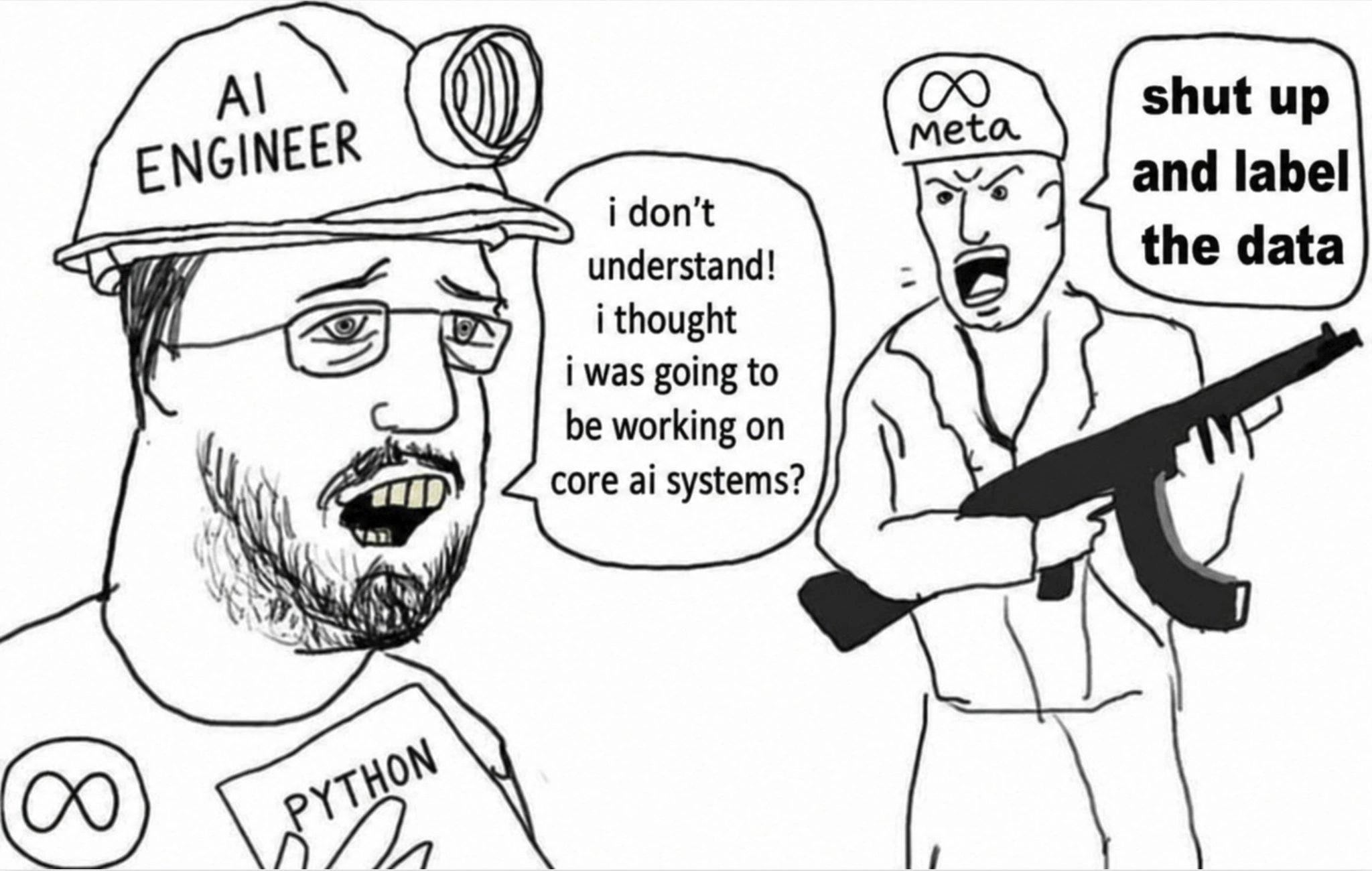
Bleeding-edge mandate meets Java-8 reality in classic window toss meme
CorporateCulture Post #6217, on Sep 1, 2024 in TG

Bleeding-edge mandate meets Java-8 reality in classic window toss meme

Why is this CorporateCulture meme funny?

Level 1: Fancy Tower, Shaky Base

Imagine you’re helping to build a really tall block tower with your friends. The friend in charge says, “Our tower should be the coolest and most advanced tower ever!” They start suggesting to add all these new, shiny blocks on top, maybe some blinking lights and a toy rocket – super fancy stuff to make the tower look awesome. Now, you look at the bottom of the tower and notice the lowest blocks are old and cracked, and the tower is wobbling a bit. So you say, “Hey, maybe we should fix the bottom blocks or replace them before adding more on top, so the tower doesn’t collapse.” But the friend in charge gets really mad at you for bringing that up. In the cartoon, they even toss you out the window for suggesting it (that’s the silly, exaggerated part – like a slapstick joke). The funny (and stupid) thing here is that the bossy friend ONLY cares about making the tower look cutting-edge and impressive, and doesn’t want to deal with the boring, basic work of fixing the foundation. We all know if you ignore the shaky base, the bigger you build the tower, the harder it will fall. So the joke is showing how backwards that is: the person in charge acts like they want the best, but they refuse to do the simple important stuff that actually makes it the best. The result is a goofy scene where a good suggestion gets literally thrown away. It’s like a story you’d tell to point out, “See, that’s not how you should do things!” and we laugh because it’s obviously a recipe for disaster – and yet, some people do act like that in real life (minus the actual window-throwing).

Level 2: Legacy vs Latest

Let’s break down the humor in simpler terms. The boss in the meme is saying, essentially, “We are super advanced and modern as a company, so use the newest technologies!” – that’s what “bleeding edge” means: the very latest, even if it’s so new it might “bleed” (cause issues). The engineers start suggesting ideas that sound cutting-edge and full of 2024 buzz: one says “Agile AI and Machine Learning integration?” which is basically throwing trendy terms together (Agile is a way of working quickly and flexibly, AI/ML means adding artificial intelligence features). Another suggests a “ChatGPT chatbot?” – ChatGPT is a famous AI language model (a system that can talk or answer questions like a human), and making a chatbot out of it was a hot idea in 2023-2024 for many companies. These two ideas are exactly the kind of thing many managers would love to hear because they’re flashy and exciting. They promise something that sounds revolutionarily high-tech and can make the company seem innovative to outsiders.

Now, the third engineer’s idea is totally different: “Update our Java version to something higher than 8?” To unpack that: Java is a very common programming language, especially in large companies. Java 8 refers to a specific version (from the year 2014). By 2024, Java had newer versions (Java 11, Java 17, etc.), so Java 8 is quite old in software terms. The engineer is suggesting, “Hey, maybe we should finally move off this old version to a newer one.” This is a very practical and reasonable tech suggestion. It’s like saying, “We’ve been driving on an old spare tire for years; maybe we should get new tires?” Upgrading a core piece of technology like the Java version can make the software run better, be more secure, and let the team use modern programming features. In other words, it’s basic maintenance and modernization. It might not sound exciting to a non-developer, but it’s actually super important for the health of the codebase (the collection of all the code that runs the company’s applications).

So why does the manager respond so badly – literally throwing the guy out the window in the meme? This is obviously a comedic exaggeration. But it represents a manager basically yelling, “No! How dare you suggest that!” The humor (and truth) behind it is that some managers or companies talk big about innovation but in reality they don’t want to invest time or money in the less glamorous upkeep of their systems. They prefer things that can be shown off. Upgrading Java might require a lot of testing and could even slow down feature development while engineers ensure everything still works on the new version. It’s the kind of work that users won’t directly notice (because the app will look the same, just running on a new engine). In contrast, making a new AI feature (like a chatbot) is something you can show to customers or put in a press release. So from a shortsighted business perspective, the AI project seems more attractive. The meme is poking fun at that mindset.

There’s a term developers use: technical debt. It’s not mentioned explicitly in the comic, but it’s very relevant here. Technical debt is like when you take a shortcut or delay upkeep in your code, it’s “debt” that you’ll have to pay back later with interest. Staying on Java 8 for years is a form of technical debt – the longer you wait, the harder it becomes to upgrade because more and more stuff piles up that relies on the old version. The engineer suggesting the upgrade is basically acknowledging that debt: saying “we need to pay this off by upgrading our core platform.” But the manager’s reaction is essentially “No, I don’t want to deal with that, give me something shiny instead.” In real workplaces, a manager wouldn’t throw someone out a window for suggesting this, of course! More likely they’d just say “Not now, maybe next quarter,” or “We can’t allocate resources to that.” The meme uses the physical window toss as an extreme metaphor for how strongly the idea gets rejected. It’s an instance of management vs. engineering priorities clashing: the engineering team cares about stability, cleanliness, and updates (because they know in the long run it’s vital), while management cares about quick wins and impressive-sounding initiatives.

For a junior developer or someone new to the industry, this meme highlights a common real-life scenario in a jokey way. Plenty of companies have older tech (legacy systems) like an outdated Java version, old databases, etc. Working with those as a newcomer can be surprising — you might think, “Why the heck are we using something so old-school if we claim to be innovative?” Often, the reason is exactly as shown: the decision-makers keep pushing for new features and trendy projects, and they put off updating the foundations because it doesn’t show immediate results. It’s like always buying new decorations for your house because guests will notice them, but never repairing a creaky floorboard or a leaky roof since guests don’t see those as much. Eventually, though, that leaky roof is a big problem. Developers find this frustrating, and that frustration is what the meme humorously captures. We laugh at the meme because it’s an exaggeration (no one literally gets hurled out of a window in real life for suggesting an upgrade!), but we also nod because the attitude behind it is something we’ve experienced or at least heard about. The engineer’s face in the comic – kind of a mix of fear and “I know this won’t go well” – is a perfect touch. It implies even he half-expected that suggesting something sensible but not sexy would get a bad reaction.

In short, at this level of explanation: the meme is funny because it contrasts buzzword-driven ideas with a boring-but-important idea. The boss says he wants the latest tech, but when given a genuinely useful update (that isn’t flashy), he freaks out. This highlights a disconnect that’s very relatable in tech jobs. A junior dev might take away the lesson that just because a company claims to be “cutting-edge” doesn’t mean every part of their technology is up to date — often far from it! And it’s a poke at how managers can sometimes prioritize appearances (cool new features) over the hard work of software housekeeping. The window toss is just the meme’s way of saying “that suggestion was thrown out hard.” It’s exaggerated physical comedy representing a real communication gap. Engineers see an old Java version and think “we really should fix that,” whereas the manager thinks “ugh, that doesn’t help my quarterly goals.” The result? The suggestion (and sometimes the suggester, metaphorically) goes flying out the window.

Level 3: Bleeding-Edge Hypocrisy

The meme’s scene unfolds in a classic boardroom-window toss setup that many developers know well. The manager at the head of the table proclaims, “We are a state-of-the-art company. I want you to be on the bleeding edge, go!” This boss is throwing around the phrase bleeding edge – a favorite corporate buzzword meaning “use the newest, most cutting-edge tech.” In 2024, that translates to anything with AI or Machine Learning sprinkled on it. Sure enough, in the next panel the eager engineers propose on-trend ideas: “Agile AI and Machine Learning integration?”, “ChatGPT chatbot?” These suggestions are dripping with buzzwords, combining the latest AI/ML craze (everyone’s talking about ChatGPT-like solutions) with “Agile” for good measure. They’re basically offering the kind of flashy projects management loves to brag about. But then comes the punchline: the third engineer suggests, “Update our Java version to something higher than 8?” — a mundane, essential modernization instead of a sexy new feature. The reaction is immediate and extreme: the manager’s face twists in rage and in the final panel the poor “Java 8” guy is literally hurled out the skyscraper window. The humor here is darkly spot-on: the boss demands innovation, but the moment someone suggests an actual practical improvement (upgrading an ancient Java 8 codebase), he gets metaphorically and physically ejected. It’s a textbook case of corporate hypocrisy that senior developers sadly recognize: when management’s idea of “state-of-the-art” is all talk and no willingness to tackle the unglamorous truth of their Legacy Systems.

For seasoned engineers, this scenario triggers a knowing smirk (or a groan). We’ve sat in those meetings where leadership insists on leveraging the latest and greatest tech – whatever’s trending that quarter – while utterly ignoring the technical debt holding the product together with duct tape. Here, Java 8 represents that hidden technical debt: it’s a runtime from 2014 still underpinning the company’s software in 2024. To put that in perspective, Java 8 is so old that it predates Kubernetes, modern CI/CD pipelines, and most current machine learning frameworks – hardly “bleeding edge”! Upgrading to a newer Java (be it Java 11, 17, or beyond) would normally be a basic requirement to call your stack modern. Newer Java versions have significant improvements: performance boosts, garbage collection enhancements, support for modern language features like var and records, the JPMS module system introduced in Java 9, and a slew of security fixes. Running everything on Java 8 a decade later is like claiming to be on the cutting edge while your core is frozen in time. Because nothing says “state of the art” like relying on a runtime that's old enough to be in 5th grade, right? The engineer’s suggestion to finally upgrade is the truly logical one if the company wants to be innovative in a sustainable way. But management often doesn’t see it that way – they hear “upgrade the runtime” and envision weeks of work, possible bugs, downtime, and no flashy demo to show off. In contrast, saying “Let’s add a ChatGPT-powered chatbot!” sounds exciting, marketable, and can likely be done as a separate add-on without touching the fragile core. The irony is rich: the boss would rather chase a flashy AI project than allow a critical infrastructure upgrade that genuinely moves the tech forward.

The meme nails this engineering irony through exaggeration. The boardroom meeting format is a well-known meme template: usually the reasonable but unwelcome suggestion gets the person flung out the window. It’s funny because it’s absurd – no real manager would literally defenestrate an employee – but it feels true on a metaphorical level. That flying programmer represents how fast a good idea can get shot down. The over-the-top response (enraged face, yeeting the guy through a high-rise window leaving a Looney Tunes-style hole in the wall) symbolically shows management’s hostility toward boring but necessary ideas. To experienced devs, it’s a dramatization of encounters we’ve had. We laugh, and we wince, because we recall those planning sessions where suggesting “let’s fix our outdated platform” went nowhere or got you labeled as negative. The humor comes from recognition: the management vs. engineering tension is painfully real. Management’s bleeding-edge posturing (“we’re state-of-the-art!”) collides with the reality of a crusty Java 8 codebase that they don’t want to touch. It’s a contradiction so common that it’s practically a trope in tech companies. The meme is essentially calling out that contradiction: you can’t be truly cutting-edge if you’re terrified of updating your core technology stack, but plenty of companies live this paradox every day. The result is a kind of collective knowing laughter from developers – the “it’d be even funnier if it weren’t so true” vibe.

Digging deeper, this comic highlights systemic issues in tech CorporateCulture. The boss character exemplifies a mindset where buzzwords trump basic engineering. Why does this happen? Often, the folks in charge get rewarded for delivering visible features and riding hype waves, not for doing behind-the-scenes maintenance. Implementing a new AI feature can be announced in a shareholder meeting or a press release: “Now with ChatGPT integration!” — it sounds innovative and forward-looking. On the other hand, upgrading from Java 8 to Java 17 is invisible to customers and doesn’t generate exciting headlines. It’s an internal improvement; in some managers’ eyes, it’s all risk and no glory. After all, if the upgrade goes well, users won’t notice a difference (except perhaps fewer bugs or faster performance, which are hard to link directly to the upgrade in a flashy way). But if it goes badly, it could cause outages. So from a short-sighted perspective, legacy code and outdated platforms are left alone — “let sleeping dogs lie.” This is how technical debt accumulates into a monster. Year after year, deferring that Java update means more code written that relies on Java 8 specifics, more libraries stuck at older versions, and more developers unfamiliar with the new features because the company never uses them. Eventually the system is so far behind that an upgrade is a herculean task fraught with peril. Management then becomes even more averse to tackling it, preferring to layer on “innovations” around it. It’s a vicious circle: the older and more critical the system, the more untouchable it becomes. Meanwhile, those shiny AI pilot projects are often developed in isolation, maybe even in a modern language or platform (Python microservice here, a Node.js serverless function there) – they give the illusion that the company is technologically progressive, even though the core business logic might still be running on a JVM from the Obama administration.

Let’s talk about Java 8 specifically, since it’s the lynchpin of the joke. Java 8 (1.8) was released in March 2014 and was a huge deal at the time – it introduced big improvements like lambda expressions for functional-style programming and the new Streams API. Many companies jumped on Java 8 and built robust systems with it. Fast forward ten years: Java has had multiple releases (Java 9, 10... up to 17 and beyond, with 11 and 17 being major Long-Term Support versions widely adopted by those keeping up). These newer versions bring features that make developers’ lives easier (for example, local variable type inference with var in Java 10, record classes in Java 14 for easy data carriers, text blocks, improved concurrency APIs, etc.), as well as performance improvements (a smarter garbage collector, more optimizations) and security patches. By sticking with Java 8, a company misses out on all of that. Worse, Java 8’s public updates officially ended a while ago, meaning unless you have a paid support contract or use a community-maintained build, you might be running with known security vulnerabilities. It’s the software equivalent of using an old smartphone that can’t get OS updates anymore – eventually, things start to fall apart or expose you to risks. So why on earth would a “state-of-the-art” company not upgrade? Because upgrading a large, mission-critical Java application is non-trivial. There could be hundreds of thousands of lines of code that might break due to changes in the Java runtime. For instance, Java 9 introduced the module system (Project Jigsaw) which, among other things, encapsulated internal APIs. If the legacy code or any of its libraries were cheekily using those internal Java APIs (quite common in the old days), the upgrade will fail unless that code is refactored. Similarly, some libraries used in the project might not be compatible with versions beyond 8, meaning you have to update those libraries too (which can cascade into further changes). It’s a lot of testing and potential bug-fixing — in short, hard work with no flashy outcome. Management often responds to upgrade proposals with “later, not now” or “what’s the business value?” They might see it as a cost with no immediate benefit to users. In the meme, this attitude is blown up to cartoon proportions: suggest the upgrade and you’re outta here! It’s a joke, but it stems from a real frustration: the longer you neglect an upgrade, the scarier it becomes, and the more pushback you get when someone finally insists on doing it. Honestly, it sometimes feels like companies have an unspoken rule against touching the old system. They might as well enforce it in code:

// Company build script (satire)
if (currentJavaVersion > 8) {
    throw new UnsupportedOperationException("Nice try, no upgrades allowed.");
}

That’s obviously a joke (no company would literally code that… I hope!), but it captures the spirit of how stubborn some organizations are about updates. The engineer in the comic likely knew suggesting a Java bump was a long shot; the joke is he hugely underestimated just how unwelcome that idea was!

For veteran developers, this meme elicits a chuckle of “so true, it hurts.” The Management vs. Engineering tension here is exaggerated but insightful. The manager represents those higher-ups who champion whatever tech buzzword is in fashion to appear innovative (today AI/ChatGPT, yesterday blockchain, tomorrow who-knows-what), yet simultaneously refuse to invest in the unglamorous work that actually enables long-term innovation (like keeping frameworks and languages up-to-date). The result is a deep cynicism among engineers: you hear the boss say “bleeding edge” and you roll your eyes because you know they don’t back it up when it counts. In the meme, the hapless developer gets literally ejected for his reasonable suggestion – a comedic dramatization of being shut down or even punished (ever been labeled “not a team player” for pointing out inconvenient truths?). There’s also a bit of developer disillusionment captured here: the thrown engineer’s facial expression in the meme is almost resigned, as if he expected this outcome. Many of us have been that engineer, suggesting a necessary upgrade or refactor only to be told “stop living in the weeds” or “we don’t have time for that.” Over time, you learn that some places just pay lip service to innovation. As a coping mechanism, devs share memes like this to vent and bond – “Yep, I had an boss just like that,” we say, half-laughing. The satire shines a light on how absurd it is to call yourself “state of the art” while clinging to decade-old technology. Ultimately, the meme is funny-not-funny: we laugh at the cartoon, but it underscores a real war story from tech life. The next time some exec demands the team be on the bleeding edge, any experienced dev might jokingly check the nearest window... just in case someone suggests doing the sensible thing. 😉

Description

Three-panel cartoon in the familiar boardroom-window meme style. Panel 1: a suit-clad manager at the head of a conference table proclaims, “We are a state of the art company. I want you to be on the bleeding edge, go!” while two engineers listen. Panel 2: the engineers enthusiastically propose ideas inside speech bubbles: “Agile AI and Machine Learning Integration?”, “ChatGPT chatbot?”, and the third, looking thoughtful, says “Update our java version to something higher than 8?”. Panel 3: close-up of the enraged manager, then the final frame shows the Java-upgrade engineer being hurled out of a high-rise window, leaving a comic-book-style hole in the building façade. The humor lies in the sharp contrast between management’s buzzword-laden push for ‘bleeding edge’ and their refusal to tackle the mundane but critical modernization of an aging Java-8 codebase, highlighting the persistent technical debt and corporate hypocrisy senior developers regularly face
Comments

26
Anonymous ★ Top Pick At this shop, proposing a quantum-AI blockchain microservice is visionary - but suggesting we leave Java 8 is career-limiting
  1. Anonymous ★ Top Pick

    At this shop, proposing a quantum-AI blockchain microservice is visionary - but suggesting we leave Java 8 is career-limiting

  2. Anonymous

    The real bleeding edge is the engineer who suggested upgrading from Java 8 - a version so ancient that archaeologists study its lambda expressions while the company chases AI trends on infrastructure held together by deprecated APIs and prayer

  3. Anonymous

    The real bleeding edge is convincing management that upgrading from Java 8 to Java 17 is less risky than integrating an LLM that hallucinates code. At least with Java 17, the garbage collector won't gaslight you about what it's doing

  4. Anonymous

    Enterprise innovation plan: paste GPT on top, leave the monolith pinned to Java 8 because the vendor’s SOAP client dies on JDK 11

  5. Anonymous

    Only in enterprise land does the CAB greenlight a ChatGPT pilot while deferring the JDK 8->17 upgrade to “post‑Q4 stabilization” - bleeding edge on fossilized cores

  6. Anonymous

    Boss chases AI unicorns while the JVM clings to Java 8 like a legacy lifeline past its Oracle obituary

  7. @TheFloofyFloof 1y

    At my last job Java 6 was used in production

    1. @dsmagikswsa 1y

      I know that feel bro

    2. @SamsonovAnton 1y

      Linux 2.4 and GCC 2.95 + 3.3. 🫣

      1. @TheFloofyFloof 1y

        z/OS on a massive IBM mainframe written in Cobol. Though the project was converting that code into java

  8. @kitbot256 1y

    Is confusing "bleeding edge" with "cutting edge" the additional layer to the joke?

    1. @callofvoid0 1y

      a paper can be a cutting edge, but it's not comparable to an army knife

    2. @trainzman 1y

      Yes

    3. @Agent1378 1y

      It's because of the very advanced armor with the same name

  9. @trainzman 1y

    At least most companies today go with former

  10. @graduated_vernier 1y

    "Wait there's a Java newer than 8?"

    1. @JackOhSheetImSorry 1y

      No, no reason for newer Java, 8 is already perfect

      1. @TheFloofyFloof 1y

        GC stutter lurking nearby

      2. @qtsmolcat 1y

        Personally I use java 5

        1. @elonmasc_official 1y

          Personally you ca go and fuck yourself

          1. @qtsmolcat 1y

            Twas a joke sir

          2. dev_meme 1y

            Please, don’t be so rude to other with no reason

            1. @JackOhSheetImSorry 1y

              They're Goose, the peace is never an option for them

  11. Felix 1y

    … and they always have a reason

  12. @homo_saspins 1y

    Rewrite all in C😁

  13. Mario 1y

    am i lucky to use java 17?

Use J and K for navigation