Emoji Filenames Compile, Somehow
Why is this Languages meme funny?
Level 1: Funny File Labels
This is like labeling your school notebooks with tiny pictures instead of words. A flame sticker for science and a speech bubble sticker for English might make sense to you, and it may even work for a while. But when someone else has to find your homework quickly, they start wishing you had just written the subject name.
Level 2: Names Are Interfaces
TypeScript is JavaScript with types added, commonly used in frontend and full-stack applications. A .ts file usually contains TypeScript code, and a .tsx file usually contains TypeScript plus JSX, which is the syntax often used for React components and screens.
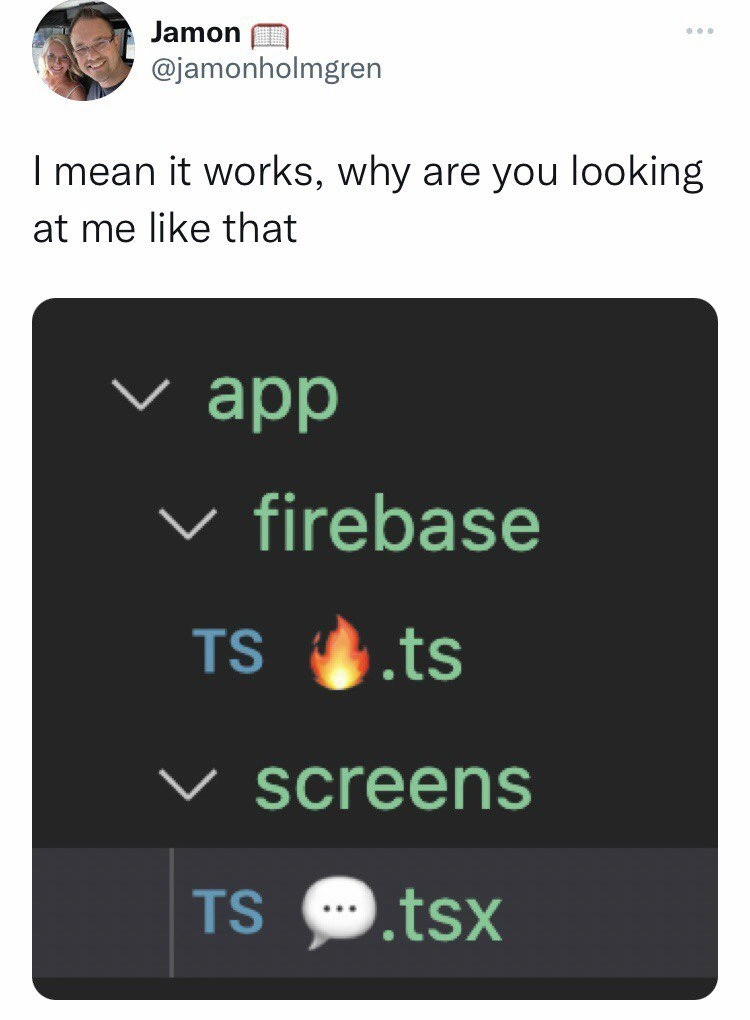
VS Code and similar editors can display folders and files using icons. In the image, the file explorer shows normal folder names like app, firebase, and screens, but the actual file names are emoji: ๐ฅ.ts and ๐ฌ.tsx.
This works because many tools support Unicode, the standard that lets computers represent characters from many languages plus symbols like emoji. The problem is not that the computer cannot understand the name. The problem is that developers have to type it, search for it, discuss it in chat, read it in errors, and debug it when one tool in the pipeline does something slightly different.
Naming conventions exist because code is read far more often than it is written. A junior developer might think, "If it compiles, it is fine." Then they hit their first real team project and learn that readability, grep-ability, refactoring, and boring predictable names are not bureaucracy. They are how people avoid losing half a day to a file that looks cute in the sidebar and terrible in a failing test log.
Level 3: Unicode Works, Unfortunately
The tweet says:
I mean it works, why are you looking at me like that
Below it, the editor shows a TypeScript project where app/firebase contains ๐ฅ.ts and app/screens contains ๐ฌ.tsx. That is the whole confession. The codebase is technically valid enough for the developer to plead innocence, but culturally cursed enough for every teammate to start checking the bus factor.
The humor sits in the gap between Unicode support and engineering judgment. Modern operating systems, editors, Git, Node tooling, TypeScript, and bundlers can often handle emoji filenames because filenames are just sequences of characters or bytes interpreted by the surrounding platform. If an import path resolves and the filesystem returns the file, the machine shrugs. The human maintenance layer is where the alarms start going off.
Emoji filenames stress a surprising number of assumptions:
- Shells may require awkward quoting or input methods.
- Search tools may display, normalize, or copy the characters differently.
- Code review diffs can become harder to scan.
- CI images, terminals, fonts, and log processors may render missing glyph boxes.
- Filesystem normalization can make "same-looking" Unicode names behave differently across platforms.
- Import statements become tiny acts of performance art.
For a TypeScript and frontend project, names are not just labels. They are part of navigation, refactoring, stack traces, module resolution, test output, coverage reports, documentation, and onboarding. A file named LoginScreen.tsx tells a future maintainer what they are touching. A file named ๐ฌ.tsx tells them someone discovered that the editor accepted paste.
The best part is that the screenshot uses firebase for ๐ฅ.ts, which is almost defensible as a pun, and screens for ๐ฌ.tsx, which could imply a chat screen. That is why it feels dangerous: the names are not random enough to reject instantly. They have just enough semantic charm to lure a team into spending the next two years explaining to build logs that, yes, the flame is production code.
Description
A tweet screenshot from Jamon ๐ , @jamonholmgren, says, "I mean it works, why are you looking at me like that." Below it is a dark VS Code-style file explorer with folders `app`, `firebase`, and `screens`. Inside `firebase` is a TypeScript file named `๐ฅ.ts`, and inside `screens` is a TypeScript React file named `๐ฌ.tsx`. The joke is that Unicode and emoji filenames are technically accepted by the stack, but they turn maintainability, searchability, and tooling assumptions into a dare.
Comments
2Comment deleted
Emoji filenames are harmless right up until grep, CI, and the release engineer all choose different encodings for the argument.
https://www.emojicode.org/ I'll just leave this here Comment deleted