Skip to content
DevMeme
4330 of 7435
Finding a trivial bug on your phone triggers a full-blown developer existential monologue
Bugs Post #4732, on Aug 5, 2022 in TG

Finding a trivial bug on your phone triggers a full-blown developer existential monologue

Why is this Bugs meme funny?

Level 1: Little Problem, Big Worry

Imagine you have a little toy or game that has a tiny problem – say a toy car that makes a weird squeak occasionally. It doesn’t really bother you much, so you don’t tell your parents or the toy maker about it. No big deal, right? But then you start thinking in a funny way: “What if the toy maker knows some cars are squeaking but can’t figure out why? They might be really worried or upset, trying to find that problem. If only I told them mine squeaks, maybe it would help them fix it and feel better.” That’s already a big worry over a small squeak!

Now you take it a step further – you start comparing that situation to yourself. It’s like saying, “Huh, I try so hard to figure out what’s wrong with me when I feel bad or make mistakes. What if all I need is for someone else to point out a little flaw in me so I can fix it? Just like I could point out the flaw in that toy car.” You begin to wonder if maybe you have some little habit or problem that nobody has told you about, and that’s why you haven’t fixed it. Kinda wild, right?

All this is a pretty big, deep thought stemming from a squeaky toy! In the meme, one friend (the developer guy) is doing exactly that – he finds a small bug in a phone app and his mind snowballs into this huge ‘what does it all mean for my life?’ moment. His friend at the table is basically looking at him like, “What on Earth are you talking about?” – and that’s the funny part. We’ve got one person turning a teeny issue into a huge personal question, and the other person is super confused.

So, why is it funny? Because it’s an over-the-top reaction. We don’t usually connect a tiny app glitch to a soul-searching life problem, right? It’s a big leap! The humor comes from how dramatically the developer friend overthinks the situation, while his buddy is just baffled. It’s like if you noticed a pencil with no eraser, then started worrying this means your life can never fix mistakes, and your friend is sitting there like, “Uh… it’s just a pencil.” In simple terms, the meme is joking about how people (especially those who build or fix things, like developers) can sometimes worry too much or connect unrelated things in a silly way. And seeing someone go on such a wild tangent – and the other person’s dinner-plate astonishment – makes us laugh because it’s both relatable and ridiculous at the same time.

Level 2: Bug Report Guilt Trip

Let’s break down what’s happening in this meme in simpler terms, especially for those newer to software development. We have a developer (Jesse) who finds a small bug in a smartphone app. In software, a bug is any mistake or error in the code that causes the program or app to behave in a way it shouldn’t. For example, a button in the app might not work, or the app might crash when you try a certain action. Bugs can be large or tiny, but even a tiny bug is technically a flaw in the software.

Normally, when users encounter a bug, they might submit a bug report – basically telling the developers of the app, “Hey, something’s wrong here.” A bug report is a form of communication. It often includes details like what exactly the user did before the bug happened, what the app did wrong, and maybe info about the phone or version of the app. Many apps and companies encourage users to send in bug reports (sometimes through a “Feedback” button or an email) because that’s how they learn about problems. If nobody reports a bug, the developers might not even know it exists, especially if they barely use that feature themselves or if it only happens under special conditions. For instance, if a game crashes only on a specific model of phone, the dev team might only find out from a user who owns that phone. This cycle of users reporting issues and developers fixing them is part of the user feedback loop: users give feedback (like bug reports or suggestions), developers make improvements, and the product gets better for everyone. Good communication from users can directly lead to a better app.

Now Jesse says he’s not going to report it because he barely uses the app. This is a pretty common situation: maybe it’s a minor glitch that doesn’t really bother the user, so they decide it’s not worth the effort to report. But then developer empathy kicks in. Jesse is himself a developer, so he starts to put himself in the shoes of the app’s developer. He knows that even a small bug can be frustrating for the person who wrote the code. Developers often have a list of known bugs they can’t figure out, and it can be really hard to solve them without enough information. Think about when you’re trying to fix something but you’re missing a clue – it’s super frustrating! So Jesse feels a bit guilty: this feeling is what we’re calling a “bug report guilt trip.” He’s essentially thinking, “Ugh, I should help them by reporting it, even if I don’t care about it much, because I know how much I’d appreciate that information if it were my app.” This is tied to the tag software_quality_guilt – developers like things to be correct and high-quality, so they feel guilty leaving a known flaw unfixed or unknown to the maintainers.

He then imagines that maybe his little report could contain the exact info needed to fix the bug. Perhaps the app’s developer has been seeing some crash reports or hearsay about this bug but can’t reproduce it on their own devices. Maybe they’ve been checking their code or error logs at night (DeveloperAnxiety is real – many devs have lost sleep worrying about a mysterious issue!). Jesse’s report could include, say, the exact sequence of steps that cause the bug or a screenshot of the error. That could be the missing puzzle piece. In technical terms, a good bug report might include:

  • Steps to Reproduce – a list of actions (e.g., “open app, go to Settings, tap on Profile, then the screen freezes”).
  • Expected vs. Actual Behavior – what Jesse thought should happen vs. what actually happened due to the bug.
  • Environment Details – the kind of phone, operating system version, or app version he’s using, because bugs can depend on these.
  • Maybe even an error message or screenshot if he saw one.

All this “data” Jesse mentions is what a developer often needs to finally identify and fix a tricky bug. Without these details, the dev might be stuck thinking, “I know it crashes for some users, but I just can’t make it happen on my phone! What am I missing?” This uncertainty can indeed keep developers up at night scratching their heads. So from a new developer’s perspective, it’s clear why Jesse is torn. On one hand, it’s just a small bug in an app he doesn’t use much – on the other hand, the BugsInSoftware knowledge in him is saying “if you can help improve the software for everyone, maybe you should.”

Now the meme takes a bit of a turn: Jesse starts talking about himself as if he were a program or app that needs fixing. He basically says, “Maybe what’s happening to me in life is like this bug scenario. I keep trying to figure out what’s wrong with me and how to fix it (like debugging myself). Maybe all I need is someone else to point out my problem and tell me to fix it, but nobody does.” Here Jesse is using a programming metaphor for real life. Developers use the term debugging for finding and fixing errors in code; Jesse is talking about debugging himself, meaning doing a lot of self-reflection to find personal flaws or issues (for example, habits or behaviors he thinks are “wrong” with him). He suggests that, just like an app might need an external bug report, he might need outside feedback from other people to know what to work on.

This comparison touches on MentalHealthInTech topics in a light-hearted way. In the tech world, people sometimes joke about diagnosing their own “bugs” (personal issues) or needing a “patch” (some self-improvement) or seeking “updates” (life changes or therapy) to fix themselves. It’s a way of using what we know (technology and debugging) to describe personal growth or mental health. For a junior developer or someone new to this humor, it’s basically saying: "I fix bugs in code all day by getting clear information, so wouldn’t it be nice if personal problems were that straightforward too? If only someone would hand me an instruction manual or a bug report about me, I’d know what to work on!" It’s a tongue-in-cheek way to express the common feeling of not knowing our own shortcomings while others might see them. In real life, getting feedback from friends or coworkers (like in a code review, someone else checking your code) can indeed help us improve, because we don’t always notice our own mistakes — whether in code or in how we act.

Finally, Walt’s response in the meme, with the famous “Jesse, what the f— are you talking about?” line, is funny because it’s exactly how someone not in Jesse’s head (or not familiar with these tech analogies) would react. If you imagine a coworker or friend sitting across from a developer who suddenly starts talking about unreported bugs and comparing them to deep personal issues, you can see why that friend would be confused! Walt essentially says “What?” earlier, indicating he’s lost, and then the strong reaction at the end shows total bafflement. This captures a classic communication gap: Jesse’s doing a serious developer self-reflection out loud, but to Walt (and to many people), it sounds like random nonsense. The meme format using Breaking Bad is popular because those characters are well-known – Jesse often got overly emotional or philosophical in the show, and Walt sometimes couldn’t comprehend Jesse’s tangent. In a dev humor context, it’s referencing how we sometimes rant about technical or abstract things and our peers (or bosses, or non-tech friends) give us that blank look. The breaking_bad_meme_format here is perfect: the scene originally had heavy, dramatic tension, and repurposing it for a comedic tech rant makes the contrast even funnier.

In summary, to a newcomer: this meme is about a developer completely over-thinking a minor app glitch. He feels guilty for not helping the app’s dev by reporting the bug, and then he goes off on a wild analogy, worrying that he himself might have “bugs” that nobody is helping him identify. It mixes techie talk (bugs, reports, fixing) with a dose of personal anxiety in a humorous way. And the other character’s confusion is basically saying, “You’re overcomplicating things, man.” It’s a playful poke at both our responsibility to communicate (report issues) and at how developers can sometimes dramatize or over-analyze a situation – even tying code and life together in a melodramatic fashion. Anyone who’s spent time debugging or has felt unsure about themselves can chuckle at how these two very different feelings got linked in this skit. It’s equal parts DeveloperHumor and a tiny nod to the fact that, yeah, developers are humans too with worries and a need for feedback, just like software needs feedback to improve.

Level 3: Infinite Loop of Self-Doubt

This meme takes a trivial software bug and spirals it into a grand drama about developer guilt and personal faults. It’s funny because it exaggerates how a developer’s mind can jump from a tiny tech issue to an existential crisis. In the first panel, Jesse (a developer) mentions finding a bug in a mobile app on his phone. Normally, a small bug in an app you barely use wouldn’t be a big deal – you might shrug and move on. But as a developer, Jesse can’t let it go that easily. He’s experiencing a kind of “bug report guilt” – the peculiar remorse developers feel when they spot a bug and hesitate to report it. Why guilt? Because he knows firsthand that behind every app is a dev or team who wants to squash those BugsInSoftware. If nobody tells the dev about the glitch, it might never get fixed. He’s empathizing intensely with the unknown coder who might be DebuggingFrustration on the other side of that app. It’s an engineer thing: we know how every little bug can become a nightmare in production, and how a single user report can sometimes illuminate a problem that’s been hiding in the dark.

When Jesse says, “What if my report has the data the developer needs to finally fix the bug that has been keeping them up at night,” he’s tapping into the reality of debugging. In real development, the hardest bugs are often those that are rare or hard to reproduce. Developers might see error logs or hear vague complaints, but can’t pinpoint the cause without more info. A well-written bug report from a user can be like gold: it may include the exact steps to reproduce the bug, screenshots of the error, or details about the phone model and OS version. That’s the kind of data that can finally crack a stubborn issue. Jesse imagines that maybe the app’s developer is losing sleep over this mysterious bug, combing through log files at 3 AM (a scenario many of us in software know too well). His one report could complete the puzzle, resolving the issue and giving that dev their peace (and sleep) back. This is the classic user feedback loop in action: user finds bug -> user reports bug -> developer fixes bug -> software improves. Jesse, being a developer himself, feels a heavy software_quality_guilt about potentially breaking that loop by staying silent.

Then the meme brilliantly pivots to a deeper personal analogy. Jesse compares the unreported app bug to his own personal “bugs.” He wonders if, just as the app has an undiagnosed flaw, he might have flaws or issues that he can’t see and no one is telling him about. This is where the humor gets layered with a dose of MentalHealthInTech introspection. Developers often jokingly compare themselves to programs: we talk about needing to “debug” our habits or wishing life had a unit test for our decisions. Here Jesse basically says, “maybe I’m trying to figure out what’s wrong with me (debug myself) and I can’t fix it because nobody has given me the outside feedback (a bug report about me) saying ‘I noticed this issue, please fix.’” This hits on the truth that as humans we all have blind spots. In software, an outside user can catch a bug the original programmer missed; in life, an outside friend or mentor might notice a personal issue we’re unaware of. Jesse’s dramatic monologue humorously mirrors the concept of personal growth through feedback: just like software needs user bug reports, people sometimes need gentle critique or advice from others to improve. It’s a clever analogy mixing BugFixing with self-improvement. Seasoned developers reading this might smirk and nod, recognizing that line between DeveloperAnxiety (worrying about code quality and user experience) and deeper anxiety about oneself. It’s funny because it’s true – many of us have had late-night thoughts equating code problems with life problems when under stress.

Now, Walt’s reaction – “Jesse, what the fuck are you talking about?” – is the punchline grounding the whole scene. This panel comes from the Breaking Bad diner scene, a famous moment repurposed in memes to juxtapose an overly intense rant against a baffled listener. Walt’s confusion represents the outside perspective (or the non-tech friend) who just cannot follow how we went from a tiny bug on a phone to a full-blown identity crisis. His straight-faced “What?” in the second panel and then the exasperated final line act like reality checks. This contrast is what makes the meme hilarious: Jesse’s speech is an over-the-top parody of how developers sometimes overthink, and Walt reacts like, “You’re reading way too much into this.” It’s reminiscent of those times a developer tries to explain a complicated debugging saga or an odd analogy to a friend and the friend is totally lost. The meme format leverages that breaking_bad_meme_format perfectly – using a serious TV drama scene to amplify the absurdity of the situation. The diner setting and Walt’s progressively more bewildered face perfectly capture how a simple question (“Why not just report the bug?” perhaps) turned into a philosophical rant.

In essence, at this level we see the meme poking fun at the developer psyche: the blend of responsibility, over-analysis, and a touch of existential dread that can lurk beneath our daily work. It highlights a common communication gap too: developers live in a world of bugs, debugging, and fixes, and sometimes we drag those concepts into places they don’t usually belong (like our sense of self). Seasoned engineers recognize both the absurd humor and the underlying relatability. Who hasn’t lain awake fixating on a seemingly minor issue? Or wondered if a bit more feedback (in code or life) could solve the problems that nag us? The meme strikes a chord by showing that relatable internal monologue – then snapping us out of it with Walt’s frank, incredulous response. It’s a reminder that sometimes a mobile_app_bug is just a bug, not a mirror to your soul… and maybe you should just report it and go to bed. 😅

Description

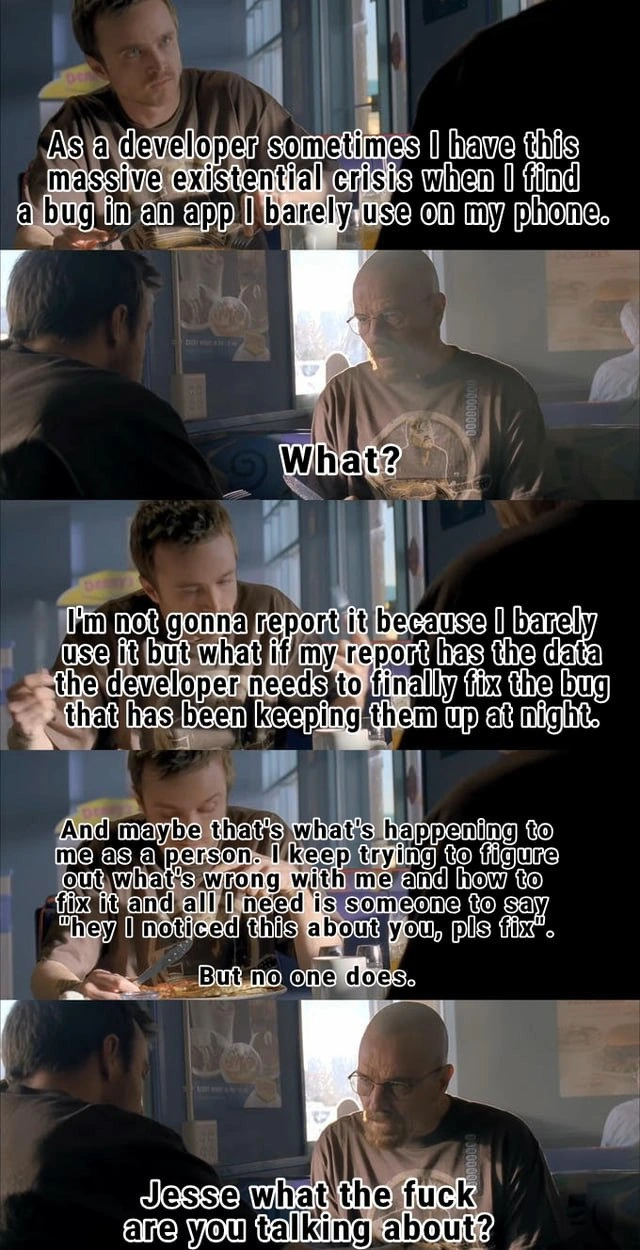
Five panels from the Breaking Bad diner scene; faces are blurred for anonymity. Panel 1 shows Jesse leaning over a table saying: "As a developer sometimes I have this massive existential crisis when I find a bug in an app I barely use on my phone." Panel 2 cuts to Walt, equally blurred, replying with a confused "What?" Panel 3 returns to Jesse: "I'm not gonna report it because I barely use it but what if my report has the data the developer needs to finally fix the bug that has been keeping them up at night." Panel 4 continues Jesse’s ramble: "And maybe that's what's happening to me as a person. I keep trying to figure out what's wrong with me and how to fix it and all I need is someone to say 'hey I noticed this about you, pls fix'. But no one does." Panel 5 ends on Walt’s bewildered face captioned: "Jesse what the fuck are you talking about?" The meme humorously highlights common engineering guilt around unreported bugs, the feedback loop between end-users and dev teams, and the parallel between software defects and personal self-improvement - adding a layer of mental-health reflection familiar to seasoned developers

Comments

8
Anonymous ★ Top Pick Rejecting the crash-report popup is my quiet form of chaos engineering: I keep my guilt in prod while some poor dev keeps chasing a Heisenbug their telemetry will never see
  1. Anonymous ★ Top Pick

    Rejecting the crash-report popup is my quiet form of chaos engineering: I keep my guilt in prod while some poor dev keeps chasing a Heisenbug their telemetry will never see

  2. Anonymous

    The same developer who won't file a bug report for an app they barely use will spend three hours writing a detailed GitHub issue for a library they'll never use again, complete with reproduction steps, environment details, and a proposed fix

  3. Anonymous

    The real bug here is the O(n²) complexity of overthinking: you're debugging your own debugging process while simultaneously wondering if your bug report would be the missing log entry that finally reveals the root cause in someone else's production incident at 3 AM. Classic case of recursive introspection without a base case - eventually you stack overflow into 'Jesse what the fuck are you talking about' territory

  4. Anonymous

    That split-second where your obscure bug report might be their missing repro steps miracle - or just Jira chum for the 'wontfix' shark

  5. Anonymous

    Found a crash in an app I barely use and hit the senior-dev trolley problem: tap “Send report” and become the 0.1% repro (Turkish locale + DST + low battery) that triggers a sev-2, or walk away and preserve “Unable to reproduce.”

  6. Anonymous

    Observability law: the only session that reproduces the P1 deadlock belongs to the user who opted out of telemetry - and never files the ticket

  7. @azizhakberdiev 3y

    Developer, after seeing report: fuck, again

  8. @bezuhten 3y

    that's actually deep

Use J and K for navigation