Skip to content
DevMeme
258 of 7435
Abusing C++ emoji macros until even the NSA and FBI get worried
CodeQuality Post #314, on Apr 11, 2019 in TG

Abusing C++ emoji macros until even the NSA and FBI get worried

Why is this CodeQuality meme funny?

Level 1: Secret Emoji Code

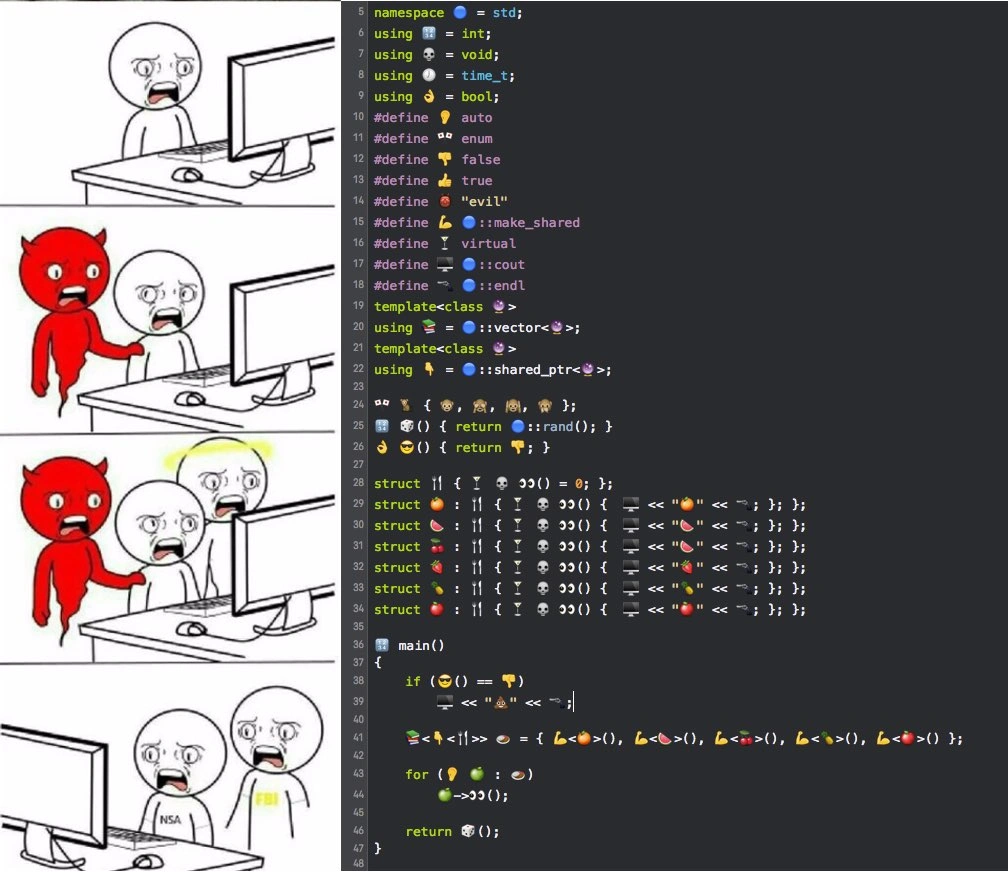
Imagine you wrote a message or your homework using only funny emoji symbols instead of normal words. 😃 Let’s say you replaced every word with an emoji, so nobody could read what you meant except you. When your teacher or parents see it, they’d be completely confused – they might even worry you’re up to no good, because it doesn’t make any sense to them. In this comic, a programmer did exactly that but with computer code: they turned a normal program into a secret emoji language. At first, the programmer thinks it’s crazy and maybe a bit funny (that’s the wide-eyed surprise). Then a little “devil” on their shoulder encourages them, like “Yeah, go on, do it, it’ll be cool!” But their good conscience (the halo) also appears, saying “Hmm, this is a bad idea, isn’t it?” In the end, the programmer’s joke goes so overboard that even the big serious grown-ups – represented by agents from the NSA and FBI – show up as if the person did something really suspicious. The whole thing is funny because it exaggerates a simple truth: if you do something so weird that nobody can understand it, people will freak out! It’s like drawing a treasure map in secret code – it might make you giggle, but don’t be surprised if others call in the authorities thinking it’s some super-secret plan.

Level 2: Macro Mayhem

Now let’s break down what’s happening in simpler terms. In the code on the right, the programmer used macros (a C++ feature that lets you replace words in your code with other text before the program actually compiles) to swap out normal keywords for emoji. For example, they wrote #define 🎯 auto, meaning wherever the blue dart emoji 🎯 appears, the compiler will treat it as the keyword auto. Similarly #define 👎 false and #define 👍 true let them use a thumbs-down to mean “false” and a thumbs-up to mean “true”. Essentially, the code is smothered in emojis that stand for real C++ tokens. There are even type aliases using using: e.g. using 🟥 = int; which means “from now on, the red square emoji represents the int type.” So 🟥 is another name for an integer. They did this for a bunch of types (🟩 for void, 🟡 for bool, etc.) and even for std::cout (the standard output stream) which is aliased to a blue diamond 🔷. The result is a program that, to a human reader, looks like complete gibberish – or maybe some alien emoji language – but to the computer, after all the macros expand, it’s a valid C++ program. This kind of extreme code obfuscation means making the code deliberately hard to read. It’s like writing with a secret code.

For a junior developer or someone new to C++: macros are a bit like search-and-replace on steroids. They happen before actual compilation. So if the code says 👌() == 👎, the preprocessor will swap that to something like falseFunction() == false (assuming 👌 was a function returning false). In our case, 👌() is defined as a function that always returns 👎 (false), so that if statement in main becomes if (false == false)... which is always true, hence the code prints a poop emoji "💩" to the screen. This is the level of silliness going on: even the output is an emoji! All those fruit emojis like 🍇, 🍉, 🍑 are probably names of other little functions or variables (maybe generating random numbers, given one function 🐒 returns rand()). The line for (🐍 in e) ::cout << 🐍(); is especially horrifying because C++ normally doesn’t allow for (x in e) syntax – but if they #defined 🐍 or something like #define for 🔍 (just guessing), they might have even hacked the for-loop syntax. It’s a cursed C++ code indeed, intentionally written to be a code reviewer’s worst nightmare.

Now the left side comic illustrates the human side of this. In panel 1, the stick figure has discovered or written this crazy code and is shocked. That wide-eyed look is basically “What have I done?!” or “What am I looking at?!” It’s a familiar feel when you open a source file and it’s full of inscrutable macros or symbols. Panel 2 introduces the little red devil character pointing at the screen – in cartoons and memes, a devil on your shoulder represents temptation. Here that temptation is the thrill of doing something forbidden in code. The devil in this context is encouraging the programmer to keep going with these naughty macros, implying “Yes, do it, make it even more unreadable! Who cares about the poor soul who reads it later?” In panel 3, we see the programmer sprouting a yellow halo – this is the angel/conscience appearing. It usually means the person is thinking twice and realizing this might be wrong or irresponsible. The devil is still there, pushing, but now the coder knows this is an ethically dubious move (in terms of code ethics, writing intentionally confusing code is frowned upon).

Finally, panel 4 has a twist: the devil is gone, and instead two stern figures labeled “NSA” and “FBI” are standing behind the scared programmer. That’s the meme’s way of saying the prank has gone way too far. In reality, of course no agents would literally show up just because you wrote obfuscated code. This is a hyperbole – a big exaggeration for comedic effect. The NSA (National Security Agency) and FBI (Federal Bureau of Investigation) are U.S. agencies concerned with security and law enforcement. The joke is that the code is so incomprehensible and suspect that it attracted attention from top-level authorities, as if it were some encrypted communication or dastardly hacking tool. It implies “This isn’t just a minor code smell; this is a full-blown code crime!” In developer humor, we often say code that bad “should be illegal.” Here, they depict it literally: the programmer’s now being watched as if he committed a federal offense by writing such spaghetti code.

So, in simpler terms: the meme is a funny cautionary tale. CodeQuality matters – if you abuse a programming language’s features (like C++ macros) too much, you’ll end up with something no one can understand. Sure, you got creative with a LanguageQuirk of C++, but now your code looks like an emoji puzzle. The devil-and-angel comic shows the internal struggle of a developer debating whether to do something clever-but-wrong. And the final frame with NSA/FBI is a playful slap on the wrist, saying “This is so extreme that the code police have been alerted!” It’s a joke many programmers appreciate because it emphasizes how not to code, wrapped in an absurd scenario that even a government agent might shake their head at.

Level 3: Obfuscation Olympics

For experienced developers, this meme hits on the nightmare scenario of reviewing utterly unreadable code. The humor comes from taking a known code smell – excessive macro use – to such an extreme that it becomes a parody of itself. In professional C++ circles, macros that redefine language keywords or fundamental types are considered black magic (or more bluntly, cursed). We have all seen some spaghetti code or cryptic macro hacks, but this takes it to a new level: every variable, type, and operator in the snippet is masked behind an emoji. It’s like the coder looked at C++ and said, “Let’s make this even harder for humans.” Seasoned C++ devs are painfully aware that while macros can do clever things, abusing them leads to code that is nearly impossible to maintain or debug. Here that reality is cranked up to 11 for comedic effect.

Why is this funny? Because it’s an exaggeration of a real temptation. Developers sometimes try to be clever with one-line macros or overly terse code, but there’s a moral line between being clever and creating an unholy mess. In the meme’s left panels, the stick-figure coder’s wide-eyed stare and the little red devil represent that temptation to do something very wrong in code. The devil is practically saying, “Go ahead, it’ll be hilarious – turn your entire program into emoji soup!” This is a devil’s code review: the dark side encouraging a programmer to forsake all best practices for the sake of a twisted joke or a tiny bit of convenience. Any senior engineer watching this happen would cringe or intervene – hence the appearance of the angel’s halo in panel 3, symbolizing the coder’s conscience or a wise mentor voice saying “This is evil, please don’t do it.” That halo moment is the recognition of just how horrifying this code is from a readability and maintainability perspective.

Then we get the final punchline: the code is so far beyond acceptable that it has drawn the attention of the NSA and FBI. This is hilarious to developers because it metaphorically suggests “writing code this bad should be a crime.” It’s as if the programmer’s deed tripped some alarm at the highest levels of authority. In reality, extremely obfuscated code can indeed look suspicious – malicious software authors often deliberately obfuscate code to hide malware, and here our innocent (?) developer’s creation looks indistinguishable from some clandestine cipher. It’s a play on the idea that if you encountered a program full of bizarre symbols and no clear text, you might think it’s an encrypted message or something nefarious. The suited NSA/FBI agents in the last panel represent the ultimate code review escalation: not only is your team lead upset, now government agencies are concerned you’ve invented a crypto-system or are communicating in an undetectable way.

This resonates with seasoned devs because we’ve all seen code so incomprehensible that we joke “someone call the cops on the author.” Here that joke is literal. From an industry perspective, it also jabs at code quality standards: any respectable project has guidelines to prevent this kind of thing. Major style guides flat-out ban redefining keywords or using mysterious macros because they lead to debugging nightmares. Imagine trying to step through this code in a debugger – variables named with 🍇 and 🍉, functions like 🐒() – you’d lose your mind mapping them back to real concepts. Compile errors would spit out emoji tokens, and you’d have to mentally replace them with actual C++ to figure out what went wrong. It’s a scenario that would give even a battle-hardened C++ veteran cold sweats.

In short, the meme humorously encapsulates a recurring theme in developer humor: just because you can do something in a powerful language like C++, doesn’t mean you should. The combination of the devil/angel comic and the absurd emoji source code tells a mini-story every experienced coder understands. It starts with curiosity (staring at the screen: “What is this? Could I?”), moves to temptation (devil: “Do it, who cares about the next guy!”), then to a spark of guilt (halo: “Oh no, this is wrong”), and ends with over-the-top consequences (NSA/FBI: “Step away from the keyboard, sir.”). It’s a cautionary tale wrapped in a joke – one that gets an exasperated chuckle from anyone who’s ever had to untangle someone’s macro-filled monstrosity.

Level 4: Preprocessor Pandemonium

At the deepest level, this meme showcases C++’s preprocessor madness and the extremes of code obfuscation. The right-hand side is essentially a glyph-laden cipher compiled via preprocessor macros. In C++, the preprocessor runs before actual compilation, doing blind text substitution. By abusing #define and using directives, the coder has remapped the language’s vocabulary to emojis. Every keyword and literal (like auto, enum, true, false, std::cout, etc.) is aliased to an emoji symbol. This means the source code is written in a custom hieroglyphic dialect that only resolves to real C++ during compilation. It’s reminiscent of entries from the International Obfuscated C Code Contest – a sort of “Obfuscation Olympics” where contestants push C/C++ syntax to absurd limits. Here, the author has effectively created an esoteric programming language on top of C++ using macros.

From a language theory standpoint, this is a wild demonstration of how flexible (or dangerously unrestrained) C++’s character set and macro system are. C++ (since C++11) allows Unicode characters in identifiers, so one can name a variable 🍕 or define a function 🐒(). The compiler’s front-end will accept those as long as they’re valid Unicode and not reserved. Macros then take it further by allowing the programmer to introduce new “keywords” (like 🎯 to stand for auto) or even override existing ones in the translation unit. This blurs the line between code and data – the source becomes a puzzle only decipherable by running it through the preprocessor. Essentially, the meme is showing a metaprogramming incantation: a series of text substitutions that transform innocent-looking emoji art into a real program.

The Pandemonium comes from how this hack abuses the compilation process. Preprocessing is a blunt, context-free text replacement – it has no understanding of C++ syntax or semantics. It will gladly replace 👌 with a function call or 👎 with false wherever those tokens appear. This can lead to chaotic interactions (imagine if an emoji macro accidentally matches part of an identifier or string literal). In the snippet, even the string "💩" likely contains an emoji character literal. We’re seeing a complete breakdown of readable semantics: the code is logically valid to the machine but semantically hostile to humans. It’s a demonstration of Turing tarpits in real life – theoretically, you can compute anything with these macros, but understanding or maintaining it is nearly impossible. In other words, the author turned C++ into a secret emoji language that only the compiler can directly parse, highlighting the power and peril of C++ preprocessor metaprogramming.

Description

The image is split vertically. On the left, a four-panel stick-figure comic shows: (1) a white figure staring wide-eyed at a monitor; (2) the same figure while a red devil appears behind them pointing at the screen; (3) the devil still present while the user now has a yellow halo; (4) the devil is gone and two suited silhouettes labelled “NSA” and “FBI” stand watch as the shocked user keeps looking at the monitor. On the right, a dark-theme editor contains intentionally unreadable C++ where every keyword, identifier, and literal has been replaced by emojis. Visible lines include: namespace 🔵 = std; using 🟥 = int; using 🟩 = void; using 🕓 = time_t; using 🟡 = bool; #define 🎯 auto #define 📋 enum #define 👎 false #define 👍 true #define "evil" #define 🐍 ::make_shared #define 🌌 virtual #define 🔷 ::cout #define 🌚 ::endl template<class 💜> using 💎 = ::vector<💜>; template<class 💙> using 🖤 = ::shared_ptr<💙>; 🐒() { return ::rand(); } 👌() { return 👎; } struct 🗑{🍺() = 0;}; struct 🍔{🍟(){return 👌;}}; // more similar emoji structs main() { if (👌() == 👎) 🔷 << "💩" << 🌚; 🖤<💜> e = { 🍇(), 🍉(), 🍑(), 🍒(), 🍍() }; for (🐍 in e) ::cout << 🐍(); return (🐒); } The chaotic macro abuse humorously illustrates how far obfuscation can go in C++, horrifying reviewers (devil), invoking a moral dilemma (halo), and finally attracting government-level scrutiny (NSA/FBI)
Comments

7
Anonymous ★ Top Pick If your emoji-macros make the compiler pull in ICU, the juniors pull a sick day, and the NSA pull a chair, congrats - you’ve officially weaponised #define
  1. Anonymous ★ Top Pick

    If your emoji-macros make the compiler pull in ICU, the juniors pull a sick day, and the NSA pull a chair, congrats - you’ve officially weaponised #define

  2. Anonymous

    The scariest part isn't the emojis in production - it's that this actually compiles in C++20 and someone on your team just discovered it works with our CI/CD pipeline

  3. Anonymous

    The devil left, the FBI showed up - even Satan respects the boundary where #define becomes a war crime

  4. Anonymous

    This is what happens when someone discovers C++20's extended Unicode identifier support and decides that 'self-documenting code' means using emojis as variable names. Sure, `🍕->🍔()` is technically valid C++, but just because the compiler accepts it doesn't mean your coworkers won't stage an intervention. The real horror isn't the emoji abuse - it's realizing this code probably compiles faster than your template-heavy 'clean' codebase, and now you're questioning everything you thought you knew about software engineering best practices

  5. Anonymous

    Satan's C struct: big enough for 90k ints on stack, small enough to fit all your segfault regrets

  6. Anonymous

    Only in C++ can the preprocessor become an emoji DSL that passes CI, fails code review, and quietly gets Infosec to open a ticket for steganography - readability as undefined behavior

  7. Anonymous

    If your C++ PR aliases std::vector<int> to 🍑 and #defines true as 👍, the compiler might accept it - but your change request will be treated like an incident report

Use J and K for navigation