From zero knowledge to daily CI failures: the ironic developer glow-up
Why is this BuildSystems CICD meme funny?
Level 1: Follow Your Dreams
Imagine you started as a kid who didn’t even know what baking was. Ten years ago, you’d never seen an oven or measured a cup of flour. Now you’ve grown up to become an aspiring baker, and guess what? Every day you try a new recipe, and every day something goes a little bit wrong – maybe you burn a batch of cookies on Monday, spill cake batter on Tuesday, and collapse a soufflé on Wednesday. It might sound frustrating, but it actually shows how far you’ve come: you’re baking every day and daring to make tricky treats that sometimes flop. The meme is like that scenario. In the beginning, our developer didn’t even know the basic tools of the trade (kind of like not knowing what an oven is). Today, they’re using all the fancy tools and techniques daily – and things still go wrong frequently. The phrase “Follow your dreams” is used here in a funny, ironic way. Usually people say “follow your dreams” to mean “keep going, it will be great!” In the meme, it means “keep going, you’ll mess up a lot but that’s part of the dream.” It’s poking fun at the idea of success by showing that real success isn’t perfect. Just like a real baker ends up with flour on their face and a burnt tray now and then, a real developer ends up with broken tests and computer errors as part of their everyday life.
In simple terms, the meme is telling us: when you grow and get better at something, you also take on new challenges that will make you stumble – and that’s okay. It’s saying that ten years ago, you didn’t even know how to try, and now you’re trying so much that you sometimes fail, and that’s a sign of progress. So, “follow your dreams” – even if it means you’ll trip and fall a bunch of times each day, at least you’re moving forward!
Level 2: From Hello World to Pipeline Hell
Let’s break down the technical terms and situations in this meme for those newer to the field. Ten years ago, our developer didn’t know about unit tests, version control, or continuous integration. These are cornerstone concepts in modern software development that every engineer eventually encounters (often sooner than later). If you’re a junior dev or just learning, here’s what those mean and why they matter:
Unit Tests: These are short programs or code snippets written to test individual pieces of your code (usually at the function or module level). For example, if you have a function
add(a, b)that should return the sum of two numbers, a unit test would calladd(2, 2)and check that the result is4. If the result is anything else, the test fails. Unit tests act like automated checklists that run every time you make changes, to ensure nothing that used to work has broken. When the tweet says “my code fails at [unit tests] at least once a day,” it means every day at least one of these little test programs is catching something wrong in the code. It’s normal – even good – for tests to fail sometimes because they’re doing their job of finding problems. For a newcomer, writing tests might be new (you might have relied on manually running your program to see if it works). But in professional projects, unit testing is a best practice to maintain code quality. Of course, it also means you’ll regularly face the irritation of a test turning red (failing) when you thought your code was fine. Fixing those failures is how you know you’re improving the code, one bug at a time.Version Control: This refers to systems that track changes to your code over time, so you can collaborate with others and undo mistakes. The most popular version control system today is Git (with platforms like GitHub or GitLab). If you’re new, imagine writing an essay with a friend: version control is like Google Docs revision history on steroids – every change is recorded, and multiple people can work on the text simultaneously without constantly emailing files back and forth. When the meme mentions “failing at version control,” it’s poking fun at the kind of mistakes developers make with Git all the time. For instance, you might try to combine your code changes with a teammate’s (
git merge) and get a merge conflict – Git’s way of saying “I don’t know which code to keep, because both of you edited the same part.” Resolving those conflicts can be confusing at first (you have to manually edit the code to reconcile differences). Another way to “fail” at version control is accidentally committing the wrong files, messing up the project history, or even overwriting someone’s work. Early-career devs often go through a phase of being intimidated by Git commands; terms likerebaseorcherry-pickcan sound like magic spells. Rest assured, everyone – even experienced devs – occasionally messes up with version control. The difference is that after a while, you learn how to fix those oopsies (and to always make a backup branch, just in case). The meme exaggerates by saying it happens at least once a day, but it really can feel that frequent on some teams! It’s part of the daily Developer Experience (DX): you push code, something goes wrong in Git, you scratch your head and learn a bit in the process.Continuous Integration (CI): Continuous Integration is an automated process that kicks off every time code is pushed to the repository. Think of it like a robotic build-and-test assistant. The moment you push your code (say to GitHub), a CI service (like Jenkins, Travis CI, or modern ones like GitHub Actions) will automatically compile your code (if needed), run all your unit tests, and perhaps even deploy your application to a test environment. CI is part of the broader CI/CD pipeline (Continuous Integration/Continuous Delivery) that many teams use to ensure software is always in a releasable state. If anything is wrong – a test fails, or the code doesn’t compile, or you forgot to include a dependency – the CI system marks the build as failed. Typically, it will send a notification (maybe a Slack message or an email, or you’ll see a red X on your pull request) letting everyone know something went wrong. For someone new, the first time you see a CI failure can be alarming: “Oh no, I broke the build!” But seasoned developers know it’s common. A ci_pipeline_failure just means the automation caught an issue before it merged to main code or went live. It could be something as small as a styling issue or as big as a major bug. When the meme’s author says their code fails at CI daily, they’re humorously admitting that there’s always some hiccup. Maybe a test that was passing on their laptop doesn’t pass on the CI server (perhaps due to a different environment or a missing configuration). Maybe the build script had a typo. Maybe another team member’s change is incompatible with theirs, and integration testing caught it. Continuous Integration is great for catching problems early, but it means you’ll be fixing errors every day – that’s its job! It turns development into a loop of coding -> testing -> fixing -> coding again. For newbies, it’s similar to running your program to see if it works, except now a robot is running it for you on every change and double-checking everything, even the stuff you might forget to test manually.
Now, the tweet’s joke is that ten years ago this person didn’t even know what any of that jargon meant. If you’re just starting out, you might relate – maybe you’ve only written small scripts or school projects without worrying about automated tests, using Git, or setting up CI on GitHub. That’s totally normal. These concepts often come into play as you work on bigger projects or collaborate with others. The ironic “glow-up” here is that a decade later, the same person is working with all these professional tools but still faces problems every single day. It’s like a reality check for anyone idealizing senior developers: even with experience, things go wrong regularly. In fact, in software, things going wrong is the usual state of affairs! A junior dev might think that experts write perfect code on the first try – the reality is experts have just gotten used to troubleshooting and quickly fixing issues when tests fail or builds break.
This is what makes the meme so relatable in DeveloperHumor circles: it’s basically saying, “Remember when you were a newbie and you had no idea what CI was? Well, now you do, and surprise – it’s just another source of headaches (but also a sign you’ve made it as a real developer)!” It pokes fun at the motivational posters that tell you to dream big. Instead of “In ten years you can accomplish anything!”, it cheekily says, “In ten years, you too can be fighting with unit tests and CI failures every day. Dream big!” There’s truth in it: every added tool or process in software engineering (testing, version control, CI, etc.) makes the software better and more robust, but also gives you something new to worry about each day. As a newcomer, you might feel frustrated the first time you encounter a red failing test or a merge conflict. Don’t be discouraged – even developers with years of experience face those daily. That constant stream of small failures is exactly how we ensure we don’t have big failures later on. It’s a sign that you’re moving fast and pushing the boundaries.
So, in simpler terms: this meme is laughing at the fact that progress as a developer means graduating from not knowing much to dealing with a lot of mini-crises all the time. It’s the growth_through_failure mindset. Don’t let it scare you. The message “Follow your dreams” is sarcastic, but also somewhat sincere: if your dream is to become a full-fledged developer, it’s encouraging to know that struggling with these tools daily is normal and even expected. Each time your code fails a test or a build, you’re learning something and making the software a bit better. It’s a humorous twist on a pep talk – acknowledging that the journey is tough, but still worth it.
Level 3: When Best Practices Attack
Ten years of experience can transform blissful ignorance into a daily gauntlet of failures. The tweet highlights a classic senior_dev_reality: embracing best practices like unit tests, version control, and continuous integration (CI) doesn’t magically eliminate problems – it just introduces more sophisticated ways to fail. The humor comes from motivational_irony: the poster went from not even knowing these concepts to having their code break in each of them every single day. In other words, growth_through_failure is real, and the “glow-up” of a developer isn’t the picture-perfect success story we imagine – it’s a series of constant small failures in new, high-tech arenas.
For seasoned engineers, this scenario is painfully and hilariously relatable. We’ve all been there: you finally set up a fancy CI/CD pipeline in your build system, only to watch it go up in flames on the first commit of the day. The meme jokingly suggests that following your dreams in software means signing up for daily doses of frustration:
Unit tests failing: Every time you think your new feature is rock solid, some unit test turns red, complaining that
expected 42 but got 43. You fix one thing and inadvertently break another. In theory, tests are your safety net catching bugs early – in practice, a large test suite means there’s always something failing somewhere. Seasoned devs joke that if all tests are green on the first run, you probably ran the wrong suite. Writing tests is easy; writing reliable tests that don’t flicker between pass/fail is hard. Veteran developers carry emotional scar tissue from fighting flaky tests that pass on their machine but fail in CI at 2 AM for no apparent reason. It’s a rite of passage to mutter “But it works on my machine…” while combing through logs of a test failing in the cloud.Version control drama: Then comes version control, usually with Git at its heart – the tool that was supposed to save us from the chaos of shared code. Sure, ten years ago you might have just emailed zip files of code around (shudder), but now you have a single source of truth and a full commit history. Great, right? Until you experience the joy of a
git mergethat won’t merge cleanly or the classic “merge conflict inREADME.md” because two people added their name to the same line. In a team setting, breaking the build or messing up a merge is the modern equivalent of dropping the production database – not career-ending, but you’ll never forget the sting of all your teammates waiting for you to fix the repository you just unintentionally wreaked havoc on. Maybe you attempt agit rebaseto clean your commit history and end up withheadachesHEAD-aches (as in detached HEAD state, the bane of many). Failing at version control can mean anything from overwriting a teammate’s changes to getting hopelessly lost in a maze of branches. Every senior dev has that war story where a simple “git pull” on Friday afternoon turned into a whole weekend of conflict resolution. As the saying goes, “Git happens.” It’s VersionControlHumor at its finest: the tool that protects you from chaos still finds ways to create new chaos of its own.CI pipeline failures: And of course, the crown jewel of modern development pain – the Continuous Integration pipeline. You push your code to the repository, and a friendly automated system (think Jenkins, Travis CI, or GitHub Actions) grabs it and starts building, testing, and deploying it. In theory, this is fantastic: integration issues are caught early, and no buggy code hits production. In practice, your CI/CD pipeline becomes a strict school principal, ready to smack down any tiny deviation. Did you forget a semicolon? Build failed. An upstream library changed? Build failed. Random network hiccup while downloading dependencies? Build failed. Oh, the tests passed on your laptop but not on the CI server? Failed, of course. A senior dev’s morning routine often starts with checking last night’s build report – nothing like a big red ❌ in the CI dashboard to go with your coffee. It’s almost comical how predictable it is: “What’s broken today?” CI failures are so common that teams develop superstitions around them (like not merging on Friday, unless you enjoy spending the weekend fixing the pipeline of broken dreams). In a large codebase with dozens of contributors, daily CI failures are practically guaranteed – if it’s not you who broke the build today, it’s someone else. In fact, seasoned teams learn to fail fast and fix fast; a broken build is annoying, but it beats discovering a bug after a release. Still, the emotional toll of that constant red build icon cannot be understated. It’s as if the CI server is continuously whispering “Not good enough yet…” – a relentless cycle that can turn enthusiasm into cynicism if you’re not careful.
So why is this funny (and not just sad)? Because it’s true. It’s a shared secret in the developer community that more automation and more process doesn’t mean you sail smoothly – it means you encounter new types of problems daily. The meme is essentially a tongue-in-cheek DeveloperExperience_DX report. Ten years ago, our developer had zero knowledge of these things, likely writing code in a simpler (if error-prone) way. Now, after embracing modern DevOps practices, they’re neck-deep in sophisticated tooling… which still finds a way to humble them every single day. It’s the programmer’s version of “new levels, new devils.” We adopt Continuous Integration to improve quality, but it also means every tiny mistake gets magnified on a big screen for the whole team. We use version control to collaborate better, but it forces us to reconcile conflicting changes constantly. We write unit tests to catch bugs early, which means we are confronted with our code’s failures more frequently. This is the ironic developer glow-up: from “it compiles, ship it!” to “it compiles, but 42 tests just failed and Jenkins is yelling at me.”
Importantly, there’s a silver lining hidden in the sarcasm. Failing at these steps at least once a day means you’re actually using them – and that’s far better than the alternative. The tweet’s final line, “Follow your dreams,” adds that extra twist of motivational irony. It parodies those inspirational tech talks that promise growth and success, by implying: Look, kid, one day you too can achieve the dream of having every part of the software process break on you daily! The cynical humor masks a real truth: growth_through_failure is how developers get better. A newbie might not know what they don’t know – back then our poster didn’t even realize unit tests or CI existed, so of course they weren’t failing any tests or builds. But that ignorance wasn’t bliss; it was just ignorance. Now they’ve leveled up: each daily failure is proof they’re working with bigger systems, collaborating with others, and catching issues early. This is how you learn. It’s the messy, unglamorous reality behind the polished image of a “10x engineer.” The industry has a habit of selling these tools as pure productivity boosters, but every veteran knows that with each new tool comes new flavors of failure. Yet, we still adopt them because the alternative – no tests, no version control, no CI – leads to far worse pain down the line (imagine the horror of discovering a bug in production that a simple unit test could have caught, or losing a week of work because you didn’t use version control). So we accept the daily grind of broken tests and merge conflicts as the price of improvement.
In summary (and without being too on-the-nose about it), the meme resonates with developers because it captures a RelatableDevExperience: the more you learn and the farther you go in this field, the more you realize that failing is an integral part of the process. It’s a bit like a dark comedy – you laugh because otherwise you might cry. The BuildFailures, the test flops, the version control kerfuffles – they’re all signs that you’re doing real work and pushing the codebase to evolve. As a battle-scarred coder might say with a shrug: “If my CI pipeline isn’t throwing a fit at least once a day, I’d wonder if it’s even running.” The tweet encourages us to wear those daily failures as a badge of honor. Follow your dreams, it says, just don’t be surprised when your dreams come with a side of broken builds and a sprinkling of sarcastic commit messages.
Description
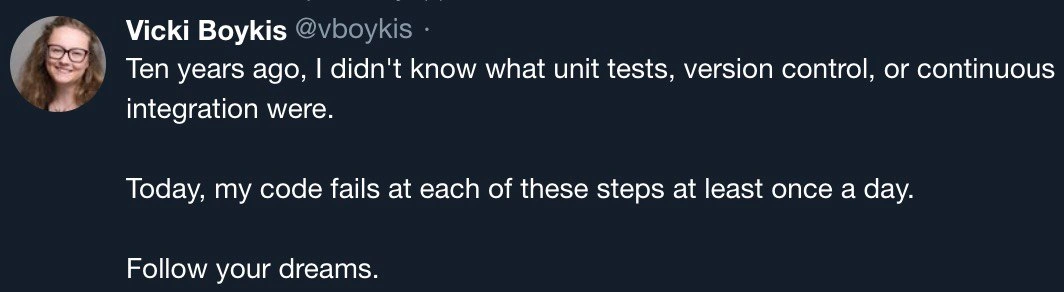
Dark-mode tweet screenshot: a circular, slightly blurred avatar sits to the left of a bold white display name and gray username. The tweet text, in white on a navy background, reads: "Ten years ago, I didn't know what unit tests, version control, or continuous integration were. Today, my code fails at each of these steps at least once a day. Follow your dreams." The layout follows Twitter’s standard UI with line breaks separating the punch lines. Technically, the joke contrasts a beginner’s ignorance with today’s reality of broken unit tests, merge conflicts in version control, and red CI pipelines - familiar pain points for engineers working with automated builds and testing workflows
Comments
7Comment deleted
Nothing says “20 years of industry experience” like watching the linter, unit tests, and CI pipeline fail sequentially - turns out “shift-left” just means the humiliation arrives earlier
The real 10x developer is someone who can fail at 10 different stages of the CI/CD pipeline in a single commit - unit tests, linting, integration tests, security scans, performance benchmarks, deployment, rollback, post-mortem, and still have time to update their LinkedIn with 'passionate about quality engineering'
Seniority is just expanding the surface area of things that can page you
The beautiful irony of software engineering maturity: ten years ago, your code worked perfectly because you had no tests to fail, no CI pipeline to break, and you just overwrote files directly on the server. Now you're a 'senior engineer' whose code fails three different ways before lunch - but at least you know *why* it's failing. Progress is realizing that 'it works on my machine' was never the achievement you thought it was, and that green CI badges are just red ones that haven't run yet
Peak senior: break unit tests, trigger a merge conflict, and light up the CI matrix with one push - and call it shift-left quality
Leveled up from zero SDLC gates to redlining all three daily - true pipeline enlightenment
Career growth is when your PR gets rejected by pre-commit linters, flaky unit tests, and a red CI merge queue - all before lunch; automated disappointment at scale