When 'Hello World' Throws a Syntax Error
Why is this Bugs meme funny?
Level 1: If at First You Don’t Succeed
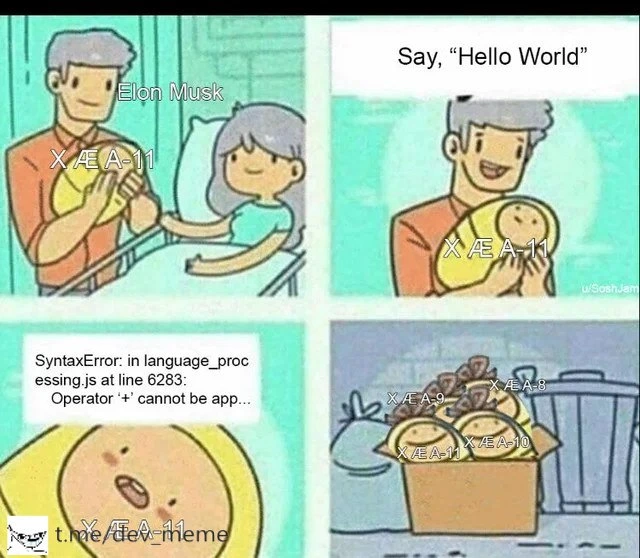
Imagine a dad trying to get his baby to say a simple word, like “hello”. It’s just like when you try to teach a parrot to talk or get a kid to say “dada” as their first word. In this cartoon, the dad expects the baby to say “Hello World” (a techie way of saying hello to everyone). But instead of speaking, the baby kind of malfunctions — think of a toy that makes a weird sound or an error noise instead of what you expected. The dad sees a big error message pop up, as if the baby is a tiny broken computer. It’s a silly way to show the baby’s first attempt at talking completely failed. What does the dad do? In the joke, he literally throws that attempt in the trash and is ready to try again with a new baby! 😆 Of course, in real life you wouldn’t throw away a baby just because it can’t say a word! The humor is in pretending that raising a child is like testing a new gadget or a new app: if version 1 doesn’t work, you toss it and move to version 2. It’s playing on the phrase “try, try again” in a very over-the-top way. The core funny idea is how ridiculous it is to treat a baby like a piece of software. We all know babies take time to learn to speak, and you nurture them patiently. But here the dad is as impatient as a programmer whose app crashed — he’d rather scrap everything and start from scratch. It’s like if you built a sandcastle that fell down, and you said “welp, that one’s no good, let’s build a completely new castle from the beginning.” The meme makes us laugh because it mixes something everyday and emotional (a baby’s first word) with something mechanical and cold (debugging a broken program). Deep down, it’s capturing that feeling of frustration when a simple task fails, and exaggerating the response to an absurd level. In plain terms: the baby didn’t say hello right, so Dad jokingly treats the situation as a broken device that he can just replace. It’s comedy by contrast — we know real parenting isn’t like that, and that’s exactly why it’s so ludicrous and funny!
Level 2: Debugging Baby Steps
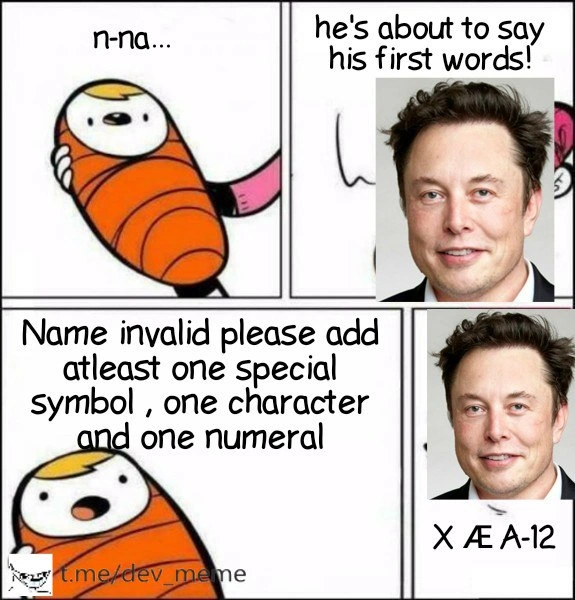
For those newer to coding, let’s break down the references. The meme is built around the idea of a baby’s first words being treated like a program’s first output. In programming, a very common first exercise is to write a simple program that prints "Hello, World!" to the screen. This is famous in practically every language’s introduction — if you can get Hello World to display, it means your code ran successfully. Now, in the second panel, the dad (labeled as Elon Musk, the well-known tech entrepreneur) is holding a baby labeled "X Æ A-11", and he’s prompting, “Say, 'Hello World'”. So he’s basically trying to run the “Hello World test” on his newborn child!
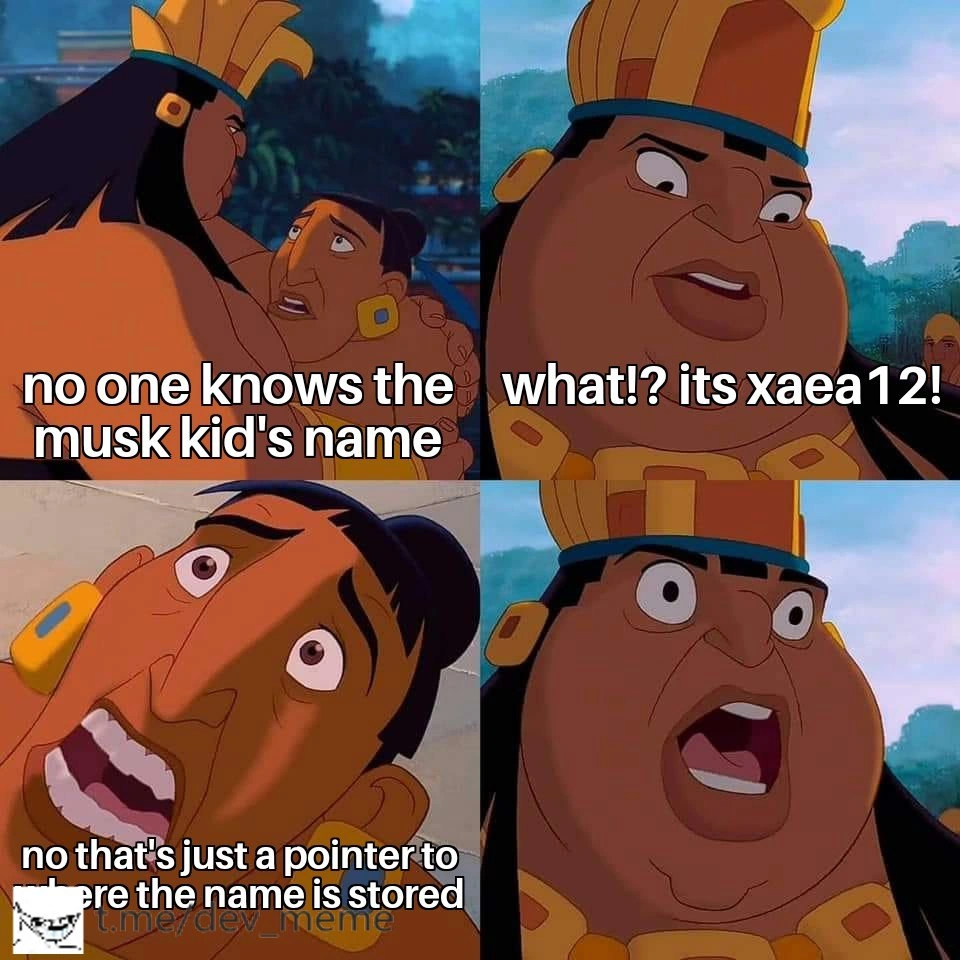
Why is the baby named X Æ A-11? That’s a joking reference to Elon Musk’s actual baby, who was named X Æ A-12. It’s an unusual name with letters and symbols that look like something out of a sci-fi novel or a piece of code. In the meme, they used X Æ A-11 (with 11 instead of 12) to portray an earlier “version” of that baby. Think of it like version numbers in software: software projects often have versions like 1.0, 1.1, 2.0, etc. Each new version is an update or a fixed release after the previous one. So calling the baby X Æ A-11 hints that he’s the 11th iteration just before the real 12.
In the third panel, we see the baby’s face with an overlapping error message:
SyntaxError: in language_processing.js at line 6283: Operator '+' cannot be app...
This looks just like an error you’d see in a programming console (especially in JavaScript or similar languages). Let’s decode that: A SyntaxError means the code was written in a way that the computer can’t even understand the instructions — it broke the rules of the programming language’s grammar. For example, in JavaScript, if you forget a quote or a parenthesis, you get a syntax error. Here it claims an issue with an operator +. In many languages, the + operator is used either to add numbers or to concatenate (join together) strings of text. The error "'+' cannot be applied..." suggests that somewhere in the code, it tried to use + in a way that isn’t allowed — maybe adding something that’s not a number or string. The context is language_processing.js, possibly a fictitious JavaScript file that handles speaking or language logic for the baby. The idea is the baby’s attempt to say "Hello World" actually caused a programmatic error internally, as if the baby’s brain runs on code and it hit a bug. In real life, babies often just coo or babble nonsensically as their first sounds. The meme exaggerates this by saying the babble was so off that it threw a coding exception! It’s like the baby’s brain program crashed because it encountered a character or operation it couldn’t handle.
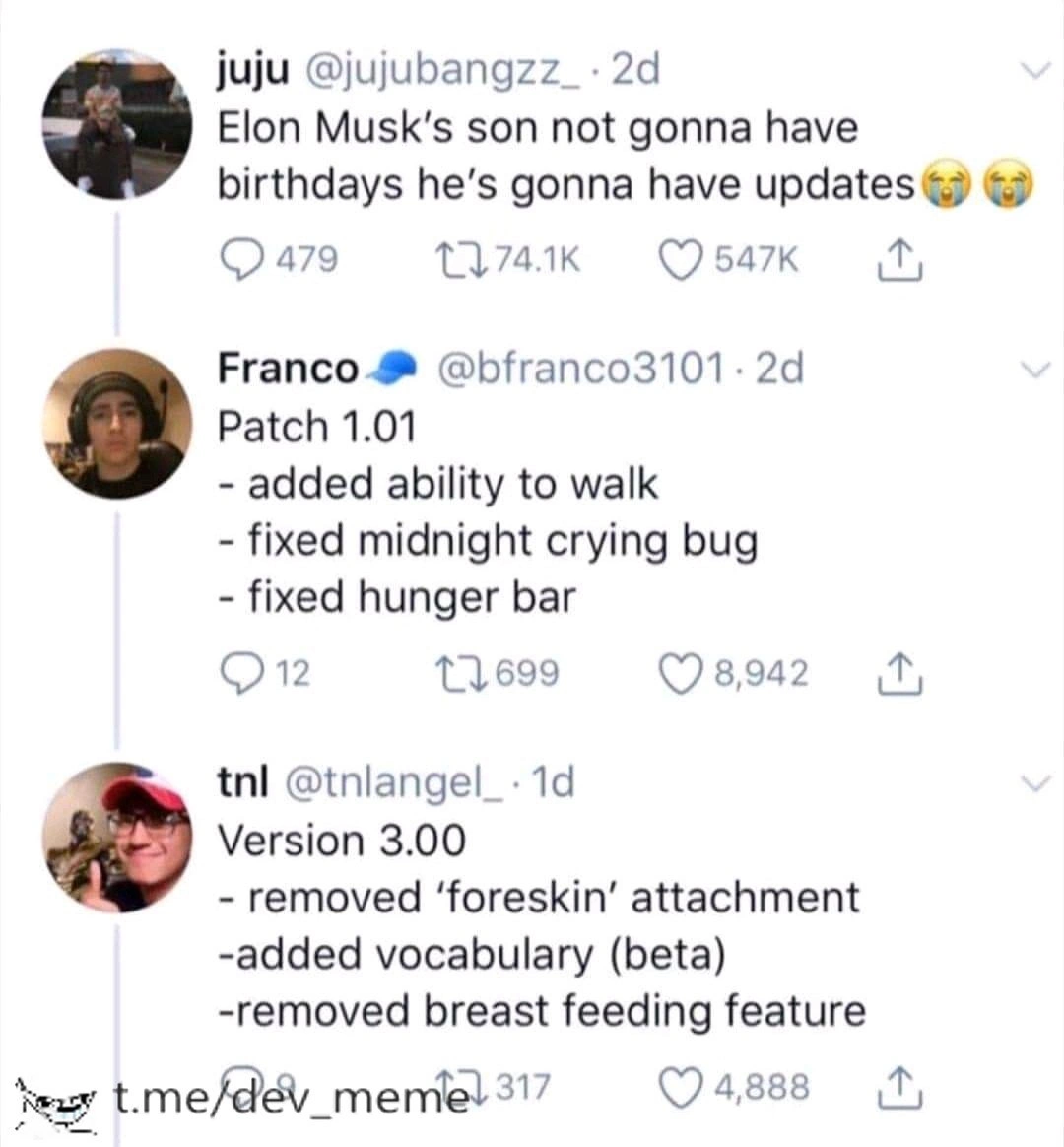
Now, the final panel shows Elon Musk tossing the baby X Æ A-11 into a trash can that already contains other babies labeled X Æ A-9, X Æ A-8, X Æ A-10. This is a visual gag comparing failed software builds to failed children. 😅 Of course, in reality, parents don’t throw away babies if they cry or fail to speak—the humor is in the absurd literalism. In software development, though, it’s not uncommon to discard a whole approach or version of a program if it’s not working out. Developers joke about “throwing away code” or starting over with a new version when the current one is too buggy. The labels 8, 9, 10, 11, etc., are like version numbers of the baby. It’s poking fun at how Elon Musk’s baby name X Æ A-12 sounds more like a software version or a model number than a person’s name. The title text even says “Time For Version Increment,” implying that since version 11 failed the test, time to increment to 12. This is exactly what we do in debugging: if version 1.1 of an app keeps crashing, we might work on fixes and release version 1.2. Here, baby 11 crashed on “Hello World”, so baby 12 will be the next attempt. It’s a playful analogy: each baby in the trash can is like a buggy build that failed quality assurance.
Let’s also clarify the Elon Musk baby name bit for those unfamiliar: Elon Musk and his partner Grimes chose the name X Æ A-12 in 2020. It’s pronounced somewhat like “X Ash A Twelve” or “X Ash Archangel” (the Æ was said to stand for “Ash”, and A-12 was a reference to a plane). It was the subject of many internet jokes because it looked so code-like and people quipped that the kid might be an android or a robot. The meme plays on that by literally treating the baby as if he’s a program that Musk is running tests on. It also references that they had to alter the name later (to X Æ A-Xii, using Roman numeral XII for 12) due to legal restrictions — which is like a forced patch update after a bug is discovered! So even in real life, there was a “version change” from 12 (digits) to XII (letters). Developers find this parallel irresistibly funny.
So, the key technical concepts and references here are: Hello World (simple test program), SyntaxError (code not following language rules), operator '+' (addition or string concatenation), and version increment (updating a version number for new releases). The meme combines these with the scenario of teaching a baby to talk. For a junior coder, it’s illustrating what happens when code fails in the most basic way and how developers sometimes respond by scrapping the faulty version and trying anew. It’s like writing your first program, seeing it crash with a confusing error, and jokingly saying “Alright, time to rewrite from scratch and bump the version, because that one was a dud.” Except here, the “program” was a baby’s first word attempt! The absurdity makes it funny, but it’s rooted in very real coding experiences (we’ve all been frustrated by mysterious errors and done radical things to fix them, like starting over). Also, there’s an underlying tongue-in-cheek lesson: maybe give variables (or babies) names that don't confuse the interpreter. Using simple characters and avoiding funky symbols in names can save a lot of debugging... 😜
Level 3: Rapid Prototyping Parenthood
From a senior developer’s perspective, this meme hilariously mashes up software debugging culture with real-life baby drama. The scene depicts Elon Musk (label on the cartoon dad) proudly holding baby X Æ A-11, a reference to Musk’s famously unconventional baby name X Æ A-12. In mid-2020, tech circles buzzed about how that name looked like someone smashed the keyboard or named a variable in a cryptic code. Seasoned devs immediately saw the humor: "X Æ A-12" resembles a code token or a failed regex pattern more than a typical name. Here, the meme takes that to an extreme: Musk is “testing” his baby like software, expecting the classic output "Hello World". In programming, “Hello World” is the first thing you teach or try — it’s the most basic functionality. If that fails, you know you’ve got a serious bug. Indeed, the baby’s attempt causes a SyntaxError, akin to a program crashing on launch.
Why is this so funny and painfully relatable? Because every experienced developer has faced a moment where their code couldn’t even do the simplest thing right. It’s the ultimate facepalm when a basic tutorial or a trivial feature fails due to a silly bug or misconfiguration. Maybe you missed a semicolon or your environment is messed up — either way, it’s “baby’s first words” going haywire. The meme channels that frustration through absurdity: Elon’s baby essentially throws an error message instead of saying “da-da.” The specific error, Operator '+' cannot be applied, hits home for anyone who has debugged type errors or syntax issues — it’s reminiscent of the times we’ve seen our program blow up because we tried to add incompatible types or had a stray + in our code. In JavaScript, seeing a SyntaxError in a simple snippet conjures the nightmare of chasing a missing bracket or a rogue character through thousands of lines (hence line 6283 in language_processing.js, which exaggerates how deep one might have to dig).
Now, the kicker is the iteration joke: in the final panel, “Elon” dumps baby version X Æ A-11 into a trash can already filled with rejects labeled X Æ A-9, X Æ A-8, X Æ A-10. This is dark humor, effectively equating discarded code builds or failed prototypes with… tossed-out babies. 😅 It’s a morbidly funny nod to how developers often handle buggy software: if version 1.0 is hopelessly broken, you might scrap it and jump to 2.0. We even have a term for this: “death march” projects get rewritten,” or “throw one away; you will anyway” (a famous Fred Brooks advice). Elon Musk himself is known in engineering for rapid iteration and fearless discarding of failures — SpaceX built and blew up multiple Starship prototypes (SN8, SN9, SN10…) in quick succession, each time learning and incrementing the number, much like those baby name versions. Senior devs see the parallel to software versioning: Musk treating his child’s name like a software release cycle. Version X Æ A-12 (the real baby’s name) is presumably the successful “release” after all these beta tests that ended up in the bin. It’s a tongue-in-cheek commentary on how absurd tech culture can be when applied literally to life. We don’t literally throw away a baby if it “fails a test”, but in software, we sometimes do abandon a code branch if it’s a failure and start fresh on a new one.
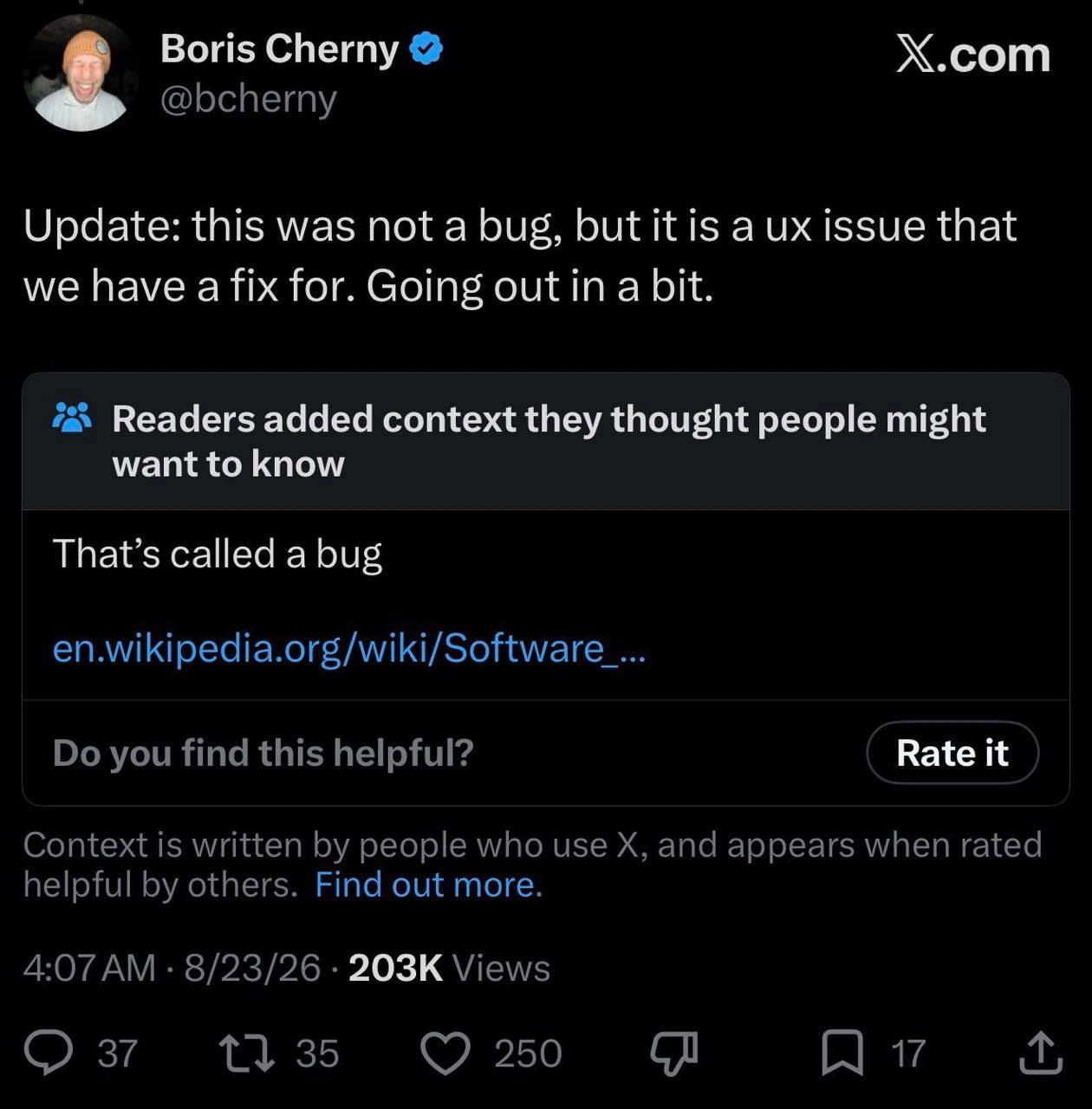
The meme also touches on the perennial joke that naming things is one of the hardest problems in programming (the others being cache invalidation and off-by-one errors, as the saying goes). Here the parents chose a name so hard that it broke something—indeed, the real name X Æ A-12 ran afoul of California’s legal character limits, forcing an iteration to X Æ A-Xii. Engineers smile wryly at that because it mirrors how certain inputs can break systems. We’ve all seen database forms or scripts choke on special characters (like the infamous Little Bobby Tables SQL injection comic). Musk’s baby name with symbols and numbers is basically a test case no one expected. In the meme, it’s as if Elon’s baby triggered an error in the universe’s “language processor” by including an illegal character or operation. The final solution? “Version increment” — a phrase evoking software version bumps after bug fixes. It’s a sardonic punchline: rather than debug the poor infant (or fix the code), Elon just bumps the version number from 11 to 12, hoping the next iteration will run without errors. Seasoned devs recognize this coping mechanism: when all else fails, cut a new release and cross your fingers that the problem doesn’t recur. It’s a humorous take on debugging/troubleshooting culture, merging it with the surreal scenario of parenting. In short, the meme lands so well with the experienced crowd because it blends a real-world tech inside joke (Musk’s oddly named baby) with classic programming fails (Hello World errors, syntax gotchas) and the brutal pragmatism of software iteration. It’s both an indictment of over-engineering (maybe don’t give your kid a name that needs an instruction manual?) and a celebration of the iterative spirit — fail fast, fix fast, even if that means “trash it and roll the next build.”
Level 4: Context-Free First Words
At the deepest technical layer, this meme riffs on the syntax and parsing of languages—both programming and natural. The father instructing the newborn to say "Hello World" is analogous to running the simplest possible program in a new environment. In computer science tradition, the "Hello, World!" program is a sanity test of a language's syntax and toolchain; if even printing HelloWorld fails, something is fundamentally misconfigured. Here, baby X Æ A-11's attempt at first words triggers a SyntaxError, hinting that the infant’s output doesn’t conform to any valid grammar the system (or brain) recognizes. The error message Operator '+' cannot be applied... suggests a type mismatch or illegal operation in language_processing.js at line 6283. This filename implies a JavaScript module responsible for the baby's speech—treating human language acquisition like a software library. In formal language theory, a SyntaxError means the sequence of tokens (sounds, in this absurd case) violated the grammar rules. The baby's futuristic name "X Æ A-11" itself looks like an expression that would perplex a parser: the character 'Æ' could be an unrecognized symbol in ASCII-based systems, and the hyphen "-" might be misinterpreted as a minus operator rather than part of a name. If one tries to parse X Æ A-11 as code, a compiler might see an identifier X, then choke on Æ as an unexpected token, or read A-11 as A minus 11 — none of which makes semantic sense in a Hello World context. The meme exaggerates this as a runtime failure: a baby’s babbling is humorously equated to code that doesn’t compile.
We can even imagine the underlying abstract syntax tree (AST) that a JavaScript interpreter might build: perhaps the code was something like output = "Hello " + baby.firstWords;. If baby.firstWords were an object or an undefined entity, a strict type system could throw an error that + (string concatenation) cannot be applied to that type — though JavaScript is usually permissive and would convert types, a languages like TypeScript or Java might balk. This hints at static type checking and operator overloading rules: in many languages, the + operator is only defined for certain combinations (e.g., adding numbers, or concatenating strings). A newborn’s attempt to speak might effectively produce a null or invalid value, hence the concatenation fails. Under the hood, it’s as if the baby’s language processing engine hit an illegal state or unhandled exception when trying the most basic output. The error at line 6283 is a comically specific detail that nods to how deep and complex language processing code can be (maybe referencing thousands of lines of AI code or rules). It evokes real-world Natural Language Processing libraries which can throw cryptic exceptions deep in their guts when fed unexpected input. In essence, the meme’s core joke at this level is a blend of compiler theory and cognitive science: it treats a child's first words as if a program must pass a formal syntax check. The name X Æ A-11 is like a variable name that doesn’t meet any known lexical convention (most programming languages wouldn't allow a hyphen in an identifier, for instance). The phrase "Context-Free First Words" riffs on context-free grammars (the mathematical structures defining most programming language syntax) contrasted with a baby’s decidedly context-needed babbling. It’s a deep cut: even the famed linguist Noam Chomsky, who proposed the hierarchy of grammars, studied child language acquisition. Here we see a satirical collision of those worlds—where a baby’s failure to utter a simple phrase is debugged with the same merciless logic a compiler uses on malformed code.
Description
A four-panel comic meme that portrays software development and debugging through the metaphor of Elon Musk and his child. In the first panel, a cartoon character labeled 'Elon Musk' is shown with his newborn baby, labeled 'X Æ A-11'. In the second panel, the father character tries to get the baby to say 'Hello World', a classic first program for developers. The third panel shows the baby's attempt resulting in a JavaScript error message: 'SyntaxError: in language_processing.js at line 6283: Operator '+' cannot be app...'. This implies the baby's name or 'code' is invalid. The final panel shows the baby 'X Æ A-11' discarded in a cardboard box next to trash cans, along with other, presumably failed, versions labeled 'X Æ A-8', 'X Æ A-9', and 'X Æ A-10'. The meme humorously equates parenting and the child's development to a software development lifecycle, complete with versioning, syntax errors, and discarding buggy builds. Watermarks for 't.me/dev_meme' and 'u/SoshJam' are visible
Comments
7Comment deleted
That's not a bug, it's a feature. The child is just demonstrating type safety at an early age. The '+' operator was probably overloaded
Continuous delivery in its purest form: ship a new minor version every nine months, and if console.log("Hello World") still throws, straight to /dev/null and on to vNext
When you spend years building robust Unicode support and someone still manages to break your parser with their kid's name - this is why we can't have nice things and why our regex patterns look like someone fell asleep on the keyboard
When your 'Hello World' throws a SyntaxError in production, you know you've achieved the rare feat of failing the interview question that even the interviewer's child could pass - though in this case, the child's name itself is a parsing nightmare that would make any compiler weep
Elon's kid proves even Hello World needs a linter: unescaped Æ and + operators turn first words into runtime parse panics
Only JavaScript could turn ‘Say, Hello World’ into a SyntaxError about ‘+’ - normalize the grapheme soup to NFC and use template literals, not ASCII-era concatenation
Naming things really is the hardest problem: “X Æ A-11” fails the linter - the hyphen parses as minus and Æ breaks NFC normalization - so “Hello World” throws while v8 - v10 have already been garbage‑collected