Single-cut apple puzzle meets side-eye monkey in an algorithmic humor meme
Why is this CS Fundamentals meme funny?
Level 1: Sharing Apples Fairly
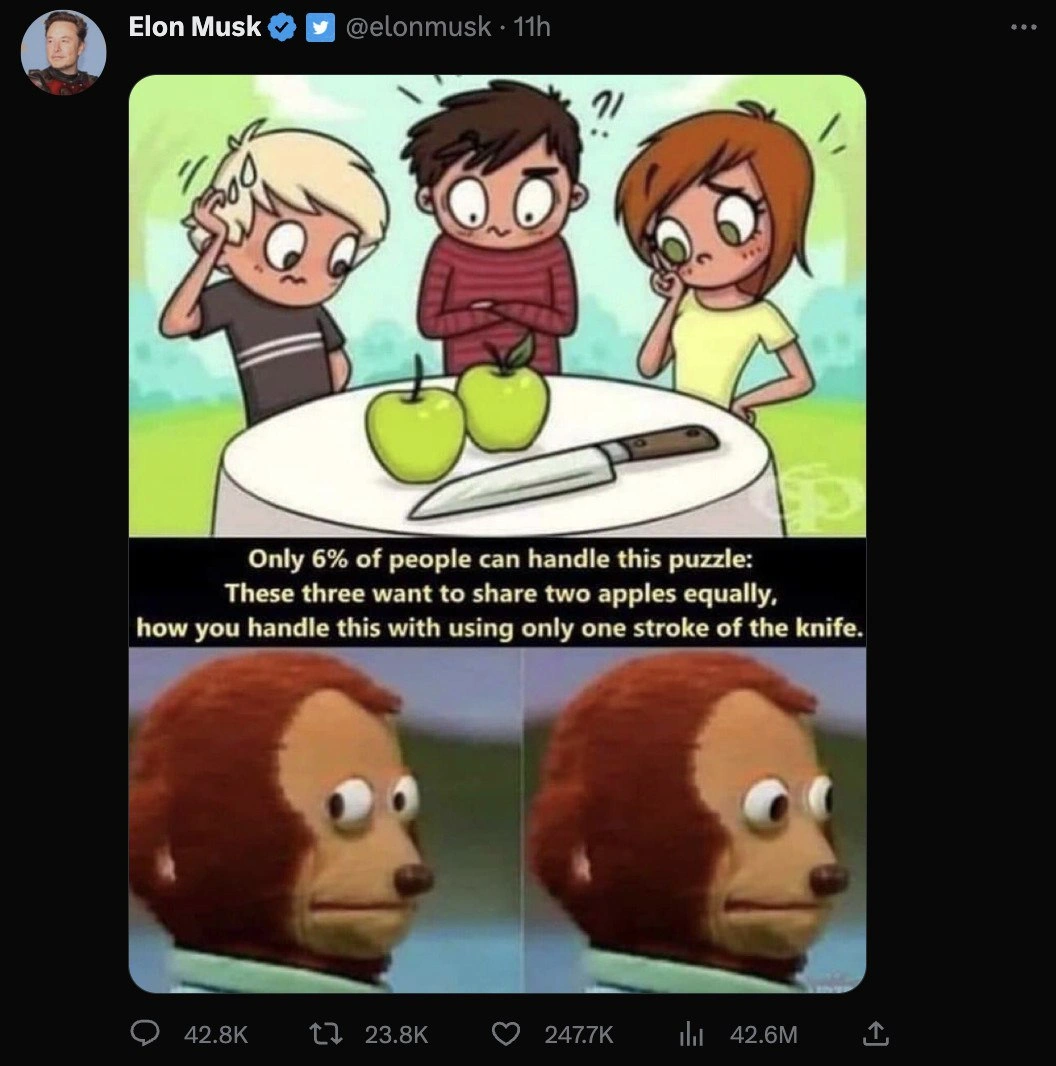
Imagine you have two apples and three friends, and you want everyone to get the same amount of apple. But you’re told you can only cut the apples once. How would you do it? It sounds kind of tricky, right? You might line up or stack the apples and cut them all in one go so that you get just enough pieces for everyone. The meme shows a picture of kids puzzled by this apple problem. It’s like when a teacher gives you a riddle that seems almost impossible at first. Below that, there’s a picture of a funny monkey puppet turning its eyes to the side looking nervous. That monkey face is a popular way to joke about feeling embarrassed or caught off-guard. So the whole meme is basically saying: “Here’s a hard puzzle (share two apples among three kids with one cut)... and here’s me, looking awkward like this monkey because I have no idea how to solve it immediately.” It’s funny because even though it’s just about apples, it makes us think of times when we got a tough question and felt just like that wide-eyed monkey – a bit surprised and unsure what to do, but trying to play it cool.
Level 2: Single Cut, Shared Apples
Okay, let’s break this down in plainer terms. The meme references a puzzle where you have 2 apples and 3 children who want to share those apples equally. The catch: you’re only allowed to use the knife once – one cut, straight through, and that’s it. Normally, to give everyone the same amount, you might cut each apple into 3 pieces (so you get 6 pieces total and give 2 pieces to each child). But here, the rule of “only one stroke of the knife” means you can’t just chop everything up repeatedly. You need a clever solution to this apple_sharing_problem. The classic trick (spoiler alert!) is to stack the two apples on top of each other and then cut straight down through both at once. This single slice will split both apples simultaneously. You’d end up with some pieces of apple that you can then mix and match to ensure each of the 3 kids gets an equal total share. It’s not immediately obvious, which is why apparently only “6% of people” solve it quickly (though that 6% line is likely just dramatic flair). The important part is that this is a brainteaser – a little riddle that requires thinking creatively rather than following a normal step-by-step solution.
Now, why is this funny to developers? Because it reminds us of those quirky technical interview questions or coding challenges where the interviewer gives a problem with a twist: you can only do something in one pass or with one quick operation. In coding terms, imagine being asked to process a list of data but only loop through it once. If you think of each apple as a small dataset, the puzzle is asking for a solution that handles both datasets with one sweep of the algorithm (one knife stroke). That’s what we call a one-pass solution. Many new programmers learn that a naive solution might loop (or in this case, cut) multiple times, but a more optimized solution combines steps to loop once. This meme takes that idea into the real world with apples and a knife as props.
Let’s also talk about the bottom panel – the side-eye monkey puppet. This is a very famous meme image in internet culture. It shows a puppet (with a monkey face) looking to the side with wide eyes, then looking forward, clearly uncomfortable and unable to hide it. People use it to humorously depict the feeling of being caught off-guard or silently freaking out. In a developer context, that monkey face often represents us when we get asked a question we didn’t prepare for. So in this meme, after seeing the tough puzzle (top panel), the bottom panel’s monkey is essentially saying, “Uh oh... I have no idea how to do that with one cut, but I don’t want to admit it.” It’s the exact vibe of a junior developer sitting in an interview, confronted with a riddle or an algorithm question they haven’t seen before. Your face might stay neutral, but internally you’re that wide-eyed monkey calculating furiously or thinking “Is this a trick? What am I missing?”
Some key terms here: AlgorithmicThinking is basically the skill of solving problems step by step, like how you’d write a recipe or a program. An algorithm is just a procedure or method to get something done. This apple puzzle encourages algorithmic thinking because you can’t just hack away randomly – you must plan a single clever move. It’s a bit like a coding puzzle where you have to find an efficient trick. ProblemSolvingTechniques come into play since you might think of known strategies: “What if I combine the apples? What if I cut at a certain angle?” You’re looking for that aha! insight. In interviews, questions like this test your ability to stay calm and think creatively under constraints. It’s definitely part of InterviewHumor because a lot of us have been through nerve-wracking interview problems that, in hindsight, seem kind of funny or absurd (like writing code on a whiteboard to invert a binary tree, or in this case, playing fruit ninja with algorithms).
So, on a simpler level: the top half is a cartoon kids brainteaser about sharing apples fairly with a tricky rule. The bottom half is a reaction image, the puppet monkey meme, representing how one might feel confronted by that brainteaser (especially in a high-pressure situation like an interview). The combination is funny because it’s so relatable – even though the scenario is about kids and apples, developers immediately connect it to their own experiences of being tested on the spot. And even if you’re not a developer, you probably recognize that feeling of “Hmmm, I’m not sure what to do, this is awkward!” The humor works on a couple of levels: it’s the contrast between a serious puzzle challenge and a goofy puppet reaction, and it’s also a bit of a wink to those in tech about the sometimes over-the-top nature of interview puzzles. In short, it’s CodingHumor or TechHumor using a simple riddle and a classic meme face to capture a universal feeling in the programming world. We laugh because we’ve all been there, staring at a problem (or an interviewer) with that same monkey-eyed expression, searching our brain for a brilliant one-pass solution.
Level 3: One-Pass Puzzle Panic
For the experienced developer, this meme hits close to home as interview humor and algorithm satire rolled into one. The top panel presents a classic brain-teaser scenario: three puzzled kids, two apples, one knife, and a challenge to share the apples equally with a single cut. If you’ve been through a few technical interviews (especially the kind heavy on riddles or whiteboard problems), this feels eerily familiar. It’s essentially the apple_sharing_problem – a stand-in for any tricky resource allocation question – with a strict constraint that makes you scratch your head. Interviewers love these “only do X with one pass” or “solve it in one go” challenges to test your creativity and ProblemSolvingTechniques. And that bold caption “Only 6% of people can handle this puzzle” adds a tongue-in-cheek elitism, reminiscent of dubious online IQ puzzles and the way some companies brag about their tough hiring filter (as if only the top 6% deserve an offer). It sets the stage for a programmer’s mild trauma: Oh no, am I in the 94%?
Enter the bottom panel: the famous monkey_side_eye_meme, featuring a puppet monkey turning its eyes awkwardly sideways then forward. In developer meme lore, this two-frame monkey represents the silent, sweaty realization of “Uh… I have no clue, but I hope no one notices.” It’s the exact expression many of us had in an interview when facing a brain-teaser we weren’t prepared for. Here, the monkey’s side-eye reaction perfectly mirrors a candidate’s internal panic when an interviewer asks: “How would you share two apples equally among three people with one cut?” There’s a moment of wide-eyed stillness – just like the monkey – where your brain goes “Wait, what? Only one cut?!” and you’re calculating furiously while trying not to look completely lost. This is InterviewHumor at its finest because it exaggerates that feeling we’ve all had during a TechnicalInterviewProcess: being put on the spot with a quirky algorithmic riddle.
From a seasoned developer’s perspective, the humor also comes from recognizing the algorithmic analogy. The puzzle is basically asking for an optimized solution – no brute force allowed. Brute force in this context would be making multiple cuts (slice each apple into thirds, for example, with several strokes). But “only one stroke of the knife” means you need a clever algorithmic approach: a one-pass solution that handles all items (both apples) in one go. It’s like an interviewer saying, “Can you solve this in O(n) time and O(1) space?” To those in the know, the trick likely involves a nifty move – perhaps stacking the two apples and chopping through them both simultaneously. That would be the one-stroke solution: you align the resources and perform one action that divides them together. This is where the AlgorithmHumor kicks in: the puzzle’s solution is essentially performing two operations in parallel under the guise of one. Any senior dev will chuckle at that, recalling countless times they combined steps to make a single-pass algorithm (and the times they completely missed the trick under pressure!).
We also recognize an undercurrent of satire about the technical interview process. These kinds of riddles – whether about apples, pirates dividing gold, or wolves and cabbages across a river – have been both loved and loathed in tech interviews for decades. A seasoned engineer might roll their eyes (much like the monkey) because they know that solving a contrived puzzle under stress isn’t the best predictor of real job performance. But it remains a shared cultural experience among developers. Discussing a resource_division_algorithm like this in an interview setting is almost a rite of passage. We bond (and commiserate) over questions like “How do you measure exactly 4 liters with a 5L and 3L jug?” or “How many cuts to divide a cake into 8 pieces?” – the apple puzzle is cut from the same cloth. So the meme gets a knowing laugh: the top half is the kind of question you’d see on a whiteboard, and the bottom half is every candidate’s internal reaction meme-fied.
To summarize the senior perspective: The cartoon_kids_brainteaser setup represents those deceptively simple algorithmic problems, and the side-eye monkey represents us – the developers – reacting with a mix of concern, surprise, and “keep cool” facade. It’s funny because it’s true: we’ve all been that monkey at some point, faced with a puzzler that makes us momentarily question our brain’s clock speed. The combination of innocent imagery (kids and apples) with a stringent one-stroke rule is absurd in the same way coding puzzles can be: sure, it’s solvable with insight, but the pressure and weirdness of the scenario can leave even a good engineer looking just like that monkey, side-eyeing the interviewer with “Are you serious with this?”
And of course, as developers, we appreciate the meta-joke: this is DeveloperHumor poking fun at how we sometimes over-engineer even a kindergarten-level sharing problem. The meme lets us laugh at both the puzzle and ourselves. After all, what is a coding career without a few moments of being the side-eye monkey in front of a whiteboard?
# Naive approach (multiple cuts - brute force, frowned upon):
cut(apple1, into=3_equal_parts) # requires multiple strokes - not allowed
cut(apple2, into=3_equal_parts) # another set of cuts - too slow, boss!
# Clever approach (one-pass solution - the trick):
stack(apple1, apple2)
cut(stacked_apples, in_one_stroke=True) # one knife stroke through both apples
distribute_equal_pieces_among(3, kids) # voila, fair shares from one cut
In the pseudo-code above, Plan A shows why the straightforward method fails the puzzle’s constraints – it’s like an O(n) solution with n=2 cuts, which in puzzle terms is “too many strokes.” Plan B is the cunning one-pass method: combining the apples (like combining loops or operations in code) and slicing once. This little code analogy gets a chuckle from those of us who’ve been told to refactor our two-pass algorithm into one-pass – it’s the same energy as stacking apples to cheat a one-cut rule. The comments convey the humor: the interviewer (or puzzle) doesn’t allow the obvious multi-step solution, so you have to think outside the box. That’s the algorithmic thinking in AlgorithmDesign interviews: finding the non-obvious ProblemSolvingTechnique that meets strict requirements. And when you do figure it out, it’s oddly satisfying – you feel like you’ve joined the “6%” super-solvers club, laughing with relief (while the monkey wipes its brow).
Level 4: Atomic Apple Algorithm
At the theoretical extreme, this single-cut apple puzzle hints at deep concepts in algorithm design and even math. The requirement of only one stroke of the knife is like demanding an atomic operation – a single, indivisible step that accomplishes the entire task. In computational terms, it's analogous to a one-pass algorithm that must produce a fair outcome without any second chances. This brings to mind the realm of fair division algorithms in computer science and mathematics. For instance, the classic cake-cutting problem asks how to divide a resource (like cake, or apples) among multiple people so everyone feels they got a fair share (no envy). There are even rigorous results like the Ham-Sandwich Theorem, which guarantees that given (say) two apples and one more object, a single planar cut can bisect all of them at once – essentially splitting multiple resources fairly with one action. That theorem lives in the world of high-dimensional topology and measure theory, but its spirit sounds a lot like our puzzle: one magical cut slicing through everything just right. In practice, implementing fair division often involves iterative algorithms and moving cuts, but here we entertain a beautifully simplified scenario. The puzzle is an atomic_operation_analogy because it forces us to condense what’s normally a multi-step process (cut apple A, cut apple B, then distribute) into a single uninterruptible step. This is reminiscent of how compilers perform loop fusion or how vectorized CPU instructions operate on multiple data points with one instruction – think of slicing both apples at once as if doing a SIMD operation on fruit. The humor, from a high-level view, is that something as messy as sharing apples among three kids is formulated like a constrained algorithmic problem. It tickles the CS_Fundamentals part of our brains: we recognize a nod to AlgorithmDesign principles (minimize operations) and even a whiff of computational complexity: can we achieve equal sharing in O(1) knife strokes? The answer expects an elegant trick, much like an optimal algorithm that outsmarts a brute-force approach. Fundamentally, the meme sets up a scenario where the physical-world task of fair resource allocation is treated with the strictness of a code execution limit – and any seasoned dev or computer scientist can appreciate how AlgorithmicThinking is being playfully applied to a literal cutting problem. The result is a nerdy delight: a childlike riddle elevated to a discussion of optimal one-pass solutions, and it’s amusing at a brainy level because it merges a classic kid’s brainteaser with serious algorithmic vibes.
Description
Screenshot of a dark-mode tweet from a verified user (avatar blurred) containing a two-panel meme. Top illustration: three cartoon children stand around a round white table that holds two green apples and a kitchen knife; all three look puzzled and scratch their heads. Beneath the drawing, white text on a black bar reads: "Only 6% of people can handle this puzzle: These three want to share two apples equally, how you handle this with using only one stroke of the knife." Bottom section shows the well-known side-eye puppet monkey meme in two frames, silently reacting with mounting concern. For developers the scene evokes classic interview brain-teasers about fair resource allocation and "one-pass" algorithms - finding an elegant, single-operation solution rather than brute-forcing with multiple cuts
Comments
42Comment deleted
Do one SIMD slice across both apples, tag the four shards with consistent hashes, and hand them out - boom, fruit microservices; the interviewer’s side-eye said I’d over-architected lunch
When your PM says 'just split the two-week sprint equally among three teams' and you realize the only clean solution involves refactoring the org chart with extreme prejudice - classic N+1 problem where N is the number of stakeholders who survive the planning meeting
This puzzle is basically the software equivalent of being told to optimize for O(1) space complexity when you've already written the O(n) solution. The answer isn't to cut the apples into thirds - it's to cut through both apples simultaneously with one stroke, giving each person two halves. Much like production incidents, the real solution often requires reframing the problem entirely: you're not dividing two apples among three people, you're creating six equal pieces with one cut. Senior engineers recognize this immediately - it's the same mental model shift required when someone asks you to 'just make it scale' and you realize the architecture itself needs rethinking, not just adding more servers
Stack the apples and slice at the one‑third mark - SIMD knife; tell the PM it’s O(1) cake‑cutting and close the ticket
PM: 'Divide 2 epics equally across 3 squads with one PR merge.' Architects: [Elon monkey.exe has stopped working]
Two apples, three people, one stroke? Set requests=limits: 666m each and kubectl apply - instant “fair share” with a side of throttling
do a triple kill Comment deleted
One stroke only Comment deleted
with a single (but long) stroke Comment deleted
rip and tear until it's done I don't need no knife Comment deleted
Stack them up and cut third of both of them at once Comment deleted
Kill the third one 🔪 Comment deleted
spin the knife kill whoever the knife is pointing at when it stops spinning ? Comment deleted
good luck finding the offset Comment deleted
r * sqrt(3) / 3 Comment deleted
Don’t you think that middle part gonna be bigger than those on sides? Comment deleted
They think an apple is a perfect sphere, not a thing made of unequal sectors Comment deleted
Espicially with the perfect sphere sides proofably will be smaller than the middle sector Comment deleted
I know, but the type of equality hasn't been provided Comment deleted
bool operator ApplePart::==(const ApplePart& other) const { return true; } 😎 Comment deleted
"operator" should go after:: Comment deleted
I have never actually wrote an operator outside of a class declaration. Comment deleted
:3 Comment deleted
which language has this fucking syntax? Comment deleted
corrupt C++ Comment deleted
And yes, I ate a literal tonne of various apples. Comment deleted
I draw this with hand just as a schema you can take rulers with yourself Comment deleted
And there’s gonna be only 2 middle parts of apple Comment deleted
So 2 middle parts could be OK Comment deleted
Despite comprising only 6% of the population, these people account for 52% of the iq in the US Comment deleted
(((people))) Comment deleted
Use One stroke of the knife and use multiple stroke of another knife Easy Comment deleted
One stroke to the person who is counting stroke, then as many strokes as you like Comment deleted
then there will be no need for more strokes Comment deleted
Kill the odd person with one stroke :) Comment deleted
What about the apple cores? Most people don't eat those and that's a major piece of 2 parts of your diagram. Comment deleted
middle part of apples if assumed as a complete sphere; has more volume than the sides so the core is for compensating unequality Comment deleted
Well. They ask you how will you deal with situation, stating only that those three want to share apples equally. Noone said the decision has to actually be equal. You need to pay more attention to details bro. You're to inattentive Comment deleted
I don't get your point Comment deleted
Well, can't help you Comment deleted
understandable,have a good day Comment deleted
why these sliced guts are still getting reactions Comment deleted