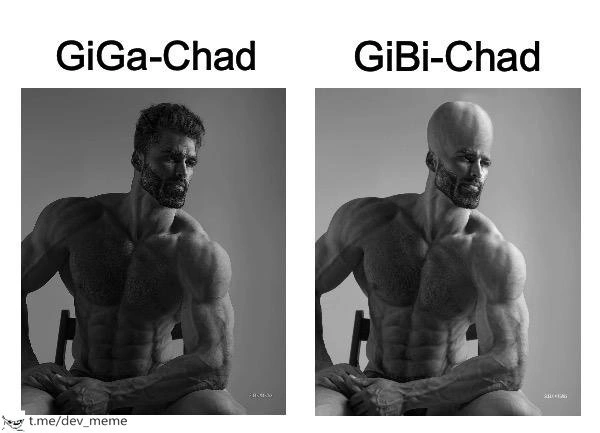
Giga-Chad vs Gibi-Chad: meme over 1000 versus 1024 units size
Why is this CS Fundamentals meme funny?
Level 1: Candy Counting Contest
Imagine two friends comparing who has more candy. One says, "I have one thousand candies!" The other grins and says, "Oh yeah? I have one thousand candies too... but in my special way of counting, a 'thousand' means 1024!" Now the second friend technically has a few more candies, even though he also called it a thousand.
This meme is joking about a similar trick but with computer bytes. It’s funny because the second friend (like the GiBi-Chad) is showing off a nerdy secret: he uses a different way of counting to get a bigger number. The first friend (like GiGa-Chad) used the normal counting (1000 means 1000). Both friends have a ton of candy, but the one who counted differently can brag that his "thousand" is a bit larger. It’s a silly little comparison, and that’s why it makes us smile – it’s poking fun at how tech folks sometimes count things in a different way just to seem a little more impressive.
Level 2: 1000 vs 1024
In computers, the words gigabyte and gibibyte sound similar but mean slightly different things:
- Gigabyte (GB) usually means about one billion bytes. Specifically, it's 1,000 × 1,000 × 1,000 bytes ($10^9$). This is the definition used by hard drive manufacturers and the standard SI system – "giga" is the prefix for a billion.
- Gibibyte (GiB) means 1,073,741,824 bytes. That number is 1,024 × 1,024 × 1,024 ($2^{30}$). The prefix "gibi" isn’t as common in everyday use; it was created to mean "binary gigabyte." Essentially, 1 GiB is a gigabyte measured in powers of two.
Why have two versions? Computers like powers of two (because of how memory and binary math works). Back in the day, people casually used "GB" to mean 1024^3 bytes since it was close to a billion. But this can cause confusion. For example, if you buy a "500 GB" external drive, your computer might report its capacity as ~465 GiB. Nothing is actually missing – it's just that the computer is using 1024-bytes-per-KB math, while the drive’s packaging used 1000-bytes-per-KB math. Both are legitimate ways to count, but mixing them makes the numbers look different.
The meme itself is an example of tech humor playing on this mix-up. The left image labeled "GiGa-Chad" refers to the well-known Gigachad meme (a super buff, confident guy image often used in jokes). The right image labeled "GiBi-Chad" swaps in the binary prefix. It’s a tongue-in-cheek way of saying: the truly in-the-know developer uses GiB instead of GB. Basically, it’s a pun – Giga vs Gibi. Notice "GiGa" vs "GiBi": that one letter change (G to B) is exactly the difference between GB and GiB abbreviations. The meme shows two almost identical ultra-strong Chads side by side, joking that using the more precise binary term is a subtle but pride-worthy difference.
For a junior developer, the key takeaway is: 1 GB and 1 GiB are not exactly the same. One is based on tens (decimal), and one is based on twos (binary). It's a classic source of confusion for anyone new to storage units. We’ve all had that moment of wondering why our "16 GB" RAM shows up as around 15.something in system info. Now you know: it’s not the computer losing count, it’s two different ways of counting big amounts of data!
Level 3: Binary Bulk-Up
This meme flexes a niche bit of CS fundamentals that every seasoned dev eventually encounters. On the left, we have GiGa-Chad, and on the right, GiBi-Chad – a play on the viral "Gigachad" persona. By swapping one letter, the meme references the age-old storage unit confusion: the difference between a gigabyte (GB) and a gibibyte (GiB). For anyone who has dealt with disk capacities or memory sizes, this is a familiar muscle-flexing of knowledge.
Why do experienced devs smirk at this? It's poking fun at the almost pedantic debates about SI vs IEC prefixes for data sizes. In the SI (metric) system, "giga" means $10^9$ (one billion), but in many computer contexts "gigabyte" historically meant $2^{30}$. To eliminate ambiguity, standards bodies introduced a new prefix "gibi" for the binary version, so 1 GiB = 2^30 bytes whereas 1 GB = 10^9 bytes. It's a classic naming things headache in tech – we ended up with two definitions for what casual users think of as "a billion bytes." Seasoned developers remember their first time realizing a "1 TB" drive only shows about 931 GB of space in the OS (because it's actually 931 GiB). That moment is both frustrating (where did my space go?!) and enlightening (ohh, it's the 1000 vs 1024 issue).
The humor here comes from elevating this nerdy knowledge to Chad status. The term "Gigachad" usually describes someone or something absurdly confident and ultra-tier. So the meme jokingly implies that the real alpha tech guru isn't just a Gigachad, but a Gibi-Chad – the kind of developer who casually corrects "GB" to "GiB" with a smug grin. It's the ultimate geek flex: knowing your binary prefixes better than the marketing folks. In developer culture, being aware of this detail (and maybe teasing colleagues who mix them up) is an industry in-joke. It's like saying, "Sure, a regular strong dev knows gigabytes, but the über-elite know about gibibytes." The two side-by-side buff dudes highlight that we're basically looking at the same hulking number of bytes, just counted in different ways – yet some will insist the distinction is crucial.
Historically, this confusion stems from how computers use binary. Memory chips and file systems naturally count in powers of two, so $2^{10} = 1024$ felt like a "round number" to early engineers (close enough to one thousand). Back in the day, calling 1024 bytes a "kilobyte" was convenient shorthand. But as storage grew, the gap between 1000-based and 1024-based measurements widened (1024 is about 2.4% bigger than 1000; by the time you get to gigabytes, that difference is ~7.4%). By the time we hit terabytes, that marketing "1 TB" drive has a significantly smaller number when viewed in binary. The International Electrotechnical Commission (IEC) stepped in around 1998 and introduced KiB, MiB, GiB to clear things up. Adoption was slow and uneven – many operating systems and vendors stuck to the old usage, some even labeling binary sizes as "GB" out of habit. So to this day, devs who know their history will grin when they see 1,000,000,000 bytes vs 1,073,741,824 bytes and say, "Ah, the classic gigabyte vs gibibyte discrepancy!"
Ultimately, the meme captures a very developer-specific comedic vibe: a pun on terminology and a shared "gotcha" moment we’ve all experienced. It's winking at those of us who've been through the binary prefix pedantry drill or had to explain to a friend why their new USB stick shows odd free space. In short, nothing says "I lift (and I'm a nerd)" like flexing knowledge of gibibytes in casual conversation. Being in on this joke makes you feel like a Giga-Chad (or rather a Gibi-Chad) among your peers!
Description
The meme is a side-by-side, grayscale photo of a heavily muscled male model sitting on a stool, shown twice in almost identical poses. The left image is captioned "GiGa-Chad" at the top, while the right image is captioned "GiBi-Chad"; both captions use bold black sans-serif text centered over each panel. A small watermark reading "t.me/dev_meme" appears in the bottom-left corner. The joke plays on the viral “GigaChad” archetype by swapping the SI prefix Giga (10^9) with the binary IEC prefix Gibi (2^30), poking fun at developers who debate gigabytes vs gibibytes when discussing disk sizes and RAM. It highlights the perennial confusion between marketing numbers based on powers of ten and operating-system numbers based on powers of two - core trivia for anyone who has ever wondered why a “1 TB” drive only shows 931 GiB

Comments
7Comment deleted
GiBi-Chad is the SRE who waits until 03:00 to remind everyone that your “100 GB” Kubernetes limit is actually 93.1 GiB - right after the node goes OOM
The real chad move is explaining to your PM why their '1TB' drive only shows 931GB available, then watching their eyes glaze over as you dive into the philosophical implications of base-2 vs base-10 counting systems while your Kubernetes cluster silently runs out of disk space because someone forgot to account for the difference
The eternal struggle: you buy a '1TB' drive, but your OS reports 931GiB. Marketing teams are GiGa-Chads using decimal (1000³), while file systems are GiBi-Chads using binary (1024³). The real question is: which Chad do you trust when explaining to stakeholders why the data warehouse is 'mysteriously' 7% smaller than purchased?
Architects spec Giga-Chad's tidy 10^9; SREs curse Gibi-Chad's honest 2^30 when prod fills 7% early
GiGa-Chad is SI; GiBi-Chad is IEC - the 7% haircut between them is where your K8s scheduler says “Insufficient memory.”
GiBi-Chad ships honest metrics, so your PM stops opening Sev-2s for a 'missing 69 GB' on every '1 TB' disk
>large brain >bold scalp Comment deleted