ChatGPT writes quantum physics tome while Siri mishears basic music command
Why is this AI ML meme funny?
Level 1: Superhero vs Clumsy Sidekick
Imagine you have two helpers. One helper is like a superhero genius – if you ask them for something tough, say “Can you write me a big book all about rocket science?”, this helper can do it almost magically. They’ll come back with page after page of explanations, drawings, everything, as if they have all the knowledge in the world. Pretty cool, right?
Now your other helper is like a clumsy sidekick. You give them a really simple task – for example, you say, “Hey, can you play the next song for me?” That’s something you’d expect anyone to do easily, like just press the ‘Next’ button. But instead of doing it, this sidekick gets confused. They look at you with a derpy face and go, “Uh, did you try googling how to do that?” 🙃 Not helpful at all! You end up facepalming because it was so obvious what you wanted, but they totally missed the point.
This is funny because you’d expect the roles to be reversed: usually, the genius can handle hard things and of course also easy things, and a clumsy assistant might mess up the hard stuff but at least do the easy stuff. But here it’s the opposite – the genius helper (like ChatGPT) is doing an insanely difficult task with ease, and the simple helper (like Siri) is failing at the easiest little request. It’s like if Superman could save the world but forgot how to open a door, or if your smartest friend can solve a college math problem but can’t find his own shoe. That mix-up makes us laugh and also shake our heads. Basically, the meme is a goofy way of saying: some smart technologies can be really smart in one way and still oddly dumb in another. It makes us chuckle because we’ve all seen something like this – where a super advanced thing surprises us, while a basic gadget lets us down on a simple job.
Level 2: Quantum Prose vs Song Woes
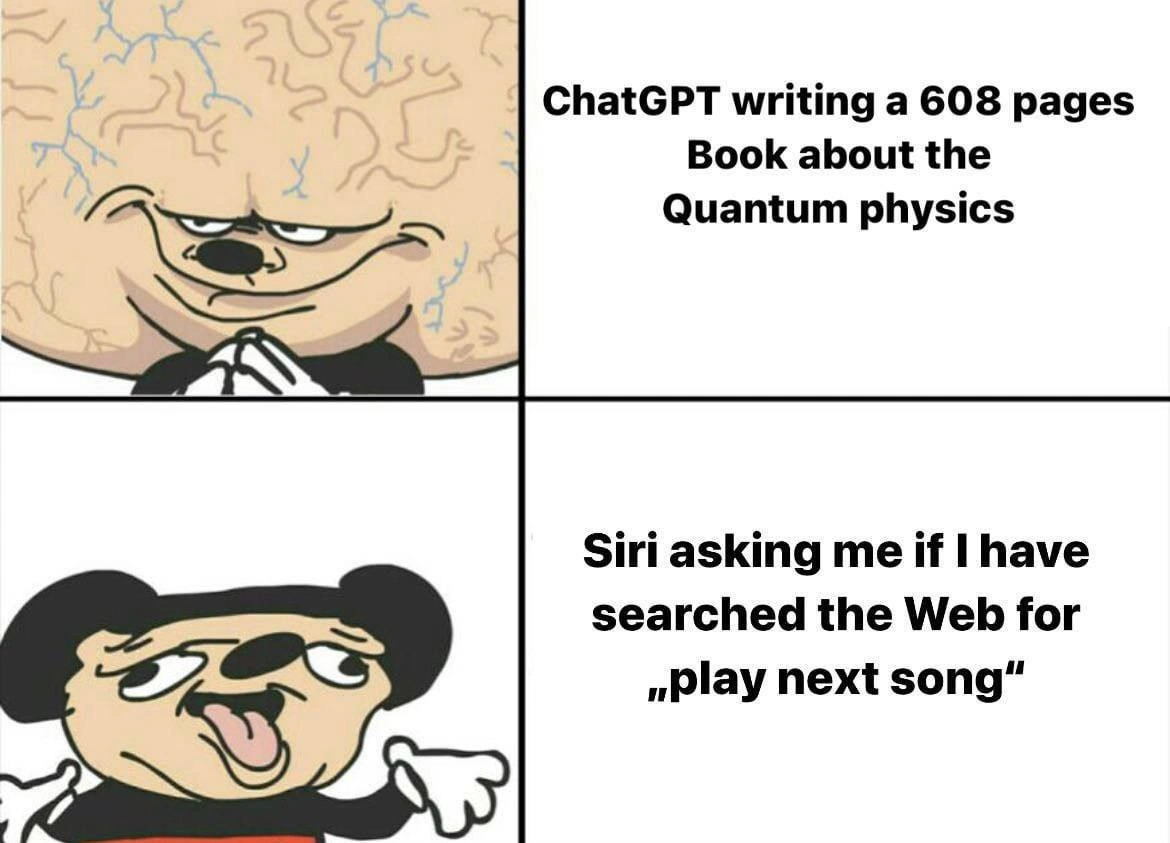
Let’s break down the meme in simpler terms. On the top half, we have ChatGPT being depicted as an ultra-brainy character. ChatGPT is an example of a Large Language Model (LLM), which basically means it’s a very advanced AI program trained on tons of text so it can talk with you or answer questions by producing its own sentences. The text says “ChatGPT writing a 608 pages Book about the Quantum physics.” Grammatics aside, this implies that ChatGPT can generate a huge amount of content on a really difficult topic like quantum physics. And that’s grounded in reality (though exaggerated for effect) – people have used ChatGPT to produce long essays, articles, or explanations. If you ask it about a complex subject, it will try to give you a detailed answer. For example, you could say, “Explain quantum physics to me,” and it might start explaining things like subatomic particles, wave functions, and so on, potentially going on for pages if you keep letting it continue. It’s like having a knowledgeable (if somewhat verbose) encyclopedia that’s eager to share. This is part of why there’s so much hype around AI like ChatGPT in 2023 – it often feels shockingly clever and capable. Developers and users are amazed that a computer program can produce something that reads like a well-informed human wrote it. That’s why in the meme, ChatGPT is shown with a giant brain and a smug expression: it represents it as this super-intelligent entity that can handle a very brainy task (writing a book about a heavy scientific subject).
Now, contrast that with the bottom half, which features Siri. Siri is Apple’s built-in voice assistant – basically, the helper on your iPhone or Mac that you can talk to. You say “Hey Siri” and ask it to do things for you, like send a text, set an alarm, or play music. Siri’s depicted by the droopy, tongue-out version of the cartoon character, looking pretty dopey. And the text next to it says: “Siri asking me if I have searched the Web for ‘play next song’.” This refers to a frustrating (but comically common) scenario: You gave Siri a very simple voice command – "play next song" – which any human would understand as “go to the next track” in whatever music is playing. But instead of doing that, Siri essentially responded with something like, “I don’t know that one. Shall I search the web for ‘play next song’?” In other words, Siri misheard or misunderstood your request so badly that it treated the phrase as a random query to Google (or Apple’s search) rather than as a music command. This is the equivalent of asking someone to pass the salt, and they respond by handing you a dictionary opened to the word “salt” – technically related, but completely unhelpful! 🫠
Why does this happen? For a newer developer or someone just learning about these assistants: Siri operates on a system of known commands and keywords. It has a list of tasks it can do (like play/pause music, send a message, etc.), and it listens for phrases that match those tasks. If everything lines up – you use the right phrase in the right context – Siri performs the action. But Siri is not as generally smart about language as something like ChatGPT. If your phrasing is off or it doesn’t catch what you said correctly, Siri often defaults to “I can search that on the web for you.” This is basically Siri’s polite way of saying, “I don’t know what you mean, maybe the internet has it.” It’s a known frustration with older voice assistants: they can be pretty inflexible. In the meme’s case, perhaps Siri didn’t realize you were giving a music command. It might have thought “play next song” was a question about the concept of playing the next song, rather than an order to skip the track. So, it did the only thing it’s programmed to do when confused – offer a web search. This leads to a really dumb-looking response from a user’s point of view. You’re like, “Seriously, Siri? I literally just want you to do the obvious thing and you’re asking me if I’ve Googled it?!” It’s that exasperation that the meme captures.
Now compare that to ChatGPT’s approach to understanding. ChatGPT doesn’t have a fixed list of commands. It’s using machine learning to predict an appropriate response to whatever you ask. If you say “write the next song” or “play the next song” to ChatGPT in text, it might not control a music app (because ChatGPT can’t press buttons on your phone), but it would at least respond in a relevant way like, “I’m sorry, I can’t actually play music.” Or if you asked it in a more general way, it might describe how to play the next song. The key point: ChatGPT tries to respond in context to your request with natural-sounding language, because it has been trained on countless examples of how humans write and speak. Siri, in contrast, is more like a set of if-then rules behind a voice interface. It’s great when you stick to what it knows (“Set a 5 minute timer” or “Call Mom” usually work fine), but it falls apart with unexpected phrasing or requests outside its programmed knowledge.
This meme resonates with developers and techies because it highlights how uneven the landscape of AI is. On one end, we have advanced AI models (like ChatGPT by OpenAI) that can produce an entire chapter about a complex science topic - something you’d think only an expert or a very studious person could do. On the other end, we have a daily-use voice user interface (like Siri, a product of Apple’s massive resources) that can’t handle a straightforward command that a child would understand. It’s a huge contrast. The meme is making fun of Siri’s lack of progress or clunkiness by comparing it to the shiny new AI star. It’s like saying: “One of these AIs is writing our term papers now, and the other can’t even press ‘Next’ on the music player without help.” For anyone who’s used Siri and also played with ChatGPT, this contrast is both funny and a little bit true. Siri often feels a bit “dumb” for an AI, while ChatGPT feels almost too smart (sometimes it’s so verbose or confident that it’s humorous in its own way).
In terms of developer experience (DX): if you’re a new dev playing with AI, interacting with ChatGPT feels like a big leap forward. You don’t have to define every possible thing it can do; you just give it a prompt and see surprisingly rich output. Working with Siri (via SiriKit or voice shortcuts), you quickly learn you must work within strict confines and test a bunch of phrasing to be sure it understands. The meme’s scenario (“play next song”) is something Apple did anticipate (that should work!), which makes it even funnier – even a supposed built-in command can fail in practice, depending on how Siri interprets your speech. It’s the classic tech humor of “smart” gadgets acting not-so-smart at times. And trust me, every developer has a story of some AI assistant frustration, whether it’s yelling at Siri, Alexa, or Google Assistant when they misinterpret a simple request. It’s practically a rite of passage in modern tech life to realize these assistants can be both amazing and amazingly dense.
So, the meme is basically showing: ChatGPT as the genius who can do the hard stuff, and Siri as the dunce who can’t do the easy stuff. The images (big-brain Mickey vs derpy Mickey) visually exaggerate this difference. It’s poking fun at Siri (and by extension Apple’s AI efforts) while riding the excitement around ChatGPT’s capabilities. For a junior developer or anyone new to these technologies, it’s a quick lesson that “AI” isn’t one single thing — there are different generations and types of AI. Some, like Siri, are older, rule-based or narrowly-focused systems that might disappoint you outside their comfort zone. Others, like ChatGPT, are cutting-edge machine learning models that can surprise you with very human-like, general responses — yet even they have limitations (they might give you wrong info confidently, for example, whereas Siri at least knows what it doesn’t know). This meme chooses an example where ChatGPT looks ridiculously good and Siri looks ridiculously bad to get a laugh and a knowing nod from those of us who’ve seen both in action.
Level 3: Trillions vs Triggers
For seasoned developers, this meme hits a nerve by juxtaposing two very different AI experiences we’ve all seen. On one side, we have ChatGPT, the poster child of the current AI hype. It’s backed by a model (GPT-3, GPT-4, etc.) so large and data-hungry that it’s essentially soaked up every textbook, Stack Overflow post, and Wikipedia article you can imagine. The result? It can eloquently churn out a detailed explanation of quantum physics or generate a full documentation guide on a framework as if it had a PhD in the subject. We chuckle at the meme’s exaggeration — "608 pages Book about Quantum physics" — but honestly, it’s only a tad hyperbolic. Give ChatGPT a prompt to "write a book on quantum mechanics", and you might need to remind it to stop because it will seriously attempt to do it, chapter after chapter. This is the power of LLMs: they are conversational AI systems that feel like they have an answer for everything, delivered in neatly formed sentences and paragraphs. From a developer’s perspective, it’s both impressive and uncanny. We know it’s essentially an advanced autocomplete on steroids, yet it often comes across as if it truly understands complex topics. It’s no wonder every product manager suddenly wants to sprinkle some GPT magic into their app — the Developer Experience (DX) of prototyping with such an API is wild. One moment you’re coding a simple interface for user queries, the next your app can produce entire articles or solve coding problems at a human-like level. Talk about riding the industry trend wave!
On the other side of this meme’s comparison is Apple’s Siri, a representative of what you might call legacy AI assistants. Siri was revolutionary when it first came out over a decade ago, introducing millions to the idea of talking to their phones. But by now, most devs regard Siri (and cousins like Alexa and older Google Assistant) as somewhat… well, dim 😅 in comparison to the new AI hotness. We’ve all been there: you give Siri a perfectly reasonable, simple request and it responds with something that makes you question if it even heard you right. In the meme’s scenario, the user says a very straightforward command — “play next song” — essentially asking Siri to skip to the next track in the playlist. Any human, or frankly any minimalist music app, understands this intent. Yet Siri’s comeback is to ask if you’ve searched the web for that phrase. Oof. That’s the kind of non-sequitur response that has made Siri the butt of so many tech jokes. It’s like you told your smart speaker, “Turn off the lights,” and it responded, “I found some light switches on the web, take a look.” Not very helpful, Apple!
Why does this happen? As experienced devs know, it’s because Siri relies on a limited set of trigger phrases and domains. If your wording or context falls outside the ones Apple anticipated, Siri doesn’t generalize well. It either misunderstands (thinking you said something else) or defaults to a web search because it literally doesn’t have a better answer in its playbook. It’s essentially a pattern matching failure. To Siri, “play next song” might have been parsed as just a generic query about the phrase "next song" instead of a command, especially if, say, no music was currently playing or the phrasing didn’t exactly match its expected voice command for that action. In contrast, ChatGPT isn’t hemmed in by a fixed list of commands. It’s been trained on countless sentences about every topic under the sun, so it will confidently respond to anything, from quantum physics to inquiries about your horoscope, whether or not it really should.
The humor here also stems from inconsistent AI quality – the idea that not all “smart” assistants are smart in the same way. One AI seems to have a galaxy-brain 🧠 capable of intellectual feats, while another struggles with what feels like common sense. Developers have a front-row seat to this irony. Many of us remember spending time integrating with Siri (using SiriKit Intents for our iOS apps) and feeling the constraints of that system. For example, if you were building a music app and wanted Siri to recognize “play my XYZ playlist next”, you had to plug into Apple’s predefined intent cases. If the user’s phrasing or your app’s registration of the intent didn’t line up perfectly, Siri would act oblivious. There’s a real rigidity there: Siri is only as smart as the scenarios Apple has explicitly taught it.
By contrast, working with ChatGPT (or GPT-based APIs) as a developer is a very different experience. You don’t script out every possible user utterance. Instead, you give a prompt and the model free-forms a response. It feels almost alive because it can handle variability in input that we didn’t specifically code for. Of course, that creative freedom comes with its own headaches — the model might hallucinate false information or go off on tangents, which is another kind of unpredictability. But it rarely says “I don’t know” outright. It will attempt an answer to virtually anything, which is both its charm and its flaw. Siri, in contrast, will very quickly say “I can’t do that” or revert to “Here’s what I found on the web…” if you venture outside its script.
This meme’s contrast encapsulates a broader tech commentary: The new breed of AI (like OpenAI’s ChatGPT) has dramatically expanded what we expect from machine intelligence – writing full articles, answering complex questions, generating code, etc. Meanwhile, some older AI products we use daily (like Siri in the Apple ecosystem) haven’t improved at the same pace for those everyday tasks. It’s a bit of a running gag in developer and tech circles: we have AI that can beat chess grandmasters and write poetry, yet my phone’s voice assistant still messes up setting a timer or, in this case, playing the next song. No wonder the meme shows the big-brained, smug Mickey for ChatGPT and the derpy, drooling Mickey for Siri – it really can feel like dealing with a genius savant versus a slow learner.
To put it in perspective, here’s a quick comparison that developers will appreciate:
| Aspect | ChatGPT (Modern LLM) | Siri (Voice Assistant) |
|---|---|---|
| Knowledge & Training | Trained on the Internet’s text (huge general knowledge). Capable of lengthy generative answers on almost any topic. | Trained on limited domains and phrases (music, timers, texts, etc.). Capable of executing predefined tasks it’s been explicitly programmed for. |
| Understanding Language | Uses context and probability to handle free-form natural language input, even if phrased in uncommon ways. | Relies on exact phrases or very close matches to known commands. Struggles with unusual wording or unanticipated requests. |
| Capabilities | Can produce a 608-page explanation, write code, hold a conversation, etc. (purely in text form). Adaptable but may hallucinate info. | Can perform phone actions (call someone, play music, set alarm) if asked correctly. Sticks to built-in functions; will fail or search web if it’s something it doesn’t recognize. |
| Response to Failure | Improvises an answer to almost anything, right or wrong, rather than giving up. | Falls back to “I found this on the web…” or “Sorry, I didn’t get that.” if it doesn’t know how to handle the request. |
From a senior developer perspective, the meme is also a commentary on tech progress and user expectations. We have this stark AI divide: on one hand, an AI that feels like sci-fi – writing “books” and chatting with remarkable fluidity – and on the other hand, the older generation AI that feels stuck playing catch-up on basic user commands. It’s funny, but also a little bit of an industry self-own. Users are now asking, “Hey Apple, if ChatGPT can explain quantum physics so easily, why can’t Siri reliably play the next song?” As devs, we know it’s not an apples-to-apples comparison: one is essentially a super-intelligent parrot with knowledge of text, the other a voice-activated butler with a limited script. They were built for different purposes. Still, the contrast in user experience is jarring and ripe for humor. It reminds us (in a tongue-in-cheek way) that “AI” isn’t a single thing — the quality and scope of “intelligence” can vary wildly depending on design and training. And as those of us in development and tech have seen countless times, sometimes the hype outpaces reality in one area, while in another area the reality has leapt ahead of what we even hyped. This meme nails that dichotomy with a simple, absurd visual: the genius AI scribbling away on a grand tome, and the simpleton AI asking if you’ve tried Googling that really basic request. It’s both a laugh at the current state of AI and a nod to how far things have come (and how far behind some things seem).
Level 4: Attention vs Intents
Under the hood, these two AI systems couldn’t be more different. ChatGPT is powered by a gargantuan Transformer model — think of a neural network with hundreds of billions of adjustable weights (parameters) that was trained on vast swaths of the internet. Its secret sauce is the self-attention mechanism, which lets it consider relationships between all the words in your prompt when generating a response. This architecture gives ChatGPT an almost encyclopedic contextual awareness. Ask it to write a 608-page tome on quantum physics, and it will dutifully start producing content on wave-particle duality, Schrödinger’s cat, quantum fields, and beyond. It doesn’t truly understand quantum theory like a physicist does, but it has statistically absorbed patterns from textbooks, research articles, and Wikipedia. The outcome is that it can generate a lengthy, coherent-sounding explanation of advanced science. In essence, ChatGPT treats writing about quantum physics as just a very large sequence prediction problem – it predicts one word after another, guided by all that training data and those enormous learned weights. The result can feel superhuman: a single prompt yielding a whole quantum physics book worth of text as if by magic. ✨
Meanwhile, Siri operates with a more traditional NLP pipeline oriented around intents and fixed commands. When you say “Hey Siri, play next song,” several discrete steps fire off: First, Siri’s speech recognition module (which, in early days, used Hidden Markov Models but now uses smaller-scale deep learning on your device) converts your voice into text. Next, a Natural Language Understanding component tries to parse that text to figure out what you want. Essentially, Siri checks: does this sentence match any known intent in my library? (For example, an intent might be NextTrack in the Music domain.) If it finds a match and the context is right (say, music is playing), Siri executes the corresponding action via a predefined API call in the Apple ecosystem (skipping to the next track in your music app). But if the voice command doesn’t quite match any known pattern, or if context is missing, Siri’s logic might not catch it. This is where things often break down. A slight phrasing change or an unrecognized accent can throw it off. In our case, Siri apparently failed to confidently map "play next song" to the Music domain’s “next track” action. When Siri’s intent matcher comes up empty-handed or uncertain, its fallback is often to punt the query to a web search. Essentially, Siri goes: “I don’t have a direct command for that; maybe the web knows.” This is why you sometimes get that familiar response offering to search the web for the exact thing you just said. It’s a failsafe for when Siri’s finite, rule-based brain reaches its limits.
This disparity comes from fundamentally different approaches to language comprehension. ChatGPT’s Large Language Model (LLM) approach is generative and probabilistic: it has no explicit list of commands; it just produces what seems like the most appropriate next words based on context. It’s flexible (608 pages about an esoteric topic? Sure!), but it doesn’t interface with your device or guarantee factual accuracy – it wasn’t built to press the “skip track” button on your phone or even know what that means in a practical sense. Siri’s approach is deterministic and task-oriented: it’s designed to map certain phrases to specific actions in your device, using a structured but limited understanding of language. It excels at a narrow set of things (like setting a timer or launching an app) when phrased just right, and it maintains a tight integration with device functions inside the Apple ecosystem. However, it can’t improvise or step outside its programmed domains. It lives in a world of triggers and predefined responses.
In academic terms, ChatGPT’s prowess is an emergent property of scaling up machine learning – as models get huge and ingest essentially all of human written knowledge, they start showing surprising capabilities. Siri’s system harks back to an earlier era of AI assistants where reliability and privacy (often running models on-device) were prioritized over open-ended knowledge. Apple has historically kept Siri’s processing constrained (to protect user privacy and ensure snappy responses), which means using smaller models and a curated set of skills. The downside is what we see in the meme: a somewhat rigid understanding of language that doesn’t always generalize well. The phrase “play next song” to a human seems obviously a music command, but to Siri’s old-school NLP brain, it might as well have been a random question if it wasn’t an exact match.
The meme humorously exposes this technical gulf: an AI with a practically galactic-memory neural network that can spew out a detailed quantum physics dissertation versus an AI with a finite-state task engine that stalls on a simple music request. It’s like comparing a brainstorming supercomputer to a walkie-talkie that only has a few preset channels. The inconsistency in AI capabilities comes down to these design decisions. ChatGPT’s attention-based architecture lets it juggle complex concepts and long contexts with ease, while Siri’s intent-based pipeline can crumble if your request doesn’t fit neatly in one of its predefined boxes. This is a textbook example of how newer AI paradigms (end-to-end deep learning models) are leapfrogging the older, modular NLP systems in some respects, producing almost surreal results… even as the legacy systems sometimes struggle with the basics.
Description
Four - panel cartoon meme in a 2×2 grid. Top-left panel shows a smug Mickey-like character with an enormous, veiny brain, hands steepled in evil-genius fashion. Top-right panel contains bold black text: “ChatGPT writing a 608 pages Book about the Quantum physics”. Bottom-left panel shows a derpy, tongue-out Mickey-like character with droopy eyes and a blank stare. Bottom-right panel contains bold black text: “Siri asking me if I have searched the Web for „play next song“”. The juxtaposition humorously contrasts the seemingly superhuman capabilities of modern large language models with the often-clumsy comprehension of legacy voice assistants, highlighting real developer experiences with inconsistent AI quality, NLP pipelines, and user-facing DX

Comments
10Comment deleted
ChatGPT’s drafting a layman’s guide to lattice QCD, meanwhile Siri routes “next song” through six legacy microservices, hits a 500, and opens Safari - proof that model parameters scale, but tech debt compounds
It's like watching a distributed system that can handle petabyte-scale ML workloads but crashes when someone tries to increment a counter - except here it's AI that can hallucinate an entire physics textbook but can't parse 'skip to next track' without suggesting a Google search for musical navigation techniques
The meme perfectly captures the generational leap in AI: ChatGPT can hallucinate 608 pages of quantum physics with confident authority, while Siri still treats 'play next song' as an existential crisis requiring web search confirmation. It's the difference between a transformer model with 175B parameters and a rule-based system that peaked in 2011 - one writes doctoral theses (accurate or not), the other asks if you meant to Google your Spotify command
ChatGPT can derive Schrödinger, but Siri’s ASR→NLU→OAuth→rate-limit chain decoheres into “open Safari” - the gap between AI research and shipping an integration
Reasoning scales faster than integrations: an LLM can stream a 608‑page thesis, while Siri’s pipeline still ends ASR→NLU<0.7→FallbackStrategy.WebSearch('play next song')
LLMs scale to quantum textbooks on 175B params; voice AIs route 'next track' to Bing - edge inference tax hits different
Imagine Siri and Google assistant use an AI like chatGPT... Comment deleted
imagine Boston Dynamics doing the same...wait...already done Comment deleted
https://fxtwitter.com/svpino/status/1650832349008125952 Comment deleted
Pello! Comment deleted