Electron Devs Welcome Apple's RAM Upgrade
Why is this Frameworks meme funny?
Level 1: Bigger Closet Instead of Cleaning
Imagine you have a toy box that’s overflowing with toys. You keep stuffing more and more toys in until the lid barely closes and things are spilling out. Instead of sorting through and removing some toys (or getting smaller toys), your parents come home with the biggest toy box you’ve ever seen – so huge it can fit all your toys with room for more. You’re overjoyed and say, “This is the best solution ever!” In this story, your messy toy box is like a computer program that uses a lot of memory. Cleaning up toys (making the program use memory better) is hard, so the “Apple parents” just gave you a giant new box – a computer with tons of extra memory. You didn’t fix the messy habit, but you don’t have to worry about it now because the box is so big. It’s funny because, in real life, it’s a bit silly to solve a problem by just making the container ridiculously larger instead of improving the mess. The meme makes us laugh at how the software developers are basically doing just that – they’re thrilled to have a super huge “closet” for their “messy app” rather than cleaning up the mess!
Level 2: Electron’s Memory Appetite
Let’s break down the meme’s ingredients in simpler terms. First, Apple’s Mac Pro with 1.5 TB of RAM: RAM is the computer’s short-term memory, where it holds data it’s actively using. 1.5 TB (terabytes) is an enormous amount of RAM – about 1,500 gigabytes. For comparison, a typical new laptop might have 8 or 16 GB of RAM. Having 1,500 GB is like having nearly 100 high-end PCs worth of memory all in one computer. Apple announced this monster machine in 2019, and it was a big deal in the tech world (especially in the Apple ecosystem). It’s the kind of computer spec that made everyone say “wow.” In the meme, the text “Apple: 1.5 TB of RAM” is basically Apple bragging: “Look how much memory our new Mac has!”
Next, the response: “Electron/Chromium devs:” This refers to software developers who build apps using the Electron framework, which runs on Chromium (the engine behind the Chrome browser). Why single them out? Because Electron apps are notoriously heavy on memory usage. Electron lets developers create desktop applications using web technologies (like building a mini website that runs as an app). It’s cool because you can write your app once in JavaScript and it works on Windows, Mac, and Linux. The catch: every Electron app includes the whole Chromium browser engine inside it. That’s like using a full Chrome browser for each app you have open. Browsers need a lot of memory to run modern web pages (think of how Chrome can use gigabytes of RAM if you open many tabs). So, if you have several Electron-based apps open, each one might be using hundreds of megabytes or more. This can quickly eat up the RAM on a normal computer and cause performance issues (your machine might slow down or start swapping data to disk). Developers jokingly call such apps “memory hogs” because they gobble up RAM. Memory management in these apps isn’t poor in the sense of leaks; it’s just that the design (embedding a browser) is inherently bulky.
Some popular Electron apps you might recognize include:
- Slack – a workplace chat app (built on Electron, it can use a lot of memory especially if you’re in many chat channels).
- Microsoft Teams – another Electron-based communication app, also known to be pretty heavy.
- Discord – a chat app for gamers, built on Electron with Chromium.
- Visual Studio Code (VS Code) – a very popular code editor. It’s surprisingly built with Electron too, which is why even a text editor can end up using quite a bit of RAM with many extensions or projects open.
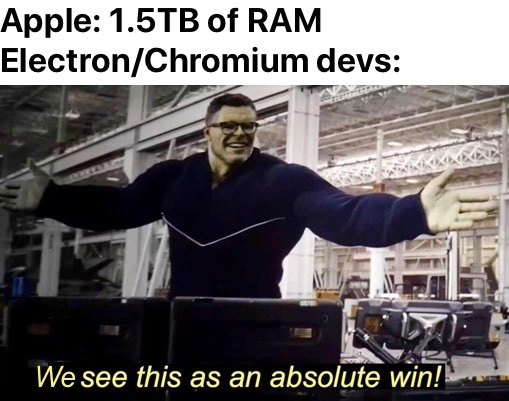
These apps are super handy and cross-platform, but they trade efficiency for convenience. On a typical computer, running Slack, Teams, and Chrome all together might make the system struggle if you don’t have a lot of memory. That’s why the meme shows Electron/Chromium developers getting excited about Apple’s new 1.5 TB RAM offering. It’s like they’re saying: “Yesss, finally a machine that can handle our apps without breaking a sweat!” The image of the Hulk at the bottom reinforces this excitement. It’s from a scene in Marvel’s Avengers: Endgame where the Hulk (who is actually Bruce Banner in a big green superhero body) smiles proudly with his arms open wide. The caption on that image is “We see this as an absolute win!” – meaning “We think this is a total success.” In the context of the meme, the Hulk is labeled as the Electron/Chromium devs, and he’s thrilled. This is funny because it’s a bit sarcastic: generally, you’d want to make your software use less memory, but instead these devs are just happy they can buy a computer with massive memory. It highlights a real tech inside-joke: modern apps sometimes use so many resources that we’re relieved when hardware catches up to our software’s appetite.
In short, the meme is saying: Apple made a super-powerful Mac Pro with tons of memory, and developers who make apps with Electron/Chromium (which are known to use a lot of memory) are cheering. They’re represented by a happy Hulk saying “absolute win” because now they can run their hefty apps without worrying about memory as much. It’s a lighthearted poke at both the Apple news and the state of modern app development. Even if you’re a newer developer, you might have noticed how something simple (like a chat app or an editor) can consume a lot of RAM – this meme exaggerates that problem and jokes that the solution is just to give those apps a ridiculous amount of memory to play with. That’s the humor: solving software bloat by just throwing more hardware at it. 🤣👩💻
Level 3: Absolute Unit of RAM
Apple’s unveiling of a Mac Pro with 1.5 TB of RAM sent shockwaves through the tech community. To put this in perspective, 1.5 terabytes of memory in a single workstation was unheard of in 2019 – that’s more memory in one machine than many entire server racks had a decade prior. Professional users in the Apple ecosystem (video editors, scientists) saw it as raw power for intensive workloads. But a very specific group of developers – those working with Electron and the Chromium engine – cheered for a more tongue-in-cheek reason: their notoriously memory-hungry apps would finally have room to breathe. In developer humor circles, this meme captured that ironic celebration. Apple’s supercharged hardware is essentially a performance bailout for software bloat, and the devs jokingly “see this as an absolute win.”
At the heart of the joke is Electron’s reputation for heavy memory usage. Electron is a framework that lets you build cross-platform desktop apps using web technologies (HTML, JavaScript, CSS) by embedding a full Chromium browser inside. It’s the engine behind apps like Slack, VS Code, Discord, and many others. This convenience comes at a cost: each Electron app is like running a mini Chrome browser (or sometimes several). That means big overhead – multiple processes, duplicate memory for each app, and extra layers (Node.js, V8 engine) all chewing through RAM. Developers have long noticed that opening a simple chat app built on Electron can consume hundreds of megabytes of memory (or more) just to show what’s essentially a glorified web page. Open a few Electron-based apps at once, plus some Chrome tabs, and suddenly even 32 GB of RAM on a high-end laptop can feel small. This meme riffs on that pain by implying, “Hey, now we have 1.5 terabytes – finally enough to run all our Electron apps without worry!” It’s a sarcastic nod to the performance issues we’ve all seen, like the joke that Chrome will use all the RAM you give it. (Developers often quip that if you had 1.5 TB of memory, Chrome would still find a way to eat it all with enough tabs open!)
There’s an underlying commentary here about software memory management (or the lack thereof) and industry trends. In an ideal world, frameworks would become more efficient over time – but in reality, hardware improvements often outpace software optimization. This leads to a comfortable (if slightly dysfunctional) cycle: why spend time painstakingly optimizing memory usage when next year’s hardware will double the RAM? It’s akin to the famous contrast between Moore’s Law (hardware gets exponentially better) and Wirth’s Law (“software gets slower faster than hardware gets faster”). Electron and similar frameworks exemplify this: they trade efficiency for developer convenience. Companies embrace Electron because it boosts productivity – one codebase for all platforms – even if it means each user’s machine works harder. The meme playfully acknowledges that trade-off. The AppleEcosystem is known for tight hardware-software optimization (think of how efficient native iOS apps can be), yet here we have the opposite scenario: developers leaning on brute-force hardware advancements to offset software bloat. It’s a reversal of Apple’s usual “optimized performance” narrative, which makes it extra funny to those in the know.
The image choice adds another layer for seasoned devs. It uses the Hulk “absolute win” template from Avengers: Endgame. In that scene, Bruce Banner (as Professor Hulk) declares “I see this as an absolute win!” after a risky experiment with only partial success. Anyone who’s dealt with on-call 3 AM outages or messy legacy code can appreciate the dark irony: sometimes you celebrate the small wins or unconventional solutions. Here, the solution to Electron’s hefty appetite isn’t elegant refactoring or better architecture – it’s Apple handing us an absurd amount of RAM. The Hulk’s broad grin and outstretched arms perfectly represent Electron/Chromium devs basking in the glow of a hardware fix. It’s a senior-engineer kind of punchline: the meme spotlights a real problem (software bloat) and a real trend (throw hardware at it) with a wry smile. Every experienced developer has seen this pattern – from the days of bloated enterprise Java apps in the 2000s to today’s Electron apps – where adding more CPU or memory is the quick but costly fix. The humor lands because it’s so true: we’ve created apps so hefty that a 1.5 TB RAM Mac is joked about as “finally, a machine that can run our stuff smoothly.” The absurdity is an inside joke about our own industry’s habits.
Description
This is a meme using the 'I see this as an absolute win' format featuring Professor Hulk from 'Avengers: Endgame'. The top text reads 'Apple: 1.5TB of RAM' followed by 'Electron/Chromium devs:'. The image shows a smiling Professor Hulk with open, welcoming arms, and the caption below him says, 'We see this as an absolute win!'. The meme humorously points out the notoriously high memory consumption of applications built with Electron or based on Chromium. The joke is that instead of optimizing their applications to use less RAM, developers of these apps are celebrating the availability of more powerful hardware with massive amounts of RAM, as it means their resource-intensive apps can continue to run without issue, effectively treating a hardware upgrade as a solution for software inefficiency

Comments
7Comment deleted
Electron apps don't have memory leaks, they have 'unmanaged long-term memory allocation features.' The 1.5TB Mac Pro isn't a computer; it's just a dongle to run Slack
Apple ships 1.5 TB of RAM; the Electron team’s roadmap just added “one Kubernetes cluster per BrowserWindow - plus headroom for the leaks.”
Finally, we can run three instances of our todo app without Chrome's memory pressure API kicking in
Apple finally ships machines with 1.5TB of RAM, and somewhere an Electron developer just updated their minimum system requirements. Meanwhile, senior engineers remember when we had to fit entire operating systems in 640KB and wonder if we've collectively forgotten that memory isn't free just because it's abundant. The real irony? We're now shipping 'Hello World' apps that consume more resources than the Apollo Guidance Computer used to land on the moon - but hey, at least we can use React hooks in our desktop calculator
I don’t optimize Electron anymore; I capacity‑plan the workstation
Apple: 1.5TB RAM. Electron/Chromium devs: perfect - bump --max-old-space-size, run a browser per button, and call the leaks “site isolation.”
Electron: Where 'lightweight cross-platform' means your app idles at 4GB while the backend sips 128MB