Rebels of the Main Branch
Why is this VersionControl meme funny?
Level 1: What Could Possibly Go Wrong?
Imagine four friends working on a big school painting together. There’s a rule that each friend should paint their part on a separate sheet first and let the teacher check it, then carefully add it to the final poster one by one. But these four just can’t wait – they all grab paint and start drawing directly on the final poster at the same time, grinning at each other. They’re so proud that they skipped asking the teacher and finished super fast. For a moment, it feels awesome to break the rules and get away with it. But soon, they might notice they painted over each other’s work and made a bit of a mess. The poster might end up with oddly mixed colors and shapes that don’t quite fit. When the teacher comes to see the poster, uh-oh! There’s chaos on the page, and now all four friends will have to stay after class fixing it. The meme is joking about that exact kind of situation in coding: a team taking a wild shortcut, feeling like playful villains who got away with something, all while the audience knows there’s probably trouble brewing once the “grown-ups” (or in real life, the consequences) catch up. It’s funny because the friends in the moment are happy rule-breakers, just like the developers pushing code without permission and laughing — until things inevitably go wrong.
Level 2: Push vs Pull Requests
So, what’s going on here in simpler terms? This meme is talking about a software team that updates the main code directly, like throwing a new page into a book without anyone else reading it first. In Git (a popular VersionControl system), teams usually have a main branch (often called the master branch or nowadays main). This is the official source of truth for the codebase — the product everyone uses or the code that’s deployed. Normally, when developers want to add or change something, they don’t touch the master branch right away. Instead, they create a new branch (a copy of the code where they can safely make changes) and later merge those changes back after reviews and testing.
Committing directly to master means these developers skipped that whole process. They didn’t create a separate branch for their work, and they didn’t ask teammates to check their code. A Pull Request is basically a formal way of saying “Hey team, I have some code changes on my branch, can you take a look and approve before we merge it into master?” It triggers a code review, where colleagues comment on the code, suggest improvements, or catch mistakes. Usually, automated tests also run on the pull request to ensure nothing is broken. Only when everything looks good do you merge the PR into the master branch. This careful workflow is like cooking in a separate kitchen and only serving the dish to customers after the chef and food critic taste it.
In the meme’s scenario, the “boys” are doing the opposite. They directly push their changes to the master branch on the main repository without any review. It’s as if they said, “I’ve cooked something, and I’m putting it on the menu right now, hope you all survive!” No second opinions, no taste test. This is generally considered a workflow anti-pattern because it can lead to big problems: if there’s a bug in their code, it’s now immediately in the live codebase; if two people push conflicting changes, the code will hit a merge conflict or break the app.
Let’s break down the difference between the best practice and what this team is doing:
| Best Practice (Safe Workflow) | “Me and the Boys” Approach (Reckless) |
|---|---|
| Create a separate feature branch for your work. | Make changes directly on the master branch. |
| Open a Pull Request for team review and feedback. | Bypass code review entirely – no PR, no approval. |
| Let automated tests run to catch bugs before merging. | Skip or ignore tests; find out about bugs after pushing. |
| Resolve any merge conflicts in the PR before merging. | Deal with conflicts later, possibly on the live master branch. |
| Merge into master only when checks pass and reviewers approve. | Merge whenever you feel like it, checks or no checks. 🤷 |
As the table shows, the meme’s dev team skips the “pull request party” and goes straight for the merge. In platforms like GitHub or GitLab, there are settings called branch protection that can prevent direct pushes to the main branch. For example, you can require at least one code review approval and passing tests before the master branch accepts new code. If those protections aren’t in place (or someone with admin rights ignores them), developers can push changes directly, just like the meme suggests.
Why is this bad? Think of a mergeConflict: that’s when two people change the same part of the code in different ways. If both push directly, Git won’t know whose change to keep, and the master branch can end up in a broken state until someone resolves the conflict manually. Also, without code reviews, a lot of eyes miss the chance to spot a mistake. Maybe Alice on the team has seen a similar bug before and would notice it, or Bob knows a scenario that needs an extra check. If Alice and Bob never see the code before it goes live, those insights are lost. This can lead to bugs in production or a build that doesn’t compile.
Another issue is technical debt – little problems and messy code that accumulate over time. Code reviews aren’t just about catching outright errors; they also enforce style consistency and good practices. By skipping reviews, the team might introduce code that’s hard to read, not well documented, or doesn’t follow the team’s standards. That’s like adding one unstable block in a Jenga tower; it might not fall now, but you’re making the structure shakier for later.
Now, sometimes on very small projects or early in a product’s life, teams do commit straight to master because it’s fast and everyone is in the loop. This is often called “cowboy coding” when done informally. It feels like freedom – no process, just code and go. But as a project grows and more people collaborate, this approach becomes chaotic. Imagine five people editing the same document at the same time without any Google Docs-style live syncing – you’d end up overwriting each other’s paragraphs and making a mess. That’s why most teams move away from this as soon as they can, adopting a structured branching strategy (GitFlow, GitHub Flow, etc.) to keep the codebase stable.
In short, the meme humorously highlights a GitBranching worst-case scenario. The “boys” are proudly breaking the rules that protect the main code. It’s funny because they feel no remorse for something that usually causes every other developer massive anxiety. If you’ve ever been the new developer who accidentally pushed to master (“oops!”) and then watched tests fail or teammates panic, you’ll recognize both the horror and the thrill in this image. The meme is basically a nod and wink: “We’ve all seen this kind of mischief — and if you haven’t, you might be the mischievous one!”
Level 3: Masters of Disaster
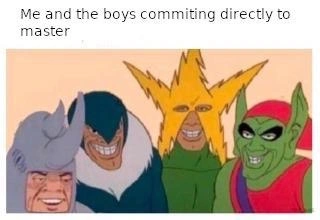
In this meme, a band of grinning Spider-Man villains (from the popular “Me and the Boys” template) stand in for developers gleefully bypassing every safeguard in their VersionControl workflow. The caption reads “Me and the boys commiting directly to master,” misspelling committing as if even spellcheck was an unnecessary code review. Seasoned engineers immediately recognize the villainy here: pushing code straight to the master branch with zero code review, no pull request, and absolutely no branch protection. It’s the software equivalent of a getaway crew bragging about robbing a bank in broad daylight — bold, reckless, and bound to trigger alarms.
By committing to master without a review, these developers are effectively disarming all the safety nets modern teams put in place. Most professional workflows enforce branch protection rules on the master (or main) branch: you must create a feature branch, open a Pull Request (PR), get a CodeReview, and pass automated tests before merging. That process is there to catch bugs, mergeConflicts, and bad ideas before they hit the main codebase. But our grinning rogues? They’re having none of it. They push changes directly to master like it’s no big deal – a brazen workflow anti_pattern. The humor bites because many of us have felt the aftermath of this anti-pattern: the broken builds, hotfix scramble, and “who pushed this?!” blame game that follows a bad commit.
This scenario is essentially cowboy coding on a shared repository. The team is acting invincible, feeling “no remorse” as they merge unvetted code. And why should they worry, right? Continuous Integration pipelines turning red, overnight on-call alerts, and angry Slack messages are Future Them’s problem! The meme nails that shared industry trauma where one person’s “quick fix” or YOLO push to master brings down the whole app or causes hours of bug-hunting. Each villainous grin in the image is a teammate thinking, “We got away with it!” – meanwhile every senior developer who sees this image can practically hear the Jenkins build failing and the Jira tickets piling up.
It’s worth noting that trunk-based development (committing straight to the main branch) can be a legitimate strategy, but only with ironclad discipline: thorough testing, small incremental changes, and team agreement. Here, though, the context is clearly a lack of discipline – more Sinister Six than Agile. They’ve essentially bypassed the branch_protection_bypass mechanism that would normally prevent such direct pushes. On platforms like GitHub, you’d typically lock down master so nobody can push without reviews or at least two approvals. If “the boys” can freely do this, it implies either those protections are turned off or they have godlike admin rights (and poor judgment to match). It’s the kind of setup where almost inevitably someone will type git push origin master on Friday at 5 PM and then peace out, leaving everyone else to deal with the fallout.
The real punchline is the team_mischief vibe: these devs treat a serious GitBranching violation like a harmless prank. The image source amplifies this: those Spider-Man villains look so pleased with themselves, just as a clique of coders might feel when they’ve skirted the rules and “nothing bad happened… yet.” There’s a darkly comic undertone here that any senior developer can appreciate. We’ve seen how “master of disaster” moments play out. Today’s triumphant direct commit can become tonight’s production outage. The technical_debt accruing behind those smirks is almost palpable. As the saying (almost) goes, “With great power (to push to master) comes great responsibility.” These guys took the power and ditched the responsibility — and every experienced engineer watching is cringing and chuckling at how perfectly that hubris is captured.
In short, the meme humorously spotlights a classic anti-pattern in software development: the rogue team that skips process and treats the shared master branch like a Wild West frontier. It’s funny because it’s true — many of us have either been those over-confident committers or had to clean up after them. The villains’ giddy faces embody that momentary victory feeling when breaking the rules, even as the viewer knows a dose of karma (or emergency bug-fix commits) likely awaits. It’s a cautionary cackle from the trenches of software engineering: push to master at your peril, boys.
Description
This image uses the popular 'Me and the Boys' meme format, which features a lineup of four grinning supervillains from the 1960s Spider-Man cartoon: Rhino, Vulture, Electro, and Green Goblin. They all have mischievous, conspiratorial smiles. The caption above them reads, 'Me and the boys commiting directly to master'. The humor lies in framing a notoriously bad software development practice as a form of rebellious, villainous fun. In modern version control workflows (like Git), committing code directly to the main branch (historically named 'master', now often 'main') is heavily discouraged. It bypasses crucial safety nets like code reviews and automated testing, risking the introduction of bugs directly into the production codebase. The meme perfectly captures the chaotic energy of a team that either doesn't know the rules or willfully ignores them, much to the horror of any senior engineer or DevOps professional
Comments
7Comment deleted
Committing directly to main isn't a workflow; it's a resume-generating event
Direct pushes to master: the quickest path from five-nines SLA to a midnight git reflog archaeology expedition
The same energy as deploying on Friday at 4:59 PM with a database migration that "definitely won't need a rollback" while the on-call engineer is at their kid's recital
Ah yes, the legendary quartet who treat branch protection rules as mere suggestions and consider 'git push --force origin master' a valid conflict resolution strategy. These are the same engineers who somehow always have 'urgent hotfixes' at 4:45 PM on Friday, mysteriously bypassing that carefully crafted CI/CD pipeline the platform team spent three sprints building. The real kicker? They'll still ask in Slack why the staging environment doesn't match production
Real trunk‑based development has CODEOWNERS and required_status_checks; this is just `git push --force-with-lease origin master` followed by a Monday postmortem
No PRs, no problems - until the on-call rotation finds out
Committing directly to master: branch protection is optional, pre-receive hooks are suggestions, and the rollback plan is just git reflog at 3 AM