Skip to content
DevMeme
377 of 7435
A Developer's Book of Hilarious Self-Deceptions
Testing Post #441, on Jun 6, 2019 in TG

A Developer's Book of Hilarious Self-Deceptions

Why is this Testing meme funny?

Level 1: Cleaned My Room

Imagine a kid telling their parents, “Yeah, I cleaned my room, I promise!” – but all they really did was shove all their toys and clothes under the bed and in the closet. The room might look okay at first glance, but nothing was actually sorted or checked properly. Sooner or later, a forgotten sandwich under the bed is going to start smelling, and the truth comes out. This joke is funny for the same reason: the developer in the meme is like that kid, proudly saying “Everything’s all good, I tested it!” while skipping the real work of actually checking. We laugh because we recognize that playful fib – claiming you did a thorough job when you really took a shortcut and just hope everything will turn out fine.

Level 2: Works on My Machine

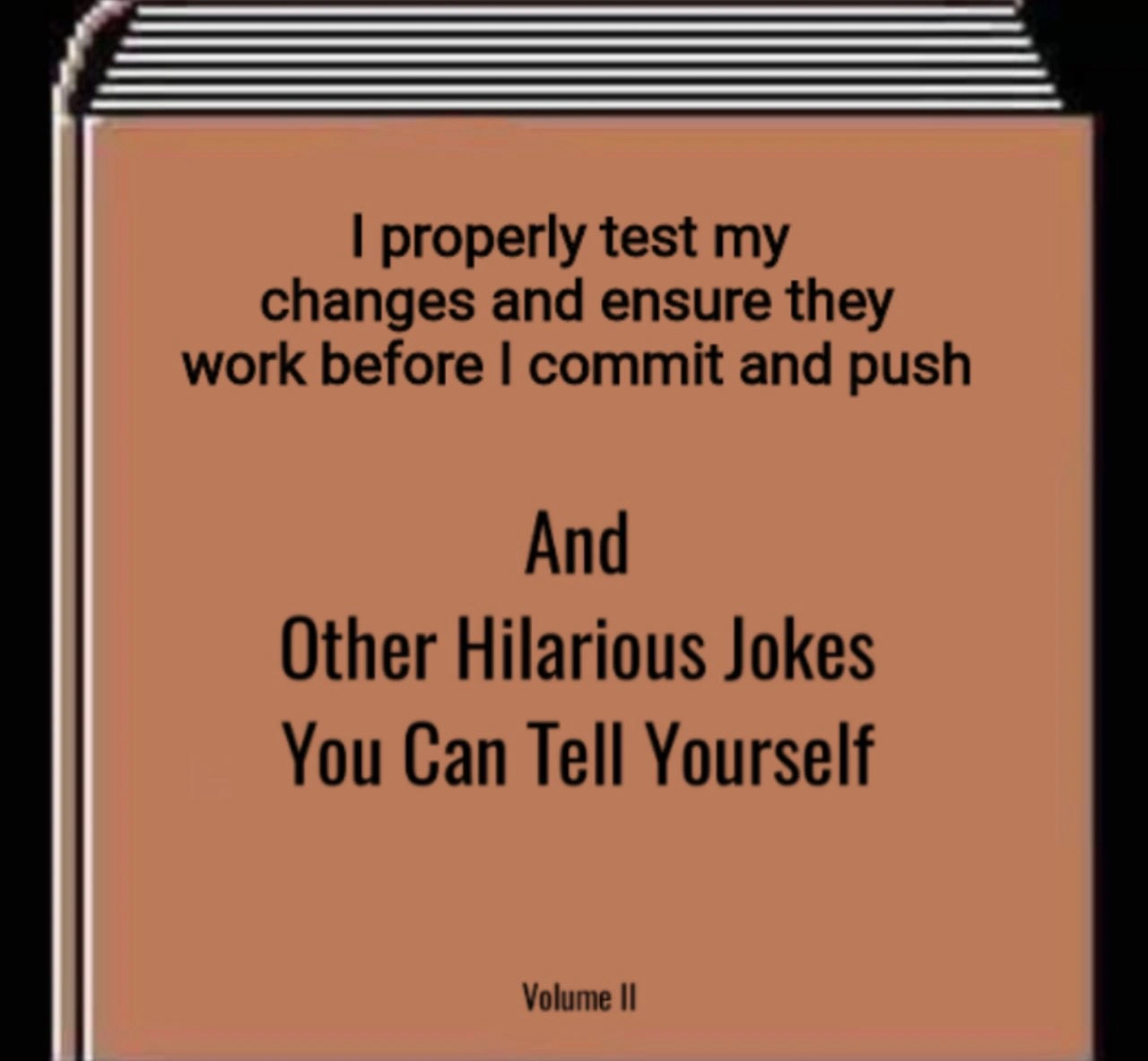
Let’s break down the joke in plainer terms. The meme’s “book title” basically says: “I always test my code changes to make sure everything works before I commit them to version control and push to the shared repository.” The punchline is that this claim is filed under “Hilarious Jokes.” In other words, it’s poking fun at developers who say they thoroughly test every time, but often they really don’t.

In a normal development workflow using Git or another VersionControl system, committing is when you save a snapshot of your code changes in your local repository. Pushing means you’re sending those committed changes up to the central server or repository so that others (or your continuous integration system) can see them. Proper Testing before that push would mean running your application or, better yet, running an automated test suite (like a bunch of unit tests that verify each part of your code). For example, if you’ve written a new function, you’d have some unit tests that call that function with various inputs to check it returns the expected output. Ensuring your changes “work” isn’t just about the code compiling; it means the code actually behaves correctly and doesn’t break anything that was working before.

The reality, especially for beginners (and, truthfully, plenty of experienced folks too), is that there’s a temptation to skip this step. Maybe you made a quick change and it seemed fine – you ran the app once and didn’t see it crash. Or you were in a hurry and thought, “It’s a tiny edit, what could possibly go wrong?” So you do a commit_without_testing beyond maybe a fast manual click-around, and then push your code to GitHub or GitLab. This is often jokingly called a “push and pray” approach: you push the code out and pray that everything will be okay (or that if something’s wrong, someone else or an automated system will catch it).

Why do developers find this funny (and a bit painful)? Because we’ve all been guilty of it at some point, and we’ve been warned many times not to do it. It’s a bit of DeveloperSelfDeprecation – we’re laughing at our own bad habits. The meme exaggerates it by suggesting that the promise “I always test before I push” is as unbelievable (and lengthy) as a volume of mythical tales. It highlights a common gap between what we aspire to do (follow best practices: write tests, run them, be thorough) and what sometimes happens under pressure or out of laziness (skip tests, hope for the best). For a newer developer, the takeaway here is: everyone knows they should test their code, yet in real life many people don’t always do it. That disconnect is both humorous and a gentle warning. The next time you catch yourself thinking, “Eh, it works on my machine!”, remember this meme – it’s nudging you that maybe you should run those tests after all, instead of becoming the main character in “Volume III” of developer fairy tales.

Level 3: The Push & Pray Doctrine

In this thick-book meme, the cover text claims “I properly test my changes and ensure they work before I commit and push” – followed by the punchline “And Other Hilarious Jokes You Can Tell Yourself.” This faux book (labeled Volume II) is basically an encyclopedia of the grand developer fairy tale that every code change gets fully tested before hitting the repository. The humor lands because experienced developers recognize this scenario all too well: it’s the gap between best practices and real-world git push habits. We’re supposed to write thorough unit tests, run them locally, double-check everything, and only then commit. In theory, every commit should be a Boy Scout checkmark for CodeQuality. But in practice? Welcome to the push_and_pray club.

Seasoned devs have survived enough 3 A.M. outages to know that “I totally tested my code” is often a blatant lie polite fiction. Maybe you changed one line (“just a small fix, what could go wrong?”), skipped running the test suite because it’s slow, and then did a git commit and git push anyway. Cue the drama: the continuous integration (CI) pipeline lights up red, or worse – something breaks in production because it wasn’t tested in a realistic environment. (For the truly brave or reckless who skip CI entirely, that untested code might sail straight into production, where the "tests" happen as real users encounter bugs – not exactly ideal.) This meme’s TestingHumor hits home precisely because we’ve all done that commit_without_testing at some point. It’s a form of technical debt roulette: you spin the chamber by pushing untested code, hoping there’s no live bullet (bug) this time. Spoiler: eventually, there is.

The phrase “Other Hilarious Jokes You Can Tell Yourself” underscores how self-deceptive these developer promises can be. It belongs on the shelf next to Volume I, “I’ll definitely write documentation for this later.” 😏 The thick_book_meme_format exaggerates how widespread and hefty this problem is – practically book-length. In VersionControl terms, the meme mocks those commit messages that might as well read, “Works on my machine, I swear.” Every senior engineer has seen (or written) commits like:

git add .
git commit -m "All tests passed locally (I didn't actually run them)"
git push origin master

Only to find out nothing passes and push_and_pray struck again.

From an architectural perspective, this joke shines a light on why robust Continuous Integration and testing culture are critical. Many teams put in safeguards – like pre-commit hooks that run npm test or branch protection that rejects a push if tests fail – precisely because without them, even well-intentioned devs can get sloppy. Yet, the existence of this meme suggests that testing_shortcuts persist despite all the tools. Deadlines, lazy moments, overconfidence (“my change is so trivial it can’t possibly break anything!” – famous last words) all conspire to make “test before commit” a nice idea that we laugh about rather than consistently practice. The grizzled veterans among us have learned the hard way that skipping tests leads to real-life horror stories – like getting paged at midnight when that “tiny untested change” crashes a critical service. We chuckle at the meme, but it’s a knowing, slightly pained chuckle: we laugh so we don’t cry about our own push-and-pray war stories.

Description

The image displays the cover of a fictional book. The book has a plain, brownish-orange cover with black text. The top and spine of the book, visible at the top edge, have a classic black and white striped pattern. The title on the cover reads, 'I properly test my changes and ensure they work before I commit and push', followed by the subtitle, 'And Other Hilarious Jokes You Can Tell Yourself'. At the very bottom, in smaller text, it says 'Volume II'. This meme format uses a fake book cover to satirize common self-deceptions or falsehoods within a specific community. In this case, it targets the software development practice of claiming to test code thoroughly before integrating it, humorously presenting this ideal as a complete fantasy. It resonates with developers who have, under pressure or out of habit, pushed code with minimal testing, only to find bugs later
Comments

7
Anonymous ★ Top Pick 'I tested it locally' is the software equivalent of 'the check is in the mail.' Both are technically true at some point, but offer zero guarantees about the outcome
  1. Anonymous ★ Top Pick

    'I tested it locally' is the software equivalent of 'the check is in the mail.' Both are technically true at some point, but offer zero guarantees about the outcome

  2. Anonymous

    Volume II was sponsored by every engineer who swore “the pre-commit hook ran fine on my laptop” - CI disagreed, PagerDuty concurred, and now we’re out of shelf space

  3. Anonymous

    The real test coverage is the number of times you've had to explain to the CEO why the hotfix deployment at 3 AM was actually a feature rollback disguised as a "performance optimization."

  4. Anonymous

    The real joke is that this is Volume II - implying we've already published an entire first volume of lies we tell ourselves about our development practices. At least we're consistent in our inconsistency. The book probably sits right next to 'I Always Write Documentation First' and 'My Code Is Self-Explanatory' on the fiction shelf

  5. Anonymous

    Volume I: 'It works on my machine.' The prequel that launched a thousand rollbacks

  6. Anonymous

    I “properly test” before pushing - deploy to canary behind a feature flag and watch Grafana; if PagerDuty stays asleep, the suite passed

  7. Anonymous

    Truly agile: bypass pre-commit hooks with --no-verify, push to main, and use a seven-figure CI to discover what ‘works on my machine’ means in a multi-region, feature‑flagged monorepo

Use J and K for navigation