Skip to content
DevMeme
337 of 7435
Developer Priorities: Data Engineering vs. Game Streaming
BigData Post #396, on May 28, 2019 in TG

Developer Priorities: Data Engineering vs. Game Streaming

Why is this BigData meme funny?

Level 1: Homework vs Playtime

Imagine your teacher gave you a tough homework assignment, but your friend invited you to play video games. The word “stream” in the meme is like that scenario. In the first part, someone is basically being asked to do a hard chore (like homework) that involves setting up something complicated with computers – that’s “stream to Kafka,” which is techie talk for moving lots of information around between computers (not very visually exciting, kind of like doing a big puzzle or chore). In the second part, the person hears “stream to Twitch,” which is like being told “you can go have fun now” – basically either watching or sharing a live video (like playing video games online with friends watching). That’s the fun, easy choice, just like playtime.

So why is it funny? It’s because the person is saying “no” to the boring, difficult task and “yes” to the fun activity, even though they used the same word “stream” for both. It’s a pun: the word stream can mean something serious in computer work (kind of like making sure water flows through a big network of pipes to do a job) or something fun in everyday life (like streaming a movie or a game online for enjoyment). The meme shows the person happily choosing the fun meaning over the boring meaning.

Think of it this way: your parent asks you to clean up the garden hose to improve the water stream (boring chore), but you pretend you thought they meant go stream cartoons on TV (fun time). You’d raise your hand like “nah, not doing the chore” and then smile and point to the TV like “yes, I’ll do that!” Everyone laughs because it’s clearly cheeky – you’re using the confusion over the word to skip the work and jump straight to the play.

In the meme, Kafka is like the garden hose system (something you have to set up and take care of), and Twitch is like the TV with cartoons (something you just enjoy). The developer in the joke knows they should be working on the complicated computer task, but they humorously act as if streaming video games is the real plan. It’s funny to developers because it’s a very human moment – choosing immediate fun over hard work, by twisting a word that fits both situations.

In simple terms: the meme is showing someone who would rather play than work, using the two meanings of “stream” to make the joke. Even if you don’t get all the computer details, you can relate to that feeling. We’ve all been Drake in that meme – shaking our head at something tough or dull, and then lighting up at something entertaining that sounds kind of similar. It’s a goofy way to say “I know what I should do, but I know what I’d rather do!” And that’s why it makes people smirk.

Level 2: Data Streams vs Video Streams

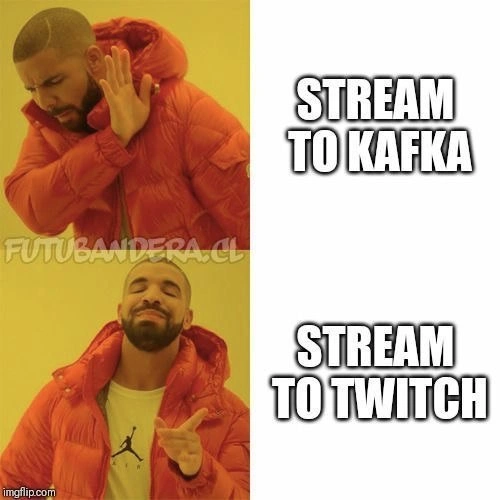
Let’s break down the basics of the joke for a junior developer or anyone new to these terms. The meme uses the popular Drake meme format (two panels with Drake showing dislike in the top image, and approval in the bottom image). In the top panel, the text says “STREAM TO KAFKA,” paired with Drake’s “no thanks” face. In the bottom panel, it says “STREAM TO TWITCH,” with Drake’s happy, approving face. This format simply means: the person prefers the second option over the first. Now, what are these options?

Apache Kafka (mentioned in the first panel) is a widely-used tool in software development, especially in backend and data engineering roles. It’s a platform for data streams – which means it helps you send and receive a continuous flow of data in real-time. Think of Kafka as a message bus or a big pipeline: one part of your system can put messages (pieces of data like events or logs) into Kafka, and other parts of your system can read those messages out of Kafka almost immediately. For example, imagine a shopping website: every time someone clicks a product or makes a purchase, you could stream those events into Kafka. Downstream services – say, one that updates recommendations or one that monitors activity for fraud – subscribe to those events and react right away. Kafka is designed to handle huge volumes of data (we’re talking millions of events per second) and is distributed, which means it runs on a cluster of servers to be scalable and fault-tolerant. It’s a cornerstone of many BigData architectures for handling real-time data. However, setting up Kafka and managing it isn’t trivial – you have to configure topics, partitions, brokers, and ensure consumers keep up with producers. So “stream to Kafka” implies doing work to build a real-time data pipeline. It’s powerful, but it’s definitely a developer’s task, not leisure.

On the other hand, Twitch (from the second panel) is a completely different world. Twitch is an online platform for video streaming, mostly known for live streaming games, creative content, or even people just chatting. If someone says “I’m streaming to Twitch,” they usually mean they are broadcasting a live video of themselves (for instance, playing a video game or hosting a talk show) to viewers on the internet. Viewers can watch the stream in near real-time, comment via chat, and interact. It’s essentially like live TV created by users, and it’s purely for entertainment or community. Importantly, “streaming to Twitch” doesn’t involve building any system yourself (Twitch the company handles all the heavy lifting of distributing your video). You just use a broadcasting app, capture your screen or camera, and go live. It’s meant to be fun, and for many it’s a hobby (some even turn it into a career in content creation). So, where “stream to Kafka” is an engineering task, “stream to Twitch” is a form of recreation or at least a very different kind of activity.

The humor comes from the double meaning of the word “stream.” In tech, streaming data means continuously sending data so that it can be processed on the fly. In everyday language (and especially online culture), streaming now often refers to streaming media – like watching Netflix or broadcasting on Twitch – where video/audio is delivered continuously over the internet. They sound the same, but one is about moving data between programs/servers, and the other is about entertainment. It’s a classic example of computing jargon overlapping with mainstream terms. As a new developer, you might hear a colleague say “we need to stream these events to a topic” and another friend say “I streamed for 4 hours last night on Twitch,” and eventually realize the word “stream” is being used in two totally different contexts!

Let’s clarify the two contexts with a simple comparison of terms in Kafka’s data streaming vs. Twitch’s video streaming:

Kafka Data Stream Twitch Video Stream
Producer – an app or service that sends data messages (events) into Kafka. It’s like the source of the stream. Streamer – a person (or channel) broadcasting video on Twitch. They are the source of the stream (the video content creator).
Topic – a named category or feed in Kafka where messages are published. Think of it like a channel of data (e.g., a topic “user_signups” for signup events). Channel – the page or account on Twitch where a person streams. Viewers go to a streamer’s channel to watch. It’s essentially the “topic” people subscribe to for video content.
Consumer – an application or service that subscribes to a Kafka topic and processes incoming messages. It’s like a sink that continuously listens for new data. Viewer – a person watching a Twitch stream. They “subscribe” or follow a channel to get the content. Each viewer’s app (browser or Twitch client) receives the video data and displays it.
Broker/Server – the Kafka servers (brokers) in a cluster that manage and store the data streams, ensuring delivery. Streaming Server & CDN – the servers on Twitch’s side (and their content delivery network) that receive the streamer’s video feed and distribute it out to viewers around the world.
Data – typically textual or binary messages (e.g., JSON logs, user events). Each message is small (KBs), but there are many. Video data – audio/video frames, which are much larger in size per frame and require compression. It’s a continuous binary stream meant to be rendered as moving images and sound.
Goal – to reliably process data in real-time for analytics, messaging between services, etc. Success = all events are delivered and handled quickly. Goal – to entertain or inform viewers in real-time. Success = viewers see a smooth, live video with minimal lag or buffering.

From the table, you can see how each side has its own kind of “stream” with analogous parts (sources and sinks, senders and receivers). But the content and purpose are different. A data engineer cares about things like throughput, consistency, and fault-tolerance in the Kafka pipeline. A streamer (or viewer) on Twitch cares about video quality, latency (delay), and interaction.

Now, why is the meme funny? It’s showing a person (Drake in this case) who clearly prefers the Twitch kind of streaming to the Kafka kind. This likely reflects a developer joking that they’d rather indulge in some fun TwitchStreams than do their actual work with Kafka streams. It’s relatable in a lighthearted way: building a data pipeline might be intellectually rewarding but can be difficult and not immediately gratifying, whereas watching or doing a Twitch stream is immediately enjoyable (or at least a break from work). It’s a bit like saying, “Would I rather debug a complex data stream processing job, or chill out and watch my favorite gamer or creator? – I choose the latter!”

For a junior developer, it’s also a gentle introduction to how the same word can mean different things in tech. If someone says “we’re implementing streaming,” check the context: are they talking about something like Kafka for processing data, or do they mean streaming media content? In this meme’s case, the joke is deliberately mixing them up. That contrast – serious tech infrastructure vs. online entertainment – is where the humor lies. It’s a form of wordplay and also a nod to developer culture (we love a good inside joke about our tools).

And of course, the Drake meme format itself is a universal way to convey a preference. Even if you didn’t know Kafka or Twitch, you could guess that the person is saying “No, not this stream…yes, that stream!” Once you learn what Kafka and Twitch are, the meme clicks: our tech friend would much rather be gaming or watching streams than handling data streams. In developer forums or social media, you’ll see a lot of this kind of TechHumor where images and text combine to make a point about our daily experiences. Here it’s making light of the fact that “stream” isn’t always as exciting as it sounds when it’s work-related, compared to the instant fun of streaming media.

Level 3: Pipelines vs Playtime

For the experienced developer, this meme hits on a couple of familiar truths. First, it’s poking fun at our priorities_in_dev_life – the eternal tug-of-war between getting serious work done and succumbing to distractions. The Drake format brilliantly captures a scenario every seasoned dev recognizes: rejecting the responsible choice and happily embracing the fun one. In the top panel, “Stream to Kafka” represents the serious task at hand: setting up a robust data pipeline or real-time event stream in your backend. That’s the kind of project that shows up in sprint planning meetings and on ambitious architecture roadmaps. It involves hard-core Backend engineering: configuring brokers, writing producers and consumers, dealing with serialization formats, ensuring message schemas and compatibility, monitoring lag, scaling out consumers – in short, real work with some BigData plumbing. We all know those projects can be important (moving data reliably is the lifeblood of modern systems), but let’s face it, they’re often complex and can be a headache. Ever spent an on-call night chasing why the Kafka consumer latency spiked, only to discover a rogue slow consumer or a disk issue on one broker? DeveloperHumor often comes from shared pain points, and Kafka’s learning curve and operational quirks have given many of us a few gray hairs. So, Drake’s dismissive hand at “Stream to Kafka” is the senior dev internally groaning, “Ugh, do I really have to deal with that right now?”.

Now, the bottom panel – “Stream to Twitch” – is Drake (and by proxy, the dev) enthusiastically saying “yes please!” to something a lot more enjoyable. Instead of wrangling log partitions and DistributedSystems intricacies, the dev is imagining either watching a fun live stream or even hosting one. This is pure playtime. Maybe there’s a big esports tournament on, or a favorite streamer is live coding a project (yes, that’s a thing now – developers streaming their coding sessions, merging the two meanings of “stream” in a literal way). The meme humorously suggests that given the choice, our developer would much rather kick back and enjoy some interactive entertainment than dive into configuring yet another cluster. It’s a classic case of procrastination by way of tech jargon confusion: “Oh, you meant data stream? I thought you meant video stream… guess I’ll fire up Twitch!” 😏.

There’s an undercurrent of irony here that seasoned devs appreciate. The tech industry has been hyping “streaming data” and real-time analytics for years – Kafka often being at the center of those DataEngineering discussions. Conferences, blog posts, and architects will say streaming pipelines are the future of big data processing (and indeed they’re powerful). The expectation is that we, as diligent developers, should be excited about building these systems. But when faced with the actual nitty-gritty of implementing them, the excitement can wear thin. That’s when the thought creeps in: wouldn’t it be more fun to stream something on Twitch instead? It’s a tongue-in-cheek admission of how we sometimes cope with complex projects – by taking a “short break” that ends up longer than intended. A senior developer has likely experienced this: deploying a Kafka cluster can feel like serious Engineering, while tuning into a Twitch stream feels like a well-deserved mental break. The juxtaposition exaggerates this feeling for comedic effect.

The shared laughter also comes from recognizing the double_meaning_wordplay. In our field, words like “stream,” “cloud,” or “container” often mean very specific technical things. But they also have plain meanings (or meanings in other domains) that can sound amusing out of context. An experienced dev has probably had to clarify, “No, not that kind of streaming,” at least once to a non-technical friend or a confused junior. We find it funny because in our day-to-day, streaming to Kafka and streaming on Twitch could not be more different – yet here they are, side by side, as if a dev is choosing between them like equal options. It’s that absurd equivalence that makes us grin. We’re basically laughing at ourselves: all our sophisticated data pipelines, yet we’d drop them in a heartbeat to catch a live speedrun or a coding session from our favorite streamer.

Real-world scenarios amplify the joke. Picture a backend engineer in crunch mode: they’ve been optimizing a Kafka Streams job all week, debugging consumer group rebalances and lag metrics. Friday afternoon rolls around, and someone suggests, “Should we live-stream the demo of our data pipeline to the team?” The tired engineer hears “live stream” and immediately thinks about Twitch, jokingly responding, “Stream? Did someone say Twitch? Let’s stream some games instead, I’m done with data for today.” It’s office humor gold – everyone understands both the exhaustion behind working on complex data infrastructure and the temptation to just relax and game or watch others game. In a way, “Stream to Twitch” is the developer’s equivalent of “take this job and shove it (for now)” – opting to have fun and defer the Kafka chores. It highlights a coping mechanism in dev culture: when overwhelmed by microservices or big data, we often resort to a bit of fun or sarcasm to stay sane.

Additionally, the meme riffs on the idea that tech workers often blur lines between work and play. Many developers are also avid consumers of live streams – whether gaming, music, or even live technical content. There’s an overlap of the communities: you might deploy code in the day and livestream your Fortnite matches at night. Some even stream their coding projects on Twitch, combining productivity with entertainment. So “Stream to Twitch” might not just mean watch someone else; it could also imply, “Forget building a pipeline for my employer, maybe I’ll stream myself building a game and build an audience.” It’s a cheeky daydream of turning a work concept (“streaming data”) into a personal fun project (“streaming video of myself”). For senior devs who have seen colleagues burn out on intense projects, the notion of escaping into TwitchStreams for a while is very relatable.

In summary, at this senior perspective level, the meme is classic TechHumor about work vs play. We laugh because we’ve all been Drake at some point – saying “no” to the daunting, albeit important, engineering task, and “yes” to a guilty pleasure that shares the same buzzword. It underscores the human side of software development: no matter how cutting-edge our stack (be it real-time streaming data with Apache Kafka or any fancy tool), sometimes we just want to chill and be a spectator rather than an architect. The Drake format perfectly captures that split-second decision to favor playtime (Twitch) over pipelines (Kafka), and every developer who has postponed a build or deployment to catch “just one more game stream” is likely smirking in agreement.

Level 4: Backpressure vs Buffering

At the highest level, this meme spotlights an overloaded term in computing: “stream.” In one universe, streaming refers to handling a continuous flow of data through a distributed pipeline (think Apache Kafka). In another, it means broadcasting live video to viewers (think Twitch). Both involve sending sequences of chunks over time, yet the engineering challenges and theoretical underpinnings differ vastly. Let’s unpack the duality of streams.

In a data engineering context, Apache Kafka implements a distributed commit log – essentially a highly scalable message queue where events (records) are appended in order. Kafka’s design draws on core DistributedSystems principles: it runs as a cluster of brokers coordinating via consensus (originally using ZooKeeper) to ensure fault tolerance and data replication. Each message stream in Kafka is called a topic and is partitioned for parallelism. Producers publish events to topics, and consumers read those events, potentially in real-time. The system emphasizes reliability and ordering within partitions, achieving at-least-once or even exactly-once delivery semantics with careful configuration. If a consumer lags behind or a spike of events arrives, Kafka applies backpressure. This means producers might slow down or buffer data server-side – Kafka’s backpressure mechanisms prevent overwhelming consumers or crashing brokers. It’s a delicate dance balancing throughput and consistency: a practical lesson in the CAP theorem and trade-offs. For example, Kafka favors availability and partition tolerance, while offering tunable consistency (you can require acknowledgments from multiple replicas for stronger guarantees). The math and theory of distributed logs (think of Leslie Lamport’s log replication theories) underpin Kafka’s durability and ordering guarantees.

Meanwhile, in the video streaming realm, Twitch must deliver continuous frames of audio-visual data to potentially millions of viewers with minimal delay. Live video streaming relies on a different set of distributed technologies: content is chopped into small segments and relayed through a global Content Delivery Network (CDN). Protocols like RTMP or HLS stream the video, where latency and network jitter are constant concerns. Instead of explicit backpressure, video streaming deals with variable network speeds via buffering and adaptive quality. If your connection can’t keep up, the Twitch player buffers (stores a few seconds of video) or lowers the resolution – essentially a real-time adjustment to maintain smooth playback. This is analogous to backpressure: the system compensates for slower “consumers” (viewers with slow internet) by accumulating data or throttling quality. Both Kafka and Twitch face the fundamental problem of continuous data flow in distributed networks, but their solutions differ due to content and context. Kafka’s streams are structured data events processed by other programs, requiring strict correctness (no events dropped, order preserved). Twitch’s streams are multimedia for human eyeballs – a dropped video frame or two is acceptable if it avoids freezing, and order is naturally the original recording order of frames.

The term stream itself has deep roots in computer science theory. A stream can be seen as an infinite sequence of data elements – a concept studied in algorithms and formal language theory (e.g., treating input as a stream of tokens). In functional programming and reactive programming, streams are handled with lazy evaluation or observer patterns, focusing on how to propagate changes through a system. Kafka embodies these ideas by providing a publish/subscribe model with persistent storage, enabling complex event processing (windowing, aggregations, etc.) on unbounded data sequences. On the other hand, Twitch’s live streaming leans on information theory and network protocols: compressing video (using codecs) and overcoming packet loss (through error correction or buffering) are crucial. It’s fascinating that a single word “stream” spans such theoretical richness – from formal definitions of streams in automata theory to BigData real-time analytics and to multimedia delivery networks.

One fun bit of streaming lore: in big data architecture, there’s something called the Kappa architecture (a streaming-first data processing design, proposed as a simpler alternative to the Lambda architecture). Amusingly, “Kappa” is also the name of a famous Twitch chat emote (used to signal sarcasm). This coincidence perfectly illustrates how the DataEngineering world and the video streaming world occasionally collide in nomenclature. In Kafka’s universe, Kappa is about unified data pipelines; in Twitch’s universe, Kappa (the gray smiling face) flies through chat when someone makes a tongue-in-cheek remark. Two completely different meanings, unified by one term – much like “stream” in our meme.

Ultimately, the meme’s humor from a deep technical perspective comes from this contrast in systems design and terminology. Building a robust data stream on Kafka involves complex coordination, guaranteed delivery, scaling partitions, and handling backpressure – a serious engineering endeavor grounded in distributed algorithms. Running a video stream on Twitch involves encoding, real-time data transport, and viewer playback buffering – a sophisticated pipeline of a different kind. Both are marvels of modern computing, relying on decades of research (from the early days of networked file systems and publish/subscribe patterns to modern CDN and video compression tech). Seeing them equated or confused, even in jest, tickles the seasoned engineer’s brain. It’s a gentle reminder that context is everything: one person’s “stream” is an Apache Kafka data topic traversing a cluster, another person’s “stream” is a live Fortnite session broadcast to the world. The meme wittily pits these parallel universes of streaming against each other, and at this level, we appreciate the intricate, behind-the-scenes mechanisms that make each possible – from buffering algorithms to backpressure protocols. It’s a celebration of how one simple word can encapsulate wildly different complexity in computing.

Description

A classic two-panel 'Drake Hotline Bling' meme. In the top panel, Drake is shown with a repulsed expression, hand raised in rejection next to the text 'STREAM TO KAFKA'. In the bottom panel, Drake is smiling and pointing in approval at the text 'STREAM TO TWITCH'. There are watermarks from 'FUTUBANDERA.CL' and 'imgflip.com'. The meme creates a humorous juxtaposition using the double meaning of the word 'stream'. For a senior developer, 'streaming to Kafka' refers to the complex and often demanding work of building real-time data pipelines with Apache Kafka, a distributed event streaming platform. In contrast, 'streaming to Twitch' represents the more leisurely and entertaining activity of broadcasting video games. The joke lies in preferring the fun, low-stakes activity over the challenging professional one
Comments

8
Anonymous ★ Top Pick Why debug a Kafka consumer group that's stuck in a rebalance loop when you could be complaining about stream snipers on Twitch? One is a distributed systems nightmare, the other is just a distributed systems nightmare with a live audience
  1. Anonymous ★ Top Pick

    Why debug a Kafka consumer group that's stuck in a rebalance loop when you could be complaining about stream snipers on Twitch? One is a distributed systems nightmare, the other is just a distributed systems nightmare with a live audience

  2. Anonymous

    After another day of chasing phantom consumer lag and babysitting Zookeeper, I’ll stick to the kind of stream where the only partitions are my monitor setup and consumer lag is just chat delay

  3. Anonymous

    When you realize your Kafka consumer lag is measured in hours but your Twitch stream delay is only 5 seconds, and suddenly you understand which streaming platform actually delivers on its promises

  4. Anonymous

    Both have lag, replays, and an audience of consumers - but only one rebalances mid-broadcast and loses your offsets

  5. Anonymous

    When your product manager asks why the real-time analytics dashboard isn't working and you have to explain that 'streaming to production' meant something entirely different to the intern who just got partner status on Twitch. At least their viewer retention metrics are better than our Kafka consumer lag

  6. Anonymous

    Kafka demands ZooKeeper orchestration and offset management; Twitch? Just hit 'Go Live' and let chat's toxicity simulate your rebalances

  7. Anonymous

    Our OKR said “streaming”; I built Kafka with partitions and exactly-once - leadership sent an RTMP URL, and now consumer lag is how fast chat notices the outage

  8. Anonymous

    Stream to Kafka: exactly-once semantics and a pager; stream to Twitch: at-most-once semantics and a sponsorship

Use J and K for navigation