Skip to content
DevMeme
336 of 7435
A Cynical Definition of Open Source
OpenSource Post #395, on May 28, 2019 in TG

A Cynical Definition of Open Source

Why is this OpenSource meme funny?

Level 1: Cheap Generosity

Imagine a kid who wants to run a lemonade stand, but his mom tells him he’s not allowed to charge money for the lemonade. So instead, he gives away the lemonade to all his friends for free and then goes around bragging about how generous he is. He’s acting like he’s doing something super nice by sharing, but in reality he just wasn’t allowed to sell it. This meme is laughing at a similar idea. In the world of coding, a company let everyone see and use their code and said, “Look how open and great we are!” – but really, they only did that because they didn’t want to pay to keep it secret. It’s like pretending to be kind when you’re actually just being cheap.

Level 2: Repo Realities

“Open-source” generally means software code that is openly available for anyone to see, use, and modify. It’s the idea behind lots of community-driven projects – for example, the Linux operating system or many libraries developers use every day. When a project is open-source, its source code isn’t kept secret. Instead, it’s shared publicly (usually with a license that gives others permission to use it). This concept is a big part of developer culture: many programmers love contributing to open-source projects or using open-source tools because it’s about collaboration and transparency. The meme is using this term “open-source,” but giving it a funny twist.

Now, GitHub is a popular platform where developers store and collaborate on code. It’s built on Git, which is a version control system – basically a tool that tracks changes in code over time and helps teams work together without overwriting each other’s work. Think of GitHub as a giant code library on the internet: some books (repositories) are open for everyone to read (public), and others are kept in a private section where only certain people can access them (private). By default, creating a public repository on GitHub has always been free. But private repositories (where you don’t want the code to be visible to the public) historically required a paid plan – especially if you were an organization or had multiple team members involved. This paid option is what the meme calls “GitHub Premium.” (GitHub actually calls them Pro, Team, or Enterprise plans, but calling it “Premium” gets the point across.)

The joke here is about a company that doesn’t want to pay for those private repositories. If you can’t pay for a private space, the simplest workaround is to make the repository public (open for everyone to see). The meme suggests that the company then goes around proudly saying, “Oh, look, our project is open-source now, you can all use our code for free!” – acting like they did it out of generosity or community spirit, when really they just had no budget for the private option. It’s poking fun at the way some organizations might brag about their code being open-source, even though their hand was kind of forced by money issues.

To put it plainly, it’s calling out a slight hypocrisy in a humorous way. Normally, being open-source is a positive, deliberate choice aligned with a philosophy of sharing. But this meme gives a sarcastic definition: “open-source” means you couldn’t afford to keep it closed. The Google-style dictionary format is used to deliver that sarcasm in a deadpan way – it looks like an official definition, which makes the punchline land even harder. Of course, this isn’t a real definition you’d find in any dictionary; someone made this image as a joke. The line “can’t afford GitHub Premium and brag about the code being freely available” is exaggerated on purpose. It combines two ideas: being cheap (not paying for GitHub’s private repo service) and being boastful about openness.

For a newer developer (or anyone new to these terms), here’s the context:

  • Private repository: a code project on GitHub that only you and invited collaborators can see. Companies use these when they don’t want their code visible to the public (for proprietary software, secret projects, etc.). This usually costs money on services like GitHub (especially for organizations).
  • Public repository: a project that anyone can find, read, and often contribute to. These are free to create on GitHub, and they’re the basis of open-source software sharing.
  • GitHub Premium (as used in the meme): refers to paying for GitHub’s services so you can have private repositories. Around the time of this meme, if a company wanted unlimited private repos or to collaborate as a team in private, they’d likely be paying for a GitHub plan. If they didn’t pay, any repo they worked on together would effectively have to be public (or they’d use a different service). That’s the “paywall” notion – private privacy is behind a paywall.

So the meme jokes that open-sourcing code in such a case isn’t a grand enlightened decision, but simply Plan B when you can’t justify the expense of keeping it secret. It’s a bit like saying, “Oh, we open-sourced our app,” with a wink, because the alternative was buying GitHub seats they didn’t want to buy. The humor is clear to people in tech because many have experienced companies being frugal with developer tools or services. Maybe you’ve heard something like, “We can’t afford that software, let’s just use the free version and make do.” Here that mentality is applied to code hosting.

Finally, the format of the meme is worth noting: it looks like a dictionary entry you might see if you googled a word. It has the phonetic spelling and part-of-speech (“adjective, computing”) and then the definition. This format has been a popular meme template for sarcastic or tongue-in-cheek “definitions.” By presenting the joke in this straight-faced, official style, it amplifies the comedic effect. It’s as if even the dictionary is sassing the companies that do this.

In summary, this meme is a lighthearted roast. It’s telling new developers: sometimes when a company proudly says “we’re open-source friendly!” it could just be because they didn’t want to pay for the private repo – a classic case of making a financial limitation sound like a generous strategy. 🤷‍♂️

Level 3: Free as in Broke

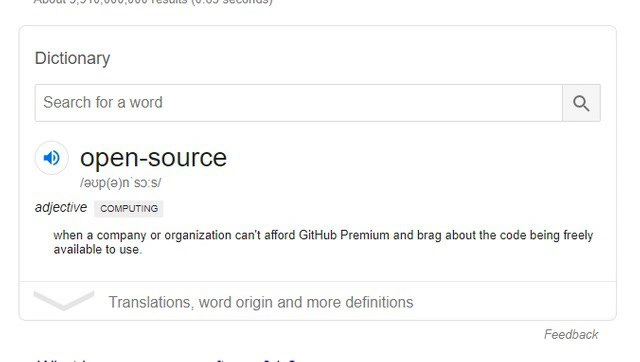
This meme takes a jab at corporate open-source motives by spoofing a Google dictionary definition of open-source. It’s presented as if you searched the term and got a result, but the definition shown is a snarky rewrite. The entry reads:

open-source (adjective, computing) – “when a company or organization can’t afford GitHub Premium and brag about the code being freely available to use.”

In other words, the meme is saying some companies only open their code because they’re too cheap to pay for private repos, yet they still brag as if they’re doing a noble deed. Seasoned developers recognize this as a familiar industry joke: sometimes being “open-source” isn’t about coding culture at all – it’s just about saving money. The humor comes from exposing the gap between the ideal and the real.

Let’s unpack why this hits home for so many in tech. OpenSource culture is supposed to be about transparency, community, and giving back. In contrast, CorporateCulture often involves tight BudgetConstraints and PR spin. This meme lives at that intersection: it implies that behind some grand open-source announcement was really a CFO muttering, “we’re not paying for that.” 😏 The term GitHub Premium here refers to GitHub’s paid plans for hosting private code. Historically, if a company wanted to keep code private on GitHub, they had to pony up for a subscription (like GitHub Pro, Team, or Enterprise). But if they couldn’t or wouldn’t budget for it, the cheapest option was to make the repository public. Suddenly, voilà, the code is “open-source”! The meme cynically suggests that these companies then strut around saying, “We believe in open collaboration,” when in reality it was more like, “We didn’t want to pay for private repos.”

This resonates with experienced devs because we’ve seen how tooling costs can drive decisions. It’s common developer lore that if management thinks a tool is too pricey, engineers end up finding a free workaround. Here the free workaround is open-sourcing the project and spinning it as altruism. It’s a classic case of budget-driven engineering being reframed as a virtue. Everyone in DeveloperHumor circles chuckles because it’s too real: how many times have we heard a company tout their “commitment to open source” while internally someone just didn’t approve the expense for a private solution? The sarcastic_definition format is perfect for this punchline, because it pretends to be an official truth dropped by a neutral source (the dictionary) – making the corporate behavior feel universally acknowledged and a bit ridiculous.

For some historical context, VersionControl platforms like GitHub have evolved their pricing, but for a long time private repositories were a paid feature. Many of us remember when our personal projects or startup code either lived in public or not on GitHub at all, simply to avoid fees. This created quirky situations: for example, a startup might quietly push all their code to a public repo, then later brag, “We’ve open-sourced our codebase to support the developer community!” – omitting the part where it also saved them a monthly GitHub bill. The meme’s faux dictionary entry highlights this by literally redefining open-source as “couldn’t afford the paywall.” It’s a tongue-in-cheek reminder of how language can be co-opted by circumstances.

To a senior developer, the joke lands because it flips a sacred concept on its head. We usually distinguish free as in speech (freedom to use/modify code) versus free as in beer (no cost to get it). Here, the meme cheekily introduces a third concept: free as in broke. 😅 In other words, the code is freely available not out of principle, but out of penny-pinching. The formal dictionary style adds an extra wink – it’s as if even the dictionary is calling out the industry’s tendency to put a positive spin on cost-cutting measures.

Consider the difference between what companies say and what they mean in these situations:

What They Say What They Mean (Reality)
“We believe in open collaboration.” “We aren’t paying for private repos.”
“Our code is freely available to all.” “We saved money on GitHub fees.”
“We’re committed to open-source values.” “We’re committed to using free hosting.”

This side-by-side hits at the core of the humor. We’ve all read glossy tech blog posts with the left column language, and many of us have quietly suspected (or witnessed) the right column truth. The meme is funny because it publicly says what devs often think privately. It’s a bit of communal eye-rolling at how CorporateCulture can mask a Budget decision as a benevolent technical choice. And by using the authoritative look of a dictionary entry (complete with phonetic pronunciation /əʊp(ə)n sɔːs/ and the label adjective, computing), the meme gives this joke a faux-official seal. It’s like the entire internet agrees, “Yep, open-source now basically means you were too cheap to go private.”

In short, the meme plays on an inside joke: open-source should be about openness and community, but here it’s portrayed as the result of a budgeting hack. That contrast – between the high-minded ideal and the mundane reality – is what makes experienced developers smirk and say, “Sounds about right.”

Description

A screenshot of a fake Google dictionary definition for the term 'open-source'. The image displays the word 'open-source' with its phonetic spelling, followed by a satirical definition: 'adjective COMPUTING when a company or organization can't afford GitHub Premium and brag about the code being freely available to use.' The surrounding interface mimics Google's search results page, including a search bar and a link for 'Translations, word origin and more definitions'. This meme humorously critiques the motivations behind corporate open-sourcing, suggesting it can be a cost-saving measure disguised as a community-oriented gesture. It resonates with experienced engineers who have witnessed companies use 'open source' as a marketing buzzword or a way to offload maintenance costs, rather than genuinely embracing the collaborative spirit of the open-source community
Comments

8
Anonymous ★ Top Pick Some companies treat 'open source' less like a philosophy and more like an unpaid internship for their codebase
  1. Anonymous ★ Top Pick

    Some companies treat 'open source' less like a philosophy and more like an unpaid internship for their codebase

  2. Anonymous

    Quarterly cost-cutting memo: cancel GitHub Premium, slap an MIT license on every repo, and call the incoming PRs our external security audit

  3. Anonymous

    The same company that couldn't afford GitHub Premium will somehow find budget for a dedicated team to triage the 847 issues from users who didn't read the "this is not actively maintained" disclaimer

  4. Anonymous

    Free as in freedom, but mostly free as in 'finance rejected the GitHub Enterprise quote.'

  5. Anonymous

    The real definition of 'open-source': when your engineering budget is so tight that you turn cost-cutting into a community contribution strategy. It's not that we believe in radical transparency and collaborative development - we just couldn't justify the $21/month per seat to the CFO. But hey, at least our README looks philanthropic

  6. Anonymous

    We saved $10k on GitHub licenses and bought a lifetime of unpaid triage, CVEs, and entitlement in the issues tab

  7. Anonymous

    Corporate open-source: Public repo for stars, private forks for actual use

  8. Anonymous

    Open source: when Finance vetoes GitHub Enterprise, Legal slaps MIT on the repo, and Engineering rebrands unpaid QA as “community.”

Use J and K for navigation