C Double Pointers: Your Shady Memory Access Fixer
Why is this Languages meme funny?
Level 1: Wrong Address, Big Mess
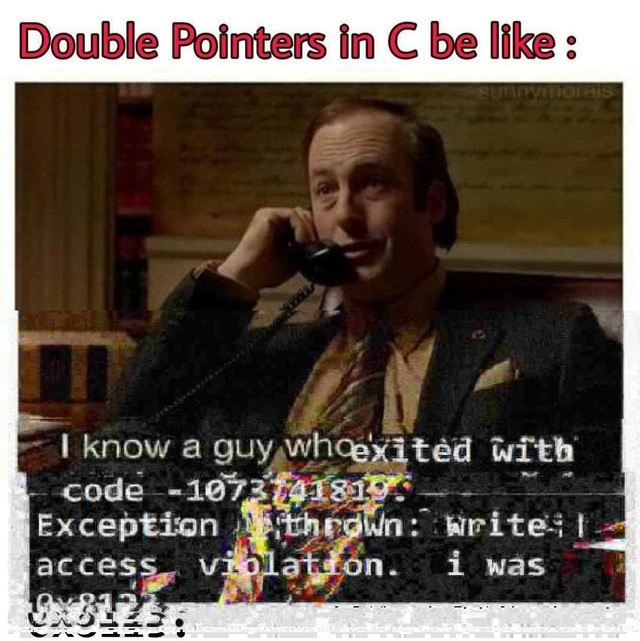
Imagine you have a treasure map that leads you to a location to dig for treasure. But uh oh – the map has the wrong address on it. You go to the spot listed and try to dig, but it’s not your land and there’s nothing there. Maybe you even hit a utility line and cause a big accident. In programming, a pointer is like that map with an address for where to put or get something. A double pointer is like having a note that tells you where another map is – it’s one extra step. If any part of those directions is wrong, the program ends up digging in the wrong place. The meme jokes about a program that “dug in the wrong spot” and crashed. It even gives a super specific secret-sounding number (-1073741819) as the “code” for the crash, kind of like a hidden message. The picture shows a sly-looking guy on the phone saying “I know a guy,” making it feel like a hush-hush mistake that happened. The reason this is funny is that programmers often talk about these crashes in a joking way to share the pain. It’s like saying, “Oops, I really messed up the address and everything blew up – we all know that feeling, right?” Even if you’re not a coder, you can relate: it’s the classic mix-up of getting a wrong address and how quickly things can go south because of it. The humor comes from making a big dramatic scene (calling a shady friend who “knows a guy”) out of something that is essentially a common silly error. In simple terms: a little mistake with an address in code caused a big mess, and the meme is how programmers laugh it off together.
Level 2: Pointing at Trouble
Let’s break down why this meme resonates with programmers, especially those learning C. In C, a pointer is basically a variable that holds a memory address – like a piece of paper with a house address on it. Now a double pointer is a pointer that holds the address of another pointer (think of it as having a second piece of paper that points to the first piece of paper which then points to the house). This concept, called double indirection, is powerful but tricky. If any link in that chain is wrong, you end up pointing at garbage. It’s like having the wrong address; when you go there, you either find nothing or make a mess.
So what does "write access violation" mean? It’s a type of runtime error that happens when a program tries to write data to a memory location that it’s not allowed to touch. In our analogy, it’s like trying to put a package into a mailbox at someone else’s address when you’re not supposed to be there – the system (OS) will slam the door on you. An Exception thrown: write access violation is the system’s way of saying “You’re not allowed to write there!” The meme specifically mentions i was 0x812. That looks like a memory address (0x812 is a hexadecimal number). Chances are, the program had a pointer (perhaps a variable ironically named i) that ended up with this bogus address 0x812, which is definitely not a valid place in memory for your program to write. Attempting to use that pointer caused a crash.
The code exited with code -1073741819 is the fallout of that crash. Different operating systems have different ways of reporting a crash. On Linux or Mac, if you misuse a pointer like this, you often get a message like “Segmentation fault (core dumped)” and an exit code like 139. On Windows, you don’t see “segfault”; instead you might just see the program terminate with a big negative number like -1073741819. It’s not obvious at first glance, but that number is a fancy code for “Access violation error.” New programmers often scratch their heads at that exit code until they Google it and realize it’s basically the Windows way of saying segfault.
Why do double pointers often lead to these kinds of errors? Well, managing one pointer is already a challenge for newcomers – you have to allocate it (give it a valid address), use it carefully, and free it when done. Now with a pointer-to-a-pointer, you have to ensure two things: that the first pointer is pointing to a valid second pointer, and that the second pointer points to valid actual data. If you forget to initialize any of those, or if you allocate memory for the data but not for the pointer array, you’ll end up with a pointer that “points at trouble.” For example, a common mistake is not allocating memory for an array of pointers. Say you want a 2D array (like an array of strings). You might do something like:
char **lines;
*lines = malloc(100 * sizeof(char*)); // WRONG! `lines` itself isn’t initialized yet
If lines wasn’t set to a valid address to begin with (maybe it’s a local variable not yet assigned), doing *lines = ... is attempting to write to some random place in memory (whatever lines was pointing to by default, which is essentially random). That’s a one-way ticket to a segmentation fault. The correct approach would be to first allocate memory for lines (the array of char pointers) or have it point to an already allocated array, then assign to *lines or use indexing. Another classic mix-up is forgetting to pass the address of a pointer to a function that’s supposed to update it. If a function expects an int** (pointer to pointer) but you accidentally pass an int*, the function will end up writing to a junk address. This is exactly how you get weird addresses like 0x812 cropping up.
We mention segmentation fault a lot – that’s the generic term for this kind of crash. It literally means “you faulted (errored) by accessing a segment of memory that isn’t allowed.” In C, if you see a segfault or an access violation, nine times out of ten a bad pointer is involved. Maybe it was a NULL pointer (address 0) that you dereferenced, maybe it was an uninitialized pointer carrying garbage, or maybe you went past the end of an array (which is also a form of pointer misuse). These are all examples of undefined behavior, which is a fancy way of saying the C standard doesn’t define what should happen – anything can happen, and usually that “anything” is a crash.
The meme turns this scary error into a joke by personifying it. Instead of just saying “I had a pointer bug that caused a crash,” it says “I know a guy who exited with code -1073741819” as if it’s some urban legend or underworld deal. The image of the man on the phone (Bob Odenkirk’s character Saul Goodman from Better Call Saul, known for saying “I know a guy”) gives it a Mafia-esque humor: dealing with double pointers sometimes feels like doing something sly or risky that might get you in trouble. Low-level programming in C has this reputation – it’s powerful, but one wrong move and you’re dealing with a crash that’s as cryptic as a secret phone call.
For a newer developer, the takeaway is: pointers are powerful but must be handled with care. A double pointer means you’re two hops away from the actual data, so you have to be careful at each hop. Always initialize your pointers (set them to NULL or a valid address), allocate memory before use, and free memory when you’re done (and maybe set the pointer back to NULL to avoid dangling). If you see an error like an access violation, think pointers. The meme is a lighthearted way to vent about how a small pointer mistake can blow up a program. It’s funny in a geeky way – once you understand what that Windows error code means, you’re in on the joke. It’s basically saying, “Yeah, double pointers are tricky – mess up and boom, segfault. Welcome to C programming!”
Level 3: Double Indirection, Double Trouble
This meme hits home for any C veteran who’s crawled through the wreckage of a segfault at 3 AM. Double pointers are infamous: they give you two levels of indirection to get wrong. The humor here leans on a shared war story: “I know a guy who exited with code -1073741819”. Seasoned devs smirk because we immediately recognize that oddly specific number. It’s the hallmark of a segmentation fault on Windows – a crash so hard it doesn’t even dignify you with a tidy error message, just that Windows exception code saying you messed up a memory write. The meme’s image (a sly-looking man on the phone) and the line “I know a guy” riffs on the idea that dealing with pointer bugs is like contacting some sketchy “fixer” in the underworld of memory hacking. It’s darkly funny: you’ve got a shady informant (the pointer) hinting at a past access violation as if it’s a clandestine crime. And in a sense, it is – you “illegally” wrote to memory you shouldn’t have, and the OS acted like a strict bouncer, throwing your program out of the club.
For those of us who’ve been burned, the scenario is painfully familiar. One common culprit: forgetting that crucial & when using a double pointer. Imagine a function designed to allocate memory and update a pointer:
#include <stdlib.h>
#include <stdio.h>
void allocate(int **p) {
*p = malloc(sizeof(int)); // allocate memory for one int
}
int main() {
int *ptr;
allocate(ptr); // BUG: should pass &ptr to give allocate the address of ptr
*ptr = 42; // Boom! ptr is still uninitialized, this write is trouble
printf("%d\n", *ptr);
free(ptr);
return 0;
}
In the snippet above, we intended allocate() to set ptr to point at newly allocated memory. But we called allocate(ptr) instead of allocate(&ptr). That tiny oversight – no ampersand – means allocate receives a garbage address (whatever junk was in ptr) and tries to write the new memory address there. In all likelihood, ptr was never initialized, so it could be something crazy like 0x812. The line *p = malloc(sizeof(int)) then attempts to write a valid heap address into memory at 0x812, causing a write access violation. Cue the immediate crash and that dreaded exit code. It’s the C equivalent of sending a hired goon to the wrong house: the operation fails spectacularly and probably alerts the authorities (the OS) in the process.
The meme’s glitchy, distorted background is a visual nod to memory corruption – things literally get glitchy when memory is mishandled. We laugh (perhaps a bit bitterly) because we’ve all been that person scouring our code, wondering “where the heck did 0x812 come from?” The text “i was 0x812” hints that maybe a pointer variable ironically named i held this bogus address. It’s a tongue-in-cheek way of saying “yeah, that pointer was way off.” For senior developers, the comedy lies in the camaraderie of suffering: “Yup, been there, done that, got the segmentation fault.” We’ve learned the hard way that pointer arithmetic and multi-level indirection can turn your program into a ticking time bomb if you’re not careful.
Why is this so relatable? Because C gives you power with one hand and shoots your foot with the other. The language’s philosophy is “trust the programmer.” It won’t check if you’re using a pointer correctly – you can cast, index, and dereference with wild abandon. That’s great for performance and flexibility, but it also means a simple off-by-one or a missed initialization can bring everything crashing down. MemoryManagement in C is manual; there’s no garbage collector watching your back. So the meme is poking fun at how easy it is to end up making that desperate phone call (figuratively) to solve a pointer hell issue. It’s basically a rite of passage in low-level programming: the first time you see a segmentation fault or an exit status like 0xC0000005, you join the club of devs who “know a guy” – perhaps an older teammate or Stack Overflow – to help you out of the nightmare.
This image of a shady lawyer-type saying “I know a guy” also mirrors how, in corporate dev culture, there’s often that one senior engineer who’s the “fixer.” They’ve seen these crashes before, they have the scars, and they can jump in with a debugger or memory profiler and say “Ah, yes, you wrote to an invalid pointer, been there.” The meme exaggerates it as if it’s an under-the-table deal, because honestly, tracking down a segfault can feel like detective work in a crime drama. There’s no stack trace in undefined behavior land – often the real mistake happened earlier than the crash. The experienced devs know all the tricks: run with heavy instrumentation (AddressSanitizer, Valgrind), enable debug heap patterns that fill freed memory with 0xDD or 0xFEEEFEEE to catch use-after-free, etc. But even with tools, it’s an ordeal.
So, the core of the joke is twofold: (1) Double pointers are a notorious source of mistakes (double the indirection, double the trouble), and (2) when things go wrong, the symptoms are absurdly opaque (a shady error code, a random address) – so we cope by joking about it as if it’s some mafia mystery. It’s funny in that “ha-ha-ouch” way: we laugh, then immediately wince remembering our own debugging horror stories. In the end, every C programmer learns to respect the power of ** and the terror of not knowing where your pointers are pointing. As the saying goes in low-level circles, *“Playing with pointers is like handling dynamite. Exciting, but one false move and… well, exit(-1073741819).”*
Level 4: Undefined Behavior Abyss
Deep in the guts of a running C program, a double pointer misstep is like summoning an elder god of undefined behavior. When you see an exit code like -1073741819 on Windows, you’re essentially looking at the hexadecimal NTSTATUS code 0xC0000005 – the system’s cryptic way of saying “Access Violation – you touched memory that wasn’t yours.” In low-level terms, the CPU’s memory management unit just caught your code red-handed trying to write to an illegal address (in this case, 0x00000812). Modern operating systems set aside certain memory pages (especially the null page at address 0) as off-limits; any attempt to read/write there triggers a hardware segmentation fault. Historically, this term comes from segmented memory architectures, but today it’s all about paging: the OS raises an exception, kills the process, and delivers that ominous exit status. There’s no safety net in C – the language leaves all the pointer arithmetic and memory bookkeeping to you. A double pointer (a pointer-to-pointer) amplifies this responsibility: you have not just one address to manage, but an address that leads to another address. If either level of indirection is wrong by even 1 byte, you’ve jumped into the abyss. The compiler won’t stop you – it assumes you know what you’re doing – so writing through a bogus pointer goes ahead until the MMU says “nope”. The result? The program vanishes in an instant, often with nothing but a numeric exit code or maybe a core dump to hint at what went wrong. Seasoned C developers know that an undefined behavior like this can even corrupt data silently or crash much later than the original mistake. In short, a double pointer disaster breaks the fundamental contract of memory safety; once you violate that, the only guaranteed outcome is that all guarantees are off. The error code is essentially a tombstone marking where your program’s fate was sealed by the kernel for trespassing in forbidden memory.
Description
A meme featuring the character Saul Goodman (played by Bob Odenkirk) from 'Better Call Saul' on the phone with a sly expression. The top text reads, 'Double Pointers in C be like:'. The bottom portion of the image is heavily distorted with glitch art effects, overlaying garbled text that includes legible phrases like 'I know a guy who...', 'exited with code -1073741819', 'Exception thrown: write access violation', and a partial memory address. The meme humorously personifies C's double pointers as a shady middleman. A pointer 'knows' the address of a variable, so a double pointer 'knows a guy who knows the address.' This indirection is powerful but notoriously leads to memory errors like the 'access violation' shown (status code 0xC0000005 on Windows), making the connection to a sketchy lawyer who operates in gray areas particularly apt for experienced C/C++ developers
Comments
7Comment deleted
Using a double pointer is the C equivalent of saying 'I know a guy who knows a guy.' It works until one of them points to null, and suddenly you're in a segmentation fault with no witnesses
Double pointers are the software equivalent of “I know a guy who knows a guy” - hand the address around twice and your process wakes up in a ditch with exit code 0xC0000005
After 20 years in the industry, I've learned that C's double pointers are like quantum mechanics - if you think you understand them completely, you probably just haven't hit the edge case where your perfectly valid code decides to reinterpret your stack frame as a Jackson Pollock painting at 3 AM in production
Ah yes, double pointers in C - the 'I know a guy who knows a guy' of memory management. When your pointer's pointer decides to take a vacation to 0x8127-nowhere-land, you get the Windows equivalent of 'you can't fire me, I quit!' - exit code -1073741819 (0xC0000005 for the hex-fluent). It's that special moment when your carefully crafted pointer arithmetic becomes pointer *alchemy*, transmuting valid memory addresses into access violations. The real kicker? The debugger shows you exactly where you crashed, but good luck figuring out which of the seventeen layers of indirection three functions back actually corrupted the heap. Double pointers: because sometimes one level of indirection just isn't enough suffering for a Tuesday afternoon
Double pointers are that legacy C API tax where Windows’ 0xC0000005 politely explains you passed &p to a function that frees *p - action item: add ASan/valgrind and a real ownership model
Double pointers in C: single indirection for plebs, double for that artisanal access violation bouquet
Double pointers in C: you think you’re fixing ownership with an out-param; the debugger thinks you’re handing it -1073741819 (0xC0000005) and a weekend of aliasing archaeology