Skip to content
DevMeme
1496 of 7435
An Engineer Father's Wholesome Redstone Review
Learning Post #1675, on Jun 8, 2020 in TG

An Engineer Father's Wholesome Redstone Review

Why is this Learning meme funny?

Level 1: Pretend Circuits, Real Pride

Imagine a dad who builds real robots or gadgets at work, and his young son who just built a tiny pretend robot out of LEGO. Instead of saying “That’s not a real robot,” the dad smiles and says, “Wow, I’m so proud of you!” He even stands in front of the kid like a big shield to make sure nothing discourages him. In the meme, the child is using Minecraft (a bit like digital LEGO) to make a simple “electrical” machine with Redstone blocks. The dad is shielding him from all the scary hard parts of real electronics (like a knight protecting his squire), so the kid can just have fun and be proud. It’s funny and sweet because the dad knows the kid’s project is simple, but he treats it like the best thing ever. It’s like when you draw a crayon picture and your parent acts like you created a masterpiece – that pure, supportive love is what this meme is all about.

Level 2: Building Blocks vs Breadboards

Let’s break down the scene in simpler terms. We have a dad who’s an engineer – that means he works with real electronics: actual circuits with wires, batteries, chips, and all those things that make our devices work. That can get really complicated. (Imagine trying to connect a bunch of tiny parts on a board called a breadboard to make a blinking LED circuit – you have to know where every wire goes, or nothing works, maybe even something burns out!) Those flying “arrows” in the picture labeled “the complexity of electronics in real life” are basically all those tricky, technical problems and details that come with real-world hardware. Things like: if you use the wrong resistor the LED won’t just be dim, it might pop; or how every sensor or chip has a datasheet with 50 pages of specs you need to understand; or simply the fact that you often have to solder components together with a hot iron carefully. It can be overwhelming, especially to someone new.

Now, the kid – 12 years old – isn’t dealing with any of that. Instead, the kid is building something in Minecraft, the video game. Minecraft has this cool feature called Redstone, which is like virtual electricity or wiring in the game. With Redstone dust and blocks, you can make simple machines and logic devices inside the game world. It’s basically a digital_logic_simulation inside a game: you place “wires” (Redstone dust lines) to connect things, you use switches, buttons or pressure plates as inputs, and doors or pistons as outputs, and you can even create basic logic circuits (like an AND gate that opens a door only if two switches are on, or a NOT gate using a Redstone torch that inverts signals). You don’t need to worry about real electricity – no one's going to get shocked or burn their fingers – you just have to understand the game’s rules for how Redstone current flows (for example, it can go up or down blocks, it weakens after 15 blocks, etc.).

So, in Minecraft, the child might proudly show Dad something like a secret door that opens with a combination of lever flips, or a little Redstone-powered elevator, or maybe a simple binary calculator they built with Redstone circuits. To the child, this is a big accomplishment – they had an idea, they built it with logic and creativity, and it works! The dad in the meme, being an actual engineer, fully appreciates what’s going on: the kid is basically learning the same problem-solving and logic skills that engineers use, just in a much friendlier environment. The text on the knight’s chest “My engineer father” and him saying “I’m proud of you son” is literally showing that. The father is proud because he sees his child taking an interest in hardware concepts and programming concepts, even if it’s through a video game.

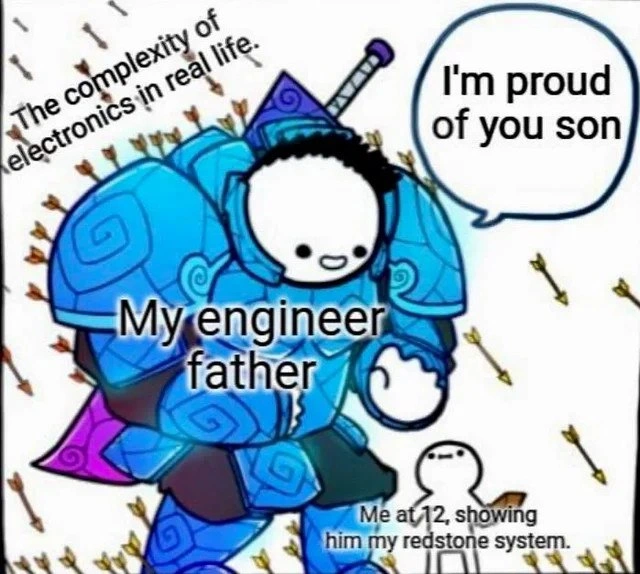
The “shielding” part – him in armor with arrows bouncing off – means the father is not letting the harsh realities of real electronics spoil that fun. It’s like he’s thinking, “I know how hard this stuff is in real life, but I want my kid to enjoy the learning process now. There’s plenty of time later to learn about all the difficult parts.” A supportive parent or mentor often does that: they’ll handle the complicated stuff or at least not burden the beginner with it right away. In this meme, the dad isn’t saying "Well, actually your Redstone contraption is nothing compared to a real circuit" – nope. He’s just genuinely happy and impressed, which in turn motivates the child to keep exploring. This dynamic is common in parental_pride_meme themes: the experienced parent protecting the child’s enthusiasm. And it’s especially common in tech families – for instance, a coder parent might be delighted when their kid writes their first simple Scratch program or builds a small robot from a kit, even though the parent works on complex software all day.

To put it simply, Minecraft Redstone is a beginner-friendly way to play with the ideas of circuits and logic. Real electronics are challenging – they have physical limitations and require careful planning (plus if you mess up, you might break something). The father’s role here is to keep that complexity at bay until the child is ready. The result? The kid feels proud of their creation and encouraged to learn more, and the dad is happy to see his own passion being lit in his child without the frustration. It’s a wholesome techie family moment wrapped in a funny image. Anyone who’s tinkered with Redstone or real circuits will smile seeing it, because they know this is how future engineers get started – one Minecraft contraption (or Lego robot, or basic coding project) at a time, supported by people who know the real stuff but let the kids enjoy the journey.

Minecraft Redstone Project 🎮🧱 Real Electronics Project 🔌📐
Built with virtual blocks and Redstone dust in a game. Built with physical components (wires, resistors, chips) on a board.
No risk: nothing can actually break or catch fire. Components can burn out 🔥 if used incorrectly (and it costs money!).
Logic is abstract: just think in terms of ON/OFF (1/0). Must consider actual voltage, current, and circuit diagrams.
Easy to iterate: change a block placement and test again immediately. Harder to tweak: need to re-solder or re-wire, use a multimeter to test.
Fun visuals and sounds when things work (door opens, lights up). Real satisfaction too, but mostly LEDs blink or devices operate (no game sparkle).
Learning focus: logic and creativity. Learning focus: precision, theory, and practical skills.

(The table above contrasts the child’s digital project vs the dad’s real-world projects.)

Level 3: Knight in Shining Solder

The humor (and heart) of this meme hits home for anyone in tech or engineering. We have a battle-hardened engineer father in full armor, cheerfully taking hits from “the complexity of electronics in real life” – all those daunting details like schematics, component specs, soldering mishaps, and debugging circuits at 3 AM – while his kid excitedly shows off a homemade Redstone contraption in Minecraft. The arrows bouncing off Dad’s armor are every frustrating thing about real electronics that could discourage a newbie: stray voltages, burnt-out LEDs, mysterious smoke when you wire something wrong, datasheets full of jargon, the works. But none of that is reaching the child. The father has effectively built a safe zone where his kid can fall in love with building and coding without feeling that real-world complexity.

It’s funny because it’s true: Minecraft Redstone is famously a gateway for kids into the world of logic circuits and programming. It’s a staple of modern GamingReference in tech circles – we’ve all seen those YouTube videos of someone building a 10-bit ALU or a working clock inside Minecraft. Here, Dad probably knows that his kid’s “door opens when I press a button” Redstone project is a far cry from designing real electronic systems. (In real life, making an automatic door might involve motion sensors, a microcontroller, a motor, a power supply… a whole list of headaches.) But instead of dismissing it, the father celebrates it. That’s the wholesome twist that makes this TechHumor meme so resonant: an expert who doesn’t gatekeep or nitpick (“Actually, son, a real XOR gate needs transistors…”), but rather says “I’m proud of you, son.” He’s treating the child’s little digital invention with the same respect as one would treat a complex hardware project. And honestly, for a 12-year-old, building something in Redstone is a complex project – it requires planning, logical thinking, and patience, all key engineering skills.

Many senior developers or engineers chuckle at this because it reflects their own experiences. Perhaps their parents protected and encouraged them similarly, or they as parents now do it for their kids. It’s a recognition of how important that encouragement is in childhood_coding_inspiration. The meme format – the knight shielding the tiny figure – exaggerates it humorously: Dad’s like a superhero tanking all the tough stuff so the kid can enjoy the creative part. In tech terms, he’s acting like an API that abstracts away the hard low-level stuff, exposing a nice easy interface for the kid’s creativity! The father might have a shelf full of Hardware prototypes, burnt fingers from soldering irons, and an army of empty coffee cups from late-night lab sessions, but he’s not dumping those war stories on his child. He knows those “arrows” (complex circuit diagrams, math, failures) could easily discourage a beginner. Instead, he fuels the kid’s confidence: HumorInTech often highlights these poignant truths – that the best engineers often start by tinkering with very simple systems, and the best mentors cheer them on every step of the way.

In the broader GamingCulture and engineering community, this meme also gently pokes at the contrast between software or simulation vs. real life. Redstone is essentially digital LEGO with logic – you snap components together, and presto, things happen. Real electronics require a lot more groundwork. Think about it: if the child gets serious about electronics later, the father knows what’s coming – the first time a circuit doesn’t work because of a nearly invisible wiring error, or when they have to learn what a flip-flop or a pull-up resistor is. But for now, the kid’s accomplishments in their digital sandbox are valid and praiseworthy. The dad’s pride isn’t misplaced or just coddling; he genuinely recognizes the spark of engineering creativity in that Minecraft creation. And that’s why this meme warms the heart of developers: it’s EngineeringHumor that comes with a nod of respect to the next generation. We see a parent character literally armoring up to preserve the child’s joy of discovery. It reminds experienced readers of the meme of all the times someone shielded them from feeling overwhelmed when they were just starting out – or maybe of times they do the same for newbies on their team ("You focus on the fun part, I'll handle the scary setup"). It’s a clever and sweet representation of mentorship and encouragement in a technical context.

Level 4: Analog Arrows, Digital Armor

In the world of circuits, Minecraft Redstone operates at a beautifully abstract level of boolean logic. It's as if the game gives you a sandbox digital logic simulator built from blocks: a Redstone torch acts like a NOT gate (inverting a signal), Redstone dust lines carry binary signals (powered = 1, unpowered = 0), and combinational logic emerges as you connect these pieces. Beneath this playful facade lies real CS_Fundamentals – the same principles that govern actual computing hardware. In a real circuit, that redstone dust is analogous to wires on a breadboard or printed circuit board, and those on/off Redstone signals correspond to voltage levels (like 5V for a binary 1, 0V for 0) in electronics. But here's the catch: real electrons don’t behave as tamely as Redstone does in-game.

A professional engineer (like the armored dad in the meme) grapples with Kirchhoff's laws, resistance, capacitance, and a barrage of analog “arrows” – signal interference, voltage drops over long wires, timing delays when signals propagate through logic gates, heat dissipation, and the ever-present risk of letting the magic smoke out of a chip if you wire something wrong. In Minecraft, signals simply stop after 15 blocks unless boosted by a Redstone repeater – a neat simplification that mirrors real life signal attenuation (when a voltage weakens over distance) and the need for amplifiers or repeaters in long wiring. But notice how the game turns that complex electrical engineering detail into a fun puzzle mechanism rather than a headache of calculations. The engineer father in the meme stands as a knight in shining armor, absorbing these analog complexities (the arrows of reality) so his child can safely experiment within a digital logic simulation. This protective dynamic highlights a core truth in engineering education: high-level abstractions (like Redstone or visual coding blocks) shield beginners from low-level complexity (like transistor physics or Maxwell’s equations) while they learn the fundamentals. The dad’s armor isn’t just metaphorical protection – it’s generations of engineering knowledge acting as a buffer, letting the child explore logical reasoning bit by bit without getting zapped by overwhelming details.

From a high vantage, this meme nods to the elegance of layering in computing systems. We build complex real-world electronics on layers of abstraction: from transistors (tiny electronic switches) to logic gates, to integrated circuits, to full computers. Minecraft compresses several of those layers into a toy-like form – essentially a game development miracle that a bunch of simple rules (Redstone power levels, torches, repeaters) can emulate actual circuitry. The father, seasoned in real hardware design, knows that under the hood of any computing system lies an army of electrons following the laws of physics. Yet here he sees his 12-year-old using GamingCulture to grasp the same logical constructs that took engineers decades to harness. It’s an almost poetic bridging of worlds: the EngineeringHumor comes from knowing how insanely complicated real hardware is, and yet how a child’s game can capture its essence so well. The proud parent is effectively saying, “Yes, your digital contraption built from game blocks is rooted in the very hardware principles I work with – and I couldn’t be happier to see you discover that magic in a fun way.”

Description

A wholesome, multi-layered comic meme. A giant figure in elaborate blue armor, labeled 'My engineer father,' is smiling down at a small, simple character labeled 'Me at 12, showing him my redstone system.' The father says, 'I'm proud of you son.' Meanwhile, the father is being bombarded by a volley of arrows, which are labeled 'The complexity of electronics in real life.' The meme beautifully illustrates the relationship between a child's early exploration of technical concepts and the parent's deep understanding of the real-world challenges. Redstone in the game Minecraft is a powerful tool that allows players to create complex circuits and logic gates, serving as a gateway to electrical engineering and programming for many young people. The father, an engineer, recognizes the significance of this creative spark and shields the child from the overwhelming complexity of his own profession to offer pure encouragement


Comments

7
Anonymous ★ Top Pick Redstone is the ultimate gateway drug. One day you're building a piston door, the next you're debugging race conditions in a Verilog module for an FPGA and wishing you could just solve it by adding a repeater
  1. Anonymous ★ Top Pick

    Redstone is the ultimate gateway drug. One day you're building a piston door, the next you're debugging race conditions in a Verilog module for an FPGA and wishing you could just solve it by adding a repeater

  2. Anonymous

    I applaud my kid’s redstone 4-bit ALU; he thinks the hard part is carry propagation - I’m just keeping quiet about the $250 k mask respin when a trace crosses the wrong metal layer

  3. Anonymous

    The real complexity isn't in the redstone circuits - it's explaining to your spouse why your 12-year-old's Minecraft world needs a dedicated server with 32GB RAM because 'the chunk loading for the automated sorting system is critical to the build's performance, honey.'

  4. Anonymous

    Every senior engineer remembers that moment when they proudly showed their parents their first 'complex system' - whether it was a Redstone contraption, a BASIC program that printed their name 100 times, or an HTML page with a <marquee> tag. Fast forward 20 years, and you're now debugging distributed systems with 47 microservices, but somehow that childhood validation still hits different. The real complexity isn't in the circuits or the code - it's explaining to your non-technical relatives that yes, you're still 'doing computer stuff,' and no, you can't fix their printer remotely

  5. Anonymous

    My engineer dad after seeing my Minecraft redstone CPU: “Solid - now add clock skew, metastability, ground bounce, and procurement; that’s the part where physics ships to prod.”

  6. Anonymous

    In Minecraft, a clock‑domain crossing is eight repeaters; in silicon, it’s metastability, timing closure, and a $5M respin - Dad still says, “nice piston door.”

  7. Anonymous

    Kid's redstone: zero electrons lost, perfect timing - no worse than Dad's last FPGA race condition nightmare

Use J and K for navigation