Skip to content
DevMeme
7227 of 7435
Margaret Hamilton vs 2026 Wojaks: Moon Code to Button Colors
TechHistory Post #7925, on Apr 15, 2026 in TG

Margaret Hamilton vs 2026 Wojaks: Moon Code to Button Colors

Why is this TechHistory meme funny?

Level 1: The Tower of Homework

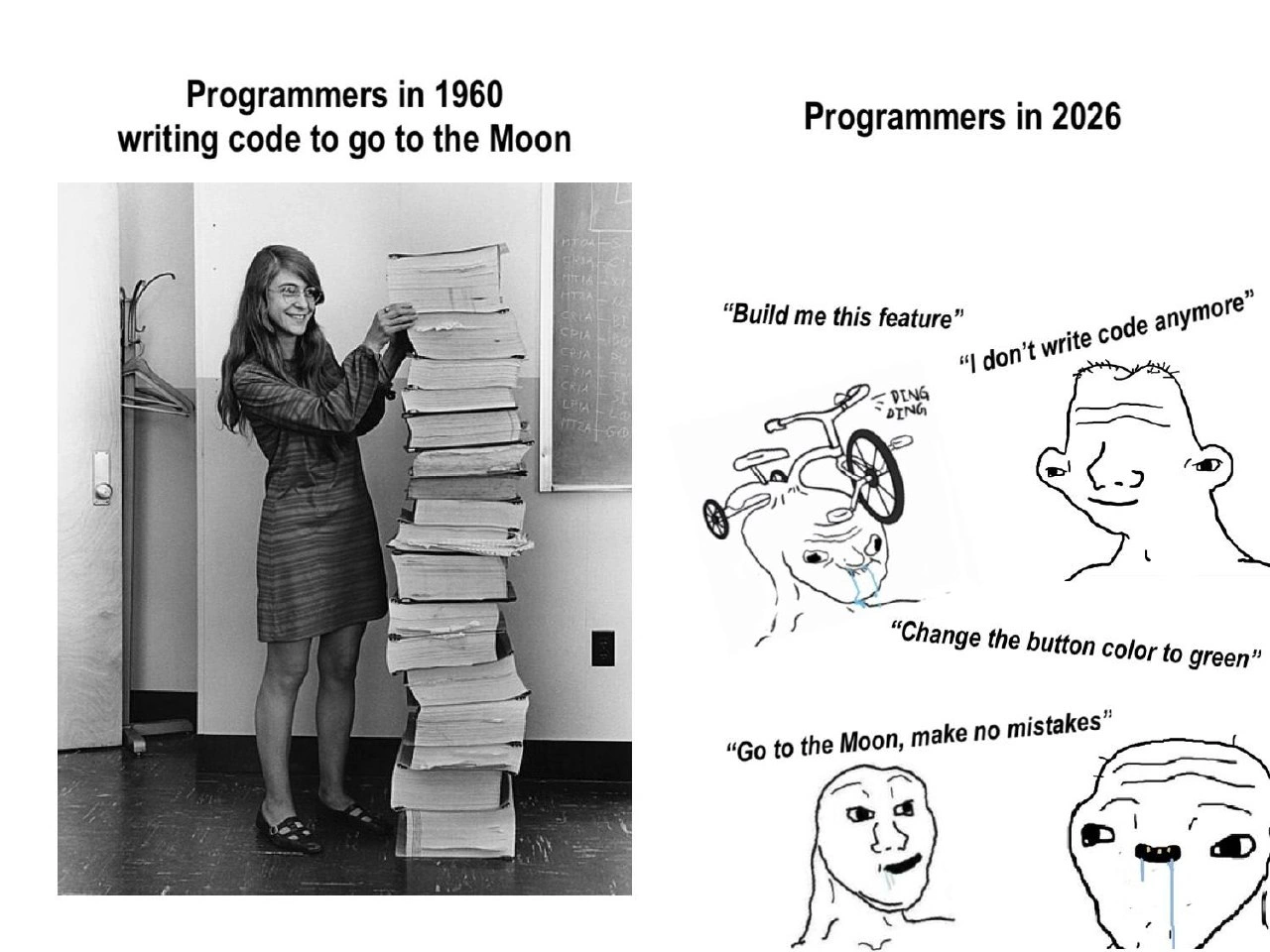
On the left is a woman standing next to a pile of homework as tall as she is — she and her friends wrote all of it by hand, and it was so good it flew people to the Moon and back. On the right are silly drooling doodle-faces who just shout orders like "make my button green!" and "fly to the Moon, no mistakes!" and expect a magic robot to do everything. The joke is like comparing someone who built a treehouse with their own hands to someone who yells "TREEHOUSE!" at the sky and waits. It's funny because the comparison is so unfair it loops around to being a compliment to the lady with the giant paper tower.

Level 2: Who's in the Photo, and Who Are the Doodles

  • Margaret Hamilton led the team that wrote the onboard flight software for NASA's Apollo program. The paper tower beside her is the printed source code — when your program is printed on paper taller than the author, you appreciate why discipline mattered. Her error-handling design famously saved the Apollo 11 landing.
  • A wojak (and its drooling cousin, the brainlet) is a crude internet caricature used to mock a group as simple-minded. Putting many of them in one panel saying dumb things is a standard meme format for "this is what those people sound like."
  • "I don't write code anymore" references AI coding assistants — tools where you describe what you want in plain English ("vibe coding") and the model writes the implementation. "Change the button color to green" is the stereotypical trivial ticket, the opposite of lunar navigation.

If you're starting out today, the contrast carries a practical lesson rather than an insult: tools that generate code don't remove the need to understand it. Your first production bug will teach you that "make no mistakes" is not an engineering strategy — someone still has to know why the code works, the way Hamilton's team had to, just with fewer paper cuts.

Level 3: From Rope Memory to Prompt Memory

The left panel is one of computing's sacred relics: Margaret Hamilton beside the printed listings of the Apollo Guidance Computer software — a stack of paper as tall as she is. (Pedants will note the caption's "1960" is a few years early; the photo is from the late 1960s at MIT's Instrumentation Lab, and Hamilton herself coined the term software engineering partly to get the discipline taken seriously.) That code ran in roughly 72KB of core rope memory, was literally woven by hand, and included priority-scheduling logic so robust that when the 1202 alarms fired during the Apollo 11 descent, the system shed low-priority tasks and kept the lander flying. No staging environment. No rollback. The "production incident" scenario was two astronauts dying on the Moon.

The right panel is the meme economy's favorite shorthand for cognitive decline: drooling wojak/brainlet caricatures, one riding a tricycle with a "DING DING" bell, captioned with the liturgy of AI-era development — "Build me this feature", "I don't write code anymore", "Change the button color to green", and the transcendent "Go to the Moon, make no mistakes". That last line is the meme's sharpest joke, because it's a real genre of prompt: the belief that engineering rigor can be replaced by appending "make no mistakes" to a request, as if correctness were a politeness setting.

But the then-vs-now framing deserves pushback, and the historically literate reader knows it. Hamilton's generation was also accused of decadence — assembly programmers sneered at compilers, and real engineers supposedly didn't need garbage collection. Every abstraction layer in computing history triggered the same panic about skill regression. What makes the current wave feel different to skeptics is the direction of the abstraction: compilers were deterministic, while delegating to an LLM trades verifiability for velocity. The meme isn't really claiming modern developers are stupid; it's mourning that the artifact Hamilton could stack next to her — inspectable, line-by-line accountable code — is dissolving into prompts whose output nobody fully reads. Whether that's the death of engineering or just the next compiler argument is the debate the meme is too busy drooling to have.

Description

A side-by-side comparison meme. Left: the famous black-and-white photo of Margaret Hamilton standing next to a stack of Apollo Guidance Computer source code listings as tall as she is, captioned 'Programmers in 1960 writing code to go to the Moon'. Right: captioned 'Programmers in 2026', a collage of crudely drawn brainlet/wojak caricatures with drooling faces saying 'Build me this feature', 'I don't write code anymore', 'Change the button color to green', and 'Go to the Moon, make no mistakes', one riding a tricycle with a 'DING DING' bell. The meme contrasts the rigor of early aerospace software engineering with the perceived regression of modern AI-prompt-driven 'developers' who delegate everything to tools

Comments

4
Anonymous ★ Top Pick Hamilton's stack of listings had fewer runtime surprises than one modern 'build me this feature' prompt - and her dependency tree fit in 72KB of rope memory
  1. Anonymous ★ Top Pick

    Hamilton's stack of listings had fewer runtime surprises than one modern 'build me this feature' prompt - and her dependency tree fit in 72KB of rope memory

  2. @RiedleroD 2mo

    lunar flyby at least. please hold for the actual landing

    1. @LonelyGayTiger 2mo

      At this point it 's looking like they're going to miss the 2028 target. Especially if the proposed budget cuts go through this year.

  3. @agonyship 2mo

    I teach Java and it's all so tiresome.

Use J and K for navigation