Documentation? We Don't Do That Here
Why is this Documentation meme funny?
Level 1: Missing Instructions
Imagine you join a group of friends to build a huge LEGO castle, but there are no instructions at all. The other kids have built this castle before, so they just start snapping pieces together from memory. When you ask, “Hey, can I see the instruction booklet?” they just grin and say, “We don’t have those here.” You’d feel pretty lost, right? You might start putting bricks in the wrong places or keep asking them what to do next. It’s not very fun, and it takes a lot longer to help build the castle.
That’s exactly the feeling this meme is joking about. Documentation is like the instruction booklet for a software project – it tells new people how to use or work on the code. But in some teams, nobody writes that booklet. So when someone new comes in and wants to help or fix something, everyone just says, “Oh, we don’t write things down here, you have to figure it out yourself.” It’s funny in the meme because of how bluntly the team refuses (“We don’t do that here”), but in real life it can be frustrating and confusing. The joke is basically comparing a team with no written guides to a group that says no instructions, good luck! It makes us laugh because it’s a bit silly – we all know having instructions would make things easier, so why wouldn’t you have them?
Level 2: No Docs Dilemma
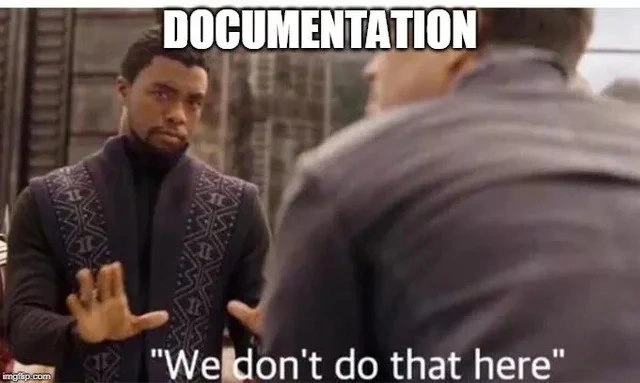
In this meme, the word “DOCUMENTATION” appears at the top, and at the bottom a subtitle reads “We don’t do that here.” The image is a popular scene from Marvel’s Black Panther, used in internet culture to humorously refuse or deny something. So basically, the team is reacting to the idea of documentation with that famous quote, implying “Nope, we don’t bother with docs.” It’s funny to developers because skipping documentation is a surprisingly common habit, even though everyone knows it’s important. This DocumentationGap between what we should do (write docs) and what we actually do (ignore them) is a well-known problem in software teams.
Let’s break down what documentation means in a dev context. It can be any written guide that helps others understand the code:
- It might be a README file at the root of your project explaining how to set up and run the app.
- It could be an internal wiki page or Confluence document describing the system architecture.
- It includes code comments and docstrings that explain tricky logic inside the code itself.
- Even commit messages and API docs are part of documentation.
Good documentation is considered part of good Code Quality because it makes the code easier to maintain and use. If you’ve ever joined a new project, you know how crucial a getting-started guide or some diagrams can be. That’s essentially Developer Experience (DX) – the experience developers have when working on or using a codebase. High DX means it’s smooth and pleasant to get things running or to contribute code; low DX (often caused by no docs) means it’s frustrating and slow. Imagine setting up a project that has 57 microservices without any instructions – your DX would be pretty awful, right?
Now, why would a team avoid writing something so obviously helpful? Often it comes down to team culture and priorities. Maybe the team is always rushing to deliver features and they treat writing docs as an afterthought (“we’ll do it later” – but “later” never comes). In some places, engineers joke that documentation is “not in our DNA” or that their code is self-documenting (meaning they think the code is written so clearly that it doesn’t need extra explanation). Sometimes people just assume someone else will document it, and in the end nobody does. This can lead to knowledge silos – a situation where a few individuals hold all the knowledge in their heads. For example, one senior dev Alice knows how the payment processing works because she built it, but there’s nothing written down. If Alice is out sick or leaves the company, everyone else is stuck because the knowledge wasn’t shared in a durable way.
The meme resonates with developers because it’s a relatable dev experience. Pretty much every programmer has at some point asked “Where’s the documentation for this?!” and gotten back blank stares or nervous laughter. It’s both humorous and exasperating. The phrase “We don’t do that here” in the meme is a playful way to admit a flaw: the team acknowledges they should be doing documentation, but they just... don’t. It’s a form of tech humor where we laugh at our own bad habits. The top caption yelling “DOCUMENTATION” and the bottom quote together create a mini-story: somebody probably suggested writing docs, and the team’s immediate response is a meme-worthy shutdown. For a junior developer or someone new, it highlights the ironic truth that even in high-tech environments, basic things like documentation can be missing.
In summary, this meme is pointing out the documentation woes in team culture. It teaches a subtle lesson beneath the humor: when teams say “we don’t do that here,” it results in confusion and extra work later on. New developers struggle to get up to speed, and even experienced devs can make mistakes because they’re missing context that should have been written down. The meme uses a funny movie reference to make that point in a lighthearted way that anyone in the field can chuckle at (while maybe feeling a tiny bit guilty if it hits close to home).
Level 3: Tribal Knowledge Kingdom
When a dev team treats documentation like a forbidden art, you get exactly the scenario this meme pokes fun at. The image (from Black Panther, with T’Challa saying “We don’t do that here”) is repurposed to show a team flat-out rejecting the idea of writing docs. It’s a sarcastic nod to a pervasive anti-pattern in software engineering: happily churning out code while collectively dodging any form of documentation. The humor hits home for seasoned developers because it’s too real – many of us have battled codebases where critical knowledge lives only in senior engineers’ heads (the classic knowledge silo situation).
New Dev: “Hey, is there any documentation for this feature?”
Team Lead: (extends hands like T’Challa) “We don’t do that here.”
At a senior level, we recognize this as a team culture issue. The meme highlights how some teams almost pride themselves on not documenting. Often it’s not an explicit boast, but an ingrained habit fueled by tight deadlines, misplaced priorities, or the misguided mantra “the code is the documentation.” There’s an Agile Manifesto principle often misused here – “Working software over comprehensive documentation.” Some teams interpreted that a bit too literally and ended up with zero docs. This cultural neglect of docs becomes self-perpetuating: if nobody writes things down, new folks learn by oral tradition (tribal knowledge), and they in turn don’t bother writing docs either. It’s a vicious circle of documentation neglect.
From a code quality and Developer Experience (DX) standpoint, this is pure chaos hiding under a veneer of “we ship fast.” Lack of docs is essentially technical debt: you “save time” now by skipping documentation, but you pay the interest later in the form of on-boarding pains, production mishaps, and endless "figure it out yourself" scenarios. Knowledge becomes exclusive – only the original authors or a few long-timers understand the system. If those people go on vacation or leave the company (commonly referred to as the “bus factor” problem), everyone else is stuck reverse-engineering cryptic code. This is the documentation gap in action: the widening disparity between what the code does and what the team actually knows or has written down about it.
Why is this funny? Because it’s painfully true. Every experienced dev can recount a horror story of diving into a codebase with a README that basically says “Good luck!” It’s a shared source of comedic trauma in the industry – hence the abundance of DocumentationHumor and TechHumor memes on this exact topic. We laugh, but only to keep from crying. The meme’s caption “We don’t do that here” perfectly personifies a smug team attitude that senior engineers recognize as a red flag. It’s an absurd juxtaposition: highly intelligent teams building complex systems, yet acting like writing a few paragraphs of guidance is against their religion. The Black Panther reference adds a layer of irony – in the movie, Wakanda is a highly advanced society, but even they might keep knowledge secret. In our dev world, secret knowledge (instead of well-documented knowledge) leads to DocumentationWoes for everyone else.
Let’s be real, we’ve all seen these symptoms of documentation neglect:
- Empty or outdated README: The project’s
README.mdproudly displays “TODO: add documentation” and then crickets. - Sparse code comments: Functions named
doMagic()with zero comments explaining the “magic.” (Self-documenting code?Sure.) - Stale Wiki pages: An internal Confluence or wiki last updated two years ago by an intern, now hopelessly obsolete.
- Onboarding by rumor: New hires learn by chasing down people to ask basic questions, because nothing was written down for them.
The meme humorously encapsulates these collective failures with a single catchphrase. For veterans, it’s a knowingly sarcastic grin – we’ve survived production incidents at 3 AM where the root cause was misunderstanding a system that had no docs. We’ve uttered “Seriously, no one wrote any docs for this?” while debugging a legacy app. The “We don’t do that here” meme is basically the team admitting, with comedic exaggeration, that documentation is just not part of their culture. And as any battle-scarred engineer will tell you, that’s a recipe for long-term pain (and plenty of late-night WTF moments). It’s funny because it’s true – and also a little sad, because we know we should do that here, but… we don’t. 😅
Description
A popular meme using a scene from the Marvel movie 'Black Panther.' The image features the character T'Challa (played by Chadwick Boseman) looking serious and holding up his hand in a stopping gesture. A large, white, all-caps caption at the top reads 'DOCUMENTATION'. Below T'Challa, a subtitled quote from the movie says, '"We don't do that here"'. The meme humorously and cynically portrays a common reality in many software development teams and corporate cultures where writing and maintaining documentation is neglected or actively discouraged in favor of pushing out new features. It resonates with developers who have struggled with undocumented codebases, treating the very idea of documentation as a foreign and unwelcome concept
Comments
7Comment deleted
Our documentation strategy is simple: the code is the documentation. And the code is a 20-year-old uncommented Perl script
Documentation: the only component with stricter eventual consistency than our distributed datastore - eventually someone will write it, eventually someone will read it, never in the same release cycle
The code is self-documenting, said the developer who just spent three hours reverse-engineering their own API from six months ago
Every senior engineer knows the painful irony: we spend hours in architecture reviews debating the perfect abstraction, then ship it with a README that just says 'TODO: Add documentation.' Six months later, when the original author has moved to a different team, that undocumented service becomes the company's most critical dependency. The real Wakanda Forever is the institutional knowledge we lost along the way because nobody wrote down how the authentication flow actually works
The golden handover rule: undocumented code self-documents via production incidents
Our documentation is event-driven: it only appears after an incident emits a postmortem, which retroactively becomes the spec
If your knowledge base is Slack search and institutional memory, you don’t have microservices - you have a distributed oral tradition