Cloud Cost Anxiety vs. Biological Needs
Why is this Cloud meme funny?
Level 1: Money Over Sleep
This meme is like a silly bedtime story about what someone cares about the most. Imagine you’re really cozy in bed at night. You should get up because you need to use the bathroom, but you decide to hold it and keep sleeping because you’re just too comfy or tired. Now imagine something else: you suddenly remember that a machine is running and it’s costing money while you sleep. That thought makes you jump out of bed immediately to go turn it off. Sounds funny, right? Most people would probably get up to pee and wouldn’t worry about a little money until morning. But in this joke, the person does the opposite. They ignore the normal, everyday need (going to the bathroom) and instead rush to fix the money issue (turn off a cloud computer to stop charges).
It’s funny because it shows an upside-down priority – caring more about saving a bit of money than about personal comfort. It’s like if your dad won’t wake up for a glass of water, but if he realizes the TV was left on (wasting electricity), he’d jump out of bed to turn it off. We find it humorous because it’s an exaggeration: no one literally does that every night. But it makes a point about how people who work with cloud computers think – they always worry about wasting resources or money, sometimes even at odd hours. The meme uses the famous Drake images to make it clear: Not interested in one thing, very excited about the other. In simple terms, the joke is laughing at how a developer might value saving a few dollars on cloud bills so much that it even beats a basic need like going to the bathroom. It’s a playful way to show just how far love for efficiency (and saving money) can go!
Level 2: Cost vs Comfort
Let’s break down why this scenario hits home for developers, even those new to cloud computing. In cloud platforms like AWS, Google Cloud, or Azure, you can rent virtual computers known as VM (Virtual Machine) instances. Think of a VM instance as a remote computer server that’s running in a data center far away. You pay for it by the hour or minute — this is the pay-as-you-go billing model. Every minute that your cloud VM is running, the cloud provider charges your account a little bit of money. If you aren’t using that server (for example, it’s a test environment you forgot to shut down), it’s like leaving a car engine idling: it’s burning fuel (money) for no reason. Cloud cost optimization is all about finding these kinds of waste and eliminating them, for instance by shutting down idle servers when they’re not needed.
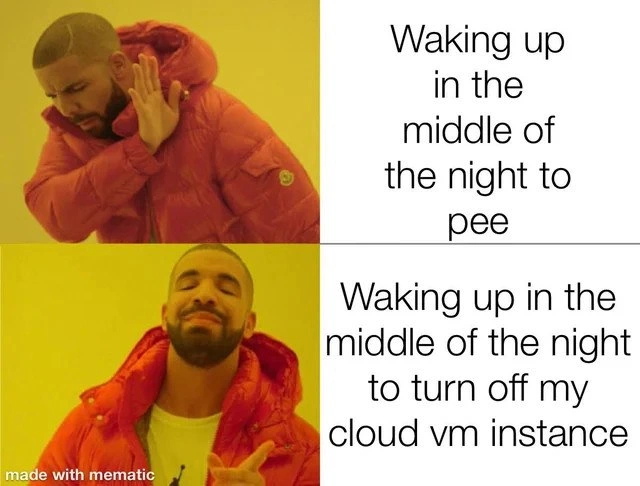
Now imagine it’s late at night. The top panel text: “Waking up in the middle of the night to pee.” This describes a totally normal situation: your body nudges you awake because you need to go to the bathroom. Drake is shown turning away with a hand up, meaning he’s saying “nah, not worth it.” So he’s not waking up for the bathroom; he’d rather stay in bed. The bottom panel text: “Waking up in the middle of the night to turn off my cloud vm instance.” Here Drake is smiling and pointing, meaning “yes, that’s the good stuff!” The joke is that this person will gladly get out of bed at 3 AM to log into their cloud dashboard and shut down a VM that’s costing money, yet they wouldn’t get up for a simple bathroom trip. It’s a playful way to say the engineer cares more about saving a bit of cloud budget than personal comfort.
Why would someone do that? In real life, DevOps engineers and SREs (Site Reliability Engineers) are often responsible for managing cloud resources. Part of that job is keeping an eye on costs — nobody wants to explain a high bill to their boss. Many teams set up monitoring and alerts for cloud usage. For example, you might get an email or text if your monthly cloud spending is exceeding a certain threshold. An idle VM left running overnight might not cost a fortune, but it adds up, and it’s considered bad practice if it’s not doing anything useful. Engineers take pride in being efficient. They might even write scripts or use automation tools to shut down development servers every night. For instance, using a simple schedule (cron job) to stop instances after hours:
# Cron job to stop a cloud VM at 3:00 AM daily (pseudo-code)
0 3 * * * aws ec2 stop-instances --instance-ids i-0123456789abcdef
(The above is an example for AWS EC2, one type of cloud VM. It says: at 3:00 AM, call the AWS command-line tool to stop a specific instance.)
By doing this, they avoid paying for 6-8 hours of compute time every night. Over a month, that could save a lot of money, especially if you have many such instances. This practice is often called cloud cost management or cloud cost optimization – basically making sure you’re not paying for resources you don’t actually need at the moment.
The meme is cloud humor because it exaggerates how far engineers will go with this habit. It hints that some of us are almost too watchful of our cloud resources – to the point of absurdity. It resonates with DevOps folks because late-night duties are already part of the job (like being on-call for system issues). Waking up to check on servers is not unheard of when you have an outage. But here, instead of an outage, it’s just to save money. It’s a relatable scenario framed in a funny way: if you’ve ever caught yourself thinking about your AWS bill at odd hours or felt the urge to double-check that you shut down an environment before bed, this meme strikes a chord. Even newcomers learn quickly that cloud bills can grow silently in the night if you’re not careful. The first time you forget to turn off a cloud VM and find an unexpected charge on your credit card, you remember to be extra careful next time! This meme simply takes that caution to an extreme: literally jumping out of bed to hit the off switch.
Also, notice the Drake “Hotline Bling” meme format: it’s a famous two-panel meme. In countless variations of this meme, Drake (a Canadian rapper) is used to show a preference comparison. The top image with Drake looking disgusted or dismissive = “no, I don’t want this.” The bottom with Drake smiling and pointing = “yes, I want that.” Here, the meme creator plugged in two scenarios: one mundane (peeing at night) and one super techy (turning off a cloud server at night). It’s the contrast that makes it funny. We expect someone to prioritize a biological need over a tiny financial save, but a die-hard DevOps engineer comically has it the other way around. In summary, for a junior developer: this meme is poking fun at how cloud engineers become very vigilant about shutting down unused resources. It’s emphasizing the lengths we’ll go to save on cloud costs, in a lighthearted, exaggerated way.
Level 3: Budget vs Bladder
At 3:00 AM in a sleep-deprived haze, a seasoned DevOps engineer will prioritize a cloud billing issue over nature’s call. In the top panel of this Drake meme, he’s effectively saying “No thanks” to waking up for a bathroom break. That’s the bladder part – a basic bodily need – being dismissed. The bottom panel is Drake happily pointing, meaning “Yes, this is good.” What’s he excited about at that ungodly hour? Shutting down a cloud VM instance to save a few bucks on the bill. It’s a perfect snapshot of modern CloudCostOptimization culture, where saving money on cloud computing services outranks personal comfort. This humor hits home for experienced engineers, especially DevOps/SRE folks, who’ve felt the sting of a surprise cloud bill. They know the cloud’s pay-as-you-go model will merrily charge by the minute, all night long, for an idle server. Waking up to pee? Meh, that can wait. But waking up to kill an unnecessary EC2 instance and stop the billing meter – oh, that’s worth the immediate action!
Why is this so funny to us hardened cloud veterans? Because it’s painfully relatable. We’ve all had that “oh no, I left an instance running” moment. Maybe you spun up a beefy VM on Friday for testing and forgot about it, only to find a nasty billing alert by Monday. After getting burned once, you become hyper-vigilant, even obsessive. Some engineers literally set up alerts or cron jobs to avoid these scenarios, automating what Drake is doing manually in the meme. But the meme exaggerates it: instead of a sane scheduled shutdown, it’s implying the engineer’s internal cost alarm yanks them out of deep sleep. It’s a tongue-in-cheek nod to how senior engineers treat cloud spending as seriously as uptime. In reliability lore, we joke about being paged at 3 AM for outages. Here, it’s like getting “paged” at 3 AM by your own brain because cloud spending is trending up. The twist is that the “incident” isn’t a site outage, but a potential ~$0.50 waste on the AWS bill. And honestly, in some startup cultures, that’s a cardinal sin!
There’s a layer of dark humor around work-life balance and priorities, too. The meme suggests an ops mindset so ingrained that even biological needs take a backseat to infrastructure duties. It satirizes the idea of being on duty 24/7 for your servers and budget. The DevOps_Humor here is that engineers often joke about having no off switch themselves — we monitor dashboards and costs even in our dreams. Turning off an idle VM at 3 AM is an absurd level of dedication (or paranoia). But ask any SRE who’s had to explain a giant cloud bill to the CFO: that paranoia comes from real experience. In cloud-native teams, saving the company money can feel as crucial as keeping systems up. It’s an unwritten part of the job description. This meme brilliantly captures that relatable humor: the extreme vigilance that seems silly to outsiders but totally makes sense if you’ve lived through big cloud cost overruns. It’s funny because it’s true — many of us have literally been one step away from doing exactly what Drake is doing here.
Description
A classic two-panel 'Drake Hotline Bling' meme format. In the top panel, the rapper Drake, wearing an orange puffer jacket, holds up a hand in rejection next to the text 'Waking up in the middle of the night to pee'. In the bottom panel, Drake points in approval with a satisfied expression at the text 'Waking up in the middle of the night to turn off my cloud vm instance'. A 'made with mematic' watermark is visible in the bottom left. The meme humorously contrasts a basic human need with a very specific developer anxiety: the fear of incurring unexpected costs from a cloud virtual machine left running. For anyone who has used pay-as-you-go cloud services like AWS or Google Cloud, the panic of realizing you've left an instance running and racking up a bill is a deeply relatable experience, making the joke land perfectly with the tech-savvy audience

Comments
7Comment deleted
The most effective developer alarm clock isn't a sound, it's the silent, soul-crushing dread of an idle EC2 instance's billing cycle ticking over at midnight
I’ll happily accept eventual consistency on my bladder, but AWS billing is strongly consistent with a 0ms grace period
That moment when your p95 instance costs are higher than your p95 response times, and both are keeping you up at night
The modern developer's hierarchy of needs: sleep < bathroom < ensuring that test VM you spun up 'just for a minute' three days ago isn't quietly burning through your AWS credits at $0.096/hour while you dream of serverless architectures
I don’t wake up to pee; I wake up because our tag-based shutdown Lambda skipped the “quick benchmark” p3.16xlarge - turns out FinOps pages louder than PagerDuty
If your sleep schedule is your instance scheduler, you don’t have FinOps - you’ve built a human-in-the-loop autoscaler with 100% toil and zero SLAs
Peeing's free; that idle t3.micro? Compounding interest on your sleep deficit since spin-up