Skip to content
DevMeme
930 of 7435
Documentation Defined as 'Stack Overflow for Boomers'
Documentation Post #1050, on Feb 25, 2020 in TG

Documentation Defined as 'Stack Overflow for Boomers'

Why is this Documentation meme funny?

Level 1: Manuals Are for Parents

Imagine you just got a new LEGO set. It comes with a big booklet of instructions (that’s like the documentation). But instead of reading that, you pull out your tablet and watch a quick YouTube video or ask a friend who built the same set how to do it (that’s like using Stack Overflow or online answers). Now, your dad sees this and goes, “Why don’t you just read the instruction book? That’s what it’s there for!” And you reply, “Ugh, no one reads the manual, that’s what old people do.” This meme is joking in exactly that way, but with coding. The “manual” here is the official guide for software, and the “asking a friend or watching a video” is like searching on StackOverflow. It’s funny because it’s a little true: a lot of us skip the boring instructions and go straight to asking someone for the answer. Calling documentation “StackOverflow for boomers” is a playful way to say “reading the official instructions is something only our parents’ generation would do.” It makes us laugh because we recognize the laziness in ourselves — sometimes we know the answer is in the book, but we just find it easier (or cooler) to get the answer from our peers or the internet. In the end, it’s poking fun at that feeling we all get of, “Do I really have to read the whole manual? Nah, I’ll just get a quick answer elsewhere.” It’s a tease that reminds us the manual is there... even if we joke that we’re too modern (or too impatient) to read it.

Level 2: Docs? TL;DR

Let’s break down the joke for those newer to the scene. First, documentation in a software context means the official instruction manuals or reference guides for a programming language or tool. Think of the official website for Python or React – they have sections explaining how features work, with examples. That’s documentation. It’s written and maintained (ideally) by the people who build the tech or by dedicated technical writers. It’s supposed to be the go-to place to learn how to use something correctly from the ground up. When the commenter says “What’s documentation?” with a straight face, they’re joking that they’ve never even heard of this official info source – implying they never use it.

Now, Stack Overflow is an online Q&A forum where developers ask questions and other developers answer them. It’s hugely popular; if you search almost any programming error or “How do I do X in JavaScript?”, a Stack Overflow page is often the first thing Google shows you. On Stack Overflow, you get practical, specific answers from peers, often with code snippets. It’s community-driven knowledge. Many of us learn from it on a daily basis. It’s so common that some developers basically copy-paste solutions from StackOverflow without consulting any official docs. (This habit is jokingly called “StackOverflow-driven development.”) So when our meme reply says documentation is “StackOverflow but for Boomers,” it’s comparing the two sources of answers. It’s like saying, “Documentation is basically the old-school version of Stack Overflow.” In other words, reading the official manual is something the older generation of programmers do to answer their questions – the way younger devs today use StackOverflow. The phrasing is meant to be funny and a bit mocking.

Who are these “Boomers” exactly? Literally, “Boomer” refers to the Baby Boomer generation (people born in the mid-20th century, many of whom would be retirees now). But on the internet, “OK boomer” has become a meme-y way to call someone old-fashioned or out of touch, regardless of their actual age. In this context, it doesn’t necessarily mean actual senior citizens coding in COBOL; it’s poking fun at anyone with a more traditional approach. So a 30-year-old developer who insists on reading the official handbook could be playfully labeled a “boomer” by a 20-year-old colleague who prefers quick online answers. It’s an exaggeration, not a real insult — part of DeveloperCommunity banter.

Why would a newcomer avoid documentation enough to wonder “what’s that?” Often, official docs can be long, detailed, and dense. When you’re new, opening a 500-page reference manual or a wiki full of technical jargon is intimidating. It might feel easier to learn by example or by asking a direct question. For instance, instead of reading an entire API documentation to find one function, a beginner might just google “How to do X with Y library” and land on a StackOverflow page where someone already provided a clear example. This saves time in the moment, so it’s very tempting. It also feeds a bit of instant gratification: you get the answer without having to skim a lot of text. That’s why we say newbies often have documentation aversion – they tend to label official docs as “TL;DR” (too long; didn’t read). They might not have the patience or experience yet to quickly find what they need in the docs. Instead, they rely on community answers that are curated by upvote counts (the higher the votes on StackOverflow, presumably the better or more applicable the answer).

However, more experienced developers know that official documentation is super important. Why? Because it’s the single source of truth maintained by the creators of the tool. It usually covers all the features (not just the popular ones people ask about online), and it’s updated when new versions come out. Community answers might be outdated or specific to an older version. For example, a StackOverflow answer from 2013 about a bug might not apply after a 2020 update – whereas the 2020 documentation will have the current info. Seasoned devs have likely been burned by blindly trusting an online snippet that turned out to be incomplete or wrong. So they learn to check the docs for the full story. In fact, a lot of high-reputation StackOverflow users often quote the documentation in their answers or link to it. It’s pretty ironic: you might ask a question on StackOverflow and the answer could literally be a copy-paste from the official docs you didn’t read. 😅

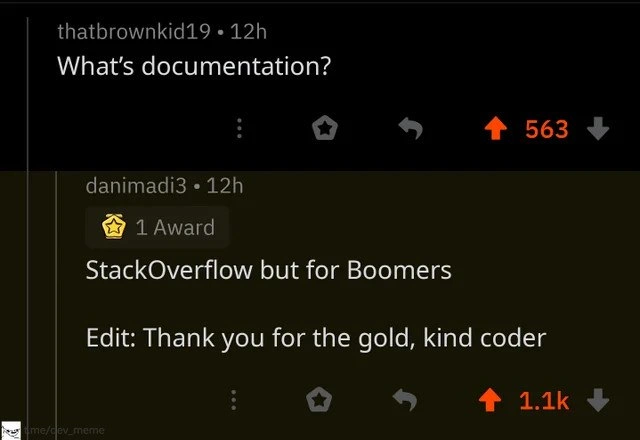
The Reddit exchange we see in the meme is exaggerated for humor. The first commenter, thatbrownkid19, asking “What’s documentation?” is probably being sarcastic – they likely know what it is, but they’re joking about never using it. The second commenter, danimadi3, jests that it’s “StackOverflow but for Boomers,” which resonated with over a thousand people (hence 1.1k upvotes and even a Reddit Gold award). When they add “Thank you for the gold, kind coder,” that’s a playful way to thank whoever gave the award (parodying the Reddit trope “kind stranger”). It shows that a lot of other developers found this joke spot-on and worth acknowledging. In a friendly way, these comments are chiding those who won’t RTFM by framing it as a generation gap. You can almost hear an older dev saying, “Back in my day, we read the manual,” and a younger dev replying, “Cool story, boomer, I have Stack Overflow.” It’s all in good fun, but it highlights a real aspect of the learning process in tech: knowing when to use quick Q&A solutions versus when to dive into the official docs. Over time, most developers figure out a balance. Early on, though, it absolutely feels like “Why read a dry manual when someone on the internet already did and can just tell me the answer?”

So, in summary: this meme uses a bit of generational humor to point out that some devs treat documentation as an ancient artifact. It’s calling out a common habit in a joking way. If you’re new to coding, take note — the joke lands because a lot of us eventually realize those official docs (the ones we ignored at first) are actually pretty useful. And if you’re the one always reading the docs, well, get ready to be teased as the “boomer” of the group (wear it as a badge of honor — you probably save everyone a lot of trouble by actually understanding the tools!). The banter might be light-hearted, but the underlying message is real: Read The Docs, folks... or at least don’t be shocked when someone older suggests it.

Level 3: The Lost Art of RTFM

In this meme, a cheeky Reddit comment asks “What’s documentation?” and the golden reply quips “StackOverflow but for Boomers.” It’s a snarky exchange that earned hundreds of upvotes because it nails a relatable developer experience: many of us have seen newbies skip the official docs and head straight to copy-paste answers. The humor comes from exaggerating that habit to the point where documentation might as well be mythical. Calling documentation "Stack Overflow for Boomers" playfully implies that reading official guides is an old-timer’s move, something only a “Boomer” (slang for an older, old-school person) would bother with. It’s developer humor (DocumentationHumor) poking fun at a real cultural gap in DevCommunities around learning.

On a serious level, this joke reflects a common anti-pattern: documentation aversion. Many junior devs (and let’s be honest, plenty of seniors too) default to searching Q&A sites like Stack Overflow for quick solutions. It’s fast and feels efficient – why wade through a 20-page manual when a top-voted answer gives you the code snippet in 20 seconds? The result is a kind of StackOverflow dependency. Over time, some developers practically treat Stack Overflow as their personal language spec. Meanwhile, seasoned engineers – the ones jokingly labeled “boomers” here – often came up in an era of RTFM (Read The Fine Manual). They remember when official docs, man pages, or hefty O’Reilly books were the only game in town. To them, it’s wild (and a bit horrifying) to see newcomers ask “What’s documentation?” as if the concept of reading the manual is extinct. The comment’s sarcasm perfectly captures that generational ribbing: “Kids these days don’t even know what a manual is, huh.”

The reason this hits home is that developer communities have lived through this scenario countless times. Imagine a young dev struggling with a framework bug at 3 AM, furiously Googling error messages. The tired veteran on the team asks, “Did you check the official docs?” — only to get a blank stare in return. The learning curve for newcomers often involves a rude awakening that, yes, those official docs exist for a reason. They contain detailed explanations, edge-case warnings, and context that you won’t always get in a bite-sized Stack Overflow answer. The meme exaggerates it for comic effect: a junior acting like documentation is some arcane boomer toolkit. But beneath the joke lies the truth that reading the docs is a skill many lack initially. That lack_of_documentation_experience can lead to the very scenarios that make veterans cynical. I’ve seen production outages caused by a copy-pasted snippet that bypassed a “minor note” buried in the docs — guess who had to dig into the manual at 3 AM to figure out what went wrong. In other words, what starts as StackOverflow-driven development can end in hard lessons that the boring official documentation would have taught upfront.

Historically, there’s a reason older devs harp on documentation. Before search engines and StackOverflow, if something broke, your options were: comb through the official manual, read source code, or ask a colleague (who would likely point you back to the manual). There’s a collective memory of thumbing through printed guides or using the man pages in Unix, which feels positively ancient to a generation raised on instant answers. So when the reply calls documentation “StackOverflow for Boomers,” it’s tongue-in-cheek tech historian humor. It’s saying: “Long before you kids had Q&A sites, us dinosaurs gathered knowledge from these dusty things called docs.” The upvotes and even a Reddit gold award on that comment show how the community loves this inside joke. It’s a gentle roast: boomers get teased for being old-fashioned, and younger devs get teased for their StackOverflow dependency and TL;DR attitude. Both sides laugh because, in practice, everyone knows a bit of both worlds. Even the most battle-scarred senior will Google quick examples, and even the greenest junior eventually learns to navigate official docs (often after getting burned by a bad copy-paste).

In true DeveloperHumor fashion, this meme shines light on a real workflow war: StackOverflow vs Documentation. It doesn’t outright say one is better (the tone is far too sarcastic for that), but the subtext is clear to experienced readers. The best developers use both: Stack Overflow for community tips and edge cases, and official documentation for the authoritative answers. The joke lands because it hyperbolically splits the crowd – if you read docs, you’re an old boomer; if you don’t, you’re a clueless kid – and every programmer recognizes a bit of this stereotype in themselves or their teammates. It’s an exaggeration wrapped in truth. Documentation is often undervalued, yet when someone mocks it so blatantly, it reminds everyone of the elephant in the room: maybe we really should RTFM more often. And if you already do? Well, congrats, the internet might just have dubbed you a boomer. 😅

Description

A screenshot of a comment thread from a social media platform, likely Reddit, with a dark mode theme. The first comment, from user 'thatbrownkid19', asks a simple question: 'What's documentation?'. Below it, a reply from user 'danimadi3' offers a cynical definition: 'StackOverflow but for Boomers'. The reply has received a 'Gold' award and is followed by an edit that reads, 'Edit: Thank you for the gold, kind coder'. The initial question has 563 upvotes, while the witty reply has 1.1k upvotes. The humor stems from the comparison, suggesting that official documentation is the old, dense, and less efficient way to get information, much like how a younger generation might view the habits of the 'Boomer' generation, whereas Stack Overflow represents the modern, community-driven, and practical source of knowledge. It's a jab at the often-criticized state of software documentation

Comments

7
Anonymous ★ Top Pick We write documentation so that future developers can experience the same confusion we did, but with a slightly more official-looking font
  1. Anonymous ★ Top Pick

    We write documentation so that future developers can experience the same confusion we did, but with a slightly more official-looking font

  2. Anonymous

    Documentation: the write-once, read-never microservice that ships with every release - juniors call it “StackOverflow for Boomers,” seniors just call it deferred debugging

  3. Anonymous

    The real generational divide is between those who read the docs to understand the system architecture and those who copy-paste from StackOverflow until the TypeScript errors go away

  4. Anonymous

    The irony is that StackOverflow answers are just documentation fragments copy-pasted by developers who actually read the docs, wrapped in passive-aggressive comments about how 'this question has been asked before' - creating a circular dependency where nobody admits to reading the source material, yet somehow the knowledge propagates through the collective consciousness of developers who swear they've never opened a manual in their lives

  5. Anonymous

    Documentation: Stack Overflow without the 'works in 2012' comments or edit wars - just pure, unadulterated RTFM bliss

  6. Anonymous

    Documentation is the source of truth; Stack Overflow is the L2 cache with undefined TTL, which you discover the hard way during a 3am page

  7. Anonymous

    Documentation: StackOverflow with a commit history and an audit trail - ignored right up until PagerDuty calls at 3 a.m

Use J and K for navigation