Skip to content
DevMeme
929 of 7435
Serverless Computing or Just a Server with Extra Steps?
AWS Post #1051, on Feb 25, 2020 in TG

Serverless Computing or Just a Server with Extra Steps?

Why is this AWS meme funny?

Level 1: Leaving the Engine Running

Imagine you have a car that can turn itself completely off to save fuel when you're not driving it. Sounds great, right? Now imagine that this car takes a minute to warm up and drive smoothly after it's been off for a long time (that's like the "cold start" in Lambda). You really dislike waiting that minute in the morning, so you come up with a plan: you go out and start your car every 15 minutes throughout the night, then turn it off again, just so it's never completely cold. By morning, the car is already warm and starts instantly.

It works — you don't have to wait in the morning — but think about what you're doing: you've basically left the car running in spurts all night long just to avoid that one-minute wait. You're using gas and putting wear on the engine even when you're not going anywhere. It’s kind of silly, right? You solved your morning problem, but now the car was running when nobody was even using it.

This meme is laughing at that same kind of silly solution in the programming world. The developer didn't want to wait for their code to "warm up," so they kept it running in little bursts all the time. They ended up treating their "no-server-needed" code just like a server that was on 24/7 – which is exactly what they were trying to avoid in the first place. It's funny because the fix completely cancels out the original benefit, like leaving a light on all day just so you don't have to flip the switch at night.

Level 2: Cold Start, Warm Lambda

Let's break this down more simply. AWS Lambda is a service where you can run small pieces of code (called lambda functions) in the Cloud without needing to set up a whole server. This is why it's part of what's called serverless computing – you write your code, and AWS handles the servers behind the scenes. You only pay when your code actually runs, and if no one is using your function, it scales to zero (meaning it basically turns off and costs nothing while idle).

Now, here's the catch: when a Lambda function hasn't been used for a while and then it gets a new request, AWS needs to start up an environment for it. That start-up delay is what we call a cold start – similar to how a car's engine might be slow when started cold. A warm Lambda, on the other hand, means the function was invoked recently and an instance is already up and running, so it responds quickly. Cold starts can cause a noticeable lag on the first request after inactivity, which can be a problem if your application needs to respond really fast.

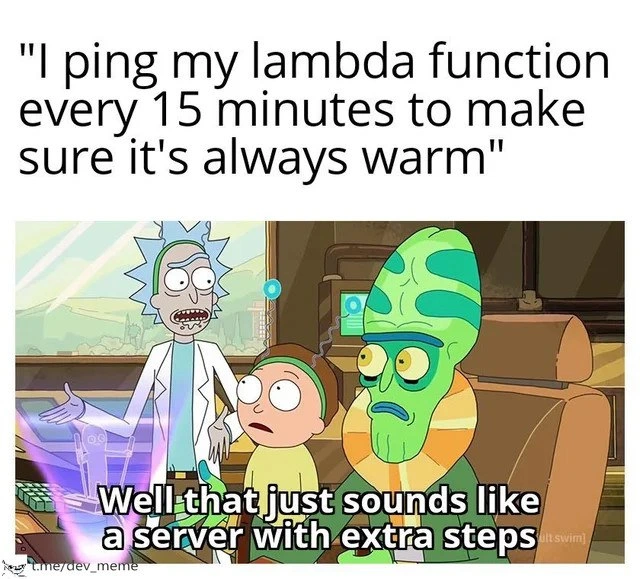
In the meme, the top panel text says: "I ping my lambda function every 15 minutes to make sure it's always warm." The developer is admitting they call (invoke) their Lambda function on a timer (like every 15 minutes using a scheduled event, kind of like a cron job) even when there's no real work to do. They do this just to keep the function alive and avoid that cold start delay. By doing so, the Lambda environment never fully goes to sleep. It's like giving it a little nudge every so often so it stays awake.

At first glance, that solves the problem: no cold start, because the function is always warm. But think about what that means – the function is now running periodically even when nobody needs it. You're effectively keeping a server process running continuously (or at least regularly) just to be ready. That's pretty much what having a server does! So, in trying to be clever, the developer has added an extra step (the periodic ping) that makes their "serverless" function act a lot like an always-on server.

The bottom panel is from Rick and Morty, a popular sci-fi cartoon known for its sharp humor. The subtitle with Rick saying, "Well that just sounds like a server with extra steps", is a direct punchline. Rick is basically pointing out the obvious: by pinging the Lambda constantly, the developer has defeated the whole purpose of serverless. It's as if Rick is saying, "Congratulations, you built a server... but in a needlessly complicated way!" This references an existing meme format ("X with extra steps") where someone describes a complicated method, and another character jokes that it's just a convoluted version of something simple.

This is funny to developers because serverless architecture is supposed to simplify things – no servers to maintain, scale automatically, pay only for what you use. People choose Lambda to avoid running a server 24/7. But here, by forcing the Lambda to run every 15 minutes, our developer is essentially running it 24/7 anyway, just in a roundabout way. It's a classic case of over-engineering: solving a problem (cold starts) in a way that cancels out the original benefits. Instead of dealing with an occasional slight delay, the developer now has to maintain a schedule, will pay for those extra invocations, and manage more moving parts. In simpler terms: they've made their system more complicated just to avoid a small inconvenience. The humor (and a bit of gentle facepalm) comes from that clear contradiction.

Level 3: Serverless with Extra Steps

This meme is a sly roast of AWS Lambda practices, exposing a ServerlessArchitecture paradox that only battle-worn DevOps veterans truly appreciate. In theory, serverless means "no servers to manage" – code runs on-demand in the Cloud, scaling to zero when idle. But here we have a developer scheduling keep_warm_ping invocations every 15 minutes to avoid the dreaded lambda_cold_start. Essentially, they've reintroduced an always-on server... just with extra moving parts.

Let's unpack the absurdity: By pinging the Lambda function on a schedule (often via an AWS CloudWatch Events rule or a cron job), the function is kept warm continuously. This prevents the runtime from spinning down, so the next real request avoids cold-start latency. Sounds clever? Maybe to someone who's never been on-call at 3 AM. In reality, it's a textbook case of OverEngineering. You've built a Rube Goldberg machine in the cloud just to dodge a few seconds of startup time. Instead of embracing the "pay-per-use" Tradeoffs of serverless, you're now paying for constant invocations and carrying the hidden burden of uptime – exactly what serverless was supposed to relieve!

The humor hits close to home for seasoned engineers. We’ve seen this pattern before: people do anything to shave off latency, even if it means effectively running an instance 24/7 under the guise of Lambda. It's the serverless_vs_servers debate wrapped in irony. Sure, your code is running on AWS Lambda, but if you're manually keeping it alive, well... you're effectively managing a tiny server instance with manual pings as your up-time mechanism. You've nullified the auto-scale to zero advantage. DevOps_SRE folks chuckle (or groan) because now there’s one more thing to monitor: the "keep alive" job itself. If that fails or if AWS ever changes how long Lambdas stay warm, guess what – your next real call will still suffer a cold start and probably wake someone up at dawn.

Rick (from Rick and Morty, pointing out the obvious): "Well that just sounds like a server with extra steps."

The meme's Rick and Morty reference nails this with sci-fi sarcasm. Rick’s line is a direct hit: you're basically running an always-on service, but with extra hoops to jump through. It's comedic gold because it echoes what a grizzled sysadmin might mutter under their breath hearing about this warm_lambdas hack. The contrast between cutting-edge cloud services and the low-tech solution of a periodic ping is stark. It's as if we've come full circle: we wanted to go serverless to escape managing servers, and we ended up managing cron_ping_lambda schedules to mimic a server. The ArchitecturalTradeoffs here are real – you traded simplicity for a convoluted reliability plan.

Historically, this isn't even new. Remember the old trick of pinging a free Heroku app to prevent it from sleeping? Same energy. The cloud just shifted the problem. AWS even introduced Provisioned Concurrency (around the time of this meme) as an official "keep it warm" feature – basically you pay extra to have Lambda instances ready at all times. Sound familiar? That’s right, it’s essentially renting a server that only runs your function. The meme is laughing at exactly that kind of full-circle moment. In short, the dev in the top panel tried to be clever with serverless, and Rick calls them out – revealing that underneath those extra steps, it's the same old server mindset wearing a trendy new hat.

Description

This is a two-panel meme using the popular 'Well that just sounds like slavery with extra steps' format from the animated TV show Rick and Morty. The top panel has white text on a plain background that reads, '"I ping my lambda function every 15 minutes to make sure it's always warm"'. The bottom panel is a scene from the show where the character Rick, a mad scientist, is explaining something to his grandson Morty and a green alien. Rick is saying, 'Well that just sounds like a server with extra steps'. The meme humorously critiques a common practice in serverless computing, specifically with services like AWS Lambda. To avoid 'cold starts' - a delay that occurs when a function is invoked after a period of inactivity - developers often set up a scheduled task to ping the function, keeping its environment 'warm' and ready to execute. The joke points out the irony that this workaround essentially simulates an always-on server, defeating one of the core philosophical benefits of serverless architecture (not managing servers) and adding complexity


Comments

7
Anonymous ★ Top Pick The three stages of serverless adoption: 1. Wow, no servers! 2. Wait, why is it so slow? 3. Ah, I'll just build a server to keep my serverless function ready
  1. Anonymous ★ Top Pick

    The three stages of serverless adoption: 1. Wow, no servers! 2. Wait, why is it so slow? 3. Ah, I'll just build a server to keep my serverless function ready

  2. Anonymous

    Nothing like a CloudWatch cron ping every 15 minutes to keep your “serverless” Lambda warm - congratulations, you’ve just rebuilt a t2.micro in denial, wrapped in 400 lines of YAML

  3. Anonymous

    Next you'll tell me you're using provisioned concurrency to "optimize costs" while running a cron job that hits it more often than your actual users do

  4. Anonymous

    Ah yes, the classic serverless paradox: spending engineering hours to keep ephemeral compute warm because provisioned concurrency costs more than your dignity. Nothing says 'cloud-native architecture' quite like a cron job pinging your FaaS every 15 minutes - it's basically a distributed space heater for your AWS bill. At least with EC2, the server had the decency to stay running without needing a wellness check

  5. Anonymous

    Serverless: where 'no ops' means you cron your own warm pool, proving EC2 nostalgia hits hardest during cold starts

  6. Anonymous

    Skipped Provisioned Concurrency to save $20/month, so a CloudWatch cron now pings Lambda every 15 minutes - congrats, we built EC2 with commitment issues

  7. Anonymous

    If your ‘serverless’ needs a CloudWatch cron, VPC warmups, and a runbook, congrats - you’ve rebuilt a tiny Auto Scaling Group with worse unit economics; use Provisioned Concurrency or admit it’s a t4g.nano

Use J and K for navigation