Skip to content
DevMeme
931 of 7435
From 0 to 100, Literally
CS Fundamentals Post #1052, on Feb 25, 2020 in TG

From 0 to 100, Literally

Why is this CS Fundamentals meme funny?

Level 1: Secret Counting Language

Imagine you have a secret way of counting that only uses two symbols, say “☀” and “🌙”, instead of the ten digits we usually use. If you start counting in this secret language, it would go something like:

  • “☀” for one,
  • “🌙” for two (because you ran out of symbols, so you flip back to the first symbol but add a new place),
  • “🌙☀” for three,
  • and “🌙🌙” for four...

In this special language, the symbols look different, so the way you write numbers is different. Now, if someone asks, “What’s something that goes from 0 to 100 really quick?”, they expect you to name something that gets fast or intense super suddenly (like a car that zooms to 100 mph). But you, using your secret number language, say: “In my language, I can go from 0 to ‘🌙🌙☀’ almost immediately!” They’d be confused, because “🌙🌙☀” looks like a big number in your code. But to you, “🌙🌙☀” just means five. You kind of fooled them by switching to a different way of counting where the symbol “100” doesn’t mean one hundred at all.

In the meme, the person did exactly that with real numbers: they used binary, which is like a little secret code for numbers that computers use. So when they said “binary numbers,” they meant “if you count in binary, you get to a number written as 100 really fast.” It’s funny because it’s like answering a riddle with a trick answer. The question was meant in a normal way, but the answer played with how we write numbers. It’s as if someone asked for something that becomes “100” quickly, and the responder said, “Hey, if I count in a different language of numbers, I can reach a thing that looks like ‘100’ in just a few steps!” It makes people who understand that secret language giggle, because they get the trick. And even if you don’t know binary, now you can see the cheeky fun: they changed the rules of counting to give an answer that’s technically true in a clever way. It’s a little nerdy magic trick with numbers!

Level 2: Binary 101

Let’s break down the joke in simpler terms. The key is understanding binary numbers (base-2) versus our usual decimal numbers (base-10). In decimal (the system most people use daily), “100” means one hundred. Decimal is base-10, using ten digits (0 through 9). Binary, on the other hand, is base-2 and uses only two digits: 0 and 1. This means binary counts in powers of 2. Every time you add a binary digit, the place values double (ones, twos, fours, eights, etc.), instead of multiplying by 10 as in decimal (ones, tens, hundreds, etc.).

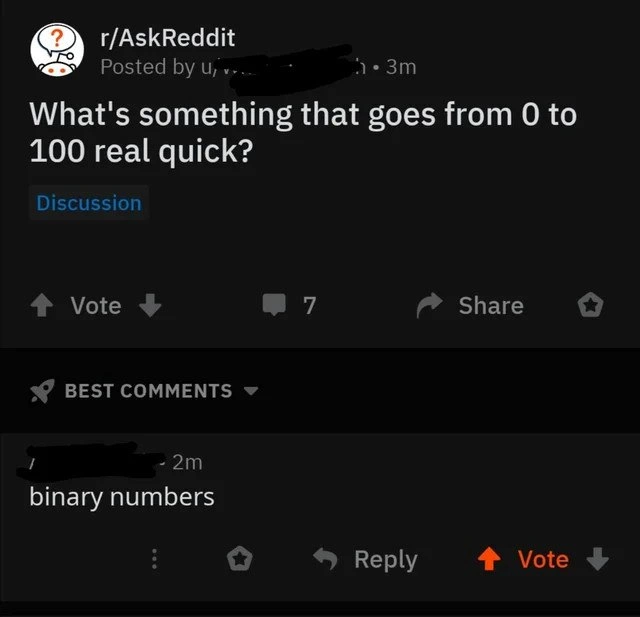
Now, the Reddit question asks: “What goes from 0 to 100 real quick?” The top answer says: “binary numbers.” Why would binary numbers go from 0 to 100 quickly? The trick is that “100” in binary doesn’t equal 100 in decimal. It actually equals 4 in decimal. Here’s a quick look at counting from 0 up in both systems:

Decimal (base-10) Binary (base-2)
0 0
1 1
2 10
3 11
4 100

In binary, after 11 (which is 3 in decimal), the next number is 100 (which represents 4 in decimal). So if you start at 0 and count up, you reach “100” by the time you get to four. That’s only four increments! In a sense, binary gets to a number that looks like “100” much faster than decimal does. In decimal, going from 0 to 100 means going through a hundred whole numbers (0, 1, 2, ... 100). In binary, “0” to “100” is just 0, 1, 10, 11, 100 – a very short trip. That’s the base_conversion joke: switching the base (the number system) changes what “100” means.

For context, this image is a screenshot of a Reddit thread (notice the reddit_screenshot style with the dark background and orange upvote arrow). The question comes from r/AskReddit, a general forum where people ask all sorts of questions to the community. A user with a programmer mindset gave the witty answer “binary numbers.” Other developers or tech-savvy folks saw that and upvoted it because they instantly understood the reference. It’s a form of DeveloperHumor where knowing a bit of computer science fundamentals makes the answer funny. The term “goes from 0 to 100 real quick” is a common phrase meaning “goes zero-to-sixty” or “starts from nothing and immediately hits high gear.” The responder took it literally about the notation of numbers. Essentially, they thought: “Hmm, in what scenario does the symbol ‘100’ appear almost immediately after starting from 0? Oh! In binary!”

If you’re new to this, don’t worry – the joke is simply about base conversion and context. It’s like a little puzzle: once you understand how binary counting works, you see that the answer is technically true (in binary, you reach the representation “100” very fast). This kind of inside joke is common in coding circles, where one word or number can have a double meaning (one for the general public and one for programmers). So “binary numbers” was a cheeky answer that turned a normal question into a math/CS pun. Now that you know how number systems work, you’re in on the joke! 🎉

Level 3: Binary Blitz

The meme showcases a classic nerdy twist on a common phrase by exploiting number_systems. In the screenshot, someone on Reddit asks, “What’s something that goes from 0 to 100 real quick?” – usually meaning accelerates extremely fast. The top reply: “binary numbers.” This answer is hilarious to developers because it interprets “0 to 100” in a literal binary_numbers sense rather than the idiomatic decimal sense. In binary (base-2), the sequence of counting goes 0, 1, 10, 11, 100. By the time you’ve incremented four times (from 0 up to decimal 4), the binary representation is already "100"₂. In other words, a binary counter reaches “100” after just four counts – so it truly goes from 0 to 100 very quickly!

This clever response is a prime example of ComputerScienceHumor and InsideJokes in developer communities. It riffs on a fundamental concept (how numbers are represented in different bases) that every programmer learns early on. The humor comes from flipping the context: the question expects answers like a fast car or a sudden mood swing, but a dev reads “100” and immediately thinks of binary base_conversion. It’s the same spirit as the classic joke, “There are 10 types of people in the world: those who understand binary and those who don’t.” Here “10” is binary for 2, and only those who know binary get the joke – creating that satisfying aha! moment of feeling in-the-know. In the Reddit thread, "binary numbers" as an answer turns the pop culture phrase into a geeky literal answer. It’s a bit of playful pedantry: the responder technically answered the question exactly, just not in the expected number system.

Seasoned devs find this funny because it signals “I speak geek fluently.” 😄 It’s a tiny DevCommunities bonding moment – seeing a fellow coder inject CodingHumor into a general forum like r/AskReddit. The screenshot’s dark-mode interface (white text on black) even feels on-brand, since many programmers prefer dark themes for their IDEs and apps. The upvotes on that “binary numbers” comment tell us that plenty of Redditors appreciated the gag. In essence, the meme captures how a simple base_conversion gag (treating “100” as base-2) can turn a normal question into a nerdy punchline. It’s a testament to how deeply ingrained binary thinking is for developers: we just can’t resist interpreting “100” in our own way and having a laugh about how quickly we got there.

Description

This image is a screenshot of a thread on the subreddit 'r/AskReddit'. The original post, flared as 'Discussion', asks the question: 'What's something that goes from 0 to 100 real quick?'. The screenshot then shows the top comment, a succinct and clever one-word answer: 'binary numbers'. The humor is a classic pun that plays on the double meaning of the phrase. While the question uses the idiom 'goes from 0 to 100' to mean something that escalates rapidly, the answer interprets it literally from a computer science perspective. In the binary number system, the sequence of numbers is 0 (0), 1 (1), 10 (2), 11 (3), and then 100 (4). Therefore, binary numbers literally go from 0 to the numeral '100' in just a few steps. It's a sharp, witty joke that resonates with anyone familiar with CS fundamentals

Comments

7
Anonymous ★ Top Pick It's true for binary, but in project management, going from 0 to 100 is just the time it takes for the client to say 'just one more small change'
  1. Anonymous ★ Top Pick

    It's true for binary, but in project management, going from 0 to 100 is just the time it takes for the client to say 'just one more small change'

  2. Anonymous

    In binary you hit 100 on the fourth increment - about the same point the codebase needs a full rewrite after “just one more boolean feature flag.”

  3. Anonymous

    The only place where reaching 100 requires just two bits of effort - though explaining the joke to non-engineers takes exponentially longer than the actual counting

  4. Anonymous

    A perfect example of why you should never ask open-ended questions in a room full of engineers - someone will always find the technically correct answer that completely subverts your intent. In this case, binary 100 is just decimal 4, making it the fastest 0-to-100 in computing history. It's the numerical equivalent of 'works on my machine' - technically accurate, contextually useless, and absolutely hilarious to anyone who's spent years thinking in multiple number bases

  5. Anonymous

    Numbers: hitting 100 in one tight loop, unlike Jira tickets chasing velocity

  6. Anonymous

    Only in base‑2 do metrics spike from 0 to 100 by the fourth request - and PMs still call it explosive growth

  7. Anonymous

    PM: “We need to go from 0 to 100 fast.” Me: “Binary or decimal?” Because in binary I can do it in three deploys and we’ll still only have four users

Use J and K for navigation