Skip to content
DevMeme
2542 of 7435
Cloudflare DNS privacy thread ends with a self-deprecating confession
Networking Post #2817, on Mar 3, 2021 in TG

Cloudflare DNS privacy thread ends with a self-deprecating confession

Why is this Networking meme funny?

Level 1: Teacher Asks Student

Think of DNS like a giant phonebook for the internet. Imagine you have a friend who knows everything about how this phonebook was made (maybe he even helped write it!). Now, a company (let’s call them “CloudPhone”) says, “Hey, use our special phonebook app so no one can spy on who you’re calling.” An older expert says, “We don’t need big companies’ phonebooks; I can keep my own list of numbers at home for secrecy.” Then another person asks, “Wait, if you keep your own list, how will you get new numbers when you need them? You’d still have to ask someone, right?”

Now, here’s the funny part: the expert who basically invented the phonebook system jokes, “Ha, I have no idea how phonebooks work. Why don’t you teach me?” 🤷‍♂️ Of course he knows! He’s just pretending not to know because the question he was asked is a bit obvious to him. It’s like in school if a teacher who wrote the textbook jokingly said to a student, “Gosh, I don’t understand this chapter at all, maybe you can explain it to me?” Everyone who realizes he’s the teacher would giggle, because clearly the teacher understands it better than anyone.

So, the meme is funny because the expert acts clueless on purpose. It’s a playful way of handling a situation where someone was kinda trying to “explain the obvious” to the expert. In simple terms: the person who helped create the system pretends to be a student, and that role-reversal makes us laugh. Plus, it teaches a tiny lesson: even if you try to keep all your phone numbers secret at home, you’ll still need to look up new ones somewhere eventually – meaning complete privacy is hard. But mostly, we laugh because the wise old tech guru is being cheeky and saying “please explain” when he’s the one who knows it inside and out. It’s a little joke that shows even super smart experts can have fun and not take things too seriously.

Level 2: The Internet’s Phonebook

Let’s break down the technical bits of this meme in simpler terms. DNS (Domain Name System) is often called “the internet’s phonebook.” Instead of storing phone numbers for people, DNS stores IP addresses for websites. For example, DNS knows that example.com might correspond to an address like 93.184.216.34. Every time you visit a website, send an email, or use any domain name, your computer quietly asks a DNS server to get the numeric address it needs. This is essential because computers locate each other by numbers (IP addresses), but we humans prefer memorable names (like www.google.com).

Now, what was Cloudflare advertising? Cloudflare is a company that, among many services, offers a DNS resolver service reachable at the IP address 1.1.1.1. A DNS resolver is a server that does the job of finding those IP addresses for any website you ask, and it caches (stores) the answers to respond faster the next time. Cloudflare released a mobile app named “1.1.1.1” to make it super easy for everyday users to use their DNS service on phones. They boasted that it’s the “world’s fastest and safest DNS resolver”. “Fastest” because Cloudflare has a huge global network, so their DNS often replies very quickly. “Safest” referring to privacy and security: they claim they won’t snoop on your lookups or sell your data, and they even support DNS over HTTPS (which means your phone’s DNS queries to Cloudflare are encrypted, like when you visit a website over HTTPS). The tweet’s message “No one should be able to snoop on what you do on the Internet” is highlighting that PrivacyConcern: normally, if you use your ISP’s DNS or some default, those entities could log what websites you’re looking up. Cloudflare wants to assure you that with their resolver, your DNS queries are private (at least from everyone except Cloudflare itself, whom you have to trust). They even use the peace sign ✌️ and a hashtag #1dot1dot1dot1 to make it catchy for social media.

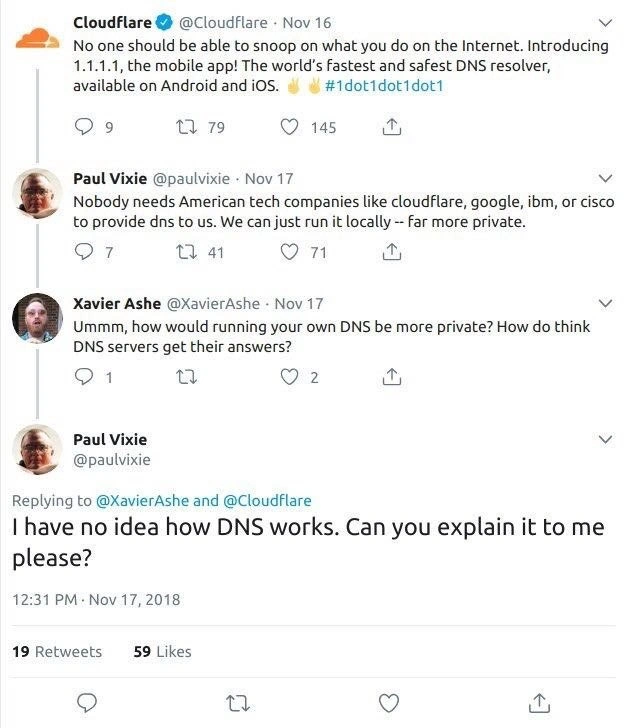
Next, Paul Vixie’s reply says: “Nobody needs American tech companies like Cloudflare, Google, IBM, or Cisco to provide DNS to us. We can just run it locally – far more private.” Let’s unpack that. Google’s DNS (you might know 8.8.8.8) and others like IBM’s 9.9.9.9 (Quad9) or Cisco’s OpenDNS are all public DNS services similar to Cloudflare’s 1.1.1.1. They’re run by big U.S. companies. Paul is suggesting that instead of sending all your DNS queries to these companies, you could run your own DNS server (or resolver) on your own machine or network. “Run it locally” means your computer itself figures out all the answers by directly asking the relevant servers on the internet (more on that in a moment). The idea is that if you do it yourself, it’s “far more private” because you’re not exposing your entire list of visited sites to a third-party company. It’s like saying, “Instead of asking Google every time where to go, just keep your own list of addresses.” This appeals to the DIY ethos in tech – many techies like the idea of running their own infrastructure for control and privacy.

Then Xavier Ashe asks, quite reasonably, how running your own DNS would actually be more private: “How would running your own DNS be more private? How do you think DNS servers get their answers?” This question points out something important: even if you have your own DNS server, that server still has to talk to other DNS servers to get the answer for, say, example.com (unless it already knows from a cache). If your local DNS doesn’t know the answer (and it won’t know it the first time you ask, unless you pre-loaded it with data), it will go out to the internet and query the root DNS servers, TLD servers, etc. as described above. So you’re still “asking around” – you’re just not asking one of the big public resolvers. Instead, you’re asking the distributed system of DNS directly.

From a privacy angle, what Xavier hints at is: queries don’t magically become private just because you run them from your own machine. Someone, somewhere will see the question. For example, if you want to know the IP for example.com, eventually the DNS server authoritative for example.com will see a query from your IP address (since your local resolver asks it directly). If you had used Cloudflare, example.com’s server would instead see Cloudflare’s IP asking (not yours), and Cloudflare would see your IP. Either way, the query exists on the network. In simple terms: DNS servers get their answers by asking other DNS servers. Xavier is basically reminding Paul (or challenging him) that you can’t escape relying on others entirely.

Now here’s the punchline of the meme: Paul Vixie replies with “I have no idea how DNS works. Can you explain it to me please?” If you didn’t know who Paul is, you might take this at face value and try to earnestly explain. But as we discussed, Paul is a DNS pioneer. This reply is self-deprecating and sarcastic. He’s not really asking for an explanation; he’s making a witty retort. Why? Because from his view, Xavier’s question, while valid, is sort of amusingly unnecessary – Paul obviously knows how DNS gets its answers (he helped build that system!). So he’s jokingly playing dumb to hint, “I see what you’re saying; of course I know that – no need to lecture me on my own turf.” It’s a polite way to diffuse the situation with humor, rather than getting into a serious debate or pulling rank. The fact Paul says this to both Xavier and Cloudflare in the reply is his way of bowing out of the argument while having the last laugh.

To understand the humor, imagine a similar scenario: A famous chef tweets a quick tip like “Don’t buy pre-made sauce, you can cook it yourself for better flavor,” and someone replies, “How is cooking it yourself better? Where do you think ingredients come from?” If the chef replies, “I have no idea how cooking works, please enlighten me,” it’s clearly tongue-in-cheek. Everyone who knows who the chef is would chuckle, because obviously that chef knows cooking inside-out. It’s the same here with a DNS expert being told how DNS works. Paul’s self-deprecating tweet highlights a common tech culture phenomenon: sometimes experts get schooled on basics by people who don’t realize they’re experts. Instead of getting offended, he jokes about it.

Summing up the key points and terms from this meme’s conversation:

  • DNS: The system that translates domain names to IP addresses (think of it as the internet’s address book or phonebook).
  • DNS resolver: A service or server that finds those translations for you. Cloudflare’s 1.1.1.1 is one such resolver, as are Google’s 8.8.8.8, etc. Your ISP usually provides a resolver too.
  • Running DNS locally: Using your own resolver on your machine (so you handle the lookups yourself rather than asking a third-party resolver). People do this with software like BIND, Unbound, or even simpler caching services on routers.
  • Privacy in DNS: Concern that whoever resolves your DNS queries can see what domains you’re looking up. Solutions include using resolvers that promise not to log data, or using encrypted DNS protocols (DoH/DoT) so outsiders can’t spy, or resolving queries yourself to avoid a single company seeing everything.
  • Misconception addressed: Running your own DNS can remove the third-party’s knowledge of your entire browsing list, but it doesn’t make the process invisible; queries still travel the internet. True complete privacy in DNS is hard – it requires both encryption and trust in either many parties or one party (and maybe future tech like Oblivious DNS tries to solve this by adding proxies).

This meme resonated in tech circles because it turned a dry topic (DNS privacy) into a memorable interaction. It educates (in its own way) that DNS isn’t magically private just by doing it yourself, and it also shows even experts use humor to handle debates. The twitter_thread_screenshot style makes it easy to read the exchange as it happened, avatars and all, almost like a tiny skit playing out on your screen. For someone newer to these concepts, it’s a lighthearted glimpse into how Networking geeks discuss and sometimes poke fun at each other about even the infrastructure that most people take for granted.

Level 3: The Localhost Illusion

At a high level, this meme captures a clash between bold internet claims and real-world tech nuance. It’s a scene every seasoned engineer recognizes: someone asserts a simple fix to a complex problem, and an expert responds with sarcasm because the issue isn’t as simple as portrayed. Here, Cloudflare proudly markets their new 1.1.1.1 DNS resolver app as a way to stop snooping on your internet habits (a clear nod to enhancing user privacy). They tweet something essentially saying, “No one should spy on you, use our DNS and be safe!” It’s classic CloudHumor marketing meets genuine tech feature — combining an anti-snooping DataPrivacy stance with the brag “world’s fastest” DNS. Engineers who’ve been around know that whenever a service claims to be “fastest and safest”, there’s a bit of hype in play.

Enter Paul Vixie with a counterpoint dripping in skepticism: why trust big companies like Cloudflare, Google, IBM, Cisco with your DNS? Just run your own and be ‘far more private.’ This is the dns_privacy_debate boiled down to a tweet. Paul’s initial reply reads as a manifesto for decentralization and self-reliance (and perhaps a subtle jab at corporate dominance in internet infrastructure). For context, Google runs 8.8.8.8 (a hugely popular public DNS), IBM supports Quad9 (9.9.9.9) which focuses on security filtering, and Cisco owns OpenDNS. Cloudflare’s 1.1.1.1 was the new kid in 2018, waving the privacy flag. Vixie basically says, “We don’t need any of them to resolve names for us.” It’s the networking equivalent of saying “host your own server instead of using the cloud” — a philosophy many veteran sysadmins have sympathies with.

Now, a less experienced engineer (or perhaps just a skeptic of Paul’s claim), Xavier Ashe, chimes in with a reality check question: “Ummm, how would running your own DNS be more private? How do you think DNS servers get their answers?” This is the moment many of us have seen on forums or Twitter threads: a newcomer challenges a statement by asking a basic “but isn’t that wrong because...?” question. Xavier is essentially pointing out the DNS protocol misunderstanding: even if you run your own resolver, you still have to query other DNS servers (the authoritative ones). The implication is “You can’t magically get answers out of thin air; you’ll still leave a trail.” In other words, Xavier suggests Paul’s claim of “far more private” with local DNS is at least debatable or needs justification. It’s as if someone declared “I don’t trust postal services, I’ll deliver all letters myself for privacy,” and another responds, “How will you find the addresses without using any public directory?” — there’s a gotcha there.

Here’s where the humor crescendos: Paul Vixie, of all people, replies with mock humility. “I have no idea how DNS works. Can you explain it to me please?” he asks, tagging both Xavier and Cloudflare. This is a hallmark of senior perspective humor: the expert isn’t angry; he’s performing a bit of self-deprecating theater to make a point. Paul knows exactly how DNS works (he’s helped build it!), but by pretending not to, he’s highlighting that Xavier’s question, while valid, is somewhat naïve given who he’s talking to. It’s a gentle takedown: instead of ranting “Do you even know who I am? I invented parts of DNS, and here’s why I said that,” he flips it and says “Gosh, you’re right, I must not know anything about DNS — please enlighten me.” This sarcasm is aimed at the peanut gallery of Twitter: it exposes how people often jump into tech debates with partial knowledge, boldly assuming the other person (even a renowned figure) might be clueless. It’s also Paul’s way of bowing out of a potential Twitter flame war with a laugh; he doesn’t want to engage in an endless thread explaining basics he’s explained a thousand times elsewhere.

For those in the know, this is hilarious because Paul Vixie’s name is practically synonymous with DNS. It’s like hearing Linus Torvalds say “I have no idea how operating systems work” or hearing the inventor of SQL say “What’s a database, again?” That contrast between the persona (expert) and the statement (feigned ignorance) is comedic gold in tech circles. It also points to a shared weariness: experienced engineers often see oversimplifications spread online (the localhost = privacy idea here) and it’s exhausting to correct every misconception. So sometimes the best response is a witty one-liner that signals, “This conversation is a bit absurd, let’s not take it too seriously.” Paul’s reply garnered modest engagement (19 Retweets, 59 Likes as shown) — it’s niche humor, appreciated by those who get the context. Among Networking and Security professionals, this exchange is a small social media legend: a cloudflare_dns thread that turned into a lesson (and a laugh) about how DNS really works and how even gurus handle debates.

In broader industry terms, the meme shines light on how we approach data privacy in infrastructure. There’s a real concern underlying Paul’s sarcasm: handing all our DNS queries to big companies creates centralized data honeypots. Yet, the alternative (everyone running a local resolver) is impractical for most and still not a privacy silver bullet due to how DNS inherently functions. It’s a catch-22 that senior devs know well: every “solution” in tech (centralize for convenience vs. distribute for control) comes with trade-offs. Networking veterans might recall similar debates from the past (like PGP for email privacy or self-hosting vs. cloud) — it’s a cycle of trust decisions. The meme captures this recurring theme perfectly in just a few tweets, and does so with humor.

Finally, the setting being a Twitter thread screenshot adds its own flavor: Twitter is notorious for hot takes and context collapse (where experts and novices collide in 280-character arguments). The tendency for bold claims on social media is exactly what Paul poked fun at. We’ve all seen cases of someone confidently wrong on the internet; here the twist is the person they’re indirectly lecturing is a founding father of the technology in question. That’s why those who catch the names and subtext find this meme so chuckle-worthy — it’s a snapshot of irony, tech misunderstanding, and a polite mic-drop by an expert who chose humor over lecture.

Level 4: The Resolver’s Dilemma

Deep in the networking stack, the Domain Name System (DNS) is a distributed hierarchy blending convenience and privacy trade-offs. At its core, DNS is a global decentralized database that translates human-friendly names into IP addresses. When you type example.com in a browser, something remarkable happens: your computer’s DNS resolver either returns a cached result or performs an iterative query up the hierarchy:

  1. Root nameservers: the 13 logical root servers (with dozens of actual instances worldwide) know where to find top-level domains. Your resolver asks a root, “where is .com?”
  2. TLD servers: the root replies with the address of the .com TLD servers. Next your resolver asks a TLD server, “where is example.com?”
  3. Authoritative nameserver: the TLD server responds with the nameserver for example.com (perhaps at the site’s hosting provider). Finally, your resolver queries that authoritative server for the specific record (like an A record for the website’s IP).

Each step involves contacting a different organization’s server: the root (managed by non-profits and consortia), the TLD (maybe Verisign for .com), and the domain’s host. Classic DNS uses plaintext UDP packets, meaning queries can be observed or modified (DNS spoofing or cache poisoning are real security threats). This raises PrivacyConcerns: every DNS query is like a postcard—readable by any intermediary. Enter modern solutions like DNS over HTTPS (DoH) and DNS over TLS (DoT), which wrap queries in encryption so outsiders can’t snoop.

But encryption doesn’t eliminate the trust dilemma—it shifts it. If you use a single public DNS resolver (like 1.1.1.1), you funnel all queries through that provider over an encrypted channel. This prevents local eavesdropping (your ISP or a coffee-shop hacker can’t see your lookups) and thwarts many attacks. However, it concentrates a lot of power in the hands of that provider. Cloudflare’s promise with 1.1.1.1 was to be the “fastest and safest DNS resolver” with strong privacy commitments (like purging logs within 24 hours and not selling data), essentially saying: “trust us, we’ll keep your secrets safe.” In this meme’s thread, Cloudflare touts #1dot1dot1dot1 as a privacy panacea against snooping.

Now consider the alternative: running your own local resolver. This means your machine (or router) does all that iterative work itself. By “run it locally,” Paul Vixie is referring to operating your own full DNS server (like using BIND or Unbound on your computer) so you don’t rely on Google, Cloudflare, Cisco, etc., for recursion. In theory, this keeps American tech companies out of the loop of your DNS traffic. But here’s the rub: even a local resolver still has to ask those authoritative servers out on the internet. You remove the centralized intermediary but now many distributed entities (root operators, TLD operators, various authoritative servers) see your queries for their piece of the puzzle. And unless you use something like DNSSEC (which provides authenticity of records, though not privacy) or DoT/DoH to each authoritative server (not widely supported), those queries are still unencrypted beyond your machine. It’s a privacy paradox: do you trust one big DNSServer with everything (hoping they keep it private), or do you trust the entire internet infrastructure in pieces (hoping no single observer can compile your entire browsing history)? The meme humorously exposes this resolver’s dilemma—both choices have privacy trade-offs, and oversimplified claims of being “far more private” are suspect.

Notably, the thread’s sarcastic twist comes from Paul Vixie himself. Vixie is a legendary DNS expert—author of the widely used BIND DNS software and operator of F-root (one of the root DNS servers). He’s literally helped design how DNS works at scale. So when he asks “I have no idea how DNS works. Can you explain it to me please?” it’s self-deprecating humor at a very nerdy level. He’s feigning ignorance, but underlying that jest is deep technical truth: DNS is complicated. Even its creators acknowledge nuances in DNSProtocol behavior that many folks misunderstand. The dns_privacy_debate isn’t black and white; it involves protocol intricacies, global trust, and even political considerations (e.g., which country’s infrastructure handles your queries). Vixie’s tongue-in-cheek plea for explanation is both a witty facepalm at misinformation and an insider’s nod to DNS’s complexity. In a way, he’s highlighting that there’s no easy answer—no one-liner solution—so anyone claiming absolute privacy by a simple trick (“just run it locally!” or “just use 1.1.1.1!”) might need a deeper explanation themselves. The Networking underpinnings and the Security layers of DNS make it a classic case where a seemingly straightforward question (“Who can see my DNS queries?”) leads to a very non-trivial answer. The meme lives at this Level 4 depth: it’s funny because it hints that even the experts find this stuff richly complex and a bit absurd.

Description

Screenshot of a short Twitter exchange. 1) @Cloudflare (Nov 16) tweets: “No one should be able to snoop on what you do on the Internet. Introducing 1.1.1.1, the mobile app! The world’s fastest and safest DNS resolver, available on Android and iOS. ✌️ #1dot1dot1dot1”. 2) Reply from @paulvixie (Nov 17): “Nobody needs American tech companies like cloudflare, google, ibm, or cisco to provide dns to us. We can just run it locally -- far more private.” 3) @XavierAshe (Nov 17) responds: “Ummm, how would running your own DNS be more private? How do think DNS servers get their answers?” 4) @paulvixie answers to both: “I have no idea how DNS works. Can you explain it to me please?” (12:31 PM · Nov 17 2018, 19 Retweets, 59 Likes). The visual is standard Twitter UI on a white background with avatars down the left. Technically, the humor comes from a known DNS advocate sarcastically admitting ignorance, highlighting common misconceptions about running a local resolver versus using a privacy-focused public resolver like Cloudflare 1.1.1.1. The meme pokes fun at privacy debates, DNS protocol complexity, and the tendency for bold claims on social media
Comments

19
Anonymous ★ Top Pick That thread where someone proclaims “just run your own DNS, way more private” and then asks how DNS works - classic Dunning-Kruger TTL: the authority expires instantly, but the cache of confidence lives forever
  1. Anonymous ★ Top Pick

    That thread where someone proclaims “just run your own DNS, way more private” and then asks how DNS works - classic Dunning-Kruger TTL: the authority expires instantly, but the cache of confidence lives forever

  2. Anonymous

    Nothing quite like watching someone confidently explain why we don't need managed DNS services, only to reveal they've been cargo-culting 'run it locally' without understanding that your local resolver still needs to recursively query the same root servers - it's like insisting you don't need a grocery store because you have a refrigerator

  3. Anonymous

    When someone questions your DNS privacy stance and you're literally the architect of BIND who helped design the modern DNS infrastructure, sometimes the most devastating response is playing dumb. It's the technical equivalent of a chess grandmaster asking 'remind me, which way does the horsey move?' after you suggest an opening strategy. The beautiful irony here is that Vixie's 'I have no idea how DNS works' is perhaps the most expert-level response possible - because anyone who actually knows networking history understands he knows DNS better than almost anyone alive, having co-authored RFC 2136 and created critical DNS security mechanisms. It's the ultimate 'tell me you don't know who I am without telling me you don't know who I am' moment, wrapped in layers of technical credibility that only senior engineers would fully appreciate

  4. Anonymous

    Everyone says “run your own DNS for privacy” - sure, as long as your localhost is a full recursive with QNAME minimization and no ECS, speaks DoT upstream, and also operates the root zone; otherwise you’ve just changed whose logs you trust

  5. Anonymous

    Running “your own DNS” for privacy is a stub resolver cosplaying as a root server - unless you ship QNAME minimization and DoT/DoH and maintain the root zone, you’re still leaking upstream; otherwise, enjoy your TTLs

  6. Anonymous

    BIND's author begging for a DNS ELI5? That's how you know public resolvers just got authoritatively pwned on privacy

  7. @Four_Velocity 5y

    https://letmegooglethat.com/?q=how+dns+works

    1. @Four_Velocity 5y

      That was definetly overironic🤭

  8. @Rogeratwork 5y

    Лол

  9. @FLIPFL0P_T 5y

    Умные мысли преследуют его... Но он быстрее

  10. @anatoli26 5y

    Похоже никто не знает, кем является Paul Vixie 😱🤦‍♂️

    1. @iriskin0 5y

      Тоже подумал, что никто не понял, что здесь сарказм

  11. @anatoli26 5y

    На всякий случай: Paul Vixie is an American computer scientist whose technical contributions include Domain Name System protocol design and procedure, mechanisms to achieve operational robustness of DNS implementations, and significant contributions to open source software principles and methodology.

    1. Deleted Account 5y

      ого, тогда ещё смешнее

  12. @mvolfik 5y

    Now how many of you know how DNSSEC works

  13. @mvolfik 5y

    A lot of fun guaranteed, I recommend messing with that

  14. @NiKryukov 5y

    How

  15. @I_like_trains 5y

    Лол, никто шутку не выкупил

  16. @sunnydaily 5y

    ну а если поднять свой днс и просто регулярно там кешить

Use J and K for navigation