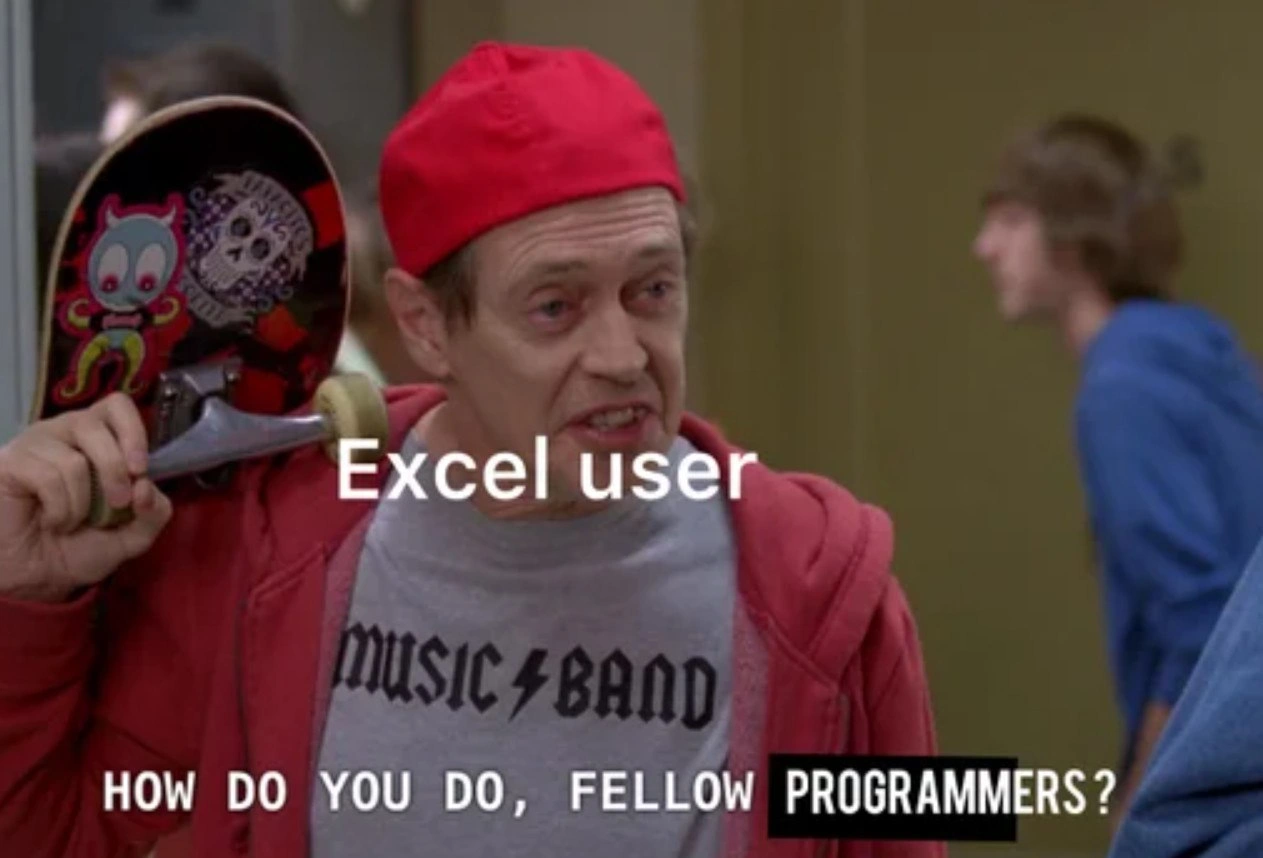
Non-technical executive awkwardly greets developers: “How do you do, programmers?”
Why is this CorporateCulture meme funny?
Level 1: Trying to Be Cool
Imagine your teacher wants to seem “cool” and starts using the latest slang with your class. She walks in wearing a backwards cap and says something like, “Yo, what’s up, my gamers?” Right away, you can tell she doesn’t normally talk like that. Everyone might start to giggle because it’s a little embarrassing and kind of funny — the teacher is trying too hard to fit in. It’s obvious she isn’t really part of the group in the way she’s acting. This meme is just like that, but in an office: someone who isn’t a programmer is awkwardly pretending to be one of the programmers. We laugh because we can see he’s trying to be friendly and fit in, but he doesn’t quite know how, and that awkwardness is exactly what makes it funny.
Level 2: Trying to Relate
Picture a workplace where the boss from the business side walks up to the software team and greets them by saying, “How do you do, fellow programmers?” in an overly eager way. In the meme, the person is labeled as an Executive – that means a high-level manager or leader at the company, likely with a background in business, not coding. He’s even wearing a casual red hoodie and carrying a skateboard, trying to dress and talk like the younger engineers. This is immediately awkward because real programmers don’t usually speak so formally to each other. The phrase “How do you do?” sounds like old-fashioned proper English, not something you’d hear in a casual team chat. And calling them “fellow programmers” makes it sound like he’s going out of his way to say, “Hey, I’m one of you!” – which ironically just highlights that he isn’t.
The core joke here is about a communication gap between management and developers. A non-technical executive often doesn’t know the everyday jargon that engineers use. For example, developers might talk about “pushing to Git,” “merging a pull request,” or “refactoring code.” To someone who’s never coded, those phrases can sound like a foreign language. Conversely, business people use terms like “ROI” (Return on Investment), “synergy,” or “quarterly roadmap” that might make a developer scratch their head. In this meme, the executive is attempting to use what he thinks is developer language to be friendly – but instead of saying something normal like “Hi team, what are you working on?”, he stiffly says “fellow programmers.” It’s kind of like a teacher trying to use teen slang but getting it slightly wrong. The intention is to connect, but it misses the mark and comes off as cringeworthy.
The “Excel user” label plastered on the executive is telling. Microsoft Excel is a spreadsheet program that people in finance or management use to organize data and create reports. Some non-technical folks who are very good with Excel feel like power users, and they might even joke, “I do a bit of programming – I made this complex Excel macro!” But in reality, writing formulas in Excel or using its menus isn’t the same as writing software from scratch. Real programming involves code (in languages like Python, Java, or C++), working with databases, debugging errors, and a lot of problem-solving. So when an Excel power user tries to equate their spreadsheet skills to what professional programmers do, it comes across as naive (and a bit amusing to the programmers). The meme hints that this executive’s tech knowledge might not go far beyond Excel, yet here he is, trying to chum around with software engineers as if they share the same expertise.
All of this points to misaligned expectations and a culture clash. That means each side (the management side and the developer side) has a different understanding of how things work or what’s realistic. For instance, a manager might expect a new feature to be built in a week because “it’s just adding a simple button,” not realizing that button might require a lot of behind-the-scenes coding, testing, and deployment steps. Meanwhile, developers expect that if they explain the technical challenges, the manager will understand why it takes longer – but that doesn’t always happen if the manager isn’t technical. When the executive in the meme uses such an odd greeting, it’s a funny example of how out of sync the two groups can be. The dev team probably appreciates that he’s making an effort to bond, but they also instantly think, “Our boss doesn’t really speak our language.”
For a junior developer or anyone new to the industry, this meme is a lighthearted caution. There will be times you interact with stakeholders (people like clients, project managers, or executives who have an interest in the project) who don’t have your technical background. They might use the wrong terms or oversimplify what you do – sometimes to a ridiculous extent, like calling any piece of code “an algorithm” or thinking that knowing a little Excel means they’re basically engineers too. It can be a bit frustrating, but it’s also a common part of corporate culture in tech. The key takeaway is the importance of clear communication: instead of just tossing around each other’s buzzwords, both sides do better when they ask questions and try to really understand each other. This meme resonates with developers because almost everyone in tech has experienced a well-intentioned but comically misguided “tech talk” from someone on the business side. It’s a funny reminder that good communication is about more than just using the right words — it’s about actually understanding what those words mean to the other person.
Level 3: Executive Cosplay
In this meme, an obviously non-technical executive is attempting to infiltrate developer culture by mimicking how programmers talk and dress. The image is a direct parody of the famous “How do you do, fellow kids?” meme (Steve Buscemi undercover as a teenager in a sitcom) – except now it’s an executive awkwardly saying “How do you do, fellow programmers?” to a room of actual devs. The humor springs from that mismatch: he’s trying to speak the programmer lingo and look casual in a hoodie, but it’s painfully clear he doesn’t belong. It’s like seeing your company’s CFO show up to a hackathon in a JavaScript T-shirt he bought yesterday, hoping it passes him off as part of the gang.
The overlay label “Excel user” is a tongue-in-cheek jab. In many enterprises, being an Excel power user (someone who lives in spreadsheets, formulas, and pivot tables) is considered being “techy” by business folks. But for actual software engineers, Excel usage is not what defines programming skill. An Excel macro or a fancy formula might impress accountants, but it won’t earn street cred with developers who are writing real code. The meme exaggerates this by having an Excel-savvy manager act like he’s one of the coders. It highlights a classic corporate disconnect: a person from the business side equates their basic technical know-how (often limited to Office tools or surface-level buzzwords) with the deep software expertise of the engineering team.
This scenario is a textbook case of the communication gap between management and engineering teams. Seasoned developers have countless stories of well-meaning MBAs and VPs trying to “speak tech” without really understanding it. The executive in the meme uses the term “fellow programmers” — something actual programmers almost never say to each other. It sounds formal and out-of-place, revealing that he’s not genuinely part of the tribe. It’s as unnatural as a VP randomly dropping “Hello, World!” in a product meeting thinking it will resonate. Everyone in the dev room can sense the misalignment immediately. The boss is trying to be relatable, but ends up confirming that he’s out of touch with the engineering culture.
This kind of disconnect can have real consequences. If a non-technical stakeholder doesn’t truly grasp what developers do, they might underestimate complexity or set unrealistic deadlines. For example, a CEO might cheerfully say, “I hear you guys just need to add some quick AI into the app — easy, right?”, not realizing they’ve just requested a month of research and coding. Developers often have to translate corporate-speak into reality, and humor like this meme is a cathartic way to deal with the frustration. It’s relatable pain: we laugh because we’ve all been in that meeting where the boss quotes some tech buzzword from a Forbes article, and the engineers exchange knowing glances.
Signs of an executive trying too hard to fit in with devs:
- Sporting a hoodie or T-shirt with a geeky slogan (over a pair of formal slacks) to appear “one of the bros.”
- Dropping terms like “Agile,” “DevOps,” or “microservice” in random conversation, hoping to sound knowledgeable.
- Making cringey references: “I did some coding back in the day – loved my Visual Basic!” (as if that earns instant respect).
- Referring to tech concepts in strange ways: “Don’t worry, I understand this GitHub thingy,” or “We need more cloud in our product.”
The humor here is good-natured but pointed. It’s poking fun at CorporateCulture attempts to appropriate developer style without doing the homework. The executive wants to engage with the engineering team (which is actually a positive intent), but he chooses the worst way – by faking an insider vibe. Experienced devs have seen this pattern repeat over the years. One week it’s a new CTO asking if everyone’s “rocking and rolling on the code,” next week it’s a project manager emailing a cat meme captioned “I can haz deployment?” to bond with the team. The tactics change, but the awkwardness remains the same. If you’ve been around long enough, you develop a radar for this kind of thing; you can practically tell when someone just learned a tech term that morning and is overly eager to drop it in conversation.
Ultimately, the meme exaggerates a truth: engineering and management operate in different subcultures. When a non-tech executive wades into the programmers’ world with only superficial knowledge, it’s a bit like a tourist using a phrasebook to sound like a local – endearing attempt, but way off the mark. The shared laughter this image provokes isn’t just making fun of one clueless boss; it’s a knowing laugh at a widespread office dynamic. We’ve all been there, and sometimes humor is the only safe way to say, “Yeah, our boss doesn’t really get what we do... and it shows.”
Description
Meme still from a sitcom: a middle-aged man wearing a backwards red baseball cap, red hoodie, and grey T-shirt reading “MUSIC BAND” holds a skateboard over his shoulder. Center-screen in bold white text is the overlaid label “Executive.” At the bottom, TV-style subtitles in all caps read, “HOW DO YOU DO, FELLOW PROGRAMMERS?” The visual joke is that an obviously older corporate leader is pretending to be part of a youthful developer crowd, echoing the common disconnect between management and engineering culture. Technically, the meme satirizes attempts by non-technical stakeholders to adopt programmer lingo or developer culture without understanding it, highlighting communication gaps and misaligned expectations inside large organizations
Comments
7Comment deleted
“Sup programmers, let’s low-code a blockchain microservice so our ROI stays eventually consistent” - distributed consensus is still easier than executive consensus
The same person who built a 50MB Excel file with 47 interdependent VLOOKUPs, circular references, and VBA macros that only work on their machine is now asking why your microservice architecture seems 'unnecessarily complex' compared to their pivot table solution
When the business analyst who automated their quarterly reports with VLOOKUP and pivot tables shows up to the architecture review meeting with strong opinions about microservices decomposition strategies. Sure, you've mastered circular reference errors and array formulas, but have you ever debugged a distributed transaction across six services at 3 AM while your on-call pager is melting? Excel might be Turing-complete in theory, but 'Ctrl+Z is my version control' doesn't quite cut it when you're managing a monorepo with 47 active feature branches
When leadership opens with “How do you do, fellow programmers?”, ask about hotfix branching - if the answer is “we use Jira,” the Agile transformation is just cosplay with budget authority
Excel users: 'My pivot table handles Big Data better than your Spark cluster - until it hits the 1M row limit.'
You know alignment’s off when the “Excel power user” proposes a quick macro as the integration layer - aka a VLOOKUP-based service mesh on a shared drive
-what do you believe in? -In excel supremacy. Comment deleted