Skip to content
DevMeme
7147 of 7435
DLSS 5 Street Scene: AI Frame Generation Melts the Traffic
AI ML Post #7835, on Mar 17, 2026 in TG

DLSS 5 Street Scene: AI Frame Generation Melts the Traffic

Why is this AI ML meme funny?

Level 1: The Dream That Almost Makes Sense

This picture works like a dream. While you're in a dream, the street looks normal, the cars look like cars, and everything feels fine. But if you stop and stare at one car, you notice its wheels don't match and its shape keeps changing, and the signs on the buildings are written in no language at all — just like dream-writing you can never quite read. The joke is that computer companies are so excited about machines that imagine pictures instead of carefully drawing them that we might end up watching dreams instead of real images — and laughing, because the dream-car in this one is having a very bad day.

Level 2: What's Actually Wrong With This Picture

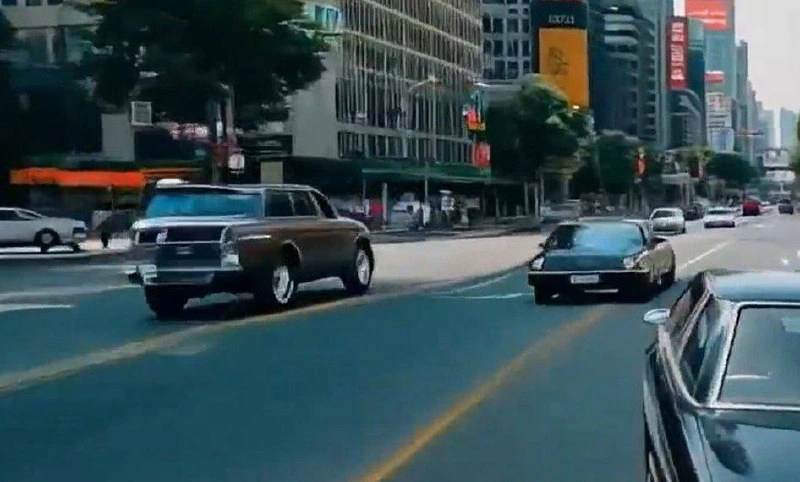
A few terms, decoded. DLSS (Deep Learning Super Sampling) is NVIDIA's neural rendering tech: the GPU renders fewer or smaller frames, and a trained model invents the missing pixels or whole intermediate frames. Frame generation means some of the frames you see were never computed by the game — they're predictions sandwiched between real ones. Generative video models (the Sora family and friends) go further: nothing is rendered at all; the entire scene is sampled from a model trained on real footage. Artifacts are where the prediction goes wrong — and this frame is a checklist of them:

  • The station wagon's wheels: different sizes, slightly different positions than physics would allow — the model has no concept of a car, only of car-shaped pixel patterns.
  • The dark sedan ahead: melted proportions, like wax left in the sun.
  • The billboards: shapes that look like Korean, English, and logos from three feet away, and like alphabet soup up close — models can't spell.
  • Lane markings that drift and pedestrians who half-merge with storefronts, because temporal coherence (objects staying the same object from frame to frame) is the hardest unsolved part.

If you've ever watched an AI video where someone's hand grows a sixth finger mid-gesture, this is the same failure class, applied to traffic.

Level 3: Temporal Coherence Sold Separately

What you're looking at is a single frame of AI-generated (or aggressively AI-reconstructed) video doing its best impression of a 1970s downtown street — and the joke, in the album this belongs to, is that this is "DLSS 5": the logical endpoint of GPU vendors replacing rendered pixels with hallucinated ones. The image is compositionally perfect and referentially broken. The brown station wagon dominating the left lane has the classic generative-video tells: front and rear wheels that don't match, a body that smears between sedan and wagon geometry, a grille that's a statistical average of every Detroit land yacht ever photographed. The billboard signage on the towers is the canonical artifact — letterforms that have the texture of text and the meaning of static, because diffusion models learn what writing looks like, not what it says.

The satire lands because of a real trajectory. DLSS started as supervised super-resolution (render at 1080p, infer 4K). Frame generation then began synthesizing entire frames between rendered ones, using motion vectors and optical flow; multi-frame generation pushed the ratio further, so marketing could claim multiples of "performance" where most displayed frames were never touched by the game engine. The community coined "fake frames" for exactly this, and benchmarks dissolved into philosophy seminars: if it's on screen, is it a frame? The meme extrapolates one more step — skip the game engine entirely, run a Sora-style video model, and ship whatever comes out. Frame rate: infinite. Ground truth: none.

The deeper industry pattern being mocked is the redefinition of quality metrics to fit what the silicon is now good at. When raster performance plateaued, "performance" became upscaled performance, then interpolated performance. Each step is defensible in isolation — neural reconstruction genuinely looks great in the median case — but the failure modes shift from predictable (lower resolution, visible aliasing) to uncanny (objects that morph between frames, text that lies to you, a car whose wheelbase is a probability distribution). For developers this rhymes with a familiar trauma: the demo that works beautifully right up until a user looks at any specific detail. Hallucinated plausibility is precisely the property you can't QA with a glance, and an entire pipeline built on it inherits that un-debuggability.

Description

A frame from AI-generated or AI-upscaled video footage of a sunlit downtown street, part of a meme album mocking 'DLSS 5' AI rendering. Retro 1970s-80s sedans drive between office towers covered in illegible billboard signage, but everything is subtly wrong: the brown station wagon in the left lane is warped with mismatched wheels and a smeared body, the dark sedan ahead has melted proportions, lane markings drift, and pedestrians blur into the storefronts. The image captures the uncanny artifacts of neural frame generation and generative video - plausible at a glance, hallucinated in every detail - satirizing GPU vendors' AI-rendered frames being passed off as native output

Comments

1
Anonymous ★ Top Pick 4x more frames, and in every single one that station wagon is a different make and model - temporal coherence is apparently a paid DLC
  1. Anonymous ★ Top Pick

    4x more frames, and in every single one that station wagon is a different make and model - temporal coherence is apparently a paid DLC

Use J and K for navigation