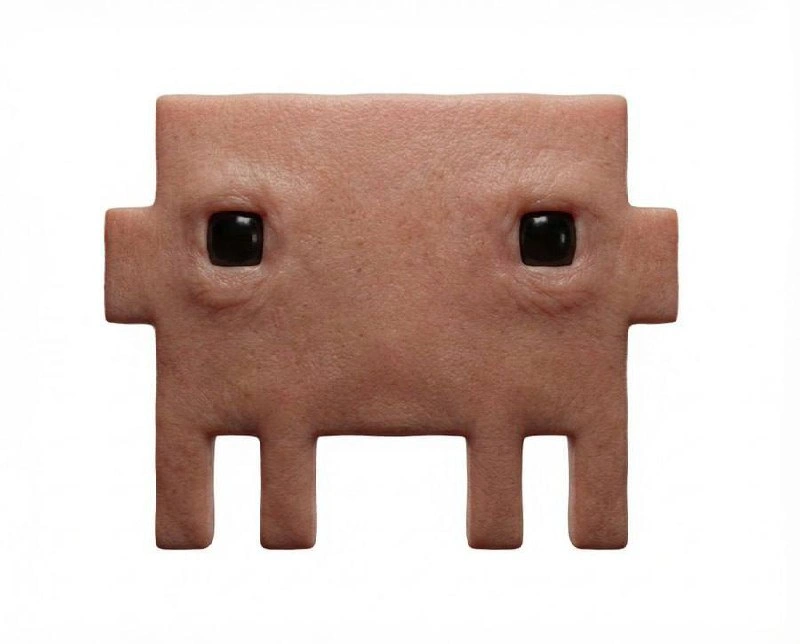
AI-Remastered Space Invader: 8-Bit Sprite, Now in Human Skin
Why is this Games meme funny?
Level 1: The Teddy Bear With Real Teeth
Imagine you have a cute drawing of a little blocky monster from an old game — just simple squares, like LEGO. Now imagine a machine that promises to make your drawing "better and more real," and it gives you back the same blocky monster... but made of actual skin, with real shiny wet eyes that follow you. Nobody asked for that. It's like asking someone to fix up your teddy bear and getting it back with human teeth. The joke is that "more realistic" isn't always "better" — sometimes the simple, blocky version was cute because it was simple, and making it real just makes everyone scream a little.
Level 2: Sprites, Texture Packs, and Why This Feels Wrong
Some vocabulary. A sprite is a small 2D bitmap — the original Space Invaders alien is just a grid of on/off pixels, designed when video game memory was measured in single kilobytes. Pixel art is deliberately blocky: artists choose each pixel, and your imagination supplies the rest. An HD texture pack or AI remaster runs old game art through software (often a neural network) that invents extra detail to make it look "modern." And the uncanny valley is the well-documented effect where something almost human-looking — realistic skin, realistic eyes, wrong everything else — feels creepier than something obviously fake.
This image is what happens when those pieces collide. The AI kept the shape (the easy, measurable part) and hallucinated the material (the part requiring judgment), choosing human skin because "make it realistic" plus "it's a creature" averages out to flesh. Junior-dev translation: this is the visual equivalent of running an auto-formatter or auto-fixer that technically satisfies the spec while destroying the intent. The checkbox says "realistic: yes." The reviewer says "please revert and never speak of this again."
Level 3: Abstraction Was Load-Bearing
This is the album's mic drop: the Space Invaders alien — Tomohiro Nishikado's 1978 sprite, one of the most recognizable bitmaps ever drawn — "remastered" into photorealistic human flesh. The silhouette is preserved with forensic fidelity: rectangular head, the side notches, stubby antenna bumps on top, four squared-off legs. But every flat pixel is now skin, with pores, faint wrinkles, soft subsurface scattering, and two wet, glossy black eyes seated in actual fleshy sockets exactly where the sprite's pixel-eyes go. It is rendered beautifully. It should not exist.
The deep joke is about what fidelity means. The original invader was abstract by necessity — Nishikado was squeezing animations into kilobytes on hardware so weak that the famous speed-up-as-you-kill-them mechanic was an accident of the CPU having fewer sprites to draw. That abstraction did enormous creative work: an 8x8 blob of pixels is a symbol, and your brain obligingly fills in "menacing alien" without ever asking what its skin feels like. Photorealistic up-rendering answers the question nobody asked. This is the core failure mode of the AI remaster and HD-texture-pack culture the meme targets: neural upscalers and "make it realistic" pipelines treat detail as a monotonic good, but realism applied to an icon doesn't restore information — there was never any to restore — it replaces a symbol with a corpse of one. The result lands squarely in the uncanny valley, the perceptual dead zone where almost-lifelike triggers revulsion instead of recognition.
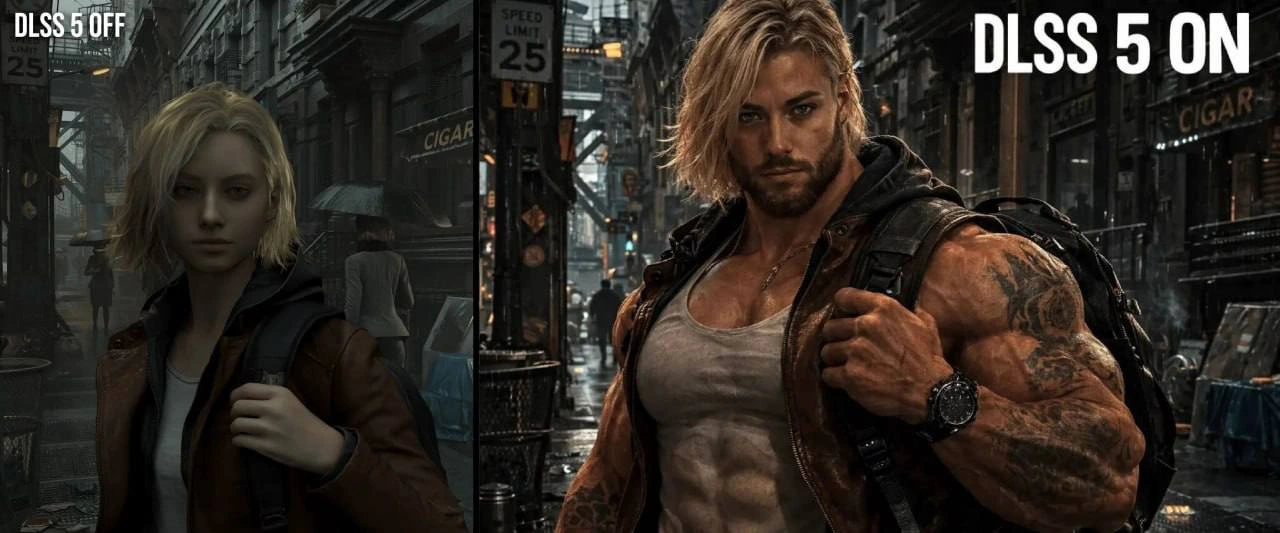
There's a sturdy industry pattern being satirized too. Every remaster cycle relearns the same lesson: art direction beats resolution. The fan community has receipts — AI-upscaled texture packs that turn painterly backgrounds into smeared plastic, remasters that redraw stylized faces into dead-eyed mannequins, "4K enhanced" classics that lose the exact crunchiness that made them legible on a CRT. The constraint was the aesthetic. Strip-mining a 1978 sprite for photorealism is the reductio ad absurdum of the whole pipeline: technically maximal fidelity, artistically maximal vandalism. As the capstone of a "DLSS 5" series about AI rendering hallucinating things no one wanted, it's the perfect terminal state — the model was asked for more detail and delivered more biology.
Description
A deeply cursed 'AI remaster' image, capping a DLSS 5 Off/On meme album: the iconic blocky Space Invaders alien sprite rendered photorealistically as living human flesh on a white background. The classic pixel silhouette - rectangular head with side notches, two stubby antennae bumps, and four squared-off legs - is recreated with pores, skin folds, subtle wrinkles, and two wet, glossy black eyes set in fleshy sockets where the sprite's pixel eyes belong. The joke targets AI upscaling and 'enhanced texture pack' culture: feed a 1978 8x8 sprite to a neural network asking for realism and it returns body-horror, because photorealistic detail hallucinated onto abstract pixel art lands straight in the uncanny valley
Comments
1Comment deleted
The 1978 original fit in 8 bytes; the remaster needs a 4090, a diffusion model, and a therapist - and the hitbox still doesn't match