Skip to content
DevMeme
7144 of 7435
DLSS 5 On: Your Protagonist Gains 80 Pounds of Hallucinated Muscle
Graphics Post #7836, on Mar 17, 2026 in TG

DLSS 5 On: Your Protagonist Gains 80 Pounds of Hallucinated Muscle

Why is this Graphics meme funny?

Level 1: The Overeager Photo Fixer

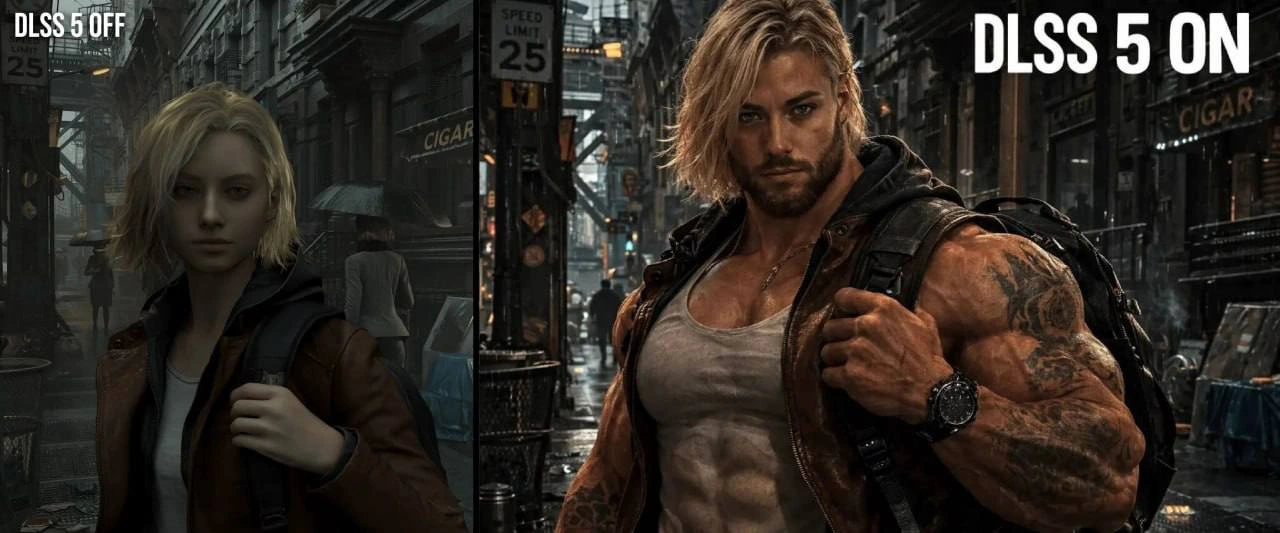
Imagine you give a blurry photo of your mom to a machine that promises to "make it sharper." The machine returns a stunningly crisp photo... of a bodybuilder with a beard. When you complain, it points out that the street behind her looks perfect — every sign is readable now! That's the joke: the machine didn't fix the picture, it replaced the person in it with whoever it likes drawing best, and it's so proud of the result it printed "ON" in giant letters. It's funny because the machine did an amazing job at everything except the one thing you asked for.

Level 2: Upscaling vs. Inventing

Quick glossary for the panels. DLSS (Deep Learning Super Sampling) is real NVIDIA technology: the game renders at lower resolution, and a neural network upscales it, guessing the missing pixels so the GPU does less work per frame. The "5" is the meme's extrapolation — each real generation (2, 3, 4) handed more of the final image to the AI, so version 5 logically generates the entire character from scratch. Hallucination is the ML term for when a model outputs plausible content that was never in the input — like the beard, tattoos, and roughly 80 pounds of muscle on the right, none of which exist on the left. A learned prior means the network fills unknowns with whatever it saw most during training.

The comparison-screenshot format itself is something you'll meet constantly in graphics work: identical scene, one variable toggled. The meme weaponizes the format's credibility — your eye verifies the matching CIGAR sign and speed-limit sign, concludes "same scene, fair test," and then hits the swapped human. That's also a practical lesson about evaluating any AI output: spot-checking the easy parts (backgrounds, formatting, boilerplate) tells you nothing about whether the important part (the actual content) survived.

Level 3: Reconstruction Without a Ground Truth

The format here is sacred internet liturgy: the side-by-side GPU comparison, "DLSS 5 OFF" stamped on the left, "DLSS 5 ON" on the right, mimicking a thousand legitimate marketing slides and tech-press screenshots. Left panel: a moody, plausibly in-engine render — slim blonde woman, leather jacket, white tank top, backpack, rain-slicked alley, SPEED LIMIT 25 sign, a CIGAR shop sign glowing in the murk. Right panel: the same alley, same sign, same scaffolding, same blue tarp in the corner — but the protagonist has been "reconstructed" into a tattooed, wristwatch-wearing, beard-equipped gigachad whose tank top is fighting for its structural life. The background fidelity is the punchline's load-bearing wall: the model nailed the street and completely invented a different human being.

This skewers a genuine epistemological problem with neural rendering. Classical upscaling (bilinear, Lanczos) is boring but honest — it cannot add information, only interpolate it. Neural super-resolution is a different beast: it's a learned prior over "what images like this usually contain," and it fills gaps with the statistical mode of its training data. When the gap is a brick texture, that's a feature. When the gap is who the character is, the prior takes over and you get whatever the dataset over-represents — which, given the internet's art corpus, is exactly this flowing-haired, hyper-muscled, generically handsome AI-art swagger archetype. The meme calls it style drift; ML people call it mode collapse toward the prior; everyone else calls it "why does my character look like a romance novel cover now."

There's also a sharper industry jab buried in the framing. Vendor comparison slides always cherry-pick: "ON" gets the crisp foliage close-up, "OFF" gets a smeary crop. The meme keeps the visual grammar but inverts the dishonesty — here "ON" is more detailed in every measurable way (sharper textures, more contrast, more incident light on more deltoids) while being wrong in the only way that matters. It's a perfect parody of optimizing the metric instead of the goal: PSNR up, identity destroyed. Anyone who has watched a team ship a "smart" feature that aces benchmarks while mangling real user data will feel this one in their sternum. The hallucination isn't a glitch in the corner; it's confident, high-resolution, beautifully lit wrongness — which is precisely what makes ML failures harder to catch than ordinary bugs.

Description

A side-by-side comparison meme labeled 'DLSS 5 OFF' (left) and 'DLSS 5 ON' (right). Left panel: a realistic game render of a slim blonde woman in a leather jacket, white tank top and backpack standing on a gritty rain-slicked city street with a '25' speed limit sign and a 'CIGAR' shop sign. Right panel: the same scene 'upscaled' - the character is now a hyper-muscular bearded blond man with flowing hair, arm tattoos, a wristwatch, and the same outfit straining over slabs of muscle, while the street background stays nearly identical (speed limit sign, CIGAR sign, scaffolding). The meme satirizes AI upscaling/frame-generation 'enhancing' images by hallucinating entirely new content - the neural network doesn't reconstruct detail, it invents a different character with maximum generic-AI-art swagger
Comments

1
Anonymous ★ Top Pick Technically still lossless - no information was preserved to lose
  1. Anonymous ★ Top Pick

    Technically still lossless - no information was preserved to lose

Use J and K for navigation