DLSS 5 Off/On: From Potato-Cam Blur to Studio Portrait
Why is this AI ML meme funny?
Level 1: The Helpful Liar
Imagine you drop your grandpa's photo in a puddle and the picture becomes a smudge. You hand it to a magic machine and ask, "Can you fix this?" The machine hums importantly and hands back a gorgeous, crystal-clear photo... of a completely different grandpa — one with nicer clothes, better lighting, and a fancy office. When you say "that's not him," the machine points proudly at how sharp the picture is. The joke is that the machine can't actually remember what was lost, so it just draws the most impressive grandpa it knows — and the green sticker on the bottom means someone is trying to sell you that machine.
Level 2: Why You Can't Unblur a Photo
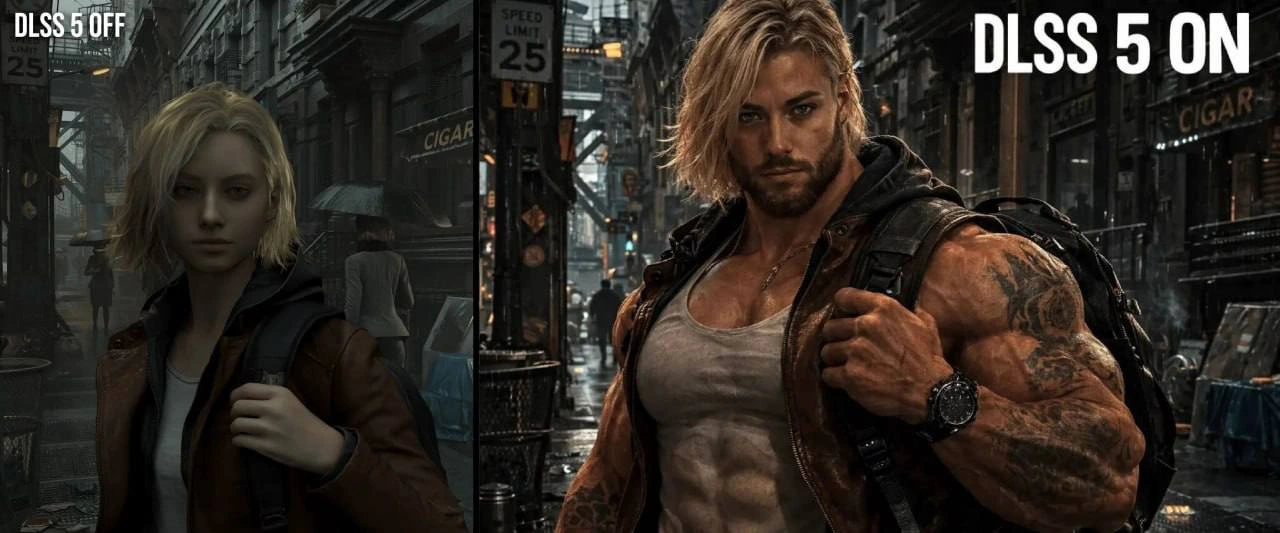
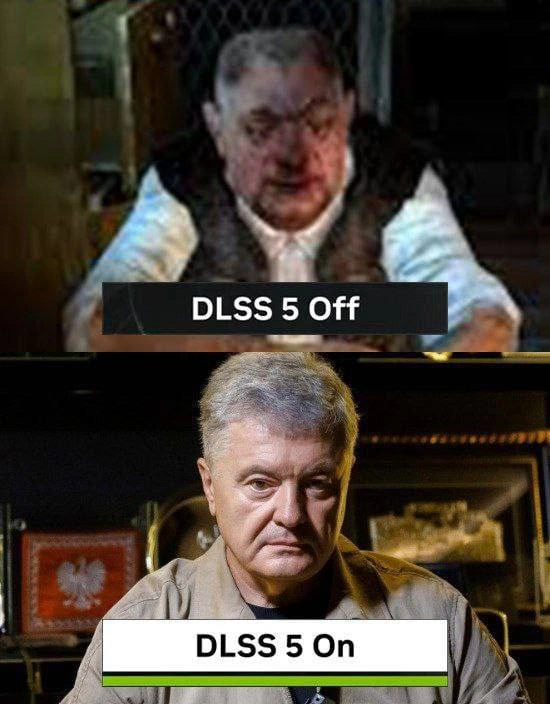
DLSS (Deep Learning Super Sampling) is NVIDIA's real technology for upscaling game frames with a neural network; "DLSS 5" is the meme's fictional next version, and the Off/On format copies the official comparison slides. Super-resolution is the general task of turning a low-res image into a high-res one. Here's the catch every junior eventually internalizes: a blurry image has lost information, permanently — the CSI "enhance!" button violates basic math. So neural upscalers cheat honestly: they're trained on millions of sharp photos, and when given mush, they output a sharp photo that could plausibly have become that mush. Hallucination means the added details come from the model's training data, not from your image — which is why the top man's actual face is unrecoverable and the bottom man is, effectively, a stock photo with a confident expression.
- Top panel = your input: real, low-quality, information already destroyed by compression artifacts.
- Bottom panel = the model's output: high "quality," zero fidelity — a different person.
It's the same lesson as trusting any AI autocomplete: fluent output is not the same as correct output, and the more polished it looks, the harder that is to remember.
Level 3: Maximum-Likelihood Identity Theft
Two panels, vertical stack, the canonical benchmark-slide costume. Top: a catastrophically compressed webcam frame — a heavyset man in a white shirt and dark vest, hunched behind what looks like a metal grille, his face reduced to maybe thirty meaningful pixels — badged "DLSS 5 Off" on a dark chip. Bottom: a studio-grade portrait of a stern gray-haired man in a beige jacket (bearing a strong resemblance to Petro Poroshenko), wood-paneled room, framed white-eagle emblem over his shoulder, badged "DLSS 5 On" with that unmistakable NVIDIA-green underline. The grammar of the GPU marketing slide is reproduced faithfully; the content is a hostage swap.
The technical joke is precise, and it's the same one researchers have been writing papers about since face super-resolution went deep-learning. Blind face restoration models (the GFPGAN/CodeFormer lineage) don't recover a face — recovery is information-theoretically off the table once compression has destroyed the data. They sample a plausible face consistent with the smear, guided by a prior trained on high-quality portraits. The result optimizes perceptual quality metrics beautifully while preserving identity not at all. The community's favorite demonstration was the 2020 "depixelated Obama" incident, where a face-upsampling model turned a pixelated Barack Obama into a white man — proving the output is the model's prior wearing your input as a loose costume. This meme is that incident retold as an NVIDIA slide: garbage in, senator out.
What elevates it beyond a tech gag is the upgrade vector. The "restored" man isn't just sharper — he's more dignified: better lit, better dressed, framed by official-looking heraldry, radiating eight-figure net worth. AI restoration priors are trained on professional photography, so they don't merely hallucinate detail, they hallucinate status. That has genuinely uncomfortable downstream implications the meme gestures at sideways: face "enhancement" is already marketed for surveillance footage and forensic work, where confidently inventing a respectable stranger from noise isn't a punchline, it's a wrongful arrest waiting on a docket. The gap between looks like evidence and is evidence is exactly the gap between these two panels, and vendors keep printing the green underline over it.
Description
A two-panel vertical meme in the 'DLSS 5 Off / DLSS 5 On' format. Top panel, labeled 'DLSS 5 Off' on a dark badge: an extremely low-resolution, blurry webcam-quality image of a heavyset older man in a white shirt and dark vest hunched at a table behind a metal grille, every feature smeared by compression. Bottom panel, labeled 'DLSS 5 On' with an Nvidia-green underline: a sharp, professionally lit portrait of a stern gray-haired man (resembling Ukrainian politician Petro Poroshenko) in a beige jacket, seated in a wood-paneled room with a framed white eagle emblem behind him. The joke: AI upscaling doesn't restore the original blurry subject - it confidently generates a completely different, far more dignified person, mocking neural super-resolution's habit of hallucinating identity-level detail from noise
Comments
1Comment deleted
Classic ML face restoration: PSNR through the roof, identity preservation at absolute zero - ship it, the benchmark only measures the first one