When your homemade encryption algorithm is all that protects user passwords
Why is this Security meme funny?
Level 1: Cardboard Safe
Imagine you have a very special toy or treasure that you want to keep safe from others. You have two choices:
Real safe: You could lock it in a big, strong metal safe with a proper lock – the kind of safe that banks use. This safe is heavy and tested to be secure, so you’re pretty confident no one can easily break into it.
Cardboard safe: Or, you could make your own “safe” out of cardboard boxes and tape. You draw a lock on it with a marker and close it up. It might look like a safe from far away (and you feel proud you made it yourself), but in reality, it’s just cardboard – anyone determined can just rip it open or cut through it, right?
Storing a password with a homemade encryption is like choosing the cardboard safe for your treasure. In the meme’s silly picture, the “cardboard safe” is shown as a wobbly wooden helicopter that a person is trusting to fly in. It’s funny because even a kid can tell that a helicopter made of scrap wood (or a safe made of cardboard) isn’t going to be very safe at all! You wouldn’t ride in that helicopter – it might fall apart – and you wouldn’t trust a cardboard box to guard something important – it can be torn open in seconds. In the same way, a password protected by a make-your-own secret code can be cracked easily by bad guys.
The reason we laugh at the picture is because the situation is so obviously silly: someone is putting something very important (a password, which is like a key to your private stuff) into something flimsy and weak (a home-built “encryption” contraption). It’s like putting your prize toy behind a paper door and hoping no one will peek. Of course that won’t work! The humor comes from how clearly mismatched the trust is – it’s clear to us that the poor fellow (the password) shouldn’t get into that sketchy helicopter. In real life, we’d use a real, strong lock (a trusted encryption method) to keep important things safe. The meme just shows this truth in a super exaggerated, goofy way so that everyone can nod and laugh, thinking, “Yeah, that’s obviously not safe at all!”
Level 2: Don’t Roll Your Own Crypto
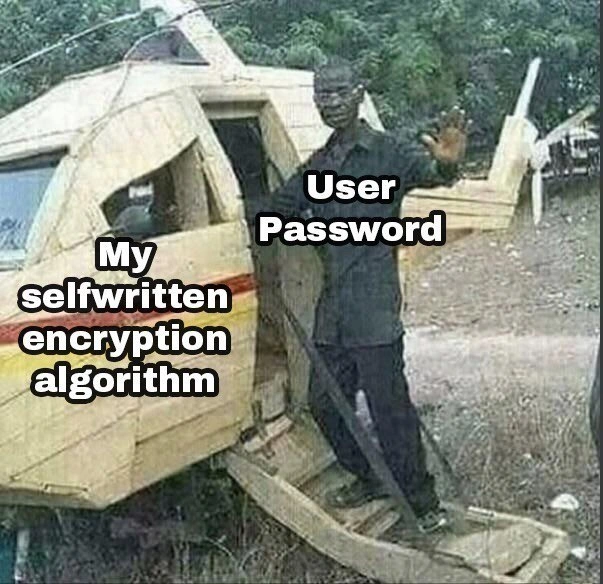
Let’s break down the meme in simpler terms and cover why every experienced developer chuckles (or winces) at it. We have two main parts in the image: the helicopter and the man. The helicopter is clearly handmade – its body is wooden, basically a DIY project that looks one step away from falling apart. In the meme, it’s labeled “My selfwritten encryption algorithm.” That phrase means the developer wrote their own method of encryption – essentially their own secret code system to protect data. The man standing in the helicopter’s doorway is labeled “User Password.” This signifies that a user’s password (something very important to keep safe) is about to rely on this homemade encryption contraption. Visually, it’s like the password is about to take a ride in this shabby helicopter. If you imagine your password as that person, you get a sinking feeling, right? The meme exaggerates to make a point: a user’s password is in danger if the only thing guarding it is some homemade_encryption scheme.
Now, what exactly is an “encryption algorithm,” and why shouldn’t you write your own? Encryption is a process used in security to scramble information so that only someone with a special key can unscramble it. Think of it like locking your data in a box: you scramble (lock) it with a key, and later you (or an authorized party) can unlock it with that key to get the data back out. Common cryptography algorithms for encryption include things like AES (Advanced Encryption Standard) for scrambling data, and for storing passwords specifically, we usually use one-way hash functions (which are like a special kind of lock that doesn’t really unlock – more on that in a second).
When a developer says “I have my own encryption algorithm,” it means they didn’t use these well-known methods; instead, they invented a custom way to scramble data. This is generally regarded as a huge mistake – so huge that there’s a famous mantra: “Don’t roll your own crypto.” Here, "roll your own" is a casual way of saying "do it yourself." And "crypto" stands for cryptography, the science of encryption and protecting information. So “don’t roll your own crypto” basically means “Don’t create your own encryption methods – use the established ones.” Why do experts say this? Because creating a truly secure encryption algorithm is incredibly hard. It’s not like baking a new cookie recipe where a bit too much sugar is still okay – it’s more like designing a new safe or lock. If there’s a tiny flaw, skilled thieves (hackers) will find it and break in. Unless you’re an expert cryptographer (and even if you are, you’d want peer review), writing a secure algorithm yourself is next to impossible. It’s reinventing the wheel, but worse – it’s like reinventing the lock and accidentally making a paper lock.
Let’s clarify some terms and best practices (the things experienced developers do as routine security best practices):
Password Storage: When we talk about protecting user passwords, the best practice is usually not to use reversible encryption at all, but rather hashing. Hashing transforms a password into a fixed string of characters in such a way that you can’t easily turn it back into the original password. It’s a one-way scramble. For example, if a user’s password is
"letmein123", a strong hash algorithm (like bcrypt or SHA-256 with salt) will output something like"5f4dcc3b5aa765d61d8327deb882cf99"(just an example of a hash output). You store that hashed result in the database, not the actual password. Next time the user logs in and types their password, you hash the input again and see if it matches the stored hash. This way, even if someone steals the database, they get only the hashes, which are extremely hard to reverse back into the actual passwords. Encryption (as opposed to hashing) would mean you could decrypt and get the original password back – which is typically unnecessary and risky. So most of the time, we don’t encrypt passwords at all, we hash them. But whether hashing or encrypting, the key is: use well-known, proven methods.Proven Algorithms vs Homemade: Established algorithms like AES, RSA, SHA-256, bcrypt, etc., have been created by experts and tested by the worldwide security community. They are like high-grade steel vaults or commercial airplanes that have passed safety tests. In contrast, a homemade encryption algorithm is like a lock or vehicle you cobbled together with basic tools. It might look like it secures things, but it probably has big holes. For instance, many amateur “encryption” methods turn out to be something like a Caesar cipher (shifting letters) or an XOR mask (toggling bits with a fixed pattern). These are not new – they’re old and considered security flaws if used today. Attackers know how to exploit these. ReinventingTheWheel here means the developer basically built a poor copy of what already exists, but with none of the strength. It’s as unnecessary as carving a new wheel from wood when rubber tires are freely available – and far more dangerous when that wheel is what’s keeping a plane (or password security) off the ground.
NotInventedHereSyndrome: This is a term for when individuals or companies avoid using external solutions just because they weren’t the ones to make them. It’s an attitude that “if we didn’t invent it, it’s not good enough.” In the context of our meme, the developer might have thought, “I won’t use AES or an existing library; I’ll create something myself for storing passwords.” That’s the Not Invented Here syndrome in action, and it often leads to duplicated effort and inferior results. In critical areas like security, NotInventedHere can be fatal (for the project’s safety), because no single developer can match the collective wisdom that’s baked into well-known security tools.
Now, consider the visual metaphor again with these ideas in mind. The wooden helicopter labeled "my selfwritten encryption algorithm" is an object that looks like it serves a purpose (it looks somewhat like a helicopter) but gives off an unsafe vibe. In real life, a helicopter must obey the laws of physics – you need the right design, materials, and testing, or it won’t fly. Similarly, an encryption algorithm must obey the “laws” of mathematics and cryptographic design, or it won’t actually protect anything. The meme’s helicopter has uneven construction and probably no real engine or aerodynamic stability. That’s analogous to an encryption method that’s poorly constructed – maybe it uses a predictable pattern or a single secret that, once discovered, exposes everything.
The man labeled "User Password" standing in the doorway is essentially saying, “Alright, I’m trusting this contraption to carry me”. This is exactly what happens when a user entrusts their password to a website or app: they assume the developers have built a secure system (a safe aircraft) to hold it. If the developer instead built a wobbly device (a weak encryption), the password is in danger. The meme is funny to developers because we instantly recognize the mismatch: a user password is precious cargo, but it’s being placed in a patently unsafe container. It’s as if someone said, “I’ll protect your crown jewels, just let me put them in this cardboard vault I made last night.” You’d laugh at the audacity and obvious folly of that statement.
For a junior developer or someone new to security, the takeaway lesson here is loud and clear: don’t build your own encryption. Use the libraries and algorithms provided by experts. If you need to secure passwords, learn about hashing functions like bcrypt or Argon2. If you need to encrypt data (something you intend to decrypt later), use established encryption like AES with a proper mode (e.g., AES-GCM) via a trusted library. These come with all the sharp edges filed off – they handle the random salt, the initialization vectors, the padding, the authentication tags – all the tricky stuff that is easy to get wrong. A homemade solution nearly always misses some of those critical elements.
It might be tempting as a programmer to solve every problem yourself (after all, we love to code and invent!), but security is one area where reinventing the wheel is more likely to give you a square wheel. The consequences of failure are also high: if your custom crypto fails, user data is compromised. That’s a catastrophic outcome professionally (nobody wants to explain to their boss or, worse, to thousands of users, that their data got stolen because you thought you could outsmart AES). It’s much safer and smarter to stand on the shoulders of giants – use the tried-and-true crypto that’s already available. There’s a reason we have it, and this meme drives that reason home with a bit of humor.
In summary, “Don’t roll your own crypto” means don’t write your own encryption algorithm because it’s almost certainly going to be weaker than you think. The meme with the wooden helicopter illustrates this in a comical way: your homemade algorithm (the wonky helicopter) isn’t something you should trust to carry valuable cargo (user passwords). Stick to the sturdy, certified helicopters – in other words, established cryptographic libraries and methods – and you’ll keep your users safe and avoid an embarrassing, and possibly career-ending, crash.
Level 3: Reinventing the Wheel
In this meme’s scenario, we see a man cheerfully posing with a rickety homemade helicopter. The labels tell the story: the helicopter is tagged “My selfwritten encryption algorithm,” and the man standing next to it with a hand up (as if saying “all good here!”) is labeled “User Password.” The humor hits home for seasoned developers and security folks immediately. It’s a vivid metaphor: a user’s password – the keys to their digital kingdom – is being entrusted to a contraption of an encryption scheme that’s held together with proverbial duct tape and bubble gum. We’re essentially looking at a password_storage_fail in progress. The poor “User Password” is about to take a ride in that sketchy helicopter, and every experienced engineer in the room is cringing and thinking, “This will not end well.”
Why is this so funny (and terrifying)? Because it’s Reinventing the Wheel in the worst possible way. Any senior developer can tell you that rolling out your own crypto is almost always a disastrous idea. We have a bit of dark humor in the industry: “Anyone can invent an encryption scheme that they themselves can’t break.” In other words, just because the developer who made it doesn’t see an immediate way to break their cipher, they assume it’s secure. It’s the same overconfidence as an amateur saying, “This wooden helicopter I cobbled together will definitely fly, I don’t see any loose parts!” Meanwhile, everyone with experience – be it in aerodynamics or infosec – is exchanging knowing glances and preparing for the crash.
This meme encapsulates the folly of Not Invented Here Syndrome as applied to security. That syndrome is when developers shun existing solutions simply because they weren’t built in-house. Here, instead of using a time-tested encryption library or established security best practices, the developer thought, “I’ll just do it myself.” Maybe they believed they could come up with something faster or more clever, or maybe they didn’t trust open-source libraries (perhaps thinking “I don’t want to pull in heavy dependencies just to hash a password”). It could even be simple ignorance – they might not have realized how dangerous that path is. But we in the field have seen this story enough times to groan preemptively. The wheel has not only been reinvented; it’s been made square and brittle, and now it’s what the entire security of the application rides on.
Let’s talk real-world patterns: There have been cringe-worthy cases where developers attempted “custom encryption” for storing passwords or sensitive data. For example, a dev might think they’ve come up with a clever scheme like “I’ll just add 1 to every character’s Unicode value” or “I’ll XOR the password with a fixed number/key – no one will guess that!” In fact, let’s look at a tiny pseudo-code snippet of the kind of encryption an overconfident developer might write:
# Naive custom "encryption" example (Caesar cipher - shifts letters by 1)
def encrypt_password(password):
encrypted = ""
for ch in password:
encrypted += chr(ord(ch) + 1) # shift character by 1 in the Unicode table
return encrypted
# Example: "password" -> "qbttxpse"
print(encrypt_password("password"))
In this contrived function, if the user’s password is "password", the output becomes "qbttxpse" – it looks “jumbled”, so the author might feel smug that they’ve built a secret cipher. But any attacker with a brain (or frankly, just the ability to Google) will recognize this as a simple Caesar shift. They’d shift the letters back by 1 and instantly retrieve the original password. It’s about as secure as hiding a key under the welcome mat. Unfortunately, variations of this happen in real projects: we’ve seen homegrown schemes where people literally use Base64 encoding and call it “encrypted” (yes, some developers equate encoding with encryption 😬). Or they XOR with a single-character key, which is basically the same weakness shown above. These approaches are child’s play for hackers to reverse. A determined attacker who obtains the encrypted data (say, via a database breach) can crack such schemes in seconds to minutes, whereas properly hashed or encrypted passwords might remain safe for billions of years (or until quantum computers take over the world). The meme is poking fun at this very gap in understanding – that false sense of security from a DIY algorithm.
From a seasoned security engineer’s perspective, this image triggers a mix of laughter and PTSD. We laugh because we’ve seen bright-eyed developers proudly present a protection mechanism that is comically inadequate – akin to showing off a helicopter made of plywood. And we have slight PTSD because we also remember the clean-up: “Oh no, we actually deployed that... and now we’re storing thousands of user passwords with basically reversible, weak ‘encryption’… and someone’s going to figure it out.” It’s the stuff of on-call nightmares. Imagine being the poor engineer on duty who discovers that the user table in production was compromised and all those “encrypted” passwords were basically one chr() shift away from plain text. It’s a career’s worth of facepalm moments.
The User Password in the meme standing there with a hand raised, looking confident, that’s like our users trusting us with their secrets. Users assume we’re doing the right thing to protect their credentials – they wave happily, boarding the “helicopter” of whatever security we built. They have no idea if it’s a solid steel machine or a clunker made in a backyard. This trust is sacred in security best practices: if we betray it by using shoddy methods, when (not if) it breaks, users are the ones who get hurt. A compromised password doesn’t just mean “oh, they can log into this one site”; many users reuse passwords across multiple services. So one breach caused by a weak homebrew cipher can spiral into multiple account compromises elsewhere. Now the user’s email, social media, maybe even banking, could be at risk because our janky helicopter of an algorithm crashed. This is why seasoned devs get a cold sweat when hearing about custom encryption protecting passwords – it’s not just one system that might go down, it’s an entire chain of dominos affecting real people.
There’s also an element of ego and humility in this humor. Cryptography is an area that demands respect. As the saying goes, "Do not meddle in the affairs of wizards, for they are subtle and quick to anger." In tech terms, cryptographers are the wizards, and their realm is full of subtle pitfalls. A developer waltzing in thinking they can whip up a secure algorithm from scratch is like a newbie climber thinking they can free-solo Everest. It’s hubris. The meme’s absurdity underlines that hubris by analogy: “Sure, you built your own helicopter… you really think it’s airworthy? Good luck, pal.” The dark chuckle from experienced folks comes from knowing how this story ends. We’ve seen instances where even widely used algorithms or implementations had fatal flaws (remember the fiasco when WEP encryption for Wi-Fi was broken due to weaknesses in RC4? Or when SSL had vulnerabilities due to implementation bugs like Heartbleed?). Those were designed and reviewed by experts, yet cracks were found. So what chance does a lone wolf algorithm have? Essentially none. There’s a near certainty that something is wrong with it – maybe the entropy source is poor, maybe the encryption key is effectively shorter than the developer thinks, maybe the algorithm is even deterministic enough to allow straightforward decoding. The whole situation screams: unstable.
This brings us back to the central comedic image: a homemade_encryption algorithm is like a wooden helicopter. It’s the perfect metaphor. Building a reliable helicopter requires mastery of physics, engineering, rigorous testing… skip those, and you get a wooden prop that might spin its rotors on the ground but is likely to disintegrate if it actually lifts off. Likewise, designing a secure encryption algorithm requires deep knowledge of mathematics, decades of peer review, and exhaustive testing against every known attack. Skip all that, and you get an algorithm that might scramble text on the surface, but won’t hold up under real-world conditions (i.e., when attackers try to break it). The humor lands (pun intended) because we immediately foresee the crash that the guy in the meme seems blissfully unaware of.
In practice, the correct approach to protect user passwords isn’t even to encrypt them (encryption is reversible, implying you could decrypt later – which you almost never need to do with passwords). Instead, the industry standard is to hash passwords with a strong, one-way hashing algorithm combined with salt. Functions like bcrypt, Argon2, or PBKDF2 are specifically designed for password storage: even if an attacker gets the hashed passwords, they can’t easily reverse them into the original passwords. And because they use salt (random data added), two identical passwords won’t hash to the same value – foiling the kind of pattern-based guessing that a naive scheme would allow. These algorithms have been extensively vetted by the security community. In other words, we already have hardened steel locks and vaults readily available – there’s no excuse to be tinkering with a personal makeshift lock when protecting valuable secrets. When a developer ignores this and does their own thing, every senior engineer who hears about it will likely respond with a mix of horror and grim humor, perhaps saying something like, “Well, that’s one way to get on the front page of /r/netsec for a breach.”
To sum up the senior perspective: the meme’s joke is a nod to a well-known rule in security circles – “Don’t roll your own crypto.” It’s practically doctrine. The helicopter and the password personify what happens when someone ignores that rule. It might be comical in a meme, but in real life it leads to breached databases, emergency security patches, forced password resets, and very expensive lessons. We laugh at the meme because the alternative is crying at the breach. This dark humor carries an underlying message: please, for the love of all that is holy (and for the sanity of your on-call security team), don’t be the person that protects user passwords with a home-cooked encryption recipe. Reinventing the wheel here doesn’t just give a bumpy ride – it can derail the whole train.
Level 4: Insecure by Design
At the cryptography theory level, creating your own cipher is a textbook example of security through obscurity – an approach long proven fragile. In formal terms, a secure encryption algorithm should withstand attackers even when the algorithm’s design is public knowledge, relying solely on a secret key (this is Kerckhoffs’s principle). A homemade encryption that only “works” because attackers don’t know how it functions is inherently insecure by design. It’s like building an aircraft that only stays aloft if no one notices its flaws – the moment a skilled adversary (or a stiff breeze of scrutiny) comes along, it nosedives. In established cryptography, algorithms are designed with mathematically proven hardness or years of expert analysis. For instance, AES-256 (Advanced Encryption Standard) is grounded in complex algebraic structures and has survived intense public cryptanalysis. A self-invented cipher, on the other hand, hasn’t undergone any of that gauntlet. One developer’s brainchild stands little chance against the collective knowledge of decades of cryptanalysis techniques.
To appreciate how shaky a DIY cipher can be, consider the properties it likely lacks. Modern encryption relies on strong confusion and diffusion – concepts from Claude Shannon meaning that the relationship between the plaintext, ciphertext, and key is thoroughly mixed and chaotic. A robust algorithm ensures that a tiny change in the input or key produces a huge, unpredictable change in output (the avalanche effect). A flimsy homemade scheme often fails here: patterns in the input (say, common letters or repeats in a password) might still be visible in the output. This makes it a sitting duck for analysis. For example, if the algorithm just shifts letters or does a predictable byte substitution, an attacker can spot the pattern and reverse it. Even if the scheme is slightly more numeric (like XOR-ing bytes with a constant mask), it’s vulnerable to frequency analysis and known-plaintext attacks. Classic ciphers like the Caesar cipher or simple XOR-based schemes were broken centuries ago or by the first semester of Crypto 101, yet a DIY encryption often unknowingly rehashes these cryptography algorithms in spirit, introducing subtle (or not-so-subtle) security flaws.
Furthermore, homemade algorithms rarely account for the myriad of attack vectors out there. Is it resistant to differential cryptanalysis or linear cryptanalysis? Probably not – these advanced methods find weaknesses by analyzing patterns in how differences in input affect output. Without rigorous design, a custom cipher can be unravelled by such techniques, exposing the user passwords it was meant to protect. Real encryption algorithms are also designed to avoid common pitfalls like short cycles, backdoors, or trivial algebraic structure that could make solving the cipher as easy as solving a simple equation. Inventors of DIY ciphers often unknowingly introduce these weaknesses. They might base their method on some pattern they think is clever, but if that pattern yields a system of equations or a predictable output structure, a cryptanalyst will crack it open like a nut. And unlike well-vetted systems, a self-made algorithm probably doesn’t handle things like key management, initialization vectors, or salt properly (or at all). For instance, if every password is “encrypted” with the same fixed secret key and no random salt or IV, identical passwords will encrypt to identical outputs – a devastating weakness. An attacker who sees the same ciphertext repeated can immediately guess those users had the same password, and by cracking one instance (or just knowing common passwords), they compromise all of them. Standard encryption and hashing schemes explicitly guard against this by design (e.g., by using random salt so that even identical inputs produce different outputs).
The security community’s consensus is that designing a secure cipher is remarkably hard – even experts get it wrong sometimes. Cryptographic algorithms are often published and left open to attack by academia and industry experts for years before we trust them. By contrast, a lone developer’s weekend encryption project has had zero peer review. It’s as if someone tried to invent a new form of aircraft in their backyard with no wind-tunnel testing or safety analyses – a metaphor that the wooden helicopter meme captures literally. The wooden chopper might look vaguely like a helicopter, but we all know it can’t achieve stable flight. Similarly, a rookie cipher might produce output that looks scrambled, but offers no real resistance to an adversary determined to break it. In both cases, complex physics or mathematics are at play, and ignoring those fundamentals results in a contraption that’s one gust (or hacker) away from collapse. The bottom line: a homemade encryption algorithm protecting user credentials is a towering risk. It defies the proven principles of cryptography, and practically invites attackers to do their worst. In theoretical terms, it’s not anchored in known hard problems or sound design, so an attacker doesn’t face the astronomically large search space or computational infeasibility that they would with properly designed encryption. Instead, they likely find a shortcut – a flaw that lets them unravel the cipher with far less effort than brute force. And once that happens, every protected password spills out, as doomed as a passenger in a plywood helicopter once gravity takes notice.
Description
Meme photo of a crudely built wooden helicopter sitting on uneven ground; its panels are rough plywood with a slap-dash paint stripe. A man dressed in dark clothing stands in the doorway, one hand raised in a reassuring gesture. Bold white-on-black caption over the helicopter reads "My selfwritten encryption algorithm" while an equally bold caption over the man reads "User Password." The visual joke equates a rickety, questionably airworthy craft with rolling your own crypto to safeguard credentials, highlighting the security risk of ignoring established cryptographic standards
Comments
15Comment deleted
We could’ve just used bcrypt, but management loved my ROT13-then-base64-then-pray() cipher - nothing like boarding a plywood helicopter to prove you’re innovating
The same developer who rolled their own crypto is now explaining to the security audit team why XOR with the company founding date counts as "military-grade encryption."
This perfectly encapsulates the cardinal sin of security engineering: spending months implementing AES-512-GCM with custom key derivation and perfect forward secrecy, only to watch it all crumble because users authenticate with 'Password123'. It's the cryptographic equivalent of installing a bank vault door on a cardboard box - technically impressive, fundamentally pointless. As Bruce Schneier would say, 'Security is a chain; it's only as strong as the weakest link.' And that link is almost always the human choosing 'admin' as their password, not your beautifully crafted - but ultimately unnecessary - custom encryption scheme that probably has timing attacks you haven't discovered yet
Rolling your own crypto: because libsodium couldn't handle your bespoke side-channel leaks
Homegrown encryption for passwords is the plywood helicopter of security - looks airborne until the first pen test adds wind
Roll-your-own crypto: your user’s password boarding a plywood helicopter - no proofs, no constant-time, no FIPS - one headwind from incident response
I have no algorithm. I always lead my users to the edge of the abyss and then push them right into it Comment deleted
plaintext rox Comment deleted
it's better not to store password at all Comment deleted
passwords are not encrypted, they are hashed Comment deleted
They are being encrypted while they are sent from client to server Comment deleted
one could argue that hashing with cryptographic algorithms counts as encryption Comment deleted
however, if we define encryption purely as a method of bidirectional data locking (i.e. you can get the original data back from the encrypted data with a key), then yeah, passwords are not encrypted. Or at least they shouldn't be, I know some companies still do it anyway because stupidity. Comment deleted
Or coz "DB leak will never happen to us" Or coz "Would be cool to have an access to user passwords, so let's also store encryption private keys IN THE SAME FUCKING TABLE" Comment deleted
That's a part of the joke, mate Comment deleted