When “hard worker” means making every single task unnecessarily difficult
Why is this Interviews meme funny?
Level 1: Doing It the Hard Way
Imagine your teacher or parent asks you if you are good at working hard. They expect you to say “Yes, I always try my best!” But instead you reply, “Absolutely. I make every chore harder than it needs to be!” 😄
Think of it like this: suppose you have to clean your room. The easy way is to put your toys in the toy box, put dirty clothes in the laundry, and you’re done. But you decide to do it the hard way: first, you sort all your toys by color and size, then you build a complicated machine with ropes and pulleys to pick each toy up and put it in the box, and then you label every shelf in your room. It takes you all day to finish a 10-minute job. You did work hard — in fact, you worked extra hard — but only because you made the job super complicated!
That’s exactly what this joke is about. In the meme, the person says they are a “hard worker” because they turn simple jobs into difficult ones. It’s funny because usually being a hard worker is a good thing, but here the person is teasing themselves for making life difficult. We laugh because it’s a silly, unexpected answer. It’s as if someone asked, “Are you helpful?” and they answered, “Yes, I always find a way to help things become more complicated!” It’s a goofy way of saying, “I sometimes mess up or overthink things, and I know it.”
So the heart of the joke is honesty with a twist: the person admits they often do things the hard way. It’s a bit like a cartoon where a character builds an enormous contraption to do a simple task — it’s playful and relatable. Even if you’re not a programmer, you probably know the feeling of accidentally making a task harder for yourself. This meme makes us smile about that very human oopsies feeling. It takes a serious question (“Are you a hard worker?”) and gives a hilarious answer that means something completely different than what the interviewer expected. That surprise and truth combined is what makes it so amusing and likeable.
Level 2: Keep It Complicated
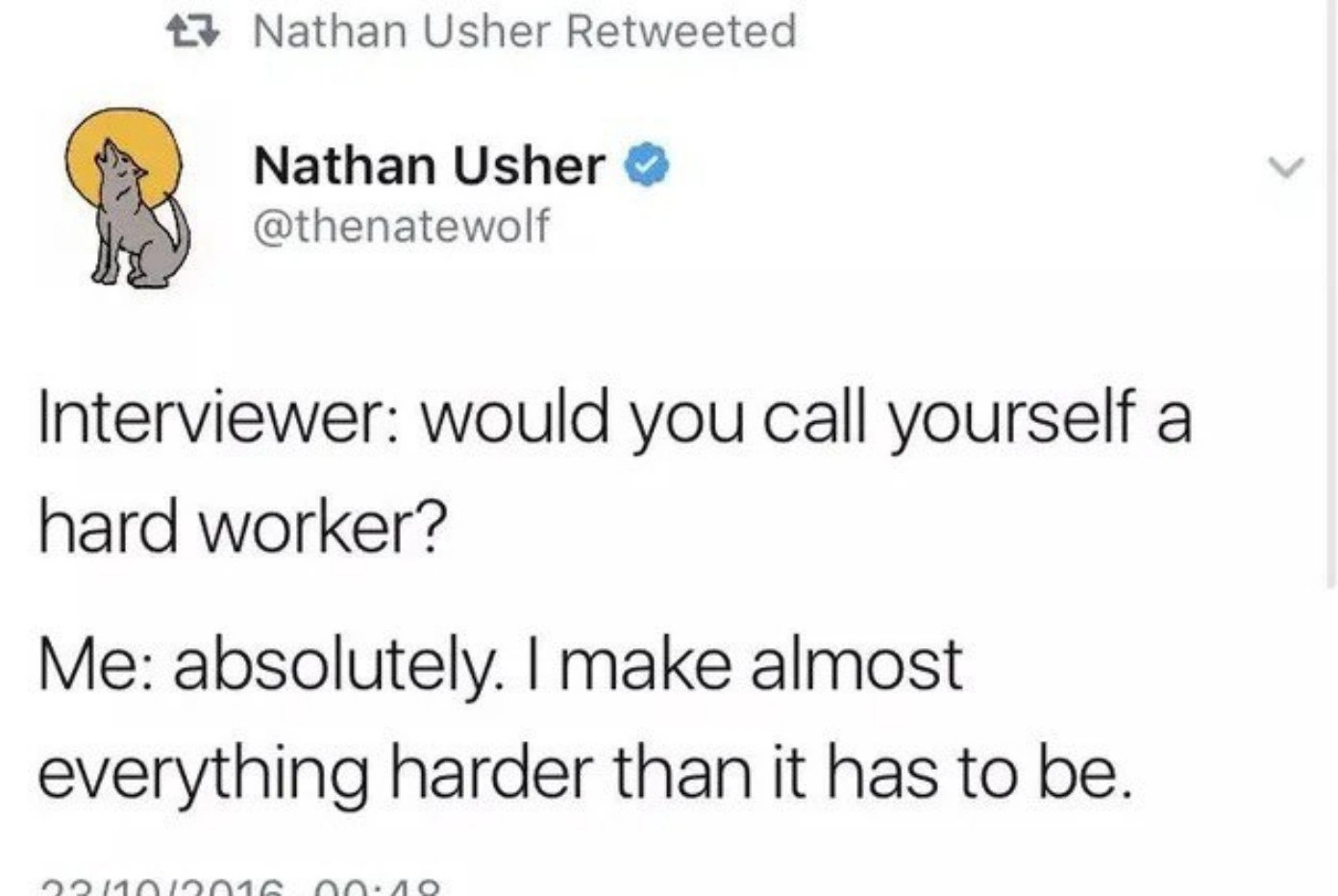
Let’s break down the joke in simpler terms. The tweet sets up a Q&A from a job interview. The interviewer asks: “Would you call yourself a hard worker?” This is a common question in the InterviewProcess and HiringHumor realm. They expect the candidate to say something like “Yes, absolutely, I’m very dedicated and work hard,” which in normal language means “I put in a lot of effort and I don’t give up easily.” It’s basically asking if you have a good work ethic.
Now the funny part: the candidate answers, “Absolutely. I make almost everything harder than it has to be.” This is a form of self_deprecating_answer – the person is joking at their own expense. The humor comes from a play on words: “hard worker” can also sound like someone who makes work hard. Instead of saying “I work hard (I put in effort),” they twist it to mean “I make work hard (I turn easy jobs into difficult ones).”
In developer terms, this describes overengineering. Over-engineering means designing a solution that's far more complex or difficult than necessary for the task at hand. It’s like using a sledgehammer to crack a nut (or writing a thousand lines of code for something you could do in ten). Many programmers have done this without meaning to. For instance, as a new coder you might not know an easy built-in method exists, so you write a lot of extra code to do it yourself. Or you just learned a fancy technique or pattern and you’re eager to use it everywhere, even when a simple approach is better. The result? You end up making the program more complicated – making things harder for yourself (and possibly for anyone who reads your code).
Let’s illustrate with a very simple coding example. Suppose we need to multiply two numbers. There’s obviously a straightforward way to do that in any language (a * b). But an “I make everything harder” approach might look like this:
// An over-engineered way to multiply two numbers (for illustration):
function multiplyHardWay(a, b) {
let result = 0;
for (let i = 0; i < b; i++) {
result += a; // add 'a' to itself 'b' times
}
return result;
}
console.log(multiplyHardWay(6, 4)); // Output: 24, but we took the long way to get it!
// The simple, straightforward way:
function multiplyEasyWay(a, b) {
return a * b;
}
console.log(multiplyEasyWay(6, 4)); // Output: 24, done in one step
In the above code, multiplyHardWay technically works, but it makes the task much more complicated than it needs to be. We wrote a whole loop to do what one * operation can do. That’s a toy example of “making something harder than it has to be.” In real coding, overengineering might mean writing a huge class with lots of settings when a single function would do, or building an entire application framework for a small feature.
Now, why is this funny to developers? It’s because we recognize ourselves. The tag RelatableHumor is apt: many of us have memories of a project where we went down a rabbit hole and ended up laughing (or crying) at how much unnecessary work we created. The DeveloperHumor here is a mix of “Haha, I’ve done that,” and “Oops, that’s so me sometimes.” It’s comforting in a way — if you’re a newcomer who has ever struggled and made a task harder, you can see even experienced folks joke about doing the same thing.
This meme is also about interview wordplay. Wordplay means a joke that plays with the meaning of words. “Hard worker” usually means a person who works very hard. The interviewee pretends to misunderstand (or intentionally misinterprets) it as “a person who makes work itself hard.” It’s a clever twist. In an actual interview, answering like this would be quite risky! But as a joke on Twitter, it’s poking fun at those stock interview questions and showing a bit of truth about the person’s work style in a humorous way. The categories listed (Interviews, Career_HR) tell us the context is workplace humor, especially about how we present ourselves in interviews versus what we’re really like. This candidate in the meme basically admits, “Sure, I’m a hard worker – I work hard at complicating things, haha.”
For a junior developer or someone early in their career, the takeaway behind the joke is: simplicity is a skill. Often, beginners equate working hard with doing something complicated. In reality, as you gain experience, you learn that the best solution is usually the simplest one that gets the job done. There are even acronyms and principles like KISS (“Keep It Simple, Stupid”) and YAGNI (“You Aren’t Gonna Need It”) which remind us not to over-complicate or add features that aren’t necessary. This meme humorously portrays someone ignoring those principles to an extreme. It’s as if the person is proud of making things harder, which is the opposite of what you’d normally brag about! That reversal makes it funny.
So, to put it plainly: the interviewer asked if the person is a hard worker (a good thing). The person answered as if being a “hard worker” means making work hard (a not-so-good thing) – turning a positive phrase into a self-jab. It’s a joke many developers laugh at because we’ve all had moments where we unnecessarily complicated a task and later thought, “I really made that harder than it had to be.” This tweet just captures that feeling in one snappy interview answer.
Level 3: Work Harder, Not Smarter
This meme flips a classic interview question into a programmer’s inside joke about overengineering. The interviewer asks if the candidate is a hard worker, expecting them to boast about diligence and long hours. Instead, the candidate quips: “I make almost everything harder than it has to be.” It’s a witty bit of self-deprecating humor that senior developers recognize all too well. Why? Because many of us have accidentally turned simple tasks into complex ones in our careers.
In software development, making things “harder than it has to be” is a familiar pitfall. We even have a term for it: over-engineering. That’s when a developer designs a solution far more elaborate and complicated than necessary. The tweet is funny because it’s literally interpreting “hard worker” as someone who works hard at making work hard! It’s a pun that lands because there’s a grain of truth: developers often joke that they’ve overcomplicated a project, turning a quick task into a marathon. The humor is a little ouch and a little 😅 because it’s relatable.
From a seasoned engineer’s perspective, this scenario satirizes a real tension in our field. We value working smart, but many of us have learned that lesson the hard way (pun intended). There’s an old mantra: “Work smarter, not harder.” The meme’s character is basically confessing, “I do the opposite.” For example, imagine a developer asked to add a simple feature but who ends up building an entire new subsystem or using five different microservices to accomplish it. We’ve seen (or written) code where a 10-line script would do, but instead we created a 100-line monstrosity framework. It’s the classic “reinventing the wheel” scenario, or as one might say, turning a molehill into a mountain of code.
Why do capable devs fall into this trap? Often it’s enthusiasm or the urge to demonstrate skill. In an InterviewProcess setting, a candidate might overthink a coding question, producing an overly complex answer to show off, when a simple solution was best. In real projects, we sometimes anticipate problems that never happen or apply every design pattern we just learned, ending up with unnecessary layers. Experienced teams talk about accidental complexity (complexity we introduce by our design) versus essential complexity (the inherent difficulty of the problem). The joke here is that this “hard worker” piles on accidental complexity to every task. Seasoned devs chuckle (and maybe cringe) because they recall the nights debugging issues in an overbuilt system that could have been simple. It’s humor with a hint of shared DeveloperTrauma: “Yep, been there, made that mistake.”
This tweet-format meme also plays on the InterviewHumor of giving an unexpected answer. It highlights a cultural truth: tech interviews often ask cliché questions like “Would you call yourself a hard worker?” Everyone expects a canned positive answer. Responding with tongue-in-cheek honesty — essentially “Yes, I’m so hard-working I even make my work harder!” — is absurd in a corporate Career_HR context, which is exactly why it’s funny. It’s an answer that would make any hiring manager do a double-take. (Pro tip: probably do not actually say this in your real interview, unless the interviewer also has a great sense of humor!).
In summary, at the senior level this meme shines a light on the overengineering habit. It’s poking fun at ourselves as developers: those times we refused to KISS (Keep It Simple, Stupid) and ended up buried in our own cleverness. It resonates because making things more complicated than necessary is almost a rite of passage in software development. The community laughs at this quip and tags it DeveloperHumor and RelatableDevExperience because we’ve all had that moment of realizing we made a task harder, not easier. The meme hurts so good because it’s true — in tech we pride ourselves on problem-solving, yet sometimes we’re too good at turning an easy job into a hard one!
Real-world “Hard Worker” Hall of Fame:
- A junior dev proudly implementing a whole new sorting algorithm from scratch (with dozens of edge cases) when the language’s built-in
.sort()would have sufficed. - Writing a complex configuration file parser with multiple classes and patterns, instead of using a simple library or just a few split strings.
- Building a Rube Goldberg machine in code: e.g. calling five microservices and a message queue to handle a form submission that could go directly to a database.
- Spending two weeks optimizing an internal tool that runs once a month — the premature optimization rabbit hole, turning a simple script into a finely tuned but over-tuned engine.
Each of these is an example of making a task unnecessarily difficult (often with good intentions). This meme packs all that into one cheeky interview answer. It’s essentially a confession: “Yes, I’m a hard worker — I’ll put in extra effort even when it’s not needed!” Developers who see this tend to laugh and maybe groan a little, because we see a reflection of our younger selves (or our current selves on a bad day) in that mirror.
Description
The image is a screenshot of a tweet UI that shows a retweet banner reading "Nathan Usher Retweeted." Beneath it is the profile of Nathan Usher (@thenatewolf) with a small gray wolf icon howling at a yellow moon and a blue verification badge. The tweet text reads: "Interviewer: would you call yourself a hard worker?" followed by a line break and "Me: absolutely. I make almost everything harder than it has to be." A faint timestamp ("23/10/2016 00:48") appears at the bottom. The humor relies on self-deprecation and a pun on “hard worker,” poking fun at developers who over-engineer or complicate tasks - an all-too-common theme in technical interviews and hiring conversations
Comments
7Comment deleted
Hard worker? I containerised a cron job, wired it through Kafka, and wrote a 20-page ADR to justify the architecture - just so marketing could run grep once a day
The real hard work isn't implementing the solution - it's convincing the team why your custom-built, microservice-based, event-sourced, CQRS pattern with blockchain audit trail is absolutely necessary for what could have been a simple CRUD app with a Postgres database
This perfectly captures the senior engineer's curse: we've seen so many edge cases and architectural disasters that we instinctively add three layers of abstraction, implement the Strategy pattern, and write a custom DSL for what could've been a simple if-statement. We're not just hard workers - we're hard-mode workers, turning every JIRA ticket into a distributed systems problem
Absolutely - like deploying Kubernetes for a static site, complete with Istio and blue-green rollouts no one needs
Interviewer: “Are you a hard worker?” Me: I once turned a 5-line cron into a multi‑region, event‑sourced microservice with Kafka and a Helm chart - accidental complexity is my cardio
Asked if I’m a hard worker, I said I can turn a one-line Bash script into a hexagonal, event‑sourced CQRS microservice with Kafka and Terraform - then ship it as the MVP
This Comment deleted