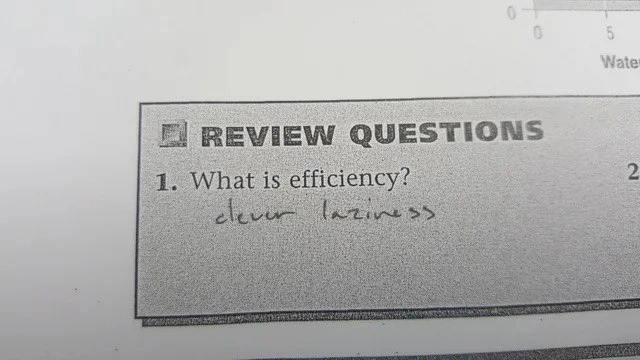
Textbook asks for efficiency, student answers 'clever laziness' - dev culture defined
Why is this DeveloperProductivity meme funny?
Level 1: Shortcut to Success
Imagine you have two kids asked to clean a very messy room. The first kid starts picking up toys one by one, running back and forth to put them on the shelf, working really hard. The second kid doesn’t want to run so much. They look around, grab a big toy box on wheels, and cleverly scoop all the toys into it in one go, then wheel it over to the shelf. Both rooms get clean, but the second kid finishes much faster and hardly breaks a sweat. That second kid was being a bit “lazy” about doing the chore, but in a smart way. They found an easier method to get the same result. We’d say the second kid was more efficient — they achieved the goal with less effort. That’s exactly what the funny answer “clever laziness” means. It’s when you solve a problem by finding a shortcut or an easier approach, so you don’t have to work as hard. It makes people smile because it’s a little cheeky: the student basically said, “Efficiency is when you’re lazy, but really smart about it!” And honestly, that’s a pretty spot-on and funny way to put it. In developer terms, it means use your brain a bit now so you can relax more later. What’s not to love about that?
Level 2: Work Smart, Not Hard
At a more beginner-friendly level, let’s break down what’s happening in this meme. We have a picture of a textbook review question asking, “What is efficiency?” Normally, in a class or CS fundamentals context, you’d answer that efficiency means doing something with as little waste as possible. For example, an efficient algorithm is one that runs fast and uses minimal memory. It’s about accomplishing a goal with the least amount of resources or effort. If this were an exam, the teacher probably expected a definition like, “Efficiency is the ability to achieve maximum productivity with minimum wasted effort or expense.”
Instead, the student responded with a witty handwritten answer: “clever laziness.” 😆 It’s funny because it’s so short and unexpected, yet it surprisingly makes sense, especially to developers. Why? In coding and developer culture, there’s a saying: “Work smart, not hard.” This means it’s better to find a smart solution than to brute-force a problem with sheer effort. The student basically defined efficiency in a playful way: instead of working super hard on something, figure out a smart shortcut so you don’t have to work as hard. That’s what they meant by clever laziness. It’s not about being a slacker who does nothing; it’s about being smart so that you avoid doing unnecessary work.
In real programming life, this idea shows up all the time. Imagine you have to resize 200 images by hand or rename a bunch of files. A straightforward but hard way is to open each image editor, do them one by one (which could take hours). The efficient coder way is to write a small Python or Bash script to batch process all images at once. Writing that script might take 10 minutes, and then it resizes everything in seconds. The developer was essentially being lazy about doing it manually, but in a clever way — they invested a bit of brainpower and coding to save a ton of labor. That’s efficiency in coding. Similarly, if a programmer keeps encountering a repetitive task (say, formatting data or running a series of test commands), they’ll likely automate it. Automating tasks is a huge part of DeveloperProductivity: it means using tools or code to do tasks automatically, so the human doesn’t have to grind through them each time. It’s like telling the computer, “You do the boring part, I’ll supervise (or go grab a coffee).”
Let’s clarify a few terms from the meme tags. “Strategic laziness” or clever laziness refers to the idea of planning or working a bit upfront so that you can save yourself (and others) effort later on. It’s strategic because it’s thought-out: you’re not just avoiding work blindly, you’re finding a better method. This ties into the principle of Don't Repeat Yourself (DRY) that new developers learn. DRY means you should not write duplicate code or do the same thing over and over; instead, write it once and reuse it. It’s a strategy to be efficient and lazy: why do something manually ten times if you can write one loop or function to handle it in one go?
Another relevant principle is often abbreviated as YAGNI – “You Aren’t Gonna Need It.” This is advice to not build features or do work that you don’t actually need yet. In other words, don’t spend time on things just because you might need them; wait until you definitely need them. This avoids wasted effort and keeps things simpler. It’s a form of disciplined or wise laziness: focus only on what’s necessary now. New coders sometimes think they should cover every imaginable scenario (over-engineering), but experienced devs know that can lead to doing a lot of work that never pays off. Efficiency often means doing less, but doing the right less.
The meme also hints at the fun side of developer humor. In the programmer community, calling someone “lazy” can actually be a compliment about their problem-solving approach. It sounds weird, but it’s because a “lazy” programmer (in this special sense) will find or create a tool to eliminate boring tasks. It’s almost a rite of passage in a dev’s career to have that “aha!” moment: “Wait, I can write a program to do this for me!” It feels like a superpower the first time you do it. That’s why this image is relatable: many in tech remember being a student or junior dev and discovering that a few lines of code could save hours of drudgery. It’s a bit of a rebellious twist too. Teachers and textbooks often give very formal definitions, but here the student injects a bit of DeveloperCulture attitude into an academic setting. The phrase “clever laziness” is informal and funny, yet it truly captures something every coder learns: the best solution is usually the one that saves you time and headaches in the long run.
So, in simpler terms: Efficiency = finding the smartest way to get something done with the least effort. And programmers absolutely love that idea. They even joke that the world runs on “clever laziness” – every great tool or script was created by someone who got tired of doing it the hard way! The student’s handwritten answer turned a dry question into a clever punchline, and in doing so, defined a core developer philosophy in just two words. That’s why this meme resonates: it’s a textbook question with a very non-textbook answer that every coder secretly appreciates.
Level 3: The Efficient Slacker
Experienced developers chuckle at this cheeky answer because it rings so true. In the real world of software engineering, one of the unofficial mottos is “Work smarter, not harder.” A seasoned coder knows that grinding away at a repetitive task is inferior to spending a bit of time to automate it. This is the heart of DeveloperProductivity culture: if you’re cleverly lazy, you’ll write a quick script, use a handy library, or build a tool so that neither you nor anyone else has to do that monotonous work ever again. There's a famous tongue-in-cheek quote often attributed to Bill Gates: “I choose a lazy person to do a hard job, because a lazy person will find an easy way to do it.” 🖥️ In tech circles, this isn’t about slacking off on outcomes — it’s about finding the most efficient path to achieve those outcomes. Why brute-force a solution when a smarter shortcut exists?
This meme’s scenario – a student redefining “efficiency” as “clever laziness” – reads like a page from the DeveloperCulture playbook. It humorously spotlights a key aspect of programmer mentality: a mix of strategic laziness and ingenuity. Seasoned devs often pride themselves on being a bit “lazy” in exactly this productive way. For instance, if a senior engineer finds themselves manually deploying code to five servers, you can bet by the third deployment they’ll write a script or use an automation tool like Ansible or Jenkins to do it in one go. It might take some effort to script it out the first time, but afterwards deploying to 50 servers is just as easy as to one. That’s efficiency through laziness – expending effort up front so you can kick back later while the computers do the heavy lifting.
Another everyday example: suppose there's a tedious report you have to compile every week. The hard-working approach is to grind through it manually each time, but the cleverly lazy approach is to spend an afternoon writing a small program to generate the report automatically. By the next week, while others are slogging through copy-paste routines, your program runs with a single click and you’re already having a coffee. You just turned laziness into productivity gold. Developers share countless stories of these relatable developer experiences. Maybe someone got tired of filling out timesheets and wrote a script to pre-populate them, or they automated their bug testing with a nifty tool instead of checking things one by one. These anecdotes get passed around as office humor but also as lessons: if something is annoying and repetitive, there’s probably a smarter way.
There’s even a venerable concept in programming folklore praising this mindset. Larry Wall, the creator of Perl, famously coined “laziness” as one of the three great virtues of a programmer (the other two being impatience and hubris). In Wall’s words, laziness drives developers to write labor-saving programs that increase efficiency. In other words, the best programmers write code today so that both they and their colleagues can be more efficient (and maybe a bit more relaxed) tomorrow. It’s a virtuous cycle: a touch of laziness prompts innovation, which leads to better tools and less grunt work for everyone. This inside joke of calling laziness a virtue is baked into developer culture. It’s why the student’s answer doesn’t just make us laugh — it actually gets a nod of respect. We’ve all been there, grinning as we automate a task and thinking, “Ha, take that, toil! I’ll be over here being productive by avoiding unnecessary effort.” The meme succinctly captures that feeling. The textbook asked for a formal definition of efficiency (perhaps expecting something about “output vs input” or “optimal resource utilization”), but the student gave an answer that any senior engineer would slyly applaud. In dev-speak, being efficient truly often means finding the smartest possible way to be lazy. And as absurd as that sounds to a professor, in practice it’s how a lot of great software and time-saving scripts are born.
Level 4: The Indolence Principle
At the most theoretical level, efficiency in computing is about minimizing wasted work — achieving maximum output with minimal input. In algorithm design and analysis (a core part of CS_Fundamentals), this often means reducing an algorithm’s time complexity or space complexity. For example, an inefficient algorithm might take O(n^2) steps for n items, while a more efficient one uses O(n log n) or even O(n) steps. The clever trick is that the faster algorithm isn’t literally working “harder” – it’s skipping unnecessary operations. In academic terms, it's doing less actual computation to get the same result. That’s where the idea of “clever laziness” sneaks into theory: the best algorithm is often the one that finds a way to avoid extra work.
Computer science has formal strategies that sound a lot like being lazy on purpose. Dynamic programming is a classic example: it stores intermediate results (using a technique called memoization) so that it doesn’t recompute answers to subproblems over and over. This is efficiency through caching – essentially “I’m too lazy to solve the same puzzle twice, so I’ll remember the answer the first time.” The result? A huge speedup by cutting out redundant effort. Similarly, short-circuit evaluation in programming languages is another built-in lazy feature: when evaluating a logical expression like A && B, if A is false, the program won’t even bother checking B because it already knows the result will be false. The system literally refuses to do unnecessary work, making execution more efficient.
Some programming paradigms embrace laziness as a first-class concept. Lazy evaluation (found in functional languages like Haskell) means deferring computations until you actually need the result. This allows for seemingly magical feats: you can define an infinite list of numbers in Haskell and it’s not a problem at all — the language will only compute the portion of that list you ask for. It won’t waste time generating millions of unused values. This strategy of “calculate it later, or maybe never” conserves both time and memory. It’s algorithmic efficiency gained by procrastinating on purpose! Mainstream languages use this idea too: think of loading web images only when they enter the viewport (lazy loading) or initializing a heavy object in an app only when it’s first used (lazy initialization). By not doing work upfront, systems run faster and leaner. In essence, laziness is baked into computing as a means to optimize performance. From CPU caches (that save results so the processor doesn’t repeat calculations) to query optimizations in databases (that don’t read more data than necessary), the highest efficiencies come from doing exactly what’s needed, and no more. The meme’s punchline “clever laziness” perfectly captures this principle: in computer science, the smartest solution often involves figuring out what you don’t have to do. It’s the science of sloth applied to silicon — skip the needless work and you’ll get better results.
Description
The grayscale photo shows a cropped section of a worksheet headed “REVIEW QUESTIONS” in bold block letters. Underneath, Question 1 reads, “What is efficiency?” and a student has handwritten the cheeky response “clever laziness” in pencil. The stark contrast between the formal printed question and the playful answer creates a meme-like punchline about developer mentality. In engineering circles, efficiency often means reducing algorithmic complexity or resource usage; here it’s reframed as the ability to avoid needless effort through smart solutions, echoing the coder ethos of automating tedious tasks. The image humorously captures how senior engineers prize strategic laziness as a path to high productivity and performant systems
Comments
7Comment deleted
Efficiency is the pull-request that replaces six microservices, a Kafka topic, and half a sprint with a 15-line cron job - clever laziness at scale
After 20 years of optimizing database queries and refactoring legacy codebases, you realize the O(1) solution to most problems is convincing management it's not actually a problem that needs solving
This answer perfectly encapsulates Larry Wall's first virtue of a great programmer: laziness - the quality that makes you go to great effort to reduce overall energy expenditure. After all, why manually deploy to production 50 times when you can spend three weeks building a CI/CD pipeline that does it automatically? The ROI might be questionable, but at least you'll never have to SSH into that server again
Clever laziness: the O(1) principle turning exponential toil into constant-time triumphs via one well-placed abstraction
Efficiency is laziness with guardrails: spend two weeks on an idempotent script and runbook so the 30‑second task never pages you at 03:00
Efficiency is clever laziness: automate the 5-minute chore with an idempotent script and a README - otherwise it becomes a 3 a.m. SEV-1
haskell intensifies Comment deleted