The Holy Firewall: Divine Packet Filtering
Why is this Security meme funny?
Level 1: Lucky Charms for Servers
Imagine you have a big, important toy castle that keeps falling apart no matter how carefully you build it. After trying everything, you decide to line up your favorite good luck charms inside it – maybe some lucky coins or superhero figures – hoping they will magically keep the castle standing. You’re basically saying, “I’ve done all I can, now I’m just wishing and trusting my little charms to protect it.”
That’s exactly the joke here, but with computers. In real life, grown-ups run computer servers that should never stop working (for example, so your games or videos online don’t get interrupted). Normally, they use other machines and gadgets to help make sure the server doesn’t fail. But in this funny picture, instead of using real backup machines or proper equipment, they put small pictures of saints (holy people) in the computer’s place. It’s like saying the servers are protected by prayers or magic rather than by science or engineering.
Why is this funny? Because it’s a mix-up of serious technology with the kind of thing people do for good luck. It’s as if someone put a rabbit’s foot or a lucky penny inside a spaceship to make sure it works – cute and hopeful, but not really how science works! People find it funny because they know those saint pictures can’t actually make the network more reliable, just like a lucky charm can’t physically hold a castle together. But when we’re really, really hoping something will go well, sometimes we still cling to our lucky charms.
So the image is basically saying: “We’ve tried everything to keep our computers running, so now we’re just hoping and praying they don’t break.” It makes us laugh because even tech experts feel helpless sometimes, and they joke about needing a little miracle. It’s a silly way to show that behind all the fancy wires and technology, even the experts cross their fingers and hope for the best once in a while.
Level 2: Praying for Uptime
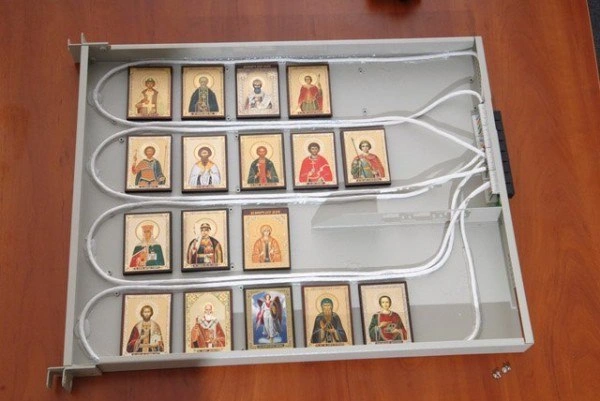
Let’s decode the joke in simpler terms. This picture shows a server rack tray (basically a shelf that slides into a data center rack) that someone has filled with religious icons and network cables. Normally, in that tray or panel, you’d expect electronic hardware – things like a network switch, a patch panel full of Ethernet ports, or perhaps a server unit. Those are the kind of devices that actually make a network run: they route data, connect different wires, and keep everything online. But here, instead of any real hardware doing work, we see 16 little framed pictures of saints (holy figures). The white cables are neatly arranged as if they’re connecting these saint pictures to the network. Of course, pictures of saints do not carry internet traffic! So this is a visual gag: the cables and neat arrangement make it look technological, but it’s actually completely non-functional.
Why would someone do that? It’s poking fun at the idea that sometimes IT people end up “just praying” that things keep working when they’ve done everything they can. Uptime is the term for how long a system stays running without crashing or needing to be restarted. High uptime is crucial for servers – for example, a website that’s always accessible has high uptime. When you’re responsible for a big website or a company’s network, you feel a lot of pressure to avoid downtime (periods when the service is unavailable). Good practice is to set up reliable equipment and backups to achieve that. We use things like:
- Redundant hardware: extra components or servers that take over if one fails.
- Backup power supplies (like generators or UPS batteries) in case of electrical failures.
- Network redundancy: multiple network cables or providers, so if one link goes down, traffic can go through another.
- Firewalls and surge protectors: to guard against hackers and electrical spikes.
- Monitoring systems: tools that alert us if something’s wrong, so we can fix issues before they cause downtime.
In an ideal, well-funded environment, you have all that safety. But many of us have worked at places where things aren’t so ideal – maybe the budget is tight, the management doesn’t understand why we need a second backup router (“the first one is working fine, why buy another?”), or perhaps the technology is old and temperamental. In such situations, a sysadmin (system administrator, the person managing the servers and networks) might joke that their only strategy left is to “pray” nothing breaks. This meme literally shows prayer-driven infrastructure: instead of proper backup hardware, they put religious_icons_infrastructure – the icons – in the rack, as if those will keep the system safe.
It’s also referencing a common cultural image: some people keep religious icons, crosses, or saint images in places as a blessing or good luck charm. For example, you might have seen a taxi driver with a small saint’s icon on the dashboard for protection, or someone wearing a cross necklace as a blessing. Here that idea is applied to a server room. The rack-mounted array of holy icons is essentially a giant good-luck charm for the entire network. It’s a tongue-in-cheek way to say, “We’ve done all we can technically; now we need a little help from above for our uptime.”
The text caption calling it a “Christian firewall” is a pun. A firewall in tech is usually a security device or software that blocks unwanted network traffic – like a bouncer for your network, keeping bad guys (hackers, viruses) out. By calling this row of saints a Christian firewall, the joke suggests these holy figures are acting as the bouncers, blocking evil (malware, network failures, maybe even literal demons if we keep up the joke) from entering the system. Of course, these icons cannot really filter network packets or prevent electrical failures. But in a humorous metaphorical sense, the sysadmin is imagining that these saints are on duty, guarding the servers and keeping them running.
Let’s clarify a few terms and references in the meme:
- 19-inch rack: A standardized frame where servers and networking gear are mounted. Everything (servers, switches) comes in widths that fit this rack. The tray in the photo is designed to slot into such a rack.
- Patch panel: A board with lots of network cable connectors. You plug cables in the front and they’re connected to wires in the back that go out to other places. It’s a way to organize and route cables neatly. The image mimics the look of a patch panel by having cables loop to a connector block (likely a dummy or real patch block) on the right.
- Ethernet cables: Those white cables are Ethernet (or similar) cables, used to connect network devices. Typically, they’d carry data signals between servers and switches. Here they’re likely just short cables looped for show.
- Reliability and Uptime: Uptime is measured often in percentages. If a service has 99.999% uptime, that means it’s down for at most just a few minutes per year. Achieving that is hard. It requires careful planning to eliminate single points of failure (any one thing whose failure could bring everything down). When people cannot eliminate all those points of failure (maybe due to cost or complexity), they sometimes joke about needing luck or divine help.
- Sysadmin humor: This is a form of inside joke among IT and network folks. We often cope with stress by making fun of the situations. Saying “I’m praying to the server gods” is a way to lighten the mood when you feel a situation is out of your control despite your expertise.
So, in summary, a junior developer or someone new to IT can understand this meme as: Instead of using actual technical solutions to keep a server running, someone is pretending that simply having holy pictures in the server rack will do the job. It’s funny because it’s obviously not true, but it captures the feeling of hoping and praying when you’re out of options. It’s a visualization of “hoping for the best” in a critical technical setting, which is both silly and oddly relatable. Everyone in tech has had that moment of just crossing their fingers (or literally saying a prayer) when pressing Enter on a risky command or rebooting a problematic server.
Level 3: Miracles at Layer 1
At first glance, this open 19-inch rack tray looks like a network patch panel – those organized rows of ports and loops of neatly routed white cables. But look closer: instead of switches, routers, or any actual electronics, each cable is meticulously glued alongside a tiny Orthodox icon of a saint. Four rows of four icons, 16 in total, are mounted where one would expect hardware components. The cables snake around them in a tidy fashion, plugging into a connector block on the right, mimicking the neat loops of a well-managed server rack. It’s as if someone built a divine patch panel, an array of spiritual fuses, in place of real networking gear.
This absurd sight is hardware humor at its finest, playing on the idea that when all engineering fails, sysadmins might turn to higher powers. In the world of infrastructure and networking, uptime (the time systems run without failing) is almost a sacred metric. We speak of "five nines" reliability (99.999% uptime) with a reverence usually reserved for miracles. Achieving such reliability normally demands redundant hardware, failover clusters, backups, surge protectors, and careful network design. But here, instead of a proper redundant array of servers or disk drives, we have what a sarcastic engineer might call a RAIS: Redundant Array of Inexpensive Saints. It’s a pun on RAID (Redundant Array of Independent Disks), joking that a stack of holy portraits is the new fail-safe. The humor lands because any senior engineer instantly recognizes this as a desperate (if comedic) measure – saint-based redundancy in lieu of real fault-tolerance.
Why is this so funny to an experienced sysadmin? Because it rings true in a dark way. There’s an old saying among battle-worn IT folks: “There are no atheists in the server room at 3 AM.” When you’re on-call and a core router keeps mysteriously crashing despite all best practices, you eventually feel like only divine intervention can save you. This meme is a physical joke about that exact feeling. We’ve all been there: a critical service is down, nothing in the logs makes sense, every fix fails, and out of exhaustion you half-jokingly pray to the tech gods (or holler “why hast thou forsaken me, O cluster?” into the void). Here, someone has literally built a shrine in the rack. It’s prayer-driven DevOps taken to its extreme.
The phrase > “Сhristian firewall” in the post caption perfectly captures the dual reference. In network engineering, a firewall is a device that guards your network from bad traffic, much like a spiritual guardian warding off evil. By calling it a Christian firewall, the meme-maker implies these saintly icons will protect the system from malicious intrusions and outages – as if malware and power surges might be thwarted by holy aura. It’s a pun mixing cybersecurity jargon with religious imagery. A cynical veteran might chuckle thinking, “Forget updating iptables or the latest firewall appliance—just install Saint Peter 1.0 on the rack and you’re PCI-DSS compliant via divine compliance.” The physical layer of the network (OSI Layer 1) is being “protected” by a higher Layer 8 (the layer of belief, jokingly beyond the user).
From a senior perspective, this image satirizes real sysadmin coping mechanisms and the superstition that creeps into high-stress IT work. Sure, rationally we trust in UPS units (Uninterruptible Power Supplies) and redundant network links. But after enough random failures (blown power supplies, flaky Ethernet cables that test fine until they don’t, memory bits flipping due to cosmic rays, you name it), even the most scientifically-minded engineer might throw up their hands and jokingly say, “We’ve done all we can; now it’s in the hands of St. Murphy.” (Murphy as in Murphy’s Law, patron saint of things going wrong). The infrastructure depicted is essentially an homage to that sentiment. It’s saint-based engineering. We see neatly managed cables – indicating the sysadmin did everything by the book with cable management and presumably proper setup – yet instead of actual network gear, there are icons, implying “All we can do now is pray for uptime.”
The humor also pokes at organizations that invest in ceremonies over substance. Ever heard of companies where instead of buying proper backup generators, an executive just hangs a lucky charm in the server room and calls it a day? It’s an exaggeration, but it highlights the frustration with penny-pinching or magical thinking in IT management. If you’ve ever sat in a post-mortem meeting after a major outage and someone half-jokes “perhaps we should sacrifice a server to appease the uptime gods,” this meme hits home. It’s the same vibe as saying “Did you try rebooting? No? Then have you tried praying?”
Technically speaking, the network cables here likely don’t connect anything meaningful – they loop back, possibly just for show, or maybe each cable is connecting to a port right next to it, which is the network equivalent of talking to oneself. In a real rack panel, those cables would route signals between servers, switches, or patch panels. But these four white cables are doing nothing productive, much like the icons themselves in terms of real data transfer. That detail underscores the joke: nothing functional is actually happening. It’s pure form without function – except if you believe these icons bring a blessing of uptime. It’s a sight gag about physical-layer networking being secured by metaphysics rather than physics.
Let’s break down some of the satirical equivalences embedded here:
- Redundancy vs. Providence: In proper infrastructure, you’d have redundant power, redundant NICs (Network Interface Cards), maybe dual ISP links. Here, redundancy is provided by multiple saints – if one saint doesn’t answer your prayers, well, you’ve got fifteen more as backup. It’s “N+15 redundancy” in religious terms. That’s why we joke about holy uptime solutions: more saints, more 9’s of reliability, right?
- Monitoring and Alerts vs. Divine Signs: Instead of monitoring systems like Nagios or Grafana sending alerts when something’s wrong, perhaps the icons will shed tears or glow if an outage is imminent (satirically speaking). A cynical veteran knows that in reality, ignoring proper monitoring and just praying is a recipe for disaster – but they’ve also been in situations where you do everything right and still only a miracle would have helped.
- Physical Security vs. Faith: A rack might normally have a lock or at least be in a secured data center. Here, maybe the admin believes these saints also ward off not just digital evil but physical unauthorized access – a truly divine firewall. (Though, to be fair, if I walked into a server room and saw this, I might be a bit afraid to mess with it – so maybe it does deter meddling, if only out of respect or confusion!)
In essence, this meme combines NetworkHumor and SysadminHumor with a heavy dose of irony. It highlights that maintaining servers and networks sometimes feels like a matter of luck or fate as much as skill. The seasoned engineers laugh because they’ve felt that absurdity: after you’ve exhausted all logical fixes, sometimes you half-seriously utter, “please, just let it stay up this time,” as if offering a prayer. The image just takes that idea and literally mounts it in a rack. It’s equal parts tech humor and social commentary on the near-religious importance of uptime in our field.
Description
This image displays the inside of a metal server drawer or network appliance chassis, which has been repurposed in a humorous way. Instead of the expected circuit boards and electronic components, the drawer is meticulously filled with seventeen small, traditional Orthodox Christian icons, arranged in four rows. Clean white wiring is neatly routed around the icons, connecting them to a terminal strip on the right side of the chassis, as if they were electronic components in a circuit. The original post caption, 'Сhristian firewall,' reveals the joke. This is a visual pun, literally interpreting a 'firewall' as a wall of holy figures meant to provide divine protection. The humor resonates with tech professionals who understand that a real firewall is a network security system that monitors and controls incoming and outgoing network traffic. This 'holy firewall' satirizes the feeling of helplessness in the face of overwhelming security threats, where one might wish for a miracle to protect their systems. It's a clever blend of modern technology and ancient faith

Comments
8Comment deleted
This must be the new zero-trust model based on faith. It denies all traffic by default, and you have to pray for an exception
Our new five-nines strategy: a 16-saint Byzantine quorum - packets only pass the firewall if they get majority blessings
Finally found a firewall configuration that actually blocks all evil() calls - though the latency on divine intervention is still measured in geological time
Sixteen icons in a 4x4 grid with redundant routing - finally an HA setup where the failover path is literally an act of God
When your infrastructure documentation is so ancient it predates version control and exists only as illuminated manuscripts, but at least the cable management is divine. This is what happens when you take 'infrastructure as code' too literally and end up with infrastructure as iconography - each saint presumably responsible for a different service: St. PostgreSQL of Data Integrity, St. Nginx of Load Balancing, and St. Kubernetes of Orchestration. The real miracle here isn't the resurrection; it's achieving five nines uptime without proper monitoring
RAIS: Redundant Array of Inexpensive Saints - divine redundancy with zero bit rot and eternal MTBF
After the last Sev-0, we implemented Byzantine Fault Tolerance literally - rack-mounted Byzantine icons; quorum now requires three prayers and a power cycle
New HA plan: rack-mounted saints with redundant cabling; incident escalation now goes from SRE to clergy, and the dashboard finally shows an uptick in PPS - prayers per second