The Holy Firewall: Divine Packet Filtering
Why is this Security meme funny?
Level 1: Praying for Uptime
Imagine you have a toy or gadget that you really don’t want to break. You’ve done everything you can to take care of it – new batteries, cleaned it, handled it gently. But you’re still worried something might go wrong at the worst time. So, just to be extra safe, you put your lucky charm or a protective talisman on it, maybe even say a little “please don’t break!” out loud. That’s exactly what’s happening here, but with computers! The picture shows a bunch of lucky saint images placed where computer cables go, almost like the engineers are saying, “We’ve tried all the normal fixes, now let’s ask for a bit of extra luck or divine help.” It’s funny because we usually think of keeping computers running as a job for experts with tools and parts – not something you’d solve by praying. It’s like seeing a chef wear a magic hat to make sure a cake doesn’t burn. The combination of something super technical (a server rack with cables) and something very mystical (religious icons) makes us laugh. We get it instinctively: those tech folks really, really want their system to stay online, so much so that they’re treating their machines like a little shrine. In simple terms, the meme is joking that sometimes, keeping things working isn’t just about know-how – a tiny part of us crosses our fingers and hopes for a miracle when we push the big red “ON” button.
Level 2: Sacred Server Rack
For those newer to IT or not yet deeply familiar with data centers, let’s break down the scene. What you see is a server rack drawer pulled out to reveal something that normally lives in the infrastructure of a company’s network. In a typical server room, a metal rack holds lots of equipment – servers, switches, and patch panels. A patch panel is like a tidy junction board with many network ports; it’s used to organize cables. Typically, you’d have Ethernet cables plugged into it, connecting different servers and network devices in an organized way, so everything in the building’s network ties back to this panel.
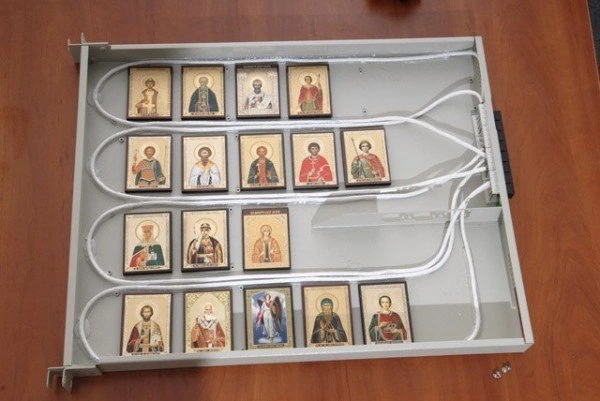
But in this picture, the patch panel’s ports have been replaced (or covered) with small religious icon plaques. These look like traditional Orthodox Christian icons – imagery of saints and holy figures often painted with golden halos. They’re arranged in a grid (four rows of four). All the white cables are still there, neatly looped along guides on the side, as if each saint were a port that the cable plugs into. The cables even gather to a harness on the right, the way network wires would. The whole setup is mimicking a piece of network hardware, but instead of tech components, we have holy images. It’s as if the server rack itself has been blessed or turned into a kind of shrine. The drawer is open on a wooden desk, with a couple of screws lying nearby, suggesting someone is in the middle of installing this unusual panel into the rack. This little detail – the loose screws – makes it feel real, like an admin is actually upgrading their system with a “saint module.”
Now, why would anyone put saints in a patch panel? Of course, this isn’t a serious piece of equipment; it’s a joke. It plays on the idea that sysadmins (systems administrators) and DevOps/SRE folks, who keep servers running, sometimes joke about needing to pray for uptime. “Uptime” means how long a system stays up and available without crashing. A very high uptime (like 99.999% as mentioned) is super hard to maintain. When people say “five nines,” that’s shorthand for 99.999% uptime, which is practically saying “we aim for almost zero downtime.” In real life, getting that level of reliability involves a lot of backup systems and careful design. But it also can feel like you need luck on your side. That’s where the humor comes in: instead of relying only on extra servers and backups, this meme shows relying on faith and luck – symbolized by the saints – to keep things running.
It’s also referencing a running joke in the IT world: calling something a “holy” solution when it’s more hope than science. For instance, you might hear someone facetiously talk about doing a ritual reboot (turning things off and on with fingers crossed) or say “we need to sacrifice a rubber chicken to the server gods” when trying to fix stubborn bugs. Here, instead of a rubber chicken, it’s actual holy icons as a good luck charm for the server rack. The label given in the post – “Christian firewall” – is a pun. A firewall in networking is a device or software that filters traffic to keep out unwanted or dangerous connections (like a security guard for your network). By calling this a Christian firewall, the poster jokes that these Christian saints are acting as the guardians of the network, blocking the “bad stuff” through divine protection. It’s as if viruses, hackers, and outages are evil spirits that saints can ward off. The idea of mixing spiritual protection with computer hardware is funny because we normally solve tech problems with science and engineering, not prayer.
There’s also a hint at cable management pride here. The white cables are meticulously arranged in satisfying loops. In many real server rooms, cables can become a spaghetti mess, but a well-organized rack is admired. Jokingly, this one is so well-done it’s “holy.” In fact, one of the context tags calls it holy_cable_management. It implies that the cables are managed with almost religious devotion to neatness. Each row of saints has its corresponding cables looped alongside, almost like a procession. This level of detail adds to the absurdity – someone took the time to properly route cables to a panel of saints, as if it’s fully functional networking gear.
To a junior developer or someone early in IT, it’s worth knowing that SysadminHumor often involves these kinds of exaggerations. Real network uptime is achieved by things like redundant internet links, backup power supplies, clusters of servers, and failover plans – not by literally putting holy pictures in your server. But the joke conveys how sometimes keeping systems running feels out of our hands. When you’ve done everything you can – tested backups, set up monitors – and you deploy an update, there’s often a nervous joke like, “Alright, everyone, say a prayer!” It’s a way to ease the tension. This meme just visualizes that sentiment. It’s taking the phrase “pray for uptime” and implementing it literally: by integrating prayer symbols (saints) into the physical network.
Also, notice the term Byzantine in one of the tags (byzantine_fault_tolerance_literal). Byzantine here has a double meaning. The icons are styled in the Byzantine art tradition (think of ancient Eastern Roman Empire church art). But in computer science, “Byzantine faults” are a type of problem where components in a system fail in unpredictable, treacherous ways. It’s a very difficult scenario to protect against. The meme is cheekily saying: to protect against even Byzantine faults, we’ve gone Byzantine – literally! We’ve brought in the saints from Byzantium. So for a junior person: imagine you have a bunch of computers that need to agree on something, but one of them might be lying or messed up. That’s a Byzantine fault problem. Solving it is hard – you almost need perfect honesty or some magic. Here, the saints represent that perfect honesty/magic, since saints, by definition, wouldn’t lie or fail you, right? It’s a nerdy layered joke, but knowing these terms helps appreciate why it’s funny on multiple levels.
In summary, to a newcomer: this image is funny because it shows serious computer equipment combined with religious icons, suggesting that the tech folks are using prayer as a tool just like any other piece of hardware. It exaggerates the desperation and hope that sometimes accompany managing critical systems. If you’ve ever stayed up late making sure your project or game server doesn’t crash, you might relate to the feeling of “I’ll try anything – even good luck charms – to keep this thing running.” In the real world, we use monitoring and redundancy; in the meme world, we add a sprinkle of holy assistance for that extra peace of mind. It’s a playful reminder that behind all the fancy tech, there are humans who worry and hope everything works out.
Level 3: Saints & SLAs
For seasoned system administrators and SREs, this image hits home as a piece of classic SysadminHumor. It highlights the oft-ridiculous lengths one might jokingly consider when striving for HighAvailability. In enterprise environments, management loves to boast about strict SLAs (Service Level Agreements) promising 99.99% or 99.999% uptime. Those extra 9’s sound great on paper, but each one is exponentially harder to achieve in reality. The meme humorously suggests that to meet such lofty promises, the ops team has resorted to a “divine uptime strategy.” In other words, when normal redundancy isn’t enough, call in the saints! It’s a wry commentary on the pressure to maintain uptime: sometimes keeping servers running feels like you need a minor miracle.
The photo shows a 19-inch rackmount drawer where we’d expect patch panels or switches, but instead there’s a neatly arranged grid of 16 saintly icons. The white network cables are carefully routed along the sides with immaculate cable management—notice those smooth loops and tiedowns. Proper cable routing is a point of pride in Infrastructure work; here it’s done so neatly it’s practically sacramental. This visual gag plays on the idea of a “Christian firewall,” as the post message calls it. A typical firewall is a network device that guards your systems by blocking unwanted traffic. In the meme’s holy twist, the saints in the patch panel are presumably guarding the servers from evil influences (be it malware or Murphy’s Law). It’s as if each Ethernet cable now passes through a saint for blessing before carrying data onward. The phrase “Сhristian firewall” (with a Cyrillic-style C) hints that this might have originated in an Orthodox Christian context (likely Eastern Europe or Russia, where having icons in various environments is common). So the joke is twofold: on a security level, divine images act as a firewall against digital demons, and on a reliability level, they provide holy redundancy against downtime.
Why is this so funny to seasoned DevOps folks? Because it’s OpsHumor 101 to quip that sometimes prayer is your last resort for keeping servers up. When you’ve been on-call at 3 AM, wrestling with a production outage for hours, you start to understand why sysadmin folklore includes offerings to the “Server Gods.” We often joke about Layer8Issues – problems that stem from the human layer (users or managers) rather than technology. Here, the human element might be unrealistic expectations or pure anxiety about uptime. Instead of adding another server cluster (which costs money that the budget gods might not allow), the team adds an array of patron saints. It satirizes the fact that engineers are sometimes asked to guarantee near-perfection without being given miraculous resources to do so. When faced with that impossible task, what can you do but humorously shrug and say, “Better start praying.”
Consider the unspoken shared experience this references: every sysadmin has had that system that must not fail – maybe it’s the company database or the production web server during Black Friday. You’ve implemented backup power, failover servers, RAID disks, the works… yet you know there’s always that one unforeseeable scenario. The “divine redundancy” in the meme is poking fun at that paranoid worry. It’s adding a redundant layer of faith on top of the hardware redundancy. There’s also a bit of dark humor about technical debt and shaky infrastructure: when you inherit a crumbling system held together by hopes and prayers, you joke that it’s literally running on hope. Here we see hope made tangible in the form of saint icons bolted into a rack.
The combination of elements – religious icons and network gear – also lampoons the almost religious fervor with which uptime is pursued. The meticulous arrangement of those icons with cables is absurdly ceremonious, as if performing a ritual. A veteran admin might chuckle remembering times they half-seriously “blessed” a server before a big deployment. There’s a common joke, “Did you turn it off and on again? If that fails, pray.” This meme takes that to the next level by hardwiring the prayer into the system. It’s also making fun of over-engineering: we talk about redundant arrays, fail-safes, chaos testing – here they’ve literally added 16 redundant saints (that’s a lot of backup holiness). Why 16? Perhaps it fills the panel nicely (4x4), or maybe they’re covering all major patron saints just in case! One could imagine labels on each port like St. Isidore (patron saint of the Internet, no joke) guarding one link, St. Barbara (patron of lightning/explosions) protecting the power supply, etc. The inclusion of loose mounting screws in the photo even suggests this “holy module” is mid-installation – as if an upgrade is in progress. The sly implication is: forget firmware updates, have we installed the latest saint patch?
In essence, this meme resonates with senior devs and IT professionals because it encapsulates the blend of serious high-stakes responsibility and the coping humor that comes with it. Data center folks often tell ServerRoomStories of weird talismans or rituals: a rubber duck on a server, a lucky rack unit, or an Elvis shrine in the corner – anything for luck. Replacing a whole patch panel with icons is an exaggeration of that tendency. It’s “byzantine_fault_tolerance_literal” in that a very academic concept (Byzantine fault tolerance) is being solved by literal Byzantine icons – a solution both over-the-top and endearingly relatable. The senior perspective sees the parody of our industry’s obsession with uptime and maybe winces a bit, because who hasn’t half-jokingly thought, “I’ve done all I can; the rest is in the hands of fate now.” Here, fate’s hands are just visibly mounted in the rack for good measure. The meme takes the old sysadmin adage “hope is not a strategy” and cheekily replies, “Maybe not, but a little hope can’t hurt – just look at my upgraded holy_cable_management!”
Level 4: Literal Byzantine Fault Tolerance
At the most theoretical level, this meme cleverly invokes concepts from distributed systems and reliability engineering. The phrase “achieving five nines” refers to maintaining 99.999% uptime, an almost mythical reliability target in infrastructure. In practice, hitting five nines means your system can only be down for about 5 minutes per year. Achieving that demands extreme redundancy and fault tolerance. This is where the meme’s genius kicks in: it satirically introduces literal saints as part of the hardware to reach that goal, hinting that you’d need divine intervention to truly get such perfection. It’s a tongue-in-cheek play on the idea that beyond a certain point, keeping systems fault-free veers into the miraculous.
In distributed computing theory, there’s a famous problem called the Byzantine Generals Problem. It deals with achieving consensus (agreement) among multiple nodes (generals) even if some are traitorous or malfunctioning. Solutions to this rely on Byzantine Fault Tolerance (BFT), which is notoriously complex. Here, the meme gives us “Byzantine fault tolerance – literally.” The icons in the rack are painted in a Byzantine style (the Eastern Orthodox saint imagery originates from the Byzantine era), and they’re being used to tolerate faults. This is a multi-layer pun: in computing, “Byzantine” faults are the worst kind (arbitrary, unpredictable failures), and historically, Byzantine icons are holy images believed to work miracles. By populating a patch panel with 16 saint icons, the meme imagines a cluster of perfectly trustworthy “nodes.” In theory, a Byzantine fault-tolerant system can handle a subset of nodes failing or even acting maliciously as long as a majority behave correctly. If each saint is an all-good node, you’ve got an infallible quorum – consensus achieved by divine honesty!
It’s also a playful jab at the limits of engineering versus the supernatural. In formal terms, certain impossibility results (like the FLP theorem for asynchronous consensus) show that no purely software solution can guarantee agreement if the system is truly adversarial or unpredictable without some extra assumption. In practice, we introduce randomness or external inputs to break deadlocks – metaphorically, an “oracle.” Here the oracle is literally an act of God. We’re effectively extending the network stack with a “spiritual layer” on top of the physical hardware. It’s as if the OSI model acquired a new top-most layer that handles the metaphysical packets: prayer requests and blessings for stable throughput. The meme’s Byzantine fault tolerance, holy edition suggests that when you’ve exhausted all algorithms, you might as well invoke a higher power to keep consensus and uptime. It’s a geeky nod to the idea that beyond cutting-edge DevOps practices, achieving perfect reliability might require breaking the rules of reality – hence a sprinkle of the miraculous.
From a historical perspective, early high-availability systems (like those in telecommunications or aerospace) were designed with massive redundancies and rigorous mathematical proofs of reliability. Even so, freak failures happen – cosmic rays flipping memory bits or Byzantine hardware bugs that defy all assumptions. The inclusion of saints is like saying, we’ve done the math, we’ve covered redundancy, and now we add some Byzantine-era patronage to guard against the truly unthinkable faults. The term “Byzantine” itself has become synonymous with intricate complexity, so a veteran engineer might smirk at the visual pun: a Byzantine solution to Byzantine faults. By literally placing Orthodox icons (of Byzantine art style) into the rack, the meme marries the highest degree of fault tolerance theory with an age-old belief in miracles. It’s an absurdly academic-meets-spiritual joke: in theory, achieving five nines might demand solving nearly unsolvable problems – unless, of course, you get a little help from some higher-order fault-tolerant patrons watching over your network.
Description
The image displays the inside of a gray metal chassis, likely a server drawer or networking hardware, placed on a wooden surface. Instead of typical electronic components, sixteen small, wooden Christian Orthodox icons are arranged in a neat grid. A thick white cable is meticulously routed in a serpentine pattern around the icons, connecting to a terminal block on the right side of the chassis. The post's caption is "Сhristian firewall". This is a clever visual pun, literally interpreting the term 'firewall' not as a network security device, but as a holy barrier against digital evil. For experienced tech professionals, the humor comes from the absurd juxtaposition of modern IT hardware with ancient religious artifacts, representing a last-ditch, faith-based approach to cybersecurity when all logical troubleshooting fails
Comments
26Comment deleted
This firewall's intrusion detection system is unmatched. It doesn't just block malicious packets; it offers them a chance to repent before dropping them into the null route
Our new high-availability appliance finally delivers true Byzantine fault tolerance - in the most literal sense
Finally found the root cause of our miraculous five-nines uptime - turns out the server room blessing wasn't just ceremonial. Though I'm concerned about the latency on divine intervention callbacks during peak prayer hours
When your cable management is so immaculate it achieves transcendence - proof that proper infrastructure documentation and physical layer organization isn't just best practice, it's a spiritual calling. This is what happens when a senior network architect finally achieves enlightenment: they realize that the path to zero packet loss and sub-millisecond latency requires not just technical expertise, but devotion worthy of canonization. Meanwhile, the rest of us are still dealing with the rat's nest behind the rack that nobody's touched since 2012 because 'if it ain't broke, don't document it.'
Error budget exhausted, so networking installed a faith-based load balancer: active-active quorum that finally fixes split-brain by divine consensus
SRE nirvana: saints deliver five-nines uptime via resurrection, no failover scripts required
HA checklist: dual power, redundant links, multi‑region… and a 1U of saints. When Raft can’t reach quorum, we fail over to prayer‑based consensus
Somebody explain it please Comment deleted
All packets going via this holy network route are protected by the saints Comment deleted
Ohhh no I only got now what that was Comment deleted
It popular in Russia to place this "icons" in different places. Like cars, condos etc. They believe this icons will protect them from bad luck and such. Comment deleted
This is "traffic orthodoxyer" model ПКДС-01-04. But it can be turned to for example "kosherizer" or "sovietizer" by using appropriate artifacts and stickers (see my reply above) Comment deleted
This won't work unless you submerge the switch in holy water Comment deleted
Russian meme, actually. Comment deleted
an icon on the steering wheel airbag makes the car most safe I cannot say it as a fact but I heard that there were accidents with that mod in place and they kind of argued against it in aftermath Comment deleted
How about this (safety belt fake, not a steering wheel)? http://neteye.ru/admin/2019/07/17/eto-rossiya-.html Comment deleted
wow it's fairly fresh technology, never heard of it! Comment deleted
yes. For those who do not fully know how this thing works: A modern car detects if your safety belt is in place. If it is not in place it is safer NOT to open the airbag in case of collision. However this thing tricks your car to think that you have your seat belt in, so it shoots the airbag... which hits your head not fully open (and moving slowly), but at the climax of its opening with much greater speed, inflicting additional damage. If in the middle of the airbag there is another icon... it is a double combo. I think people insert these crazy things to silence the red "belt is not in" symbol on their panel. Comment deleted
dayum Comment deleted
love the double safety Comment deleted
yes. This method opens the blessed airbag. Comment deleted
Many of those people fear airplanes cos they crash Comment deleted
Bluetooth-powered seat belts Comment deleted
Bluetooth protection force keeps you in the seat in case of accident Comment deleted
the flood of packets outcoming and incoming does not let your body to fly through the window in case of accident Comment deleted
База Нахуй эти пендоские наработки которые нихуя не работают Лучше еще святой водой побрызгать тогда можно будет даже не шифровать ничего святой дух защитит Comment deleted