How to Scare a Developer in the Wild
Why is this Stakeholders Clients meme funny?
Level 1: Big Idea Scare
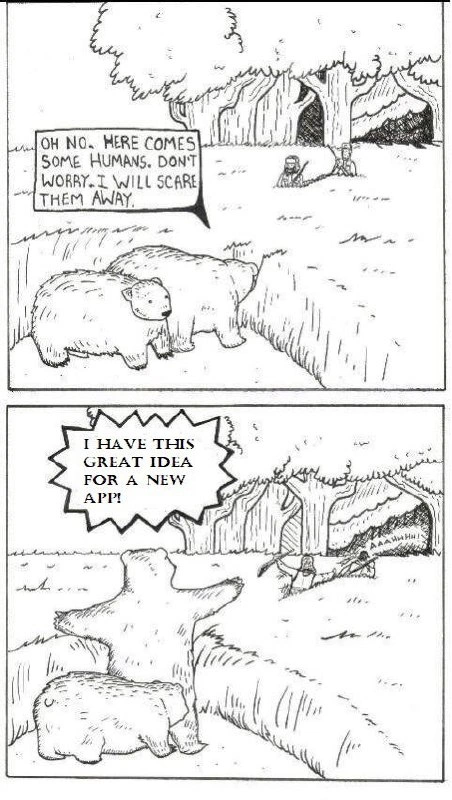
Imagine you’re at school and a classmate comes up to you saying, “I have an awesome idea for our group project! It’s going to be the best project ever!” But then you find out this classmate expects you to do all the work to make it happen. They have a big idea but no plan, and they just assume you’ll figure everything out. That would probably make you feel nervous or unhappy, right? You might even want to avoid working with that person. This meme is joking about the same kind of feeling. The bear shouts “I have this great idea for a new app!” and the people nearby run away scared. In real life, when someone has a huge idea but wants others to do all the hard work, it can feel overwhelming. So the joke is that saying “I have a great new idea” is almost like a magic spell to scare developers away, just like you’d scare someone by saying something spooky. It’s a funny way to show that big ideas are nice, but without a plan (and with lots of expected work for others), they can actually send people running in the opposite direction.
Level 2: Idea Guy Alarm
In the cartoon, a bear literally scares away some hikers by shouting, “I have this great idea for a new app!” This joke resonates with developers because it flips the usual scenario (people running from a bear) and instead shows developers running from something they find just as intimidating: a big, unsolicited app pitch. In other words, the bear acts like an overly enthusiastic startup guy with an idea, and the humans react like wary developers who know what that “great idea” really entails.
Let’s break down why this is funny and what all those terms mean. A startup usually begins with just an idea, and in startup culture there’s a stereotype of the “Idea Guy” — someone who has a grand vision but no clue how to execute it. This person might approach a developer with an exciting concept, hoping the developer will do all the hard work. That’s where things often go wrong due to a communication gap. The idea person doesn’t understand how much effort is needed, and the developer might get frustrated because the expectations are way off — we call those misaligned expectations.
A big issue that arises is something known as scope creep. Scope means the overall size or extent of a project (what features it has, how much work it is). Scope creep is when that size keeps growing and growing. For example, your friend says, “Let’s build a chat app.” You start, and then they add, “It should also share videos... and have a game... and maybe an online store!” The project’s scope keeps creeping outward with each new idea. For a developer, that’s scary because you can never finish if the goalpost keeps moving. In the meme, the phrase “great idea for a new app” is a hint that, if a developer bites, the project might spiral into an ever-expanding list of features.
Another term, architecture, is basically the blueprint or plan for software. Just like you wouldn’t build a house without a floor plan, you shouldn’t build an app without some design of how things will work (database, server, user interface, etc.). When the meme jokes about “zero architecture,” it means the idea person hasn’t figured out any of the technical details — they’re essentially saying “I have a cool idea, but no plan, you figure it out.” For a developer, that’s a red flag. It’s like being asked to build a bridge without any engineering drawings. Sure, it’s possible, but it’s risky and likely to collapse (or at least require a lot of rework).
Now, who are these humans running away, metaphorically? They represent developers or anyone who’s been in the tech industry long enough. They’ve learned to be cautious because of stakeholder expectations – basically, what non-technical stakeholders (clients, bosses, or idea people) expect versus what’s actually realistic. A stakeholder is just anyone with an interest in the project. For example, a client who hires you to build an app is a stakeholder, and so is a manager overseeing a project. Stakeholder pressure comes into play when, say, a boss or client really wants a feature done yesterday because they think it’s “easy.” If that boss keeps coming every week with a “great new idea” to add, you can see how a developer might feel overwhelmed. The expectations (e.g., how quick or simple it is to make the app) are misaligned with the reality (it’s actually a ton of work).
This meme falls under startup humor and highlights an industry trope in tech. Many developers have had the experience of someone approaching them with “the next big app idea.” Early in your career, you might feel excited to hear that — it sounds like an adventure! But soon you learn why experienced folks chuckle or roll their eyes. Often, the person pitching the idea doesn’t realize that ideas are easy, execution is hard. They might say things like “I just need you to code it up real quick,” not knowing that even a “simple” app involves: setting up databases, writing thousands of lines of code, handling errors, designing a UI, testing on different devices, etc. It’s a bit like an iceberg — the idea is just the tip, and the work to make it real is the huge chunk below the surface.
Consider a relatable scenario: say you’re a new developer and a family friend says, “Hey, I have an idea for an app like TikTok for pets. You’re into coding, why don’t we build it together?” You feel flattered and agree. Next thing you know, you’re the one doing all the coding every evening after your day job. Your friend keeps suggesting new features (“Can we also have a shopping section for pet toys?” “Let’s add live video streaming!”) without understanding how much work those are. You realize there was no clear plan at the start — no architecture — just a wish list that keeps growing. That’s scope creep combined with client expectations that are way off. In the end, you might feel burnt out or frustrated, and the app may never even launch because it became too complex.
The cartoon exaggerates this in a fun way: instead of a pushy human with an idea chasing a developer, it shows a bear using the “great app idea” line as a weapon to scare off humans. It’s implying that seasoned developers have learned to avoid these situations; they’d rather run away early than get caught in an endless cycle of work on someone else’s half-baked dream. It’s like a built-in warning system: unsolicited idea alert! Time to flee. So when the bear says those magic words, the humans (playing the part of wise developers) instinctively know to nope out of there.
In short, the meme is teaching a bit of a lesson with humor: talk is cheap, building is hard. If someone only brings a “great idea” to the table and nothing else, developers might be wary. They’ve seen how easily an exciting concept can turn into a nightmare of constantly changing demands (scope creep) with no solid foundation (no architecture). The result? The smart ones learn when to politely back off — or in this case, run away screaming, before the trouble starts. It’s a funny exaggeration of a real communication problem between idea people and tech people.
Level 3: Scope Creep Stampede
This black-and-white cartoon hits uncomfortably close to home for battle-worn developers. In panel one, two bears face an approaching pair of human hikers. Instead of growling or roaring, one bear deploys a far more potent warning: “I have this great idea for a new app!” Immediately, in panel two, the hikers turn tail and flee in a panic. It’s a hilarious role reversal with a darkly true core: for seasoned engineers, an unsolicited random app pitch can be scarier than an actual bear attack.
Why is this scenario so comically accurate? Because the phrase “I have a great idea for an app” is practically the mating call of the infamous Idea Guy — a known creature in tech startup culture. Experienced devs have developed a near-Pavlovian developer escape instinct when they hear those words. They know what's coming: infinite scope creep, unclear requirements, and probably a request to “just build it, you’re the tech wizard!” all while being promised exposure equity as compensation. In the tech industry, this setup is a classic trope you learn to dread after enough late-night coding sessions gone awry.
For a senior developer, the humor lies in how precise this deterrent is. It's like the bear discovered the ultimate idea guy repellent: just mention a brand-new app concept and watch every engineer within earshot scatter. Why? Because that innocuous-sounding pitch actually signals misaligned expectations and impending headaches. Typically, when someone excitedly pitches their app idea out of nowhere, the developer braces for:
- Zero architecture – The idea person hasn’t thought beyond the flashy concept. There’s no database schema, no API design, not even a basic plan of how things should be built. All the tough planning is going to land on the developer’s plate.
- Infinite feature expansion – “Great idea” folks often start with one grand vision but then keep adding “oh, and it should also do X…” every time you meet. That’s textbook scope creep: the project’s scope keeps ballooning like a runaway snowball. What was a simple app now “needs” social login, in-app purchases, AI integration, blockchain – basically every buzzword possible.
- Stakeholder pressure with no boundaries – Whether it’s a wannabe founder or a corporate stakeholder, they tend to wildly underestimate the effort. They might insist “It’ll be easy for you” or “We just need someone to code it up.” To a developer, those lines translate to “They have no clue about the complexity” and “I’m going to be working overtime while they assume it’s just a bit of typing.” The stakeholder expectations here are totally out of sync with reality, setting the dev up for painful crunch time.
Most veteran engineers have learned (the hard way) to be cautious around these situations. Say yes to one of these enthusiastic pitches and you often end up in a death-march project filled with shifting goals and technical debt. After surviving a couple of such ordeals, you get a lot more comfortable saying “nope” at the first red flag. It only takes a few “great idea” projects that turned into costly 3 AM debacles to train an engineer to run like those hikers in the comic.
There’s a real communication gap being illustrated, too. What the idea person says versus what the developer hears are two totally different languages. The meme is funny because it captures that disconnect perfectly. Consider a few common lines from these scenarios:
| Idea Person’s Pitch | What the Developer Hears | What Actually Happens |
|---|---|---|
| “I have a great idea for a new app!” | “They want me to build their vague vision from scratch.” | Dev backs away slowly (if they can). |
| “It’ll be super simple for you.” | “They have no idea how complex even ‘simple’ can be.” | Weeks (or months) of work on basics. |
| “This app will change the world!” | “They haven’t done any market research or validation.” | Likely struggles to find even 10 users. |
| “We just need a coder to make it real.” | “They think coding is a quick, push-button job.” | Endless explanations for missing features. |
| “We’ll split the profits 50/50!” | “No funding upfront — just promises of future riches.” | Probably no profit (and no paycheck). |
It’s funny because it’s painfully true. The cartoon exaggerates it with actual bears and frightened hikers, but any engineer who’s been cornered by a friend or stakeholder with “the next big app idea” knows the urge to escape. The bear in the meme has effectively found the perfect way to repel curious folks: bring up a fresh, ambitious app idea. In real life, that line is often enough to send veteran developers running for the hills — much like those poor hikers retreating into the trees. It’s the ultimate techie deterrent: mentioning a new app concept as if it’s a gift, when in reality it’s asking for free labor. This meme nails that insider joke with a wink and a nod: sometimes, the scariest thing you can say to a programmer is those seven little words, “I have this great idea for an app!”.
Description
A two-panel, black-and-white hand-drawn comic depicting a humorous encounter between bears and humans. In the first panel, two bears are partially hidden behind a log in a forest. One bear says to the other, "OH NO. HERE COMES SOME HUMANS. DON'T WORRY. I WILL SCARE THEM AWAY." In the background, two figures resembling hunters with rifles are cautiously approaching. In the second panel, one of the bears stands on its hind legs with its arms wide and yells in a spiky, loud speech bubble, "I HAVE THIS GREAT IDEA FOR A NEW APP!". The hunters in the background are now depicted fleeing in terror, with one screaming "AAAHHH!!!". The meme satirizes a common experience for software developers: being cornered by non-technical people who are eager to pitch their 'revolutionary' app ideas. The humor lies in equating this unsolicited pitch to a terrifying, bear-like threat, a sentiment that deeply resonates with experienced engineers who have heard countless naive or unrealistic proposals
Comments
7Comment deleted
The fastest way to make a senior developer run isn't a production outage; it's the phrase 'I've got a great idea for an app, it'll be simple. You just need a database.'
Broadcasting “I’ve got a great app idea” has the same effect on veteran engineers as a 100 Gbps DDoS - packets dropped, connection closed, no retry
Just like bears emerging from hibernation, that one non-technical friend emerges from nowhere with 'the next billion-dollar app idea' - usually right when you're trying to hide from humanity in your debugging cave
Every senior engineer knows this bear's journey intimately: you start the sprint ready to tackle that gnarly legacy authentication bug, but by standup you're three whiteboards deep into architecting a revolutionary new microservices framework that will 'solve this class of problems forever.' The bear isn't procrastinating - he's doing what we all do: converting immediate tactical problems into strategic opportunities for over-engineering. It's not scope creep if you convince yourself the new app will make the humans irrelevant, right?
Among production alarms, only one has 0ms MTTR: someone yelling “great app idea” - which reliably becomes “equity-only, simple MVP” and an AI pivot by sprint two
Shouting “I have a great app idea!” translates to “no spec, equity-only, microservices before PMF, SLOs TBD” - senior engineers will evacuate faster than a 3 a.m. Sev1
These bears aren't grizzly - they're bullish on app ideas no troll threat model can deter